Existing blazons interpreted by me

Abahinda Clan, Royal

Party per fess, fimbriated Gules: 1st Azure, two royal drums in fess Argent, stringed Or, each charged with a bar Sable; 2nd Vert, a monkey statant Argent; overall a fess tierced per fess Azure, Gules, and Vert, fimbriated Argent; overall an inescutcheon Gules, fimbriated Argent.
Escudo cortado, perfilado de gules: 1o de azur, dos tambores reales en faja de plata, cordados de oro, cargados cada uno con una burela de sable; 2o de sinople, un mono parado de plata; brochante sobre la partición una faja terciada en faja de azur, gules y sinople, perfilada de plata; brochante sobre el todo un escusón de gules, perfilado de plata.
Arms emblazoned by me, highlighted with lights and shadows, contoured in Sable, with a vesica piscis external shape and with a leather finishing.
This is the traditional coat of arms of the Royal Abahinda Clan of the Ankore Kingdom (1478), Uganda, renewed by them under the supervision of Crowned Prince Tugume Salim, and emblazoned by me.
Blazon keywords: Gules, Azure, Argent, Or, Sable, Vert, One, Two, Party per fess, Fimbriated, Drum, In fess, Stringed, Charged, Monkey, Statant, Overall (line of division), Fess, Tierced per fess, Overall and Inescutcheon.
Style keywords: Outlined in sable, Illuminated, Vesica piscis and Leather.
Classification: Civic, Interpreted, Boa and Coat of arms.
Bearer: Abahinda Clan, Royal.

Academia de Letras e Artes da Guiné-Bissau, schema 1x3

Argent, a tower with a turret Gules, port and windows Argent, masoned Sable.
Coat of arms of the Academia de Letras e Artes da Guiné-Bissau, ALAB, designed by Joseph Crews and emblazoned by me. The image shows 3 steps of my artwork, outlined, plain tinctures, and lights and shadows.
Blazon keywords: Argent, Gules, Sable, One, Tower, Turret, Port and windows and Masoned.
Style keywords: Outlined, Outlined in sable, Plain tincture, Illuminated and Semi-circular.
Classification: Socioeconomic, Interpreted, Boa and Coat of arms.
Bearer: Academia de Letras e Artes da Guiné-Bissau.
Ackerson - Akers, lineage

Ackerson and Akers lineages.
Sable, a Bend between three Acorns Or.
Illuminated and freehand finishing.
The coat of arms of Ackerson and Akers lineages emblazoned by me and extracted from [Burke, B.; 1989].
Unless the blazon specifies another layout, when a bend is between three charges, this charges are ordered, two in the chief and one in the base, as the three acorns do in this case.
[Rietstap, J. B.; 1861] escribe el blasón de «Ackers ou Akers» como «de sable, à une bande d'or, acc. de trois glands du mesme».
Blazon keywords: Sable, Bend, Between, Three, Acorn, Or and Ordered.
Style keywords: Freehand, Outlined in sable and Illuminated.
Classification: Interpreted.

Ackhurst, lineage

Ackhurst lineage.
Argent, on a Bend Sable three Acorns Or.
Illuminated and freehand finishing.
The coat of arms of Ackhurst lineage emblazoned by me and extracted from [Burke, B.; 1989].
Unless the blazon specifies another direction, the charges in a bend follow the direction of their bend, as the acorns do in this case.
Blazon keywords: Argent, Bend, Sable, Three, Acorn, Or and Bendwise.
Style keywords: Freehand, Outlined in sable and Illuminated.
Classification: Interpreted.
Adam de Cretingges

Adam de Creeting ~ Adam de Cretingges.
Argent, a chevron Gules, between three mullets Gules.
Escudo de plata, un cabrio de gules, acompañado de tres estrellas de cinco puntas de gules.
Included in [Vincent, MS; 1285; number 623] also known as [St. George's Roll; 1285; number 623].
The coat of arms of Adan de Creeting is the inverse of the coat of arms of Howel Ap Rhys.
Blazon keywords: Without divisions, Argent, One, Chevron, Gules, Between, Three and Mullet.
Style keywords: Semi-circular, Plain tincture and Outlined in sable.
Classification: Interpreted and Personal.
Bearer: Adan de Creeting.
Adrian V

186th Pope of the Church, only 40 days in 1276. «Hadrianus V», born Ottobuono de Fieschi, was born in Genoa.
Bendy of six Azure and Argent.
Escudo bandado de seis piezas de azur y plata.
Papal coat of arms interpreted by me with: a shield with a rounded arch top; the field in plain tincture of Argent; the bands illuminated in Azure and outlined in Sable; and the whole in an elevated line style.
The blazon in French is «Bandé d'azur et d'argent de six pièces».
The banding is defined in [Avilés, J.; 1725a; page 40] and [Avilés, J.; 1780a; page 45] as the shields and also, the chiefs, fesses, pales, and figures, such as animals, etc., that are «covered and filled with bands in equal number, with as many of metal as of color».
Blazon keywords: Without divisions, Bendy, Six, Azure and Argent.
Style keywords: Semi-circular, Illuminated, Outlined in sable and Freehand.
Classification: Interpreted, Religious and Papal States.
Bearer: Adrian V.
Alarcon of Cantabria, lineage

Gules, a cross flory voided Or; within a bordure Gules with eight saltires couped Or.
Escudo de gules, una cruz hueca flordelisada de oro; bordura de gules, ocho sotueres de oro.
Coat of arms painted by me, highlighted with lights and shadows, outlined in Sable, with a semi-circular external shape and with a freehand finishing.
Ancient arms of Alarcon of Cantabria emblazoned by me.
Blazon keywords: Argent, Sable, Or, Gules, Three, Cross, Flory, Voided, Bordure, Saltire and Couped.
Style keywords: Outlined in sable, Illuminated, Semi-circular and Freehand.
Classification: Personal, Interpreted, Boa and Coat of arms.
Bearer: Alarcon of Cantabria, lineage.
Albero, lineage of Aragon

Blazon of the Albero lineage of Aragon.
Vair ancient.
Escudo de veros antiguos.
Illuminated and with a glass finish.
It can be consulted in [Cadenas y Vicent, V. de; 1987; page 62].
[Friar, S.; 1987; pages 157-158] says of the veros: «originates from the fur of a species of squirrel... which was popular in the Middle Ages as a lining for the garments of those not entitled to wear ermine. The animal was blue-grey on the back and white underneath. By sewing a number of these pelts together, with white and blue-grey alternating,... one which easily translated into the stylized armorial form of Vair and its variants».
Blazon keywords: Vair ancient.
Style keywords: Freehand, Outlined in sable, Illuminated and Semi-circular.
Classification: Interpreted, Lineage and Coat of arms.
Albrecht Dürer

Gules, on a trimount issuant from the base Or, a port Gules, with canopy roof, jambs, enarched lintel, and two open leaves, upon a three-step stairway Oro.
Escudo de gules, un monte de tres peñas moviente de la punta sumado de una puerta con tejadillo, jambas, dintel arqueado, dos hojas abiertas sostenida de una escalinata de tres peldaños todo de oro, aclarada de gules.
Coat of arms painted by me, illuminated with lights and shadows, outlined in Sable, with an ogee external shape and with a freehand finish.
Coat of arms of Albrecht Dürer, 1471-1528, emblazoned by me based on the woodcut titled «Coat of Arms of Albrecht Dürer» made by Albrecht Dürer himself in 1523 on a sheet measuring 35.1 × 26.1 cm belonging to The Elisha Whittelsey Collection, The Elisha Whittelsey Fund, 1952, held at the Metropolitan Museum of New York, and on the work titled «Marriage Coat of Arms of the Families Duerer and Holper. Verso of the Albrecht Dürer the Elder portrait», dated 1490; Albrecht Dürer the Elder, 1427–1502, was his father.
Design rationale
The Dürer family coat of arms is an example of canting arms. Their family origin traces back to Ajtós, Hungary, a name which means «door» or «doorman» in Hungarian. Upon settling in Nuremberg, the family Germanized their surname to «Türer», derived from «Tür», meaning «door», and later to Dürer. This is the reason of the main charge of these arms.
Blazon keywords: Gules, One, Two, Three, On, Trimount, Issuant from base, Port, Canopy roof, Arched, Enarched, Upon, Step, Stairway and Port and windows.
Style keywords: Outlined in sable, Illuminated, Ogee and Freehand.
Classification: Personal, Lineage, Interpreted, Boa and Coat of arms.
Bearer: Albrecht Dürer.
Aldam, lineage of England

Blazon of the Aldam lineage of England.
Azure, a ray of the sun bendwise, issuant from the dexter chief Or.
Escudo de azur, un rayo de sol puesto en banda, naciente de la diestra del jefe de oro.
Illuminated with lights and shadows and with a freehand finish.
Described in [Burke, B.; 1989; page 9, column 1, entry 11].
Blazon keywords: Without divisions, Azure, One, Ray of the sun, Bendwise, Nascent, Dexter, Chief and Or.
Style keywords: Freehand, Outlined in sable, Illuminated and Semi-circular.
Classification: Interpreted, Lineage and Kingdom of England.
Alfonso IX of Leon

Born on August 15, 1171, in Zamora and died on September 24, 1230, in Sarria, Lugo.
Argent, a lion rampant Purpure, armed and langued Gules.
Escudo de plata, un león rampante de púrpura, armado y lampasado de gules.
Arms of the king of León interpreted by me as follows: the escutcheon is in a semi-circular arch; the field and the lion have been enameled and illuminated; and the ensemble has a watercolor finish.
This coat of arms of León can be seen, among many other places, for example, in [Argote de Molina, G.; 1588; chapter XLII].
Blazon keywords: Without divisions, Argent, Purpure, Gules, One, Lion, Rampant, Armed and Langued.
Style keywords: Semi-circular, Illuminated, Outlined in the field tincture and Watercolor.
Classification: Interpreted, Personal, Coat of arms and Kingdom of León.
Bearer: Alfonso IX of Leon.
Alfonso Sánchez de Perella, collage

Azure, a cross flory voided Argent; a bordure Gules charged with sixteen saltires couped Or.
Coat of arms emblazoned by me, highlighted with lights and shadows, contoured in Sable, with a semi-circular external shape and with a texturized finishing.
Alfonso Sánchez de Perella, first mayor of Burgos emblazoned by me. He appears as the [Cofradía de Santiago; Century XIV; 4th knight, 1st of the page 21 V], from this 14th century Book of the Brotherhood of Knights of Santiago de la Fuente. This was a brotherhood founded by the Burgos citizens at the time of King Alfonso XI of Castilla, 1311-1350. In the book, there are 14 saltires instead of 16, as it appears that one is missing on the sinister side of the base, and there are 4 in the chief instead of 5.
Blazon keywords: Azure, Argent, Gules, Or, One, Sixteen, Cross, Flory, Voided, Bordure, Saltire and Couped.
Style keywords: Outlined in sable, Illuminated and Semi-circular.
Classification: Personal, Interpreted, Boa and Coat of arms.
Bearer: Sánchez de Perella, Alfonso.
Alfonso VIII of Castile

Born on November 11, 1155, in Soria and died on October 6, 1214, in Gutierre-Muñoz, Avila.
Gules, a castle triple towered Or, port and windows Azure, masoned Sable.
Escudo de gules, un castillo de oro, aclarado de azur, mazonado de sable.
Existing arms interpreted by me as follows: the shield’s shape is pointed and rounded; the field has been enameled Gules; the castle is outlined, illuminated, and shaded; the whole composition features a heavily hammered metal finish.
This ancient coat of arms of Castile can be consulted, among other sources, in [Argote de Molina, G.; 1588; chapter XLII].
Blazon keywords: Without divisions, Gules, Or, Azure, Sable, One, Castle, Port and windows and Masoned.
Style keywords: Ogee, Illuminated, Shaded, Outlined in sable and Hard metal.
Classification: Interpreted, Personal, Coat of arms and Kingdom of Castile.
Bearer: Alfonso VIII of Castile.
Alfonso X the Wise

Quarterly: 1 and 4 Gules, a castle triple-towered Or, port and windows Azure, and masoned Sable; 2 and 3 Argent, a lion rampant Purpure, armed and langued Gules.
Coat of arms depicted by me, illuminated with lights and shadows, contoured in Sable, with an ogee external shape and with a freehand finishing.
Coat of arms of the King Alfonso X of Castile, 1221–1284, 1st son of the King Ferdinand III of Castile, 1199-1252, and the Queen Beatrice of Swabia, 1205–1235. The order of the quarters is first the castle of his grandmother, Queen Berenguela of Castile, and second the lion of his grandfather, King Alfonso IX of León; however, the other day I discovered that on the map by [Martineau du Plessis, D.; 1700; volume II, illustration 30, page 126], in the shield framed between parallels 37 and 36 and meridians 21 and 22, the lion occupies the 1st quarter and the castle the 2nd quarter; that is, their order appears reversed.
Blazon keywords: Gules, Or, Azure, Sable, Argent, Purpure, One, Quarterly, Castle, Triple-towered, Port and windows, Masoned, Lion, Rampant, Armed and Langued.
Style keywords: Outlined in sable, Illuminated, Ogee and Freehand.
Classification: Personal, Kingdom of Castile and Leon, Interpreted, Boa and Coat of arms.
Bearer: Alfonso X of Castile.
Allen de Brindley

County of Cheshire, visitation of 1663.
Party per bend sinister: 1 Or, three martlets Sable; 2 Sable, three martlets Or.
Escudo tajado: 1o de oro, tres marletas de sable; 2o de sable, tres marletas de oro.
Coat of arms interpreted with: a rounded base; the field illuminated in Or and Sable; the martlets outlined of the field and illuminated in Sable and Or; and the whole with a leather finish.
A coat of arms recorded in [Adams, A.; 1941] which Cheshire Heraldry blazons as follows: «Per bend sinister Or and Sable, six martlets counterchanged», note that no specific arrangement is specified for the martlets.
There is also an entry for «Allen de Brindley» in [Armytage, G. J.; Rylands, J. P.; 1909], but it only records the family tree without specifying the coat of arms.
Blazon keywords: Party per bend sinister, Or, Sable and Martlet.
Style keywords: Rounded, Illuminated, Outlined in the field tincture and Leather.
Classification: Interpreted, Personal and Cheshire County.
Bearer: Allen de Brindley.
Almorrabides of Navarre

Of the twelve lineages of Noblemen, it is the first, and they bear as arms, on a golden field, three pales Azure.
Or, three Pallets Azure.
Escudo de oro, tres palos de azur.
Coat of arms interpreted with: a semicircular (round) base; the field in flat Or; the pales outlined in Sable and illuminated in Azure enamel; and finished in highly-hammered metal.
Based on the first coat of arms of the «ricoshombres» of Navarre in [Bosque, J. del; 1540; folio 1 of the numbering of 1613] and the text is from the transcription made in [Martinena Ruiz, J. J.; 1982; pages 122 and 123].
Under the title «Los Almorauides» it can also be consulted in [Vega, P. J. de; 1702; folio 1 of the manuscript].
Blazon keywords: Without divisions, Or, Three, Pale and Azure.
Style keywords: Semi-circular, Illuminated, Outlined in sable and Hard metal.
Classification: Interpreted, Personal and Kingdom of Navarre.
Bearer: Almorrabides of Navarre.
Alphonse X of Castile

Known as the Wise, King of Castile and Leon from 1252 to 1284.
Escudo cuartelado: 1o y 4o de gules, un castillo de oro, aclarado de azur, mazonado de sable; 2o y 3o de plata, un león rampante de púrpura, armado y lampasado de gules.
Quarterly: 1 and 4 Gules, a castle triple towered Or, port and windows Azure, masoned Sable; 2 and 3 Argent, a lion rampant Purpure, armed and langued Gules.
Armories of the Wise King of Castile interpreted by me with the following characteristics: the external shape of the coat of arms ends in an ogee arch; the field, the 2 castles, and the 2 lions are outlined and enameled in flat colors; and the texture seems fabric.
This coat of arms, but with a pointed external shape, can be seen in the 2nd part of the so-called armorial [Wijnbergen; 1265; cuat of arms number 1,289], with the title «Le roy Despaingne», which in this context is understood to refer to Castilla y León.
The 2nd part of this armorial was made between 1270 and 1285 and, being Alphonse X king of Castile and Leon from 1252 to 1284, it is to Him that the title «Le roy Despaingne» seems to refer.
Blazon keywords: Quarterly, Gules, Or, Azure, Sable, One, Castle, Port and windows, Masoned, Argent, Purpure, Lion, Rampant, Armed and Langued.
Style keywords: Ogee, Plain tincture, Outlined in sable and Fabric.
Classification: Interpreted, Personal, Coat of arms and Kingdom of Castile and Leon.
Bearer: Alphonse X of Castile.
Alpoim, lineage

Azure, a crescent reversed Argent, in dexter chief a fleur de lis Or, a bordure Gules.
Escudo de azur, un creciente ranversado de plata, en la diestra del jefe una flor de lis de oro, una bordura de gules.
Arms emblazoned by me, highlighted with lights and shadows, contoured in Sable, with an ogee external shape and with a freehand finishing.
Coat of arms of the lineage Alpoim. This coat of arms has been created for Fernando Durán Cabral de Mello d’Alpoim as a preparatory work for his armorial bearings where the arms of Alpoim are in the 2nd quarter.
Blazon keywords: Azure, Argent, Or, Gules, One, Crescent, Reversed, In the dexter chief, Fleur de lis and Bordure.
Style keywords: Outlined in sable, Illuminated, Ogee and Freehand.
Classification: Personal, Lineage, Interpreted, Boa and Coat of arms.
Bearer: Alpoim, lineage.
Álvaro de Zúñiga y Guzmán

Lord of Zúñiga and Mendavia and of Béjar and Bañares and of Gibraleón, 1st Duke of Arévalo, 1st Duke of Plasencia, 1st Count of Bañares, 1st Duke of Béjar, 2nd Count of Plasencia, and Grandee of Castile.
Argent, a bend Sable; overall a chain orlewise Or.
Escudo de plata, una banda de sable; brochante sobre el todo una cadena puesta en orla de oro.
Personal coat of arms interpreted by me as follows: the shield has a semicircular (round) base; both the field and the bend have been illuminated in flat tinctures Argent and Sable; the links of the chain are enameled and illuminated in Or; and the whole is made of beaten metal.
In [Argote de Molina, G.; 1588; page 94 according to the numbering of the book, or page 93 according to the numbering accompanying the illustrations] this coat of arms appears under the title «Zúñigas» with the overlying chain formed only by 8 long links.
In [Anonymous; 1800a; page 46] the blazon of «the Zúñigas» is described, where in this book, curiously, the letter Z is ordered after C and before D.
Blazon keywords: Without divisions, Argent, Sable, Or, One, Bend, Chain, Orlewise and Overall.
Style keywords: Semi-circular, Illuminated and Metal beaten.
Classification: Interpreted, Personal and Coat of arms.
Bearer: Zúñiga y Guzmán, Álvaro de.
Alyahya, Abdulelah

Party per fess engrailed and per pale: 1 Argent, a scroll proper inscribed with the names of the lineage in letters Sable; 2 Gules, a palm tree upon two cutlasses, points upwards, in saltire Or; 3 Vert, a mullet of ten points above a crescent Or; 4 Argent, a minaret issuant from the base proper.
Escudo cortado angrelado y partido: 1o de plata, un pergamino al natural inscrito con los nombres del linaje en letras de sable; 2o de gules, una palmera sostenida por dos alfanjes alzados, en sotuer todo de oro; 3o de sinople, un creciente sumado de una estrella de diez puntas ambos de oro; 4o de plata, un minarete naciente de la punta al natural.
Coat of arms painted by me, highlighted with lights and shadows, contoured in Sable, with an ogee external shape and with a watercolor finishing.
This is the coat of arms of Abdulelah Alyahya (Riyadh, Saudi Arabia), designed by Vittorio Gifra (Italy) under his instructions, revised by Bob Juchter van Bergen Quast (Netherlands) and Kevin D. Couling (United Kingdom), and emblazoned by me (Spain). The arms reflect the heritage of the Alyahya family, descendants of the ancient tribe of Beno Tamim (Altamimi) and linked to the modern origins of Saudi Arabia. In an ordinary, I distinguish between engrailed and invected from the ordinary's point of view; for instance, I define a bordure as invected if, from the interior of the bordure, the edge appears invected (meaning the arcs appear concave); conversely, I say a bordure is engrailed if the arcs appear convex from its interior point of view; in this specific case, regarding a line of division, I describe it as engrailed because, from the perspective of the base of the coat of arms, the arcs of the partition line appear convex [Nisbet, A.; 1816; page 21, pictures 1 and 2].
Blazon keywords: Argent, Sable, Gules, Or, Vert, One, Two, Party per fess, Engrailed, Party per pale, Scroll, Proper, Inscribed, Palm tree, Tree, Upon, Cutlass, Point upwards, In saltire, Mullet, Above, Crescent, Minaret and Issuant from base.
Style keywords: Outlined in sable, Illuminated, Ogee and Watercolor.
Classification: Personal, Interpreted, Boa and Coat of arms.
Bearer: Alyahya, Abdulelah.
Amancier, lineage of Genevois

Blazon of the Amancier lineage of Genevois, Haute-Savoie, France.
Gules, three bars per pale Or and Azure.
Illuminated and a freehand finishing.
Its French blazon «de gueules, à trois fasces parties d'or et d'azur» can be found at [Rietstap, J. B.; 1861; page 40].
Any fess party per pale of metal and color or color and metal will always have a metal on metal or color on color conflict whether the field of the coat of arms is color or metal. There isn't conflict if the field of the coat of arms is also party per pale with metal under the color of the fess and with color under the metal of the fess or if the field is fur.
Blazon keywords: Without divisions, Gules, Three, Fess, Party per pale, Or and Azure.
Style keywords: Freehand, Outlined in sable, Illuminated and Semi-circular.
Classification: Interpreted, Lineage and Kingdom of France.
Amber Martinez, plain tincture

Paly of four Ermine and Or, overall two fleurs de lis in fess Azure; enté en point Azure, an estoile Or.
Coat of arms interpreted by me, in plain tinctures, contoured in Sable, with a corset external shape and with a texturized finish.
Coat of arms of Amber Martinez, California, designed by her, improved by Kevin D Couling and Bob Juchter van Bergen Quast and emblazoned by me.
Blazon keywords: Or, Azure, Four, Two, One, Paly, Ermine, Overall, Fleur de lis, In fess, Enté en point and Estoile.
Style keywords: Outlined in sable, Plain tincture and Corset.
Classification: Personal, Interpreted, Boa and Coat of arms.
Bearer: Martinez, Amber.
Amitay Edward von Stiebel, outlined

Quarterly: 1 Or, a lion rampant, facing sinister Sable, armed and langued Gules; 2 and 3 Gules, an anchor proper; 4 Or, a lion rampant Sable, armed and langued Gules; overall, a pile issuant from base Azure charged with a mount proper issuant from water issuant from base Argent, in chief, a mullet of six points Or.
Coat of arms of Amitay Edward von Stiebel outlined by me.
Blazon keywords: Or, Sable, Gules, Azure, Argent, One, Six, Quarterly, Lion, Rampant, Facing sinister, Armed, Langued, Anchor, Proper, Overall, Pile issuant from base, Charged, Mount, Issuant, Water, Issuant from base, In chief and Mullet.
Style keywords: Outlined and Bull's hide.
Classification: Personal, Interpreted, Boa and Coat of arms.
Bearer: Stiebel, Amitay Edward von.
Anderson of Erbury

Argent, a chevron between three crosses flory Sable.
Escudo de plata, un cabrio acompañado de tres cruces flordelisadas todo de sable.
Illuminated with lights and shadows and with a freehand finish.
The coat of arms of Anderson of Erbury emblazoned by me in 4 ways: 1) tricking using abbreviations, 2) hatching using lines, 3) plain tinctures, and 4) lights and shados. It is a preliminary artwork for the arms of Nick Allen Rica II.

Blazon keywords: Without divisions, Argent, One, Chevron, Between, Three, Cross flory, Cross couped and Sable.
Style keywords: Freehand, Outlined in sable, Illuminated, Pointed, Tricking, Hatching and Plain tincture.
Classification: Interpreted, Kingdom of Scotland and Schema.
Bearer: Anderson of Erbury.
André de Montbard

Azure, two barbels addorsed Argent. Behind the shield an eight-pointed cross patty Gules.
Blazon keywords: Azure, Two, Barbel, Addorsed, Argent, Behind the shield, One, Eight-pointed cross, Cross couped and Gules.
Style keywords: Outlined in sable, Semi-circular, Illuminated and Freehand.
Classification: Religious, Military, Knights Templar, Interpreted and Coat of arms.
Bearer: Montbard, André de.
André, lineage of France

Blazon of the André lineage of France.
Gules, a millstone Or.
Escudo de gules, una piedra de molino de oro.
Illuminated and a watercolor finishing with shadow in the hole.
For its better identification, I have painted the millstone with the ring that fixes it to its axis. This ring is called a millrind, it is made of iron, and usually has 4 arms to better fix the millstone. Millrinds may appear on coats of arms independently of millstones. Another heraldic element related to the previous ones is the millwheel, which is a toothed gear that is part of the mill mechanism but should not be confused with the millstone that grinds the grain.
Blazon keywords: Without divisions, Gules, One, Millstone and Or.
Style keywords: Watercolor, Outlined in sable, Illuminated and Semi-circular.
Classification: Interpreted, Lineage and Kingdom of France.
Andrea Pompili, hand-drawn

Azure, two chevronels Argent between in chief two mullets of six points Or, and in base a Scots pine eradicated proper.
G0066: the coat of arms of Andrea Pompili, of Italy, as granted by the Chief Herald of Arms of Malta and emblazoned by me for this grant. The hand-drawn tree shown in this photograph was originally created for the coat of arms of Andrea Pompili, commissioned by Dr Charles A. Gauci, Chief Herald of Arms of Malta. Some time later, an art collector asked me for a dedicated hand drawing. I chose this tree because its canopy has a distinctive heraldic shape, setting it apart from the other drawings in his collection, as it was specifically designed to fit beneath the two chevronels. This is also the reason for the handwritten note «under a chevron» beside the drawing, note that chevronel is the heraldic term for a diminished chevron. Before sending it, I inscribed the sheet with a dedication, which explains the handwritten text visible alongside the artwork.
Blazon keywords: Azure, Argent, Or, Two, One, Chevronel, Between, In chief, Mullet, In base, Scots pine, Tree, Eradicated and Proper.
Style keywords: Outlined in sable, Illuminated and Pointed.
Classification: Personal, Interpreted, Boa, Hand-drawn, Collage and Photographic.
Bearer: Pompili, Andrea.
Andrés Cruz Carballo, outlined

Or, an eagle displayed Azure.
The coat of arms of Andres Cruz Carballo designed by his father-in-law Juan Lanzagorta Vallín and outlined by me.
Blazon keywords: Or, Azure, One, Eagle and Displayed.
Style keywords: Outlined, Outlined in sable and Rounded trapezoid.
Classification: Personal, Interpreted, Boa and Coat of arms.
Bearer: Cruz Carballo, Andrés.
Aragon

Or, four pallets Gules.
Escudo de oro, cuatro palos de gules.
Recreated coat of arms of Aragón in the following manner: the escutcheon shape is pointed and rounded; the field is rendered in flat Or; the pallets are illuminated; and the whole has a parchment-like finish.
This rendition of the coat of arms is based on [Portolés, J.; Molino, M. del; 1590].
Blazon keywords: Without divisions, Or, Four, Pale and Gules.
Style keywords: Ogee, Illuminated and Parchment.
Classification: Interpreted, Civic, Coat of arms and Kingdom of Aragon.
Bearer: Aragon.
Araneta, lineage

Azure, a lion rampant Argent, in chief a mullet of four points Or; a bordure Gules charged with eight saltires couped Or.
Escudo de azur, un león rampante de plata, surmontado de un lucero de oro; una bordura de gules cargada de ocho sotueres de oro.
Coat of arms emblazoned by me, highlighted with lights and shadows, contoured in Sable, with a semi-circular outer contour and with a freehand finishing.
These are the ancient arms of the lineage Araneta emblazoned by me. They are from the Basque Country and there is a branch in the Philippines. This star is known as mullet of four points.
Blazon keywords: Azure, Argent, Or, Gules, One, Eight, Lion, Rampant, Mullet of four points, Bordure, Saltire and Couped.
Style keywords: Outlined in sable, Illuminated, Semi-circular and Freehand.
Classification: Personal, Lineage, Interpreted, Boa and Coat of arms.
Bearer: Araneta, lineage.
Aras Quirce, Manuel Maria

Or, an oak tree proper, fructed Or, with a boar supporting it Sable; on a chief Gules, three eagles displayed Or.
Escudo de oro, un roble al natural, frutado de oro, con un jabalí empinado de sable; en un jefe de gules, tres águilas de oro.
Escudo interpretado por mí, en tinturas planas, delineado de sable, con un contorno exterior medio punto y con un terminado texturizado.
Coat of arms of Manuel Maria Aras Quirce designed by Juan Lanzagorta Vallin and emblazoned by me.
Credits: Juan Lanzagorta Vallin is the designer of the coat of arms.
Blazon keywords: Or, One, Oak, Tree, Proper, Fructed, Boar, Supporting, Sable, Chief, Gules, Three and Eagle.
Style keywords: Outlined in sable, Plain tincture and Semi-circular.
Classification: Personal, Interpreted and Coat of arms.
Bearer: Aras Quirce, Manuel Maria.
Argote de Molina, Gonzalo

Gules, a cross vair ancient.
Escudo de gules, una cruz de veros antiguos.
Coat of arms that I have interpreted as follows: the shield has a semicircular (round) base; the field is in flat tincture of Gules; the ancient vair, rounded or of the old form, which are always Argent and Azure, are illuminated and outlined in Sable; and the whole of the hereditary coat of arms has a raised-stroke drawing.
Este escudo puede encontrarse en el libro del propio [Argote de Molina, G.; 1588; páginas 14 y 168], en la página 14 en grande, con cimera y rodeado de otros escudos de menor tamaño y en la página 168 de menor tamaño, con yelmo y lambrequines. En ambos casos el trazado de los veros es antiguo, redondeados, y en estas interpretaciones así los he reflejado.
Blazon keywords: Without divisions, Gules, Argent, Azure, Cross and Vair ancient.
Style keywords: Freehand, Illuminated and Outlined in sable.
Classification: Interpreted, Personal, Coat of arms and Heraldry and heralds.
Bearer: Argote de Molina, Gonzalo.
Argudo of Guipuzcoa, lineage

Argent, two wolves passant, in pale Sable, langued Gules; a bordure Azure charged with eight mullets Or.
Escudo de plata, dos lobos pasantes, en palo de sable, lampasados de gules; una bordura de azur cargada de ocho estrellas de oro.
Arms depicted by me, illuminated with lights and shadows, outlined in Sable, with a semi-circular outer contour and with a freehand finishing.
Ancient arms of the lineage Argudo of Guipuzcoa emblazoned by me. The lineage Ochoa of Vergara has a blazon equivalent to this one. Alternative blazon: «Argent, two wolves passant, in pale Sable, langued Gules; on a bordure Azure, eight mullets Or».
Blazon keywords: Argent, Sable, Gules, Azure, Or, One, Eight, Wolf, Passant, In pale, Bordure and Mullet.
Style keywords: Outlined in sable, Illuminated, Semi-circular and Freehand.
Classification: Personal, Lineage, Interpreted, Boa and Coat of arms.
Bearer: Argudo of Guipuzcoa, lineage.
Argüello of Extremadura, lineage

Azure, a holm oak proper, fructed and eradicated Or, between two goats Argent supporting it.
Escudo de azur, una encina al natural, frutada y arrancada de oro, con dos cabras de plata empinadas al tronco.
Coat of arms emblazoned by me, illuminated with lights and shadows, contoured in Sable, with a semi-circular outer contour and with a watercolor finishing.
Coat of arms of the lineage Argüello of Extremadura emblazoned by me. Its blazon may be found in the books [Atienza y Navajas, J. de; 1959; page 171] and [Cadenas y Vicent, V. de; 1987; page 167], where it is described as Vert with its acorns and roots Or. In this rendition, I have interpreted the holm oak as proper, but also fructed and eradicated Or.
Blazon keywords: Azure, Or, Argent, One, Two, Holm oak, Tree, Proper, Fructed, Eradicated, Goat and Supporting.
Style keywords: Outlined in sable, Illuminated, Semi-circular and Watercolor.
Classification: Personal, Lineage, Interpreted, Boa and Coat of arms.
Bearer: Argüello of Extremadura, lineage.
Arms of Hugo Frazão Coutinho Dias with motto and collar

Quarterly: 1 Gules, a chevron Argent, between three fleurs de lis Or; 2 Or, five mullets in saltire Gules; 3 Argent, four escutcheons in cross Azure, each charged with nine plates, those in flank with points to center, overall a carbuncle and orle of knotted cords Purpure debruised by the center escutcheon; 4 Sable, on a mount issuant from the base Vert, a tower Argent, port, windows and masoned sable, between two wolves Or supporting it; enté en point Or, three bars wavy Gules. Motto: «Progrediendo Laborando Efficiendo Vinces». The shield is surrounded by the collar of the Sovereign and Most Noble Order of the Pomegranate.
Escudo cuartelado: 1o de Gules, un cabrio de plata acompañado de tres flores de lis de oro; 2o de oro, cinco estrellas de seis puntas en sotuer de gules; 3o de plata, cuatro escudetes en cruz de azur, cada uno cargado de nueve bezantes de plata, 3, 3, 3, los dos escudetes de los flancos puestos en faja apuntando al del centro, brochante sobre el todo un carbunclo de cuerdas, orlado y anudado de púrpura, y brochante sobre el todo del todo, un quinto escudete como los anteriores; 4o de sable, un monte moviente de la punta de sinople, sumado de una torre de plata, aclarada y mazonada de sable, con dos lobos de oro empinados a ella; Entado en punta de oro, tres fajas ondadas de gules. Lema: «Progrediendo Laborando Efficiendo Vinces». El escudo está rodeado por el collar de la Soberana y Muy Noble Orden de la Granada.
Arms depicted by me, highlighted with lights and shadows, contoured in Sable, with a semi-circular outer contour and with a leather finishing.
Blazon keywords: Or, Gules, Argent, Azure, Purpure, Sable, Vert, One, Two, Three, Four, Five, Nine, Quarterly, Chevron, Between, Fleur de lis, Mullet, In saltire, Escutcheon, In cross, Charged, Plate, In each flank, Center, Overall, Carbuncle, Orle, Knotted, Cord, Debruised, Mount, Issuant, Base, Tower, Port and windows, Masoned, Wolf, Supporting, Enté en point, Bar, Wavy, Motto, Surrounded and Collar.
Style keywords: Outlined in sable, Illuminated, Semi-circular and Leather.
Classification: Personal, Interpreted, Boa and Coat of arms.
Bearer: Frazão Coutinho Dias, Hugo.
Arrano Beltza

Or, a eagle displayed Sable.
Escudo de oro, un águila de sable.
Arms painted by me, illuminated with lights and shadows, contoured in Sable, and with a freehand finish.
Coat of arms of the Arrano Beltza, the black eagle in Basque, emblazoned by me.
Blazon keywords: Or, Sable, One, Eagle and Displayed.
Style keywords: Outlined in sable, Illuminated and Freehand.
Classification: Civic, Interpreted, Boa and Coat of arms.
Bearer: Arrano Beltza.
Artillery Combat School of the Swedish Army

Kingdom of Sweden.
Gules, a grenade Or.
Escudo de gules, una bomba de oro.
Illuminated with lights and shadows and with a iridescent and metallic finish.
Blazon keywords: Without divisions, Gules, One, Grenade and Or.
Style keywords: Metal beaten, Iridescent (nacar), Outlined in sable, Illuminated and Pointed.
Classification: Interpreted, Military and Kingdom of Sweden.
Bearer: Artillery Combat School of the Swedish Army.
Asuncion and de la Asuncion, lineages

Gules, three lozenges Or.
Escudo de gules, tres losanjes de oro.
Arms painted by me, highlighted with lights and shadows, outlined in Sable, with a semi-circular external shape and with a leather finish.
Coat of arms of the lineages Asuncion and de la Asuncion emblazoned by me.
Blazon keywords: Gules, Or, Three and Lozenge.
Style keywords: Outlined in sable, Illuminated, Semi-circular and Leather.
Classification: Personal, Interpreted, Boa and Coat of arms.
Bearer: Asuncion and de la Asuncion, lineages.
Avelar, lineage of Portugal

Blazon of the Avelar lineage of Portugal.
Or, three bars Gules charged each one with three mullets of six points Argent.
Illuminated and a freehand finishing.
It can be found at [Cró, J. do; 1509; page 127].
Blazon keywords: Without divisions, Or, Three, Fess, Gules, Charged, Mullet and Argent.
Style keywords: Freehand, Outlined in sable, Illuminated and Semi-circular.
Classification: Interpreted, Lineage and Kingdom of Portugal.
Aybar of Navarre

Of the twelve lineages of Noblemen, they are the third great and ancient barony, where the first King of Aragon had his mother; they make a shield of Or without any mixture of colour or device, but a field of gold as painted in this shield.
Or.
Escudo de oro.
A coat of arms that leaves little room for interpretation, which I have recreated with: a semicircular (round) base; the field in flat Or; and finished in highly-hammered metal.
Based on the third coat of arms of the «ricoshombres» of Navarre from [Bosque, J. del; 1540; folio 1 of the numbering of 1613] and the text is from the transcription made in [Martinena Ruiz, J. J.; 1982; pages 122 and 123].
Under the title «Surname of Aybar» it can also be consulted in [Vega, P. J. de; 1702; folio 3 of the manuscript].
Blazon keywords: Without divisions and Or.
Style keywords: Semi-circular, Illuminated, Outlined in sable and Hard metal.
Classification: Interpreted, Personal and Kingdom of Navarre.
Bearer: Aybar of Navarre.
Badge Jean-Yves de Sainte Croix de la Sabliere

A crown of Baron above a falcon displayed and belled Azure, armed and langued Gules, crowned Or, grasping with its talons a scroll Argent, doubled Gules, inscribed with the motto «Per Crucem Triumphans» Sable.
Heraldic device emblazoned by me, illuminated with lights and shadows, outlined in Sable, and with a texturized finishing.
G0128, Chief Herald of Arms of Malta's grant of Jean-Yves, de Sainte Croix de la Sabliere's badge. This heraldic badge has been emblazoned by me.
Blazon keywords: Azure, Or, Argent, Gules, One, Crown of Baron, Crown, Above, Falcon, Belled, Armed, Langued, Crowned, Talon, Motto, Scroll and Doubled.
Style keywords: Outlined in sable and Illuminated.
Classification: Personal, Interpreted, Boa and Badge.
Bearer: Sainte Croix de la Sabliere, Jean-Yves de.
Badge of Austin Charles Berry

Blazon keywords: One, Cyclamor, Vert, Motto, Argent, Two, Cross-crosslet, Cross couped, Wreath, Gules, Griffin, Head, Party per fess, Beaked and Or.
Classification: Personal, Interpreted and Badge.
Bearer: Berry, Austin Charles.
Badge Rick Kasparek

A sea-griffin erect Sanguine, membered, beaked, nimbed, dorsal and tail fins Or, langued Azure, grasping in its talons a mullet of eight points Or.
Heraldic device painted by me, highlighted with lights and shadows, contoured in Sable, and with a iridescent finishing.
Heraldic badge of Rick Kasparek emblazoned by me.
Blazon keywords: Sanguine, Or, Azure, One, Eight, Sea-griffin, Erect, Membered, Beaked, Nimbed, Dorsal fin, Tail fin, Langued, Grasping, Talon and Mullet.
Style keywords: Outlined in sable, Illuminated and Iridescent.
Classification: Personal, Interpreted, Boa and Badge.
Bearer: Kasparek, Rick.
Bailleul, commune of

Gules, a cross vair.
Escudo de gules, una cruz de veros.
Coat of arms interpreted with: a semicircular (round) base; the field in flat tincture of Gules; the vair illuminated and outlined in Sable; and the whole with a roughened finish.
The commune of Bailleul is located in the district of Dunkirk, in the Nord department, in the Nord–Pas-de-Calais region of France.
The coat of arms of Bailleul, called «Belle» in Flemish, is similar to that of the heraldist Gonzalo Argote de Molina, differing in that the commune’s arms bear vair, while the heraldist’s arms bear rounded vair in the ancient style.
Blazon keywords: Without divisions, Gules, Argent, Azure, Cross and Vair.
Style keywords: Semi-circular, Illuminated, Outlined in sable and Rough.
Classification: Interpreted, Civic, Coat of arms and Kingdom of France.
Bearer: Bailleul, commune of.
Balaguer, municipality of

Quarterly per saltire: 1 and 4 Or, four pallets Gules; 2 and 3 chequey Or and Sable.
Escudo cuartelado en sotuer: 1o y 4o de oro, cuatro palos de gules; 2o y 3o ajedrezado de oro y sable.
Arms interpreted with: a lozenge-shaped shield; all tinctures in flat Or, Gules, and Sable; and a heavily beaten metal finish.
Balaguer is the capital of the comarca of La Noguera in the province of Lleida. It was the capital of the county of Urgell under Ponce I of Urgell.
The quartering per saltire, which could also be called quartered in cross, is defined in English as «per saltire», [The Heraldry Society; 2013; page 8].
This coat of arms can be found at [Costa i Cases, P.; Century XVIII; page 15].
Blazon keywords: Quarterly per saltire, Pale, Chequey, Or, Gules and Sable.
Style keywords: Tiled, Plain tincture and Hard metal.
Classification: Interpreted, Civic, Coat of arms and Kingdom of Aragon.
Bearer: Balaguer, municipality of.
Barbaro Jonathan Lopez Linares, personalized mug

Azure, a wolf's head caboshed Argent, in chief three monstrances in fess proper. Motto: «Fiat Voluntas Tua».
A mug featuring the coat of arms and motto of Bárbaro Jonathan López Linares, Cuba, designed by him and emblazoned by me. My emblazonment was used to personalize this mug. The criterion is that the tinctures must remain consistent within the same interpretation of the arms. If I paint a version of this shield, I will use a single azure for the field and for the mantling, should I depict it; the same or for the three monstrances; and the same argent for the wolf and for the sacred hosts. But in a different interpretation, another azure may be used, provided that it is azure, as well as another or and another argent. The azure used by one artist does not bind the next; that is why we use terms such as azure, which means any blue except sky blue. If we were forced to use exactly the same azure in every interpretation of the same arms, we would have to blazon them, for example, with Pantone codes or RGB specifications, and that is not what we do. Tinctures are fixed in logos, but not in coats of arms; this is one of the reasons why coats of arms leave much more room for artistic expression than corporate logos.
Blazon keywords: Azure, Argent, One, Three, Wolf, Head, Caboshed, In chief, Monstrance, Proper and Motto.
Style keywords: Outlined in sable, Illuminated, Rounded trapezoid and Watercolor.
Classification: Personal, Interpreted, Canting, Boa, Collage and Photographic.
Bearer: Lopez Linares, Barbaro Jonathan.
Bartholomew de Yattendon

Bartholomew de Yattendon ~ Bartholomeu de Loctringdene.
Gyronny Argent and Sable.
Jironado de plata y sable.
Included in [Vincent, MS; 1285; number 88] also known as [St. George's Roll; 1285; number 88].
Blazon keywords: Gyronny, Argent and Sable.
Style keywords: Pointed, Plain tincture, Outlined in sable and Freehand.
Classification: Interpreted and Personal.
Bearer: Bartolomé de Yattendon.
Baudry in France

Sable, three dexter hands turned up, and appaumée Argent.
Escudo de sable, tres manos diestras levantadas y apalpadas de plata.
Coat of arms interpreted based on blazon and explanations of [Avilés, J.; 1725a; pages 34 y 35 y sheet 2 figure 38].
Blazon keywords: Without divisions, Sable, Three, Hand, Dexter, Argent, Turned up, Appaumée and Ordered.
Style keywords: Semi-circular, Plain tincture, Outlined in the field tincture and Soft metal.
Classification: Interpreted, Personal and Kingdom of France.
Bearer: Baudry en Francia.
Baztanes of Navarre

Of the twelve lineages of Noblemen, it is the fourth, and they bear as arms a chessboard, that is, a field chequy Argent and Sable, which is black, in the same form and design as this shield is now painted.
Chequey Argent and Sable.
Escudo ajedrezado de plata y sable.
Coat of arms recreated with: a semicircular (round) base; the field in flat Argent; the chequy or checky pattern illuminated in Sable; and finished in highly-hammered metal.
Coat of arms based on the fourth of the Navarrese «ricoshombres» from [Bosque, J. del; 1540; folio 1 of the numbering of 1613], but, unlike the original, adjusting the height of each square to its width so that they are perfect squares, since in Juan del Bosque’s version—actually in its copy, because the original was stolen—they appear somewhat narrow and elongated. The text heading this article is taken from the transcription made by [Martinena Ruiz, J. J.; 1982; pages 122 and 123].
Under the title «Surname of Baztan» it can also be consulted in [Vega, P. J. de; 1702; folio 4 of the manuscript], although in this case the numbering is not clearly legible; it is the folio following 3, preceding the one also numbered 4 but marked with a letter B, which in turn is followed by folio 6, the number 5 being missing — though not folio 5, which would be 4B.
Baztanes and the Valley of Baztan are mentioned in [Garaycoa Raffo, L.; 2011; pages 8, 29, 30, 33, 37, and 38].
The geometric construction of this coat of arms can be found in [Messía de la Cerda y Pita, L.; 1990; page 108].
Blazon keywords: Without divisions, Or, Chequey and Sable.
Style keywords: Semi-circular, Illuminated and Hard metal.
Classification: Interpreted, Personal and Kingdom of Navarre.
Bearer: Baztanes of Navarre.
Beatrice of Swabia

Or, an eagle displayed Sable.
Escudo de oro, un águila de sable.
Coat of arms painted by me, highlighted with lights and shadows, outlined in Sable, with an ogee external shape and with a freehand finishing.
Coat of arms of the Queen Beatrice of Swabia, 1205–1235, baptized as Elisabeth, wife of King Ferdinand III of Castile, 1199–1252. The eagle Sable on an Or field is a distinctive symbol of the Holy Roman Empire. This coat of arms has been emblazoned by me.
Blazon keywords: Or, Sable, One and Eagle.
Style keywords: Outlined in sable, Illuminated, Ogee and Freehand.
Classification: Personal, Interpreted, Boa and Coat of arms.
Bearer: Beatrice of Swabia.
Bedgood, Alvin J.

Gyronny Azure and Argent, a Sun in splendour between three Ancient coronets Or.
Illuminated and metal finishing.
Blazon keywords: Gyronny, Azure, Argent, Sun in splendour, Between, Three, Ancient coronet, Crown and Or.
Style keywords: Metal beaten, Outlined in sable and Illuminated.
Classification: Personal, Interpreted and Coat of arms.
Bearer: Bedgood, Alvin J..
Bella, Giovanni de

Gules, a fess between in chief two mullets of eight points Argent flanking a Maltese cross, and in base three bendlets Or.
Escudo de gules, una faja acompañada en jefe de una cruz de Malta flanqueada por dos estrellas de ocho puntas, todo de plata, y en la punta tres cotizas de oro.
Arms depicted by me, highlighted with lights and shadows, outlined in Sable, with a pointed outer contour and with a watercolor finish.
G0053: the coat of arms of Giovanni de Bella as granted by the Chief Herald of Arms of Malta and emblazoned by me for this grant.
Blazon keywords: Gules, Argent, Or, One, Two, Three, Fess, Between, In chief, Eight-pointed cross, Cross couped, Mullet, In base and Bendlet.
Style keywords: Outlined in sable, Illuminated, Pointed and Watercolor.
Classification: Personal, Interpreted, Boa and Coat of arms.
Bearer: Bella, Giovanni de.
Benedict XII

197th Pope of the Church, from 1334 to 1342. «Benedictus XII», born Jacques Fournier, was born in Saverdun, in the south of Occitania.
Argent, a bordure Gules.
Escudo de plata, una bordura de gules.
Papal coat of arms interpreted with: a round-topped shield; the field in plain Argent; the bordure outlined in Sable and illuminated in Gules; and the whole design in raised outline.
Blazon keywords: Without divisions, Argent, One, Bordure and Gules.
Style keywords: Semi-circular, Illuminated, Outlined in sable and Freehand.
Classification: Interpreted, Religious and Papal States.
Bearer: Benedict XII.
Benedict XIV

247th Pope of the Church, from 1740 to 1758. «Benedictus XIV», named Prospero Lorenzo Lambertini, born in Bologna.
Or, three pallets Gules.
Escudo de oro, tres palos de gules.
Papal coat of arms interpreted with: a rounded mouth; the field in flat tincture of Or; the pales outlined in Sable and illuminated in Gules enamel; and the whole with a raised stroke finish.
Blazon keywords: Without divisions, Or, Three, Pale and Gules.
Style keywords: Semi-circular, Illuminated, Outlined in sable and Freehand.
Classification: Interpreted, Religious and Papal States.
Bearer: Benedict XIV.
Berenguela of Castile and Alfonso IX
![[ Argent, a lion rampant Purpure, armed and langued Gules ] accolé with [ Gules, a castle triple towered Or, port and windows Azure, masoned Sable ].](../escudo_heraldico/_detalle.htm?img=BerenguelaC.23.Matrimonio.jpg&cla=Centro "Berenguela of Castile and Alfonso IX")
[ Argent, a lion rampant Purpure, armed and langued Gules ] accolé with [ Gules, a castle triple towered Or, port and windows Azure, masoned Sable ].
[ Escudo de plata, un león rampante de púrpura, armado y lampasado de gules ] acolado de un [ escudo de gules, un castillo de oro, aclarado de azur, mazonado de sable ].
Arms of the King of Leon and Queen of Castile, as interpreted by me with: the two shields shaped with rounded arches; the fields of both coat of arms, the lion, and the castle illuminated; and the whole composition featuring a watercolor finish.
Representation of the coats of arms of Alfonso IX of León and Berenguela of Castile as accolé arms ~ «escudos acolados». King Ferdinand III created his coat of arms, based on the coats of arms of his parents, through the marshalling of their arms ~ «composición de sus armas». For this purpose, the saintly king invented a type of composition, which later became widely used, known as quarterly ~ «cuartelado». Other ways to combine the coats of arms of two spouses are:
- Creating a new dimidiated shield ~ «dimidiado».
- Creating a new impaled shield ~ «partido».
- Adding one coat of arms to another as an escutcheon of pretence ~ «escusón de pretensión», in this case, rather than a claim, there was full ownership.
Blazon keywords: Without divisions, Argent, Purpure, Gules, One, Lion, Rampant, Armed, Langued, Or, Azure, Sable, Castle, Port and windows and Masoned.
Style keywords: Semi-circular, Outlined in sable, Tilted shield and Watercolor.
Classification: Interpreted, Personal, Accolé arms, Kingdom of Castile and Kingdom of León.
Bearer: Berenguela of Castile.
Berenguela of Castile, Infanta

Quarterly: 1 and 4 Gules, a castle triple-towered Or, port and windows Azure, and masoned Sable; 2 and 3 Argent, a lion rampant Purpure, armed and langued Gules; a bordure compony of sixteen sections: eight Gules, a castle triple-towered Or, port and windows Azure, and masoned Sable, eight Or, an eagle displayed Sable.
Escudo cuartelado: 1o y 4o de gules, un castillo de oro, aclarado de azur, mazonado de sable; 2o y 3o de plata, un león rampante de púrpura, armado y lampasado de gules; una bordura componada de dieciseis compones: ocho de gules, un castillo de oro, aclarado de azur, mazonado de sable, ocho de oro, un águila de sable.
Coat of arms emblazoned by me, illuminated with lights and shadows, contoured in Sable, with an ogee outer contour and with a freehand finishing.
Coat of arms of the Infanta Berenguela of Castile, 1228–1279, 5th daughter of the King Ferdinand III of Castile, 1199-1252, and the Queen Beatrice of Swabia, 1205–1235. There are discrepancies regarding the year of her death, with sources suggesting either 1279 or 1288. She bore her father's arms with a bordure compony featuring the arms of Castile and those of her mother, from Swabia. [Menéndez Pidal de Navascués, F.; 1982; page 104 and illustration between pages 112 and 113] writes «We know of a seal of this infanta that displays in the field the royal quarterly, surrounded like a bordure by 4 castles and 4 eagles, alternating», and in the illustration he depicts the bordure with 8 castles and 8 eagles, which is the version I have interpreted. I am particularly fond of compony arms, and this one is, to me, among the most beautiful and quintessentially Castilian.
Blazon keywords: Gules, Or, Azure, Sable, Argent, Purpure, One, Sixteen, Eight, Quarterly, Castle, Triple-towered, Port and windows, Masoned, Lion, Rampant, Armed, Langued, Bordure, Compony and Eagle.
Style keywords: Outlined in sable, Illuminated, Ogee and Freehand.
Classification: Personal, Kingdom of Castile and Leon, Interpreted, Boa and Coat of arms.
Bearer: Berenguela of Castile, Infanta.
Bergamo

Party per pale Or and Gules.
Escudo partido de oro y gules.
Arms interpreted by me, highlighted with lights and shadows, outlined in Sable, with an ogee outer contour and with a leather finish.
Blazon keywords: Or, Gules and Party per pale.
Style keywords: Outlined in sable, Illuminated, Ogee and Leather.
Classification: Civic, Interpreted, Boa and Coat of arms.
Bearer: Bergamo.
Berlin

Argent, a bear rampant Sable, langued and armed Gules.
Escudo de plata, un oso rampante de sable, lampasado y armado de Gules.
Arms interpreted by me, illuminated with lights and shadows, contoured in Sable, with a rounded trapezoidal outer contour and with a freehand finishing.
The coat of arms of the city of Berlin emblazoned by me.
Blazon keywords: Argent, Sable, Gules, One, Bear, Rampant, Langued and Armed.
Style keywords: Outlined in sable, Illuminated, Rounded trapezoid and Freehand.
Classification: Civic, Interpreted, Boa and Coat of arms.
Bearer: Berlin.
Bernard de Tremelay

Or, a chief Gules. Behind the shield a cross patty Gules.
Blazon keywords: Or, Chief, Gules, Behind the shield, One, Cross patty and Cross couped.
Style keywords: Outlined in sable, Semi-circular, Illuminated and Freehand.
Classification: Religious, Military, Knights Templar, Interpreted and Coat of arms.
Bearer: Tremelay, Bernard de.
Berry of Molland

Berry of Molland, Devonshire.
Or, three fesses Gules.
Escudo de oro, tres fajas de gules.
It is possible that an English-speaking herald would have blazoned it as «Or, three bars Gules.» using the term «bars» instead of «fesses», just as in Castilian one sometimes uses the term «barras» instead of «palos», perhaps because these terms were not completely settled from the outset.
Blazon keywords: Without divisions, Or, Fess and Gules.
Style keywords: Pointed, Illuminated, Outlined in sable and Freehand.
Classification: Interpreted and Personal.
Bearer: Berry of Molland.
Blazon equivalent to: Clement V.
Berry, John

Admiral Sir John Berry (1635-1690)
Or, three fesses Gules.
Escudo de oro, tres fajas de gules.
Coat of arms interpreted as follows: the shape of the shield is pointed; the field is plain metal Or; the fesses outlined in Sable and illuminated in Gules; and the finish is watercoloured.
Sir John Berry bears the arms of the Berry of Molland family of Devonshire. He was born in Knowstone, North Devon, the second son of Reverend Daniel Berry, and served in the British Navy.
Blazon keywords: Without divisions, Or, Fess and Gules.
Style keywords: Pointed, Illuminated, Outlined in sable and Watercolor.
Classification: Interpreted, Personal and Army and Navy.
Bearer: Berry, John.
Blazon equivalent to: Clement V.
Blanchefort, Bertrand de

Barry of four per pale counterchanged Or and Gules.
Escudo contrafajado de cuatro piezas de oro y gules.
Coat of arms emblazoned by me with a semi-circular ended shape, illuminated, and with a freehand finishing.
Blazon keywords: Barry per pale counterchanged, Four, Or and Gules.
Style keywords: Outlined in sable, Semi-circular, Illuminated and Freehand.
Classification: Religious, Military, Knights Templar, Interpreted and Coat of arms.
Bearer: Blanchefort, Bertrand de.
Bosnia and Herzegovina

From 1992 to 1998
Azure, a bendlet Argent between six fleurs de lis Or.
Illuminated with lights and shadows and with a metallic and iridescent finish.
Coat of arms of Stephen Tvrtko I (circa 1338-1391) of the House of Kotromanic and 1st King of Bosnia and it was also the coat of arms of Bosnia and Herzegovina from 1992 to 1998.
The bendlet is a diminutive of the bend. It is a diminished bend, narrower, and typically reduced to 1/2 (as in this case) or to 1/3 of the width of a normal bend. This piece is called «cotiza» in Castilian, «cotice» in French, and «cotissa» in Italian. Remember that the width of the bend is usually 1/3 of the width of the coat of arms, therefore the width of the bendlet is between 1/3 * 1/2 = 1/6 and 1/3 * 1/3 = 1/9 of the width of the coat of arm.
Stephen Tvrtko I of Bosnia, from the House of Kotromanic, was a vassal of Louis I of Hungary. Louis I or Louis of Anjou, known as «the Great», from the Royal House of Anjou-Sicily, of the Capetian Dynasty, hence his coat of arms's 2nd quarter is seeded with fleur de lis, a feature also present in his father Charles I's arms, known as Charles Robert or Caroberto of Anjou. The Kotromanic family had in their coat of arms fleur de lis Or on a Azure field as a symbol of subordination to the Hungarian royal family.
Blazon keywords: Azure, One, Bendlet, Argent, Six, Fleur de lis and Or.
Style keywords: Metal beaten, Iridescent, Outlined in sable, Illuminated and Pointed.
Classification: Civic, Interpreted and Coat of arms.
Bearer: Bosnia and Herzegovina.
Boteler of Warrington

Azure, a bend between six covered cups Or.
Escudo de azur, una banda acompañada de seis copas todo de oro.
Illuminated with lights and shadows and with a freehand finish.
Around 1155, Beatrix de Villers married Richard le Boteler Pincerna, who became the 4th Baron of Warrington. The heir of Beatrix and Richard took the surname «le Boteler» and ruled the Warrington region, bearing arms Azure, a bend between six covered cups Or.
In Castilian, a «copa» has a lid and is referred to as a «covered cup» in English. When it doesn't have a lid, it's called a «cup» in English and a «cáliz» or «copón» in Castilian, the latter being a less preferred term for me. In English, the term «chalice» is also used, especially if it's adorned with gemstones, although that's more of an artistic license.
Naipes Heraclio Fournier is a renowned Spanish playing card manufacturer based in Villareal de Álava. The countless hours I have spent holding its cards in my hands are incalculable, whether playing with friends, opponents, or performing magic tricks. Its influence on my heraldic artwork is significant. For instance, in this covered cup.
The following image shows my covered cup and my two interpretations of his arms: 1) the most commonly viewed, and 2) my alternative layout.

Blazon keywords: Without divisions, Azure, One, Bend, Between, Six, Covered cup and Or.
Style keywords: Freehand, Outlined in sable, Illuminated and Semi-circular.
Classification: Interpreted and Kingdom of England.
Bearer: Boteler of Warrington.
Botkin, Bradlee Tatym LaRue

Azure, a saltire Argent between in chief a thistle Or, flowered Argent, in fess two fleurs de lis Or; on a chief Argent, a bald eagle displayed Azure, head and tail Argent, beaked, armed and membered Or, langued Gules; within a bordure gyronny of thirty-six Azure and Argent; overall a heart Gules, fimbriated Or.
Escudo de azur, un sotuer de plata acompañado en jefe de un cardo de oro, florido de plata, en faja de dos flores de lis de oro; en un jefe de plata, un águila calva de azur, cabeza y cola de plata, picada, armada y membrada de oro, lampasada de gules; una bordura jironada de treinta y seis piezas de azur y plata; brochante sobre el todo un corazón de gules perfilado de oro.
Coat of arms painted by me, illuminated with lights and shadows, outlined in Sable, with an invected octagon outer contour and with a leather finishing.
The coat of arms of Bradlee Tatym LaRue Botkin designed by Randy David Lee Xavier Potts and emblazoned by me.
Credits: Randy Potts is the designer of the coat of arms.
Blazon keywords: Azure, Argent, Or, Gules, One, Two, Thirty-six, Saltire, Between, In chief, Thistle, Flowered, Fleur de lis, In fess, Chief, Charged, Bald eagle, Eagle, Displayed, Head, Tail, Beaked, Armed, Membered, Langued, Bordure, Gyronny, Overall, Heart and Fimbriated.
Style keywords: Outlined in sable, Illuminated, Invected octagon and Leather.
Classification: Personal, Interpreted, Boa and Coat of arms.
Bearer: Botkin, Bradlee Tatym LaRue.
Bourgeois, lineage of Burgundy

Azure, three annulets interlaced Or.
Illuminated, with a watercolor finishing and with a pointed shape.
You can found it at [Avilés, J.; 1725a; page 76 and illustration 177]], and at [Avilés, J.; 1780a; page 85 and illustration 177]].
Blazon keywords: Without divisions, Azure, Three, Annulet, Interlaced and Or.
Style keywords: Watercolor, Outlined in sable, Illuminated and Pointed.
Classification: Interpreted, Lineage, Kingdom of France and Coat of arms.
Bourgeois, lineage of Burgundy, France

Azure, three annulets interlaced Or.
Escudo de azur, tres anilletes entrelazados de oro.
Coat of arms emblazoned by me with plain color Azure and metal Or and with a shape ended with an ogee arch.
Blazon keywords: Without divisions, Azure, Three, Annulet, Interlaced and Or.
Style keywords: Watercolor, Outlined in sable, Illuminated and Ogee.
Classification: Interpreted, Lineage, Kingdom of France and Coat of arms.
Boyd of Scotland, lineage

Azure, a fess chequey Gules and Argent.
Escudo de azur, una faja ajedrezada de gules y plata.
Coat of arms interpreted by me, highlighted with lights and shadows, contoured in Sable, with a semi-circular external shape and with a freehand finishing.
Coat of arms of the lineage Boyd of Scotland. I have emblazoned it with a fess chequy of 3 rows, symmetric and with 9 columns of squares, provided that its height is 1/3 of the width of the coat of arms.
Blazon keywords: Azure, Gules, Argent, One, Three, Nine, Fess and Chequey.
Style keywords: Outlined in sable, Illuminated, Semi-circular and Freehand.
Classification: Personal, Lineage, Interpreted, Boa and Coat of arms.
Bearer: Boyd of Scotland, lineage.
BPAC, Roger de Flor II

Light Parachute Infantry Unit.
Argent, a Fleur de lis Gules. Motto: «BPAC. Roger de Flor II».
Escudo de plata, una flor de lis de gules. Divisa: «BPAC. Roger de Flor II».
Coat of arms interpreted with: a shield with a pointed (ogival) base; a fleur de lis outlined in Sable and illuminated in Gules; and an overall rough finish.
Blazon keywords: Without divisions, Argent, Gules, Fleur de lis and Motto (identification).
Style keywords: Semi-circular, Illuminated, Outlined in sable and Rough.
Classification: Interpreted, Military, Army and Navy and Coat of arms.
Bearer: BPAC I.
BPAC, Roger de Lauria II

Parachute Light Infantry Unit.
Argent, three bendlets sinister Azure. Motto: «BPAC. Roger de Lauria II».
Escudo de plata, tres barras de azur. Divisa: «BPAC. Roger de Lauria II».
For this interpretation, I have used: a shield with a pointed shape; the angle of the main diagonal of a rectangle with a 5x6 proportion, which is 50.2o; a recreation of the division that I deduce seems to be used by the Spanish Army for this coat of arms; and for the whole, a rough finish.
Blazon keywords: Without divisions, Argent, Azure, Bend sinister and Motto (identification).
Style keywords: Semi-circular, Illuminated, Outlined in sable and Rough.
Classification: Interpreted, Military and Army and Navy.
Bearer: BPAC II.
British Monarchy

Quarterly: 1 and 4 Gules, three lions passant, guardant, in pale Or, armed and langued Azure; 2 Or, a lion rampant Gules, armed and langued Azure, within a double tressure flory counterflory Gules; 3 Azure, a harp Or, stringed Argent.
Escudo cuartelado: 1o y 4o de gules, tres leopardos en palo de oro, lampasados y armados de azur; 2o de oro, un león de gules, armado y lampasado de azur, encerrado en un trechor doble flordelisado y contraflordelisado de gules; 3o de azur, un arpa de oro cordada de plata.
Arms depicted by me, highlighted with lights and shadows, outlined in Sable, with an ogee external shape and with a leather finish.
These are arms of the British Monarchy emblazoned by me.
Blazon keywords: Gules, Or, Azure, One, Three, Quarterly, Leopard, Pale, Armed, Langued, Lion, Rampant, Double tressure, Flory, Counterflory, Harp and Stringed.
Style keywords: Outlined in sable, Illuminated, Ogee and Leather.
Classification: Civic, Interpreted, Boa and Coat of arms.
Bearer: British Monarchy.
Bunyoro-Kitara

Gules, a Royal drum of Bunyoro-Kitara proper.
Escudo de gules, un tambor real de Bunyoro-Kitara al natural.
Coat of arms emblazoned by me with a visica piscis shape, illuminated, and with a leather finishing.
Bunyoro Kitara is a Bantu kingdom located in Western Uganda. Its history begun in the 13th century. This kindowm is ruled by the King called Omukama of Bunyoro-Kitara. Now it is a subnational monarchy.
Blazon keywords: Without divisions, Gules, One, Drum, Royal and Proper.
Style keywords: Vesica piscis, Outlined in sable, Illuminated and Leather.
Classification: Civic, Interpreted and Coat of arms.
Bearer: Bunyoro-Kitara.
Burr, lineage

Or, on a pile issuant from the base Gules a sword point upwards Argent.
Escudo de oro, una pira de gules cargada de una espada alzada de plata.
Arms emblazoned by me, highlighted with lights and shadows, outlined in Sable, with a semi-circular outer contour and with a freehand finishing.
Coat of arms of the lineage Burr emblazoned by me based on the description by [Cadenas y Vicent, V. de; 1987; page 388].
Blazon keywords: Or, Gules, Argent, One, Pile issuant from base, Charged, Sword and Point upwards.
Style keywords: Outlined in sable, Illuminated, Semi-circular and Freehand.
Classification: Personal, Lineage, Interpreted, Boa and Coat of arms.
Bearer: Burr, lineage.
Buttaro, Salvatore

Azure, a bend Argent between, in chief a sword point upwards Argent, hilted Or, in base a pair of scales Or.
Escudo de azur, una banda de plata, acompañada en jefe de una espada alzada de plata, guarnecida de oro, y en punta de una balanza de oro.
Arms painted by me, illuminated with lights and shadows, outlined in Sable, with an ogee outer contour and with a watercolor finish.
G0057, Chief Herald of Arms of Malta's grant of Salvatore Buttaro's arms, whose full achievement has been emblazoned by me.
Blazon keywords: Azure, Argent, Or, One, Bend, Between, Sinister, Chief, Sword, Point upwards, Hilted, Dexter, Base and Pair of scales.
Style keywords: Outlined in sable, Illuminated, Ogee and Watercolor.
Classification: Personal, Interpreted, Boa and Coat of arms.
Bearer: Buttaro, Salvatore.
Cabral, lineage

Argent, two goats in pale Purpure, horned Sable.
Escudo de plata, dos cabras en palo de púrpura, acornadas de sable.
Coat of arms depicted by me, highlighted with lights and shadows, contoured in Sable, with an ogee outer contour and with a freehand finishing.
Coat of arms of the lineage Cabral. This coat of arms has been created for Fernando Durán Cabral de Mello d’Alpoim as a preparatory work for his armorial bearings where the arms of Cabral are in the 3rd quarter.
Blazon keywords: Argent, Purpure, Sable, Two, Goat, In pale and Horned.
Style keywords: Outlined in sable, Illuminated, Ogee and Freehand.
Classification: Personal, Lineage, Interpreted, Boa and Coat of arms.
Bearer: Cabral, lineage.
Calatrava, Order of

The Order of Chivalry of Calatrava is both military and religious, founded in the Kingdom of Castile during the 12th century by Abbot Raymond of Fitero.
The purpose of its foundation was the protection of the town of Calatrava la Vieja, which currently belongs to the municipality of Carrión de Calatrava in Ciudad Real. At the time of the order's foundation, it was an important city, in the middle valley of the river Guadiana and with a strategic position, as it was a necessary passage on the road from Toledo to Córdoba to Toledo and between the west and east of the Iberian Peninsula.
On the origin and antiquity of the Military Order of Calatrava, and the form of its Commandery
[Avilés, J.; 1780b; treatise IV, chapter IV, pages 334] writes «The Military Order of Calatrava was instituted by Don Sancho III, King of Castile (called the Desired), in the year 1158, while he was visiting his Kingdom; and being in Toledo with news of the great army that the Moors were gathering to besiege Calatrava la Vieja (which is called so today to distinguish it from the new one, which was founded later); and as the Templars, to whom this Fortress belonged, did not have sufficient power to resist such a large multitude, they handed it over to King Don Sancho himself so that he could take charge of it, as he did».
[Avilés, J.; 1780b; treatise IV, chapter IV, page 335] continues by telling us «The Abbot of Santa María de Fitero», near the river Pisuerga as he will indicate next, «of the Congregation of Cistercian, in the Bishopric of Palencia (which is a Monastery of St. Bernard, located on the river Pisuerga), named Don Raymond, and Friar Diego Velazquez, his subject Monk, who followed the Court, despite the difficulty of the enterprise, requested it from the King to defend it, which was granted, trusting in the virtue of the Abbot, and the strength of the Monk, who had previously been a great Knight in deeds of Arms, and very practiced in war».
[Avilés, J.; 1780b; treatise IV, chapter IV, page 336] continues «Seeing themselves in such an obligation, and that by themselves they could not fulfill it, they turned to Archbishop Don Juan (who was the fourth of Toledo) for help; and he, granting many indulgences in all his Archbishopric to those who, for themselves and for others, supplied the Place with provisions, in the same way as those who, unable to go due to old age or illness, helped with weapons, horses, and men; and having spread this news, so much help came to them, that when the Moors learned that the number of people exceeded twenty thousand men, they abandoned the conquest, returning to their homes: for this reason, the King ceded the Town of Calatrava to the Abbot of Fitero, and his successors, to defend it from the Moors from then on, confirmed later by King Alfonso IX, his son».
[Avilés, J.; 1780b; treatise IV, chapter IV, page 337] concludes «Having obtained this grace, Abbot Don Raymond brought the most suitable Monks from Fitero to Calatrava, and everything else that was necessary for living and for the defense of the Town and its land, which with the people inclined to war who remained, formed the Order of Chivalry of Calatrava, taking this name from the place where the institution was made, which in Arabic Calatrava means Castle».
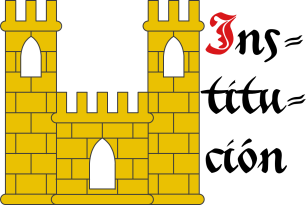
Categories: Institution, Interpreted, Religious, Military, Illuminated, Outlined in sable, Freehand, Emblem, Cross of Calatrava, Cross couped and Cross.
Carlos de la Cerda

Quarterly: 1 Azure semé of fleurs de lis Or; 2 and 3 Gules, a castle triple towered Or, the port and windows Azure, masoned Sable; 4 Argent, a lion rampant Purpure, armed and langued Gules, crowned Or.
Escudo cuartelado: 1o de azur sembrado de flores de lis de oro; 2o y 3o de gules, un castillo de oro, aclarado de azur, mazonado de sable; 4o de plata, un león rampante de púrpura, armado y lampasado de gules, coronado de oro.
Blazon keywords: Quarterly, Azure, Semé, Fleur de lis, Or, Gules, Castle, Port and windows, Masoned, Sable, Argent, Lion, Purpure, Rampant, Armed, Langued, Crown and Crowned.
Style keywords: Semi-circular, Illuminated, Outlined in sable and Soft metal.
Classification: Interpreted, Personal, Army and Navy and Kingdom of France.
Bearer: Cerda, Carlos de la.
Carlos Vidriales García y Bustamante, crest

Blazon keywords: Party per pale, Argent, Cross, Sable, Bordure, Motto, Or, Thirteen, Hurt, Hurt, torteau, pellet, pomme and golpe, Azure, Three, In pale, Four, Five, Chief, Fleur de lis, Crest and mantling, Helm, Mantling, Dexter, Doubled, Sinister, Wreath, One, Arm, Armed, Nascent, Grasping, Sword, Between, Two and Wing.
Style keywords: Freehand, Semi-circular, Illuminated and Outlined in sable.
Classification: Coat of arms, Interpreted and Personal.
Bearer: Vidriales García y Bustamante, Carlos.
Casas del Olmo

Party per pale: 1 Argent, an elm eradicated Vert; 2 Gules, a castle with an embattled tower Or.
Escudo partido: 1o de plata, un olmo arrancado de sinople; 2o de Gules, un castillo con una torre almenada de oro.
Arms emblazoned by me, illuminated with lights and shadows, outlined in Sable, with an ogee external shape and with a rough finish.
Design rationale
The arms of Castilla-La Mancha and many of its towns are party per pale; the 1st quarter is a canting elm = olmo = Casas del Olmo; the 2nd quarter symbolizes that historically, until 1861, this village belonged to Alarcón town whose castle, of Muslim origin, has a single tower. My heraldic artwork has been supervised by the Casas del Olmo Residents Association.
Blazon keywords: Argent, Vert, Gules, Or, One, Party per pale, Elm, Tree, Eradicated, Castle, Embattled, Tower and Crest.
Style keywords: Outlined in sable, Illuminated, Ogee and Rough.
Classification: Civic, Interpreted, Design rationale, Boa and Coat of arms.
Bearer: Casas del Olmo.
Castile and León, open royal crown

Quarterly: 1 and 4 Gules, a castle triple towered Or, port and windows Azure, masoned Sable; 2 and 3 Argent, a lion rampant Purpure, armed and langued Gules, crowned Or. Crest: An open royal crown Or.
Escudo cuartelado: 1o y 4o de gules, un castillo de oro, aclarado de azur, mazonado de sable; 2o y 3o de plata, un león rampante de púrpura, armado y lampasado de gules, coronado de oro. Timbrado de una corona real abierta.
Pre-existing arms interpreted by me as follows: the shield of arms has a rounded (semicircular) base; the quarterly field, the two castles and the two lions are illuminated; the lion and its crown are outlined in the colour of the field; the open royal crown and the castle are outlined in Sable, in the case of the castle because it is masoned; and the whole has a painted plaster finish.
In [Medél, R.; 1846; plate 10, illustration 4] his interpretation of the arms of Castile and León can be seen.
For the expression «a Castle triple towered» in the English blazon, I have followed [Burke, B.; 2009; pages 12, 27, 41, 51, 76, 104, 106, 109, 150, 159, 171, 189, 200, 226, 273, 281, 282, 287, 322 and others], where it is used more often with a hyphen «triple-towered» and less often without a hyphen «triple towered», which is the form I have chosen.
Blazon keywords: Quarterly, Gules, Or, Azure, Sable, One, Castle, Port and windows, Masoned, Argent, Purpure, Lion, Rampant, Armed, Langued, Crowned, Crest, Open royal crown and Crown.
Style keywords: Rounded, Illuminated and Gesso.
Classification: Interpreted, Civic, Coat of arms, Kingdom of Castile and Leon and Canting.
Bearer: Castile and León.
Cavalry Regiment Alcantara, royal crown

Disperse like the sun clears the clouds in your path.
Argent, a cross of Alcantara. Crest: A closed royal crown Or, with eight arches, visible five. Motto: «Hoec nubila tollunt obstantia sicut sol».
Escudo de plata, una cruz de Alcántara. Timbrado de una corona real cerrada. Lema: «Hoec nubila tollunt obstantia sicut sol».
Coat of arms interpreted in the following manner: the shape of the shield is of a semicircular arch; the field is illuminated in metal Argent; the cross of Alcantara is outlined in Sable and illuminated in Vert; the royal crown is closed, outlined in Sable and illuminated with the metal Or, Argent for the pearls, Azure and Or for the orb, Gules and Vert for the gems, Gules for the inner cloth, and Sable for the visible hollow at its base; and the whole has a slightly hammered metal finish.
Regiment's Motto
The Latin motto «Hoec nubila tollunt obstantia sicut sol» is often translated as «Ride like the sun, disperses the clouds in its path». I would like to offer the following observations on this translation:
- Instead of «disperse», I prefer the verb «scatter» which is more aligned with a cavalry regiment, [Royal Spanish Academy; 2001] «scatter, 3rd meaning, transitive verb, military term: To break up, rout the enemy, causing them to flee and scatter in complete disorder».
- On the other hand, even though it is about cavalry, I do not find that the Latin motto makes reference to riding, a verb that is also not needed to understand the motto's meaning, and adding an extra word lengthens the motto, reducing its impact.
- Finally, I use «your», instead of «its», so that the motto is a direct and personal rallying cry and not a phrase directed at a third person.
Blazon keywords: Without divisions, Argent, Cross of Alcantara, Cross couped, Cross, Crest, Closed royal crown, Crown and Motto.
Style keywords: Semi-circular, Illuminated, Outlined in sable and Soft metal.
Classification: Interpreted, Military, Army and Navy and Coat of arms.
Bearer: Alcantara, Cavalry Regiment.
Cavalry Regiment Montesa, royal crown

In this sign, you shall conquer.
Argent, a cross of Montesa. Crest: A closed royal crown Or, with eight arches, visible five. Motto: «In hoc signo vinces».
Escudo de oro, una cruz de Montesa. Timbrado de una corona real cerrada. Lema: «In hoc signo vinces».
Coat of arms interpreted as follows: the shape of the shield is a semi-circular arch; the field has been illuminated in metal Or; the cross of Montesa is outlined in Sable and illuminated in Sable and Gules; the royal crown is closed, outlined in Sable and illuminated the metal in Or, the pearls in Argent, the orb in Azure and Or, the gemstones in Gules and Vert, the inner cloth in Gules, and the visible hollow at its base in Sable; and the whole has a slightly beaten metal finish.
Regimental Motto
The Latin motto «In hoc signo vinces» is translated as «In this sign, you shall conquer».
Globus cruciger ~ Orb
It is called orb ~ «globus cruciger», the first in Spanish and the second in Latin, referring to the part of the royal crown, a jewel, or a jewel itself that recreates the shape of the globe topped with a cross.
Blazon keywords: Without divisions, Or, Cross of Montesa, Cross couped, Cross, Crest, Closed royal crown, Crown and Motto.
Style keywords: Semi-circular, Illuminated, Outlined in sable and Soft metal.
Classification: Interpreted, Military, Army and Navy and Coat of arms.
Bearer: Montesa, Cavalry Regiment.
Central Military Region

Party per pale: 1 Gules, a castle triple-towered Or, port and windows Azure, and masoned Sable; 2 Argent, a lion rampant Gules, crowned Or.
Coat of arms (1984-1997 and 1997-2002) of the former Central Military Region, where I serve. I interpreted now this coat of arms with a pointed shape. This kind of shape for this coat of arms are not usual.
Blazon keywords: Party per pale, Gules, One, Castle, Or, Port and windows, Azure, Masoned, Sable, Argent, Lion, Rampant and Crowned.
Style keywords: Pointed, Illuminated, Outlined in sable and Metal beaten.
Classification: Interpreted, Military, Army and Navy, Coat of arms and Kingdom of Castile and Leon.
Bearer: Central Military Region.
Charles Dunne, Chas

Motto: Stand and Be Counted
Gules fretty Argent; on a chief wavy Bleu celeste, a rising sun Or.
Escudo de gules fretado de plata; en un jefe ondado de celeste, un sol saliente de oro.
Coat of arms interpreted and emblazoned by me with with a semi-circular ended shape, illuminated, and with a iridescent finishing.
The sun used to be emblazoned with a human face, with its eyes, mouth, and nose, but in all the interpretations that I know of this blazon, the sun appears without a human face.
Schema for the fretty

Blazon keywords: Without divisions, Gules, Fretty, Argent, One, Chief, Wavy, Bleu celeste, Sun, Issuant and Or.
Style keywords: Iridescent, Outlined in sable, Illuminated and Semi-circular.
Classification: Interpreted.
Bearer: Charles Dunne, Chas.
Charles F. M. Wright

Sable, on a chevron Argent three spears' heads Gules, in chief two unicorns' heads erased Argent, horned and crined Or, langued Gules, in base on a pile of the last issuant from the chevron a unicorn head erased Sable, langued Gules. Motto: «Ad rem».
Escudo de sable, un cabrio de plata con tres puntas de lanza de gules; en jefe, dos cabezas de unicornio arrancadas de plata, cabelladas y acornadas de oro, lampasadas de gules; en punta, una pila de oro, saliente del cabrio, cargada de una cabeza de unicornio de sable, lampasada de gules. Lema: «Ad rem».
Blazon keywords: Sable, Chevron, Argent, Three, Spear's head, Gules, In chief, Two, Head, Unicorn, Erased, Crined, Horned, Or, Langued, In base, One, Pile and Motto.
Style keywords: Outlined in sable, Pointed, Illuminated and Watercolor.
Classification: Personal, Interpreted, Coat of arms and Latin language.
Bearer: Wright, Charles F. M..
Charles V of France

Banner Azure, three fleurs de lis Or.
Pendón de azur, tres flores de lis de oro.
Banner interpreted as follows: rectangular in shape with a 5x6 proportion; the field enamelled in flat Azure; the three fleurs-de-lis illuminated in Or and outlined in Sable; and the whole piece finished with an aged parchment effect.
Starting in 1376, the field sown with fleurs-de-lis was replaced by only three fleurs-de-lis. This change took place during the reign of Charles V of France (1338–1380, King of France from 1364 to 1380).
Edward III Plantagenet (1312–1377, King of England from 1327 to 1377) had incorporated the semé of fleurs-de-lis into his arms as a sign of his claim to the French throne, and Henry IV of England (1367–1413, King of England from 1399 to 1413) again changed the semé into three fleurs-de-lis in his own arms.
These three fleurs-de-lis remained in the royal arms of England until George II (1683–1760, King from 1727 to 1760).
They remained in the royal arms of the French kings until their prohibition during the so-called «Hundred Days», that is, from March 20, 1815, the date of Napoleon’s return to Paris from his exile in Elba, until June 28, 1815, the date of the Second Restoration of Louis XVIII as King of France, when they were reinstated. Finally, after the Revolution of 1830, Louis Philippe I of Orléans decreed their abolition by Order of February 10, 1831.
This banner is a recreation of the one appearing in the armorial [Edward IV of England; 1461; row 23, column 2], although in that armorial the banner seems to be associated with Louis IX of France, perhaps because of the prestige of the saintly King of France, whose arms bore a semé of fleurs-de-lis rather than three.
Blazon keywords: Without divisions, Azure, Or, Three, Fleur de lis and Ordered.
Style keywords: Rectangular, Illuminated, Outlined in sable and Old parchment.
Classification: Interpreted, Personal, Flag, Banner of arms, Kingdom of France and House of Valois.
Bearer: Charles V of France.
Charles V, Holy Roman Emperor
![Party per fess: 1 party per pale: 1 quarterly: 1 and 4 Gules, a castle triple-towered Or, port and windows Azure, masoned Sable [for Castile]; 2 and 3 Argent, a lion rampant Purpure, armed and langued Gules, crowned Or [for Leon]. 2 quarterly: 1 Or, four pallets Gules [for Aragon]; 2 quarterly per saltire: 1 and 4 Or, four pallets Gules; 2 and 3 Argent, an eagle displayed Sable [for Aragon-Sicily]. 3 Argent, a cross potent cantoned of four crosslets Or [for Jerusalem]. 4 Gules, a chain orlewise, crosswise, and saltirewise Or, charged in the fess point with an emerald Vert [for Navarre]. Enté en point Argent, a pomegranate proper, seeded Gules, slipped and leaved Vert [for Granada]. 2 quarterly: 1 Gules, a fess Argent [for Austria]; 2 Azure semé of fleurs de lis Or within a bordure compony Argent and Gules [for Burgundy modern]; 3 bendy Or and Azure within a bordure Gules [for Burgundy ancient]; 4 Sable, a lion rampant Or, armed and langued Gules [for Brabant]; overall an inescutcheon party per pale: 1 Or, a lion rampant Sable, armed and langued Gules [for Flanders]; 2 Argent, an eagle displayed Gules, crowned, armed, beaked, langued and membered Or, charged on the wings with two trefoiled stems Or [for Tyrol].](../escudo_heraldico/_detalle.htm?img=CarlosV.22.Escudo.Metal.Avr25.jpg&cla=Diestro "Charles V, Holy Roman Emperor")
Party per fess: 1 party per pale: 1 quarterly: 1 and 4 Gules, a castle triple-towered Or, port and windows Azure, masoned Sable [for Castile]; 2 and 3 Argent, a lion rampant Purpure, armed and langued Gules, crowned Or [for Leon]. 2 quarterly: 1 Or, four pallets Gules [for Aragon]; 2 quarterly per saltire: 1 and 4 Or, four pallets Gules; 2 and 3 Argent, an eagle displayed Sable [for Aragon-Sicily]. 3 Argent, a cross potent cantoned of four crosslets Or [for Jerusalem]. 4 Gules, a chain orlewise, crosswise, and saltirewise Or, charged in the fess point with an emerald Vert [for Navarre]. Enté en point Argent, a pomegranate proper, seeded Gules, slipped and leaved Vert [for Granada]. 2 quarterly: 1 Gules, a fess Argent [for Austria]; 2 Azure semé of fleurs de lis Or within a bordure compony Argent and Gules [for Burgundy modern]; 3 bendy Or and Azure within a bordure Gules [for Burgundy ancient]; 4 Sable, a lion rampant Or, armed and langued Gules [for Brabant]; overall an inescutcheon party per pale: 1 Or, a lion rampant Sable, armed and langued Gules [for Flanders]; 2 Argent, an eagle displayed Gules, crowned, armed, beaked, langued and membered Or, charged on the wings with two trefoiled stems Or [for Tyrol].
Escudo cortado: 1o partido: 1o cuartelado: 1o y 4o de gules, un castillo de oro, aclarado de azur, mazonado de sable [de Castilla]; 2o y 3o de plata, un león rampante de púrpura, armado y lampasado de gules, coronado de oro [de León]. 2o cuartelado: 1o de oro, cuatro palos de gules [de Aragón]; 2o cuartelado en aspa: 1o y 4o de oro, cuatro palos de gules; 2o y 3o de plata, un águila de sable [de Aragón-Sicilia]. 3o de plata, una cruz potenzada cantonada de cuatro crucetas de oro [de Jerusalén]. 4o de gules, una cadena puesta en orla, en cruz y en sotuer de oro, cargada en el centro de una esmeralda de sinople [de Navarra]. Entado en punta de plata, una granada al natural, tajada de gules, tallada y hojada de sinople [de Granada]. 2o cuartelado: 1o de gules, una faja de plata [de Austria]; 2o de azur sembrado de flores de lis de oro, una bordura componada de plata y gules [de Borgoña moderna]; 3o bandado de oro y azur, una bordura de gules [de Borgoña antigua]; 4o de sable, un león rampante de oro, armado y lampasado de gules [de Brabante]; sobre el todo un escusón partido: 1o de oro, un león rampante de sable, armado y lampasado de gules [de Flandes]; 2o de plata, un águila de gules, coronada, armada, picada, lampasada y membrada de oro, cargada en las alas con dos tallos trebolados todo de oro [del Tirol].
Coat of arms depicted by me, highlighted with lights and shadows, contoured in Sable, with a semi-circular outer contour and with a metal beaten finishing.
Arms of Charles, Holy Roman Emperor, emblazoned by me.
Blazon keywords: Gules, Azure, Sable, Argent, Purpure, Or, Vert, One, Four, Party per fess, Party per pale, Quarterly, Castle, Triple-towered, Port and windows, Masoned, Lion, Rampant, Armed, Langued, Crowned, Pale, Quarterly per saltire, Eagle, Displayed, Cross potent, Cross couped, Cantoned, Crosslet, Chain, Orlewise, Crosswise, Saltirewise, Charged, In the fess point, Emerald, Enté en point, Pomegranate, Proper, Seeded, Slipped, Leaved, Fess, Semé, Fleur de lis, Bordure, Compony, Bendy, Overall, Inescutcheon, Beaked, Membered, Wing, Trefoiled and Stem.
Style keywords: Outlined in sable, Illuminated, Semi-circular and Metal beaten.
Classification: Civic, Interpreted, Boa and Coat of arms.
Bearer: Charles V, Holy Roman Emperor.
Charles VII of France

King of France from 1429 to 1461.
Azure, three fleurs de lis Or.
Escudo de azur, tres flores de lis de oro.
Coat of arms interpreted with: a semicircular (round) base; the field enamelled in flat Azure; the fleurs-de-lis illuminated in Or and outlined in Sable; and finished with a mother-of-pearl effect.
This coat of arms is based on the one appearing in the armorial [Ingeram, H.; 1459; page 34, 1st shield], under the inscription «küng von franckrich» (franckrich ~ Frankreich ~ France).
Blazon keywords: Without divisions, Azure, Or, Three, Fleur de lis and Ordered.
Style keywords: Semi-circular, Illuminated, Outlined in sable and Iridescent.
Classification: Interpreted, Personal, Coat of arms, Kingdom of France and House of Valois.
Bearer: Charles VII of France.
Cheshire, County of

Azure, a sword erect Or, between three garbs Or, 2 and 1.
Escudo de azur, una espada alzada de oro, acompañada de tres gavillas de trigo de oro, 2 y 1.
Coat of arms interpreted with: a rounded base; the field illuminated in Azure; the motto and charges illuminated in Or and outlined in Sable; and the whole with a leather texture.
In England, Wales and Ireland, the term «heraldic visitations» ~ «visitas heráldicas» referred to the inspection tours carried out by the officers of the kings of arms, or even by the kings of arms themselves, with the aim of recording and sanctioning the family trees and coats of arms of the nobility, the counties and the bourgeoisie who bore them.
These journeys took place mainly between the year 1530 and the year 1688. The results of these inspections were recorded in books that could be considered a roll or heraldic census of the upper classes. For this reason, and since then, these records have been a valuable source of information for historians, genealogists and heraldists.
The County of Cheshire received the following «heraldic visitations»:
- The 1st in 1533 visited part of the county of Chester, as part of a journey covering other areas. It is a visitation ordered by the king of arms Thomas Benolte (Benalt) and carried out by the herald William Fellow. This visitation is recorded, for example, in the book [Langton, W.; 1876].
- The 2nd in 1558, the visitation was carried out by the king of arms Lawrence Dalton himself, accompanied by William Colbarne, a pursuivant ~ official of arms.
- The 3rd in 1566, by the herald Robert Glover.
- The 4th in 1580, by the king of arms William Flower and the herald Robert Glover.
- The 5th in 1591, visiting Chester, the capital, by Thomas Chaloner. This 5th visitation and the earlier 1st, 3rd, 4th, but not the 2nd, are recorded in the book [Rylands, J. P.; 1882] and also in [Goldstraw, M. S. J.; 2013a].
- The 6th in 1613, carried out by the king of arms himself Sir Richard Saint George accompanied by his son and pursuivant Henry Saint George. This visitation is recorded in the book [Armytage, G. J.; Rylands, J. P.; 1909] and also in [Goldstraw, M. S. J.; 2013b].
- The 7th and last in 1663 by the king of arms William Dugdale. This visitation is recorded in the book [Adams, A.; 1941].
Blazon keywords: Without divisions, Azure, Or, Sword, Point upwards, Between, Wheat, Garb and Ordered.
Style keywords: Rounded, Illuminated, Outlined in sable and Leather.
Classification: Interpreted, Civic and Cheshire County.
Bearer: Cheshire, County of.
City of Haguenau, Alsace

Azure, a cinquefoil Argent, seeded Gules.
Escudo de azur, un quinquefolio de plata, botonado de gules.
Coat of arms emblazoned by me with plain color Azure and metal Or and with a shape ended with an ogee arch.
Blazon keywords: Without divisions, Azure, One, Cinquefoil, Argent, Seeded and Gules.
Style keywords: Outlined in sable, Illuminated and Ogee.
Classification: Interpreted, Lineage, Kingdom of France, Civic and Coat of arms.
Bearer: Haguenau.
Ciudad de Ceuta

City of Ceuta, Spain, Africa, with a crown of Marquis
Argent, five escutcheons in cross Azure, each charged with five plates in saltire; a bordure Gules, charged with seven castles triple-towered Or, 2, 2, 2, and 1. Crest: A crown of Marquis.
Escudo de plata, cinco escudetes en cruz de azur, cada uno cargado de cinco bezantes en sotuer de plata; una bordura de gules, cargada de siete castillos de oro, dos en jefe, una en cada flanco y tres en punta. Timbrado de una corona de marqués
Illuminated and a leather finishing.
Coat of arms of Ceuta from the coat of arms of Portugal

The Portuguese conquered Ceuta in the year 1415. This event represents an important step in the development of the Portuguese Empire in Africa. Then Ceuta received its arms from those of Portugal but with the castles in another order. In the image, the 1st coat of arms of Portugal, and the 2nd coat of arms of Ceuta.
Blazon keywords: Without divisions, Argent, Five, Escutcheon, In cross, Azure, Charged, Bezant and plate, Plate, In saltire, Bordure, Gules, Seven, Castle, Or, Two, In chief, One, In each flank, Three, In base, Crown of Marquis and Crown.
Style keywords: Leather, Outlined in sable, Illuminated and Semi-circular.
Classification: Civic, Interpreted and Kingdom of Spain.
Bearer: Ceuta.
Claes Zangenberg, arms on tartan

Or, on a pile issuant from base Vert between two maunches Gules a displayed scroll Argent with seal pendant proper.
It has been interpreted by me, highlighted with lights and shadows, outlined in Sable, with a pointed external shape and with a texturized finishing.
The coat of arms of Claes Zangenberg emblazoned by me over his personal tartan registered in the Scottish Register of Tartans.
Blazon keywords: Or, Vert, Gules, Argent, One, Two, Pile issuant from base, Between, Maunch, Displayed scroll, Suspended and Proper.
Style keywords: Outlined in sable, Illuminated and Pointed.
Classification: Personal, Interpreted, Boa, Tartan and Seal.
Bearer: Zangenberg, Claes.
Claudia Trujillo Jiménez, page of armorial

Purpure, three dragons passant, in pale Argent; a bordure Gules, eight saltires couped Or. Crest: A crown of the Sovereign and Most Noble Order of the Pomegranate. The shield is surrounded by the Grand Collar of the Sovereign and Most Noble Order of the Pomegranate.
This is her coat of arms of emblazoned by me for the Roll of Arms of the Sovereign and Most Noble Order of the Pomegranate.
Blazon keywords: Without divisions, Purpure, Three, Dragon, Passant, In pale, Argent, One, Bordure, Gules, Eight, Saltire, Or, Crest and mantling, Crown, Pomegranate, Surrounded and Grand collar.
Style keywords: Ogee, Outlined in sable, Illuminated and Leather.
Classification: Personal, Interpreted, Coat of arms, Armorial roll and Castilian language.
Bearer: Trujillo Jiménez, Hermanos.
Clement V

195th Pope of the Church, from 1305 to 1314. «Clemens V», born Bertrand de Got, born in Villandraut, in the southwest of France, was the first pope to reside in Avignon in a stable manner.
Or, three fesses Gules.
Escudo de oro, tres fajas de gules.
Papal coat of arms interpreted with: a rounded triangular top; the field in plain Or enamel; the bars illuminated in Gules and outlined in Sable; and with a heavily hammered metal finish.
Blazon keywords: Without divisions, Or, Three, Fess and Gules.
Style keywords: Triangular curved, Illuminated, Outlined in sable and Hard metal.
Classification: Interpreted, Religious and Papal States.
Bearer: Clement V.
Blazon equivalent to: Fernández de Córdoba y Carrillo, Diego.
Clement XII

246th Pope of the Church, from 1730 to 1740. «Clemens XII», named Lorenzo Corsini, born in Florence and rests in St. John Lateran.
Bendy of six Gules and Argent; over all a fess Azure.
Escudo bandado de seis piezas de gules y plata; brochante sobre el todo una faja de azur.
Papal coat of arms interpreted with: a rounded mouth; the field in flat tincture of Argent; the fess and the bands outlined in Sable and illuminated in Gules and Azure; and the whole with a textured finish.
All are ordinaries, including the three bands and the fess, and since the blazon specifies that the fess is overall on the bands, therefore, it is not the Gules bands that are overall on the Azure fess, and they should be painted underneath.
Blazon keywords: Without divisions, Bendy, Six, Gules, Argent, Surmounted, Overall (deprecated), One, Fess and Azure.
Style keywords: Semi-circular, Illuminated, Outlined in sable and Freehand.
Classification: Interpreted, Religious and Papal States.
Bearer: Clement XII.
Clermont, Robert of

Grandson of Blanche of Castile, 6th son of Saint Louis IX, founder of the House of Bourbon, husband of Beatrice of Burgundy, Lady of Bourbon.
Azure semé of fleurs de lis Or, a bend Gules.
Escudo de Azur sembrado de flores de lis de oro, banda gules.
Coat of arms that I have interpreted with:: a semicircular (round) base; the field enamelled in flat Azure; the fleurs-de-lys illuminated in Or; the bend illuminated in Gules; the whole is outlined in Sable; and the freehand drawing.
Blazon keywords: Without divisions, Azure, Or, Semé, Fleur de lis, Bend and Gules.
Style keywords: Semi-circular, Illuminated, Outlined in sable and Freehand.
Classification: Interpreted, Personal, Coat of arms, Kingdom of France and House of Bourbon.
Bearer: Clermont, Robert of.
Closed royal crown and the Comunidad de Madrid

Gules, two castles triple-towered Or, port and windows Azure, masoned Sable, in chief, seven mullets Argent, 4 and 3. Crest: A closed royal crown.
Arms emblazoned by me, illuminated with lights and shadows, contoured in Sable, with a semi-circular external shape and with a iridescent finish.
Coat of arms of the Comunidad de Madrid emblazoned by me. Law 2/1983 of 23 December on the flag, the coat of arms, and the anthem of the Community of Madrid, published in the Official State Gazette, number 33 of 8 February 1984, defines this coat of arms in its Article 2 as follows: «...it consists of a single quarter Gules, charged Or with two castles in pair, embattled, donjoned, masoned Sable and ajouré Azure, surmounted in chief by seven mullets Argent, arranged four and three. For a timbre, a closed Royal Crown, which is a circle Or set with precious stones, composed of eight acanthus-leaf fleurons, of which five are visible, interspersed with pearls, from whose leaves rise diadems topped with pearls, converging in a globe Azure, with the demi-meridian and equator Or, surmounted by a cross Or. The crown is lined Gules».
Design rationale
The castles came from Castile and the 7 mullet from the bordure of the city of Madrid, they are the stars of the Plough, the 7 brightest stars of the Ursa Major. This coat of arms was adopted by the Comunidad de Madrid the 23th of December 23 of 1983.
Blazon keywords: Gules, Or, Azure, Argent, Two, Seven, Castle, Triple-towered, Port and windows, Masoned, In chief, Mullet, Closed royal crown and Crown.
Style keywords: Outlined in sable, Illuminated, Semi-circular and Iridescent.
Classification: Civic, Interpreted, Boa and Coat of arms.
Bearer: Madrid, Comunidad de.
Coat of arms of David Ryan Shorey

Sable, a dolphin naiant Or; a chief embattled Vert, fimbriated Or.
Escudo de sable, un delfín nadante de oro; un jefe almenado de sinople y perfilado de oro.
Blazon keywords: Sable, Dolphin, Naiant, Or, Chief, Embattled, Vert and Fimbriated.
Style keywords: Ogee, Outlined in sable and Plain tincture.
Classification: Personal, Interpreted and Coat of arms.
Bearer: Shorey, David Ryan.
Colebrand, William de

Willame de Colebraund ~ William de Colebrand.
Gules, three Swords Argent, erect, in fess.
Escudo de gules, tres espadas de plata, alzadas, en faja.
Interpreted coat of arms with a free hand finish.
Coat of arms included in [Marshal, L.; 1295; coat of arms number 461], also in [Brault, G. J.; 1997], and time ago in Brian Timms, but not now.
Blazon keywords: Without divisions, Gules, Three, Sword, Argent, Point upwards and In fess.
Style keywords: Pointed, Illuminated, Outlined in sable and Freehand.
Classification: Interpreted and Personal.
Bearer: Colebrand, William de.
Commoners' certification for Britania Anastoshia Korÿn McCoy

Azure, a saltire Argent between in chief a bee proper, in fess two fleurs de lis Or; on a chief Argent, a bald eagle displayed Azure, head and tail Argent, beaked, armed and membered Or, langued Gules.
The Commoners' Certification of Arms for Britania Anastoshia Korÿn McCoy with her arms designed by Randy David Lee Xavier Potts and emblazoned by me.
Credits: Randy Potts is the designer of the coat of arms.
Blazon keywords: Azure, Argent, Or, Gules, One, Two, Saltire, Between, In chief, Bee, Proper, Fleur de lis, In fess, Chief, Charged, Bald eagle, Eagle, Displayed, Head, Tail, Beaked, Armed, Membered and Langued.
Style keywords: Outlined in sable, Illuminated and Semi-circular.
Classification: Personal, Interpreted, Boa, Certification and Heraldic document.
Bearer: McCoy, Britania Anastoshia Korÿn.
Commoners' certification for Donnie Thompson

Gules, a stag's head caboshed Argent, attired Or, between its attires a dexter hand appaumée, couped at the wrist; on a bordure Argent eight camellias Gules, seeded Or. Crest: Upon a helm with a wreath Argent and Gules, a gamecock, armed, crested and bearded Gules, the neck Argent, beaked, membered and the head Or, supporting with its dexter talon a closed book Sable, leaved Or, garnished Argent. Motto: «Meliores Quotidie».
The Commoners' Certification of Arms for Donnie Thompson with his full achievement emblazoned by me.
Blazon keywords: Gules, Argent, Or, One, Eight, Stag, Head, Caboshed, Attired, Between, Dexter, Hand, Appaumée, Couped, Wrist, Bordure, Camellia, Seeded, Crest, Upon (wreath), Helm, Wreath, Rooster, Armed, Crested, Bearded, Neck, Beaked, Membered, Grasping, Talon, Closed book, Book, Leaved, Garnished, Mantling and Motto.
Style keywords: Outlined in sable, Illuminated and Pointed.
Classification: Personal, Interpreted, Boa, Certification, Heraldic document and Coat of arms.
Bearer: Thompson, Donnie.
Commoners' certification for Easton Michael Jones

Quarterly: 1 and 4 Azure, a saltire Argent between two fleurs de lis in fess Or; on a chief Argent, a bald eagle displayed Azure, head and tail Argent, beaked, armed and membered Or, langued Gules; 2 and 3 Gules, six fleurs de lis, in chief one Argent between two Or, in fess two Argent, in base one Or; within a bordure gyronny of twenty-four Argent and Azure; overall a heart Argent charged with a label Gules.
The Commoners' Certification of Arms for Easton Michael Jones with his arms designed by Randy David Lee Xavier Potts and emblazoned by me.
Credits: Randy Potts is the designer of the coat of arms.
Blazon keywords: Azure, Argent, Or, Gules, One, Two, Six, Twenty-four, Quarterly, Saltire, Between, In fess, Fleur de lis, Chief, Charged, Bald eagle, Eagle, Displayed, Head, Tail, Beaked, Armed, Membered, Langued, Bordure, Gyronny, Overall, Heart and Label.
Style keywords: Outlined in sable, Illuminated and Semi-circular.
Classification: Personal, Interpreted, Boa, Certification and Heraldic document.
Bearer: Jones, Easton Michael.
Commoners' certification for Hudson Hayes Lasco

Quarterly: 1 and 4 Azure, a saltire Argent between two fleurs de lis in fess Or; on a chief Argent, a bald eagle displayed Azure, head and tail Argent, beaked, armed and membered Or, langued Gules; 2 and 3 Gules, six fleurs de lis, in chief one Argent between two Or, in fess two Argent, in base one Or; within a bordure gyronny of twenty-four Argent and Azure; overall a crescent Argent charged with a crescent Gules.
The Commoners' Certification of Arms for Hudson Hayes Lasco with his arms designed by Randy David Lee Xavier Potts and emblazoned by me.
Credits: Randy Potts is the designer of the coat of arms.
Blazon keywords: Azure, Argent, Or, Gules, One, Two, Six, Twenty-four, Quarterly, Saltire, Between, In fess, Fleur de lis, Chief, Charged, Bald eagle, Eagle, Displayed, Head, Tail, Beaked, Armed, Membered, Langued, Bordure, Gyronny, Overall and Crescent.
Style keywords: Outlined in sable, Illuminated and Semi-circular.
Classification: Personal, Interpreted, Boa, Certification and Heraldic document.
Bearer: Lasco, Hudson Hayes.
Commoners' certification for Makayla Danée Robidoux

Quarterly: 1 and 4 Azure, a saltire Argent between two fleurs de lis in fess Or; on a chief Argent, a bald eagle displayed Azure, head and tail Argent, beaked, armed and membered Or, langued Gules; 2 and 3 Gules, six fleurs de lis, in chief one Argent between two Or, in fess two Argent, in base one Or ; within a bordure gyronny of twenty-four Argent and Azure; overall a heart Argent. Crest: A ribbon Azure doubled Argent.
The Commoners' Certification of Arms for Makayla Danée Robidoux with her arms designed by Randy David Lee Xavier Potts and emblazoned by me.
Credits: Randy Potts is the designer of the coat of arms.
Blazon keywords: Azure, Argent, Or, Gules, One, Two, Six, Twenty-four, Quarterly, Saltire, Between, In fess, Fleur de lis, Chief, Charged, Bald eagle, Eagle, Displayed, Head, Tail, Beaked, Armed, Membered, Langued, Bordure, Gyronny, Overall, Heart, Ribbon and Doubled.
Style keywords: Outlined in sable, Illuminated and Invected octagon.
Classification: Personal, Interpreted, Boa, Certification and Heraldic document.
Bearer: Robidoux, Makayla Danée.
Commoners' certification for Marie Unicorn Sparkles

Party per chevron Azure semé of unicorns passant, and Argent, a rainbow throughout proper. Crest: Upon a wreath Argent and Azure a demi-unicorn Azure, horned, crined and semé of mullets Or. Motto: «Live your Magic».
Credits: SkyL.designer and Antonio Salmerón y Cabañas is the author of the heraldic art.
Classification: Personal, Interpreted, Certification, Heraldic document and English language.
Bearer: Sparkles, Marie Unicorn.
Commoners' certification for Ryker Scott Lasco

Quarterly: 1 and 4 Azure, a saltire Argent between two fleurs de lis in fess Or; on a chief Argent, a bald eagle displayed Azure, head and tail Argent, beaked, armed and membered Or, langued Gules; 2 and 3 Gules, six fleurs de lis, in chief one Argent between two Or, in fess two Argent, in base one Or; within a bordure gyronny of twenty-four Argent and Azure; overall a crescent Argent charged with a label Gules.
The Commoners' Certification of Arms for Ryker Scott Lasco with his arms designed by Randy David Lee Xavier Potts and emblazoned by me.
Credits: Randy Potts is the designer of the coat of arms.
Blazon keywords: Azure, Argent, Or, Gules, One, Two, Six, Twenty-four, Quarterly, Saltire, Between, In fess, Fleur de lis, Chief, Charged, Bald eagle, Eagle, Displayed, Head, Tail, Beaked, Armed, Membered, Langued, Bordure, Gyronny, Overall, Crescent and Label.
Style keywords: Outlined in sable, Illuminated and Semi-circular.
Classification: Personal, Interpreted, Boa, Certification and Heraldic document.
Bearer: Lasco, Ryker Scott.
Commoners' certification László Gábor

Per fess, the base per pale: 1 Or, an eagle displayed Sable; 2 Gules, a sun in splendour Or; 3 Or, an increscent Gules; all within a bordure Sable, charged with eight fleurs de lis Or. Motto: «Virtus Nobilitatis Fidelitas» Sable, with initial letters Gules over a scroll Argent.
The Commoners' Certification of Arms for Vitéz László Gábor from Hungary with his coat of arms designed by him and emblazoned by me.
Blazon keywords: Or, Sable, Gules, Argent, One, Eight, Party per fess, the base per pale, Eagle, Displayed, Sun in splendour, Increscent, Bordure, Fleur de lis, Motto and Scroll.
Style keywords: Outlined in sable, Illuminated and Pointed.
Classification: Personal, Interpreted, Boa, Certification and Heraldic document.
Bearer: László Gábor.
Craon, Robert de

Lozengy Or and Gules.
Escudo losanjado oro y gules.
Coat of arms emblazoned by me with a semi-circular shape, illuminated, and with a freehand finishing.
Blazon keywords: Lozengy, Or and Gules.
Style keywords: Outlined in sable, Illuminated, Semi-circular and Freehand.
Classification: Religious, Military, Knights Templar, Interpreted and Coat of arms.
Bearer: Craon, Robert de.
Crepsi, comparation

Party per pale: 1 Gules, in base a castle triple-towered Or, port and windows Azure, and masoned Sable; 2 Argent, in base a lion rampant Gules, crowned Or; overall a psi letter sable; a diminished bordure Or.
Coat of arms of Crepsi, military psychology, former Central Military Region, Kingdom of Spain, emblazoned by me, where I was stationed during my military service. In the image: 1988, the original mold (1) with which the first 6 coats of arms were made; one of them is now in my office (2); the design of the badge for the 1st meeting of veterans (3), all of which were designed and made by my lieutenant colonel and friend Miguel Angel Nuñez Amador; and finally, the coat of arms of Crepsi emblazoned by me (4).
Blazon keywords: Gules, Argent, Or, Azure, Sable, Party per pale, In base, Castle, Triple-towered, Port and windows, Masoned, Lion, Rampant, Crowned, Overall, Letter and Diminished bordure.
Style keywords: Outlined in sable, Illuminated and Semi-circular.
Classification: Military, Interpreted, Compare, Boa and Coat of arms.
Bearer: Crepsi.
Crest and Greek warcry of Fernando Marán Bié

The crest and warcry of Fernando Marán Bié designed by Ignacio Koblischek and emblazoned by me. Crest: Upon wreath Or, Azure and Gules, a demi-pegasus Argent issuant from flames of fire Gules, fimbriated Or. Warcry above the crest «ΕΠΙΜΕΛΕΙΑ ΕΑΥΤΟΥ».
Blazon keywords: Crest, Azure, Gules, Argent, Or, One, Upon (wreath), Wreath, Demi, Pegasus, Issuant, Flame, Fimbriated, War cry and Above.
Style keywords: Outlined and Leather.
Classification: Personal, Interpreted and Boa.
Bearer: Fernando Marán Bié.
Crest and mantling of Arturo Taborda

Azure, issuant from base a frog's head and from flanks its forelegs in chevron Or, in chief a mullet of seven points Argent. Crest: Upon a helm with a wreath Or and Azure, a demi-frog erect Or, grasping with its forelegs an apple and a closed book Azure. Mantling: Azure doubled Or.
Coat of arms interpreted by me, highlighted with lights and shadows, contoured in Sable, with an ogee outer contour and with a freehand finish.
Coat of arms of Arturo Taborda, Venezuela, emblazoned by me.
Blazon keywords: Azure, Or, Argent, One, Seven, Issuant from base, Frog, Head, Flank, Foreleg, In chevron, In chief, Mullet, Crest and mantling, Crest, Upon (wreath), Helm, Wreath, Demi, Erect, Grasping, Apple, Closed book, Book, Mantling and Doubled.
Style keywords: Outlined in sable, Illuminated, Ogee and Freehand.
Classification: Personal, Interpreted, Boa and Coat of arms.
Bearer: Taborda, Arturo.
Crest and mantling of Chad Michael Krouse

Party per chevron Gules and barry wavy Argent and Azure, in chief two Dogwood flowers (Cornus Florida) proper, in base a Cross of Saint Chad Gules. Crest: A Cardinal's head (Cardinalis cardinalis) erased clutching in its Beak a Madonna lily (Lilium Candidum) seeded proper. Mantling: Gules doubled Argent.
Coat of arms emblazoned by me, highlighted with lights and shadows, outlined in Sable, with an ogee external shape and with a leather finish.
Blazon keywords: Gules, Argent, Azure, Two, One, Party per chevron, Barry, Wavy, In chief, Dogwood flower, Flower, Proper, In base, Cross of Saint Chad, Cross couped, Crest, Head, Erased, Grasping, Beak and Mantling.
Style keywords: Outlined in sable, Illuminated, Ogee and Leather.
Classification: Personal, Interpreted, Boa and Coat of arms.
Bearer: Krouse, Chad Michael.
Crest and mantling of Dr. Tariq Abbasi

Azure, two oak trees eradicated proper, leaved Vert, fructed Or, in chief three mullets Or; enté en point Argent, a heart Gules semé of fleurs de lis Or. Crest: Upon a helm, with a wreath Or, Azure, Gules, and Vert, a sun in splendour Or. Mantling: Azure, Gules, and Vert doubled Or.
Coat of arms painted by me, illuminated with lights and shadows, outlined in Sable, with a pointed external shape and with a leather finish.
Coat of arms of Dr. Tariq Abbasi MBE FRSA designed by Vittorio Gifra and emblazoned by me.
Blazon keywords: Azure, Vert, Or, Argent, Gules, One, Two, Three, Oak, Tree, Eradicated, Proper, Leaved, Fructed, In chief, Mullet, Enté en point, Heart, Semé, Fleur de lis, Crest, Upon (wreath), Helm, Wreath, Sun in splendour, Mantling and Doubled.
Style keywords: Outlined in sable, Illuminated, Pointed and Leather.
Classification: Personal, Interpreted, Boa and Coat of arms.
Bearer: Abbasi, Tariq.
Crest and mantling of Gian Carlo Onida

Or, a tree eradicated proper, between in base a crescent reversed Argent and a mullet of six points Gules. Crest: Upon helm Argent, barred Or a barred helm Or, a crown of Count. Mantling: On the dexter Vert doubled Or and on the sinister Gules doubled Or.
Coat of arms painted by me, illuminated with lights and shadows, contoured in Sable, with an ogee outer contour and with a watercolor finishing.
Canting arms of Gian Carlo Onida, Alessandria, emblazoned by me. «Crescent reversed» means that the points of the crescent are directed toward the base of the shield.
Blazon keywords: Or, Argent, Gules, Vert, One, Tree, Eradicated, Proper, Between, In base, Crescent, Reversed, Mullet, Crest, Helm, Barred, Crown of Count, Crown, Mantling, Dexter and Doubled.
Style keywords: Metal on metal, Outlined in sable, Illuminated, Ogee and Watercolor.
Classification: Personal, Interpreted, Boa and Coat of arms.
Bearer: Onida, Gian Carlo.
Crest and mantling of Herbert Leo Buffenbarger

Barry of six, Argent and Azure, a pile throughout, counterchanged. Crest: Upon a helm with a wreath Argent and Azure, upon a trimount Gules, an eagle wings addorsed and inverted Azure, the head and tail Argent, nimbed and grasping a closed book Or. Mantling: Azure doubled Argent.
Arms emblazoned by me, highlighted with lights and shadows, contoured in Sable, and with a watercolor finishing.
These are the arms of Herbert Leo Buffenbarger, designed by his son John Alan Francis Buffenbarger, and emblazoned by me.
Blazon keywords: Argent, Azure, Gules, Or, One, Six, Three, Barry, Counterchanged, Pile, Throughout (chief base), Chaussé, Crest and mantling, Crest, Upon (wreath), Helm, Wreath, Upon, Trimount, Eagle, Wing, Addorsed, Head, Tail, Nimbed, Grasping, Closed book, Book and Mantling.
Style keywords: Outlined in sable, Illuminated and Watercolor.
Classification: Personal, Interpreted, Boa and Coat of arms.
Bearer: Buffenbarger, Herbert Leo.
Crest and mantling of Isadora von Haimb

Argent, a rose Gules, barbed Vert; a bordure Azure. Crest: Dexter, upon a helm, issuant from an ancient coronet Or, a dove Argent, holding in its beak an olive branch Vert; and sinister, upon a helm, issuant from an ancient coronet Or, an arm proper, vambraced Argent, grasping a sabre Argent, between a pair of wings per fess alternately Azure and Argent. Mantling: Dexter Gules doubled Argent, sinister Azure doubled Argent.
Arms emblazoned by me, illuminated with lights and shadows, contoured in Sable, with a semi-circular outer contour and with a watercolor finish.
Blazon keywords: Argent, Gules, Vert, Azure, Sable, One, Two, Rose, Barbed, Bordure, Crest, Dexter, Helm, Issuant, Ancient coronet, Crown, Dove, Grasping, Beak, Olive tree, Tree, Branch, Sinister, Arm, Vambraced, Sabre, Sword, Between, Wing, Party per fess, Alternately, Mantling and Doubled.
Style keywords: Outlined in sable, Illuminated, Semi-circular and Watercolor.
Classification: Personal, Interpreted, Boa and Coat of arms.
Bearer: von Haimb, Isadora.
Crest and mantling of Jose Manuel José Manuel Villauriz Álvarez

Or, a badger rampant Sable. Crest: Upon a helm with a wreath Or and Sable, five ostrich feathers alternately Or and Sable. Mantling: Sable doubled Or.
Coat of arms painted by me, highlighted with lights and shadows, outlined in Sable, with a semi-circular external shape and with a leather finish.
Blazon keywords: Or, Sable, One, Badger, Rampant, Crest and mantling, Crest, Upon (wreath), Helm, Wreath, Ostrich feathers, Alternately and Mantling.
Style keywords: Outlined in sable, Illuminated, Semi-circular and Leather.
Classification: Personal, Interpreted, Boa and Coat of arms.
Bearer: Villauriz Álvarez, José Manuel.
Crest and mantling of Lory Santiago-Vazquez

Party per fess wavy: 1 Azure, a dolphin naiant; 2 Argent, three escallops Azure. Crest: Upon a helm lined Azure with a wreath Argent and Azure, an owl Tenné, armed, beaked, membered, the eyes, and wearing a necklace with a pendant heart Or, grasping with its dexter foot a bluebonnet proper. Mantling Azure doubled Argent.
Arms depicted by me, highlighted with lights and shadows, outlined in Sable, with a semi-circular outer contour and with a leather finishing.
Blazon keywords: Azure, Argent, One, Three, Or, Party per fess, Wavy, Dolphin, Naiant, Escallop, Crest, Upon (wreath), Helm, Lined, Wreath, Owl, Tenné, Armed, Beaked, Membered, The eyes, Collar, Heart, Grasping, Dexter, Talon, Bluebonnet, Flower, Proper, Mantling and Doubled.
Style keywords: Outlined in sable, Illuminated, Semi-circular and Leather.
Classification: Personal, Interpreted, Boa and Coat of arms.
Bearer: Santiago-Vazquez, Lory.
Crest and mantling of Maximilian Silvestri

Argent, a demi-savage issuant from the base Carnation, crined, bearded and vested Tenné, wreathed of leaves Vert, holding in his dexter a close book, bookmarked Gules, garnished, on its cover a mortar with pestle Or, in his sinister an oak club Tenné, leaved and fructed Vert; a chief wavy Gules. Crest: Upon a helm lined Gules with a wreath Argent and Gules, an oak couped Tenné, leaved and fructed Vert, its trunk charged with a mullet Argent. Mantling: Gules doubled Argent.
Coat of arms depicted by me, illuminated with lights and shadows, contoured in Sable, with a semi-circular outer contour and with a leather finish.
The coat of arms of Maximilian Silvestri emblazoned by me. 5 is the default number of points of the «mullet» in both English and Castilian heraldry. [Friar, S.; 1987; page 35] states: «a mullet is always depicted as having five points, a six-pointed mullet should be blazoned a Mullet of six points»; likewise, [Avilés, J.; 1725a; page 279, figure 126] and [Avilés, J.; 1780a; page 312, figure 126] state: «Mullets ordinarily have five rays, or straight points,... when blazoning this figure, the usual practice is to specify the number of rays when exceeding five».
Blazon keywords: Argent, Or, Gules, One, Demi, Savage, Carnation, Issuant, Base, Crined, Bearded, Vested, Tenné, Wreathed, Leaf, Grasping, Dexter, Closed book, Book, Bookmark, Garnished, Mortar, Pestle, Club, Leaved, Fructed, Chief, Wavy, Crest, Upon (wreath), Helm, Lined, Wreath, Mantling, Doubled, Oak, Tree, Charged, Trunk and Mullet.
Style keywords: Outlined in sable, Illuminated, Semi-circular and Leather.
Classification: Personal, Interpreted, Boa and Coat of arms.
Bearer: Silvestri, Maximilian.
Crest and mantling of the family of Rui J. Vaz

Party per pale Azure and Gules, overall a lion rampant Argent, winged Or, grasping in his dexter forepaw a sword erect Or. Crest: Upon a helm lined Gules, its bevor charged with a Latin cross patty and pierced with a Latin cross, and with a wreath Argent and Gules, a dexter winged forepaw Or, grasping an escutcheon quarterly: 1 Azure, a god Garuda sejant Argent; 2 Gules, a castle triple-towered Or, masoned Sable; 3 Argent, six pallets Gules; 4 Azure, five plates. Mantling: Gules doubled Argent.
Arms depicted by me, in flat tinctures, outlined in Sable, displayed as rotated shield, with a semi-circular external shape and with a leather finishing.
Coat of arms of the family of Rui J. Vaz, US, designed by him and emblazoned by me.
Blazon keywords: Azure, Gules, Argent, Or, One, Six, Five, Party per pale, Overall, Lion, Rampant, Winged, Grasping, Dexter, Forepaw, Sword, Erect, Crest and mantling, Crest, Upon (wreath), Helm, Lined, Bevor, Charged, Latin cross patty, Pierced, Latin cross, Wreath, Escutcheon, Quarterly, Garuda, Sejant, Castle, Triple-towered, Masoned, Pallet, Plate, Mantling and Doubled.
Style keywords: Tilted shield, Outlined in sable, Plain tincture, Semi-circular and Leather.
Classification: Personal, Interpreted, Boa and Coat of arms.
Bearer: Vaz, Rui J..
Crest and motto of Ajay Gopal Valecha

Quarterly Or and Argent, overall a peacock in his splendour proper. Crest: Upon a wreath Or and Azure, a god Garuda sejant Or, crowned and vested azure. Motto: «Acquiescere et Miserescere».
Coat of arms emblazoned by me, illuminated with lights and shadows, outlined in Sable, with a pointed external shape and with a watercolor finish.
Blazon keywords: Argent, Or, Azure, One, Quarterly, Overall, Peacock, In his splendour, Proper, Crest, Upon (wreath), Wreath, Garuda, Sejant, Crowned, Vested and Motto.
Style keywords: Outlined in sable, Illuminated, Pointed and Watercolor.
Classification: Personal, Interpreted, Boa and Coat of arms.
Bearer: Valecha, Ajay Gopal.
Crest and motto of Alton Thompson

Argent, a double tressure flory Sanguine, overall a raven (Corvus corax) volant saltirewise proper. Crest: A conductor's baton fesswise proper. Motto: «Liberté, Beauté, Vérité, Amour».
Arms interpreted by me, highlighted with lights and shadows, with a pointed outer contour and with a rough finishing.
Blazon keywords: Argent, Gules, Sable, One, Double tressure, Flory, Overall, Raven, Volant, Saltirewise, Proper, Crest, Conductor's baton, Fesswise and Motto.
Style keywords: Illuminated, Pointed and Rough.
Classification: Personal, Interpreted, Boa and Coat of arms.
Bearer: Thompson, Alton.
Crest and motto of Brady Brim-DeForest

Party per chevron Gules and Argent, two acorns slipped Or and in base a fleur de lis Azure. Crest: On a wreath Argent and Gules, a demi-lion Or, armed and langued Azure, holding in its paws a swallow-tailed pennon Azure, charged with a cross patty Argent. Motto above the crest: «Un cran plus loin».
Coat of arms interpreted by me, illuminated with lights and shadows, contoured in Sable, with a double pointed outer contour and with a leather finish.
The arms of Brady Brim-DeForest emblazoned by me following his directions.
Blazon keywords: Gules, Or, Argent, Azure, Two, One, Party per chevron, Acorn, Slipped, Base, Fleur de lis, Crest, Wreath, Demi, Lion, Armed, Langued, Grasping, Paw, Charged, Cross, Patty and Motto.
Style keywords: Outlined in sable, Illuminated, Double pointed and Leather.
Classification: Personal, Interpreted, Boa, Coat of arms, Pennon and Flag.
Bearer: Brim-DeForest, Brady.
Crest and motto of Dario Postolovski

Azure, two quills in saltire Argent, in chief an ancient coronet Or. Crest: Upon a wreath Or and Azure, a demi-lynx regardant Or, caped Azure, maintaining in dexter a lantern Azure, enflamed proper. Motto: «Да Живее Знаећето!».
Coat of arms emblazoned by me, illuminated with lights and shadows, outlined in Sable, with an ogee external shape and with a leather finish.
The coat of arms of Dario Postolovski, Macedonia, emblazoned by me.
Blazon keywords: Azure, Argent, Or, Two, One, Quill, In saltire, In chief, Ancient coronet, Crown, Crest, Upon (wreath), Wreath, Demi, Lynx, Regardant, Caped, Grasping, Dexter, Lantern, Enflamed, Proper and Motto.
Style keywords: Outlined in sable, Illuminated, Ogee and Leather.
Classification: Personal, Interpreted, Boa and Coat of arms.
Bearer: Postolovski, Dario.
Crest and motto of Yuri Alexander Altnau

Vert, two scythes in saltire Argent; on a chief Argent, three cornflowers Azure, seeded Argent. Crest: Upon a wreath Argent and Vert, a horse kicking Argent in front of a rose Gules, barbed Vert. Motto: «Ex antiquis pratis».
Coat of arms emblazoned by me, illuminated with lights and shadows, contoured in Sable, with a pointed external shape and with a leather finishing.
Blazon keywords: Vert, Argent, Azure, Gules, One, Three, Scythe, In saltire, Chief, Cornflower, Flower, Seeded, Crest, Upon (wreath), Wreath, Rose, Barbed, Debruised, Horse, Kicking and Motto.
Style keywords: Outlined in sable, Illuminated, Pointed and Leather.
Classification: Personal, Interpreted, Boa and Coat of arms.
Bearer: Altnau, Yuri Alexander.
Crest of Kimberley Ann Potts

Gules, six fleurs de lis, in chief one Argent between two Or, in fess two Argent, in base one Or; within a bordure Or. Crest: A ribbon Azure doubled Argent.
Coat of arms painted by me, illuminated with lights and shadows, outlined in Sable, with an invected octagon external shape and with a leather finish.
Blazon keywords: Gules, Argent, Or, Azure, Six, One, Fleur de lis, In chief, Between, In fess, In base, Bordure, Ribbon and Doubled.
Style keywords: Outlined in sable, Illuminated, Invected octagon and Leather.
Classification: Personal, Interpreted, Boa and Coat of arms.
Bearer: Potts, Kimberley Ann.
Crest of Konstånz Chantal Leóné Potts

Azure, a saltire Argent between in chief an escallop Or, in fess two fleurs de lis Or; on a chief Argent, a bald eagle displayed Azure, head and tail Argent, beaked, armed and membered Or, langued Gules; within a bordure Or. Crest: A ribbon Azure doubled Argent.
Arms interpreted by me, highlighted with lights and shadows, contoured in Sable, with an invected octagon external shape and with a leather finishing.
Credits: Randy Potts is the designer of the coat of arms.
Blazon keywords: Azure, Argent, Or, Gules, One, Two, Saltire, Between, In chief, Escallop, Fleur de lis, In fess, Chief, Charged, Bald eagle, Eagle, Displayed, Head, Tail, Beaked, Armed, Membered, Langued, Bordure, Ribbon and Doubled.
Style keywords: Outlined in sable, Illuminated, Invected octagon and Leather.
Classification: Personal, Interpreted, Boa and Coat of arms.
Bearer: Potts, Konstånz Chantal Leóné.
Crest of Köryn Alexandria Konstånz Potts

Azure, a saltire Argent between in chief a thistle Or, flowered Argent, in fess two fleurs de lis Or; on a chief Argent, a bald eagle displayed Azure, head and tail Argent, beaked, armed and membered Or, langued Gules; within a bordure gyronny of thirty-six Azure and Argent. Crest: A ribbon Azure doubled Argent.
Coat of arms depicted by me, highlighted with lights and shadows, contoured in Sable, with an invected octagon external shape and with a leather finishing.
Credits: Randy Potts is the designer of the coat of arms.
Blazon keywords: Azure, Argent, Or, Gules, One, Two, Thirty-six, Saltire, Between, In chief, Thistle, Flowered, Fleur de lis, In fess, Chief, Charged, Bald eagle, Eagle, Displayed, Head, Tail, Beaked, Armed, Membered, Langued, Bordure, Gyronny, Ribbon and Doubled.
Style keywords: Outlined in sable, Illuminated, Invected octagon and Leather.
Classification: Personal, Interpreted, Boa and Coat of arms.
Bearer: Potts, Köryn Alexandria Konstånz.
Crest of the Rawson lineage Rawson

Party per fess Azure and Sable, overall a four-towered castle Or, port and windows Sable. Crest: Upon a wreath Or and Azure, a raven's head Sable, charged upon the neck with three gouttes, 1 and 2, and holding in its beak an annulet Or.
Arms painted by me, illuminated with lights and shadows, contoured in Sable, with an ogee triple-pointed external shape and with a leather finishing.
Blazon keywords: Azure, Sable, Or, One, Three, Party per fess, Overall, Four-towered, Castle, Port and windows, Crest, Wreath, Raven, Head, Charged, Neck, Goutte, Grasping, Beak and Annulet.
Style keywords: Outlined in sable, Illuminated, Ogee Triple-Pointed and Leather.
Classification: Personal, Lineage, Interpreted, Boa and Coat of arms.
Bearer: Rawson, lineage.
Crest of Tiana Rose Lee Potts

Quarterly: 1 and 4 Azure, a saltire Argent between two fleurs de lis in fess Or; on a chief Argent, a bald eagle displayed Azure, head and tail Argent, beaked, armed and membered Or, langued Gules; 2 and 3 Gules, six fleurs de lis, in chief one Argent between two Or, in fess two Argent, in base one Or; within a bordure Or; overall a rose Gules, leaved and seeded Or. Crest: A ribbon Azure doubled Argent.
Arms emblazoned by me, highlighted with lights and shadows, outlined in Sable, with an invected octagon outer contour and with a leather finish.
Credits: Randy Potts is the designer of the coat of arms.
Blazon keywords: Azure, Argent, Or, Gules, One, Two, Six, Quarterly, Saltire, Between, In fess, Fleur de lis, Chief, Charged, Bald eagle, Eagle, Displayed, Head, Tail, Beaked, Armed, Membered, Langued, Bordure, Overall, Rose, Leaved, Seeded, Ribbon and Doubled.
Style keywords: Outlined in sable, Illuminated, Invected octagon and Leather.
Classification: Personal, Interpreted, Boa and Coat of arms.
Bearer: Potts, Tiana Rose Lee.
Crest, mantling and motto of Christopher Edwards

Party per fess: 1 Azure, an acorn leaved and slipped Or, between two ravens addorsed and regardant Argent; 2 Vert, a stag's massacre Or. Crest: Upon a helm lined Purpure with a wreath Or and Azure, a comedy mask bendwise Vert conjoined in fess with a tragedy mask bend sinisterwise Azure. Mantling: Azure doubled Or, and suspended therefrom, one on each side, two bunches of grapes Purpure, leaved Vert, and slipped Or. Motto: «Si non rides, flebis».
Arms depicted by me, illuminated with lights and shadows, contoured in Sable, with a pointed outer contour and with a watercolor finish.
The coat of arms of Christopher Edwards, from New South Wales, Australia, designed by him, refined and emblazoned by me.
Blazon keywords: Azure, Or, Argent, Vert, Purpure, One, Two, Party per fess, Acorn, Leaved, Slipped, Between, Raven, Addorsed, Regardant, Stag's massacre, Crest, Upon (wreath), Helm, Lined, Wreath, Comedy mask, Bendwise, Conjoined in fess, Tragedy mask, Bend sinisterwise, Mantling, Suspended, Bunch, Grape and Motto.
Style keywords: Outlined in sable, Illuminated, Pointed and Watercolor.
Classification: Personal, Interpreted, Boa and Coat of arms.
Bearer: Edwards, Christopher.
Crest, mantling and motto of Geremías Geremias Reyes Zelaya

Or, a fess wavy Azure between, in chief three torteaus, and a trimount issuant from the base Vert; within a bordure Gules charged with nine mullets of four points Or. Crest: Upon a helm with wreath Or and Gules, a falcon rising Or, belled Gules. Mantling: Gules doubled Or. Motto: «Honestidad y Respeto».
Arms painted by me, illuminated with lights and shadows, contoured in Sable, with a pointed external shape and with a iridescent finishing.
Design rationale
The arms of Geremías Reyes Zelaya express the history of his Honduran family: emigration, work, settlement, prosperity, and inherited values. The fess wavy Azure represents the river and the crossing of the frontier, recalling the family's emigration in search of a better life. The three roundels Gules in chief evoke the family's new settlement, prosperity, and involvement in trade. The mount Vert in base represents the family's rural origins, the mountains, the land, and the cultivation of maize and beans. The bordure Gules charged with mullets of four points Or recalls the members of the family group. The falcon Or, belled Gules, chosen as the crest, derives from the armiger's first idea for a personal emblem and provides a distinctive and personal symbol. The motto, «Honesty and Respect», declares the ethical foundation of the family.
Blazon keywords: Or, Azure, Gules, Vert, Sable, One, Three, Nine, Fess, Wavy, Between, In chief, Torteau, Trimount, Issuant from base, Within, Bordure, Charged, Mullet of four points, Crest, Upon (wreath), Helm, Wreath, Falcon, Rising, Belled, Mantling and Motto.
Style keywords: Outlined in sable, Illuminated, Pointed and Iridescent.
Classification: Personal, Interpreted, Design rationale, Boa and Coat of arms.
Bearer: Reyes Zelaya, Geremias.
Crest, mantling and motto of Rex Lancefield

Paly of six Gules and Argent; overall, a fess Or charged with a lance Gules. Crest: Upon a helm with a wreath Argent and Gules, an arm vambraced, bendwise Argent, grasping, bend sinisterwise, a bow Gules, cord Or, and an arrow point sinister Argent. Mantling: Gules doubled Argent. Motto: «Inter Primos».
Coat of arms depicted by me, illuminated with lights and shadows, contoured in Sable, with a chasuble outer contour and with a freehand finish.
Blazon keywords: Gules, Argent, Or, Six, One, Paly, Overall, Fess, Charged, Spear, Crest, Upon (wreath), Helm, Lined, Wreath, Arm, Vambraced, Bendwise, Grasping, Bend sinisterwise, Bow, Cord, Arrow, Point sinister, Mantling and Motto.
Style keywords: Outlined in sable, Illuminated, Chasuble and Freehand.
Classification: Personal, Interpreted, Boa and Coat of arms.
Bearer: Lancefield, Rex.
Crest, mantling and motto of the family of Paul and Kari Herndon

Argent, a heron volant Azure, beaked and membered between three escallops Sable. Crest: Upon a helm with a wreath Argent and Azure, an escallop Sable. Mantling: Azure doubled Argent. Motto: «Sic itur ad astra».
Coat of arms depicted by me, illuminated with lights and shadows, contoured in Sable, with a pointed outer contour and with a rough finishing.
Blazon keywords: Argent, Azure, Sable, One, Three, Heron, Volant, Beaked, Membered, Between, Escallop, Crest and mantling, Crest, Upon (wreath), Helm, Wreath, Mantling, Doubled and Motto.
Style keywords: Outlined in sable, Illuminated, Pointed and Rough.
Classification: Personal, Canting, Interpreted, Boa and Coat of arms.
Bearer: Herndon, family of Paul and Kari.
Crown and motto of the city of Almeria

Argent, a cross Gules; a bordure compony of fifteen sections: 1, 6, and 11 Argent, a pomegranate seeded, slipped and leaved proper; 2, 7, and 12 Or, an eagle displayed Sable; 3, 8, and 13 Gules, a castle triple-towered Or, port and windows Gules, masoned Sable; 4, 9, and 14 Argent, a lion rampant Gules, crowned Or; 5, 10, and 15 Or, four pallets Gules. Crest: A closed royal crown. Motto: «Muy noble, muy leal y decidida por la libertad» Sable, with initial letters Gules, over a scroll Argent.
Coat of arms emblazoned by me, illuminated with lights and shadows, contoured in Sable, with a semi-circular outer contour and with a metal beaten finish.
Coat of arms of the city of Almeria, Andalusia, emblazoned by me. The motto of the official coat of arms includes the text «Ciudad de Almería», which I have chosen not to include in my rendition, as it is redundant given that the city is already represented by the coat of arms itself.
Blazon keywords: Argent, Gules, Or, Sable, Vert, One, Four, Fifteen, Cross, Bordure, Compony, Pomegranate, Slipped, Leaved, Proper, Eagle, Castle, Triple-towered, Port and windows, Masoned, Lion, Rampant, Crowned, Pallet, Closed royal crown, Crown, Motto and Scroll.
Style keywords: Outlined in sable, Illuminated, Semi-circular and Metal beaten.
Classification: Civic, Interpreted, Boa and Coat of arms.
Bearer: Almeria, city of.
Crown and motto of the family Tamburelli

Party per fess indented perlong Or and Azure overall on a fess Azure a mullet Or; on a chief cousu Or an eagle displayed, a crown Or above. Crest: A crown of Baron. Mantling: Azure doubled Or. Motto: «Virtus Honor Imperium» Sable, with initial letters Gules, over a scroll Argent.
Coat of arms painted by me, highlighted with lights and shadows, contoured in Sable, with an ogee outer contour and with a freehand finish.
The ancient arms of the family Tamburelli, Lords of Pietra Gravina, as used by Don Eugenio Ugo Augusto Tamburelli, emblazoned by me. These arms have been requested by Andrea Tamburelli Lanzara di Pietragavina.
Blazon keywords: Or, Azure, Sable, One, Party per fess, Indented, Overall (line of division), Fess, Charged, Mullet, Chief, Eagle, Displayed, Crown, Above, Crest, Crown of Baron and Motto.
Style keywords: Outlined in sable, Illuminated, Ogee, Freehand and Cousu.
Classification: Personal, Lineage, Interpreted, Boa and Coat of arms.
Bearer: Tamburelli, family.
Crown of Castilla-La Mancha

Party per pale: 1 Gules, a castle triple-towered Or, port and windows Azure, masoned Sable; 2 Argent. Crest: A closed royal crown Or.
Coat of arms emblazoned by me, highlighted with lights and shadows, contoured in Sable, with an ogee external shape and with a freehand finishing.
Design rationale
The coat of arms of Castilla-La Mancha was adopted in 1983, it is a recent design. This coat of arms is equal to the flag of Castilla-La Mancha officially approved in 1980 and designed by Ramón José Maldonado y Cocat. The 1st quarter represents Castilla and the 2nd quarter the great plane of La Mancha.
Blazon keywords: Gules, Argent, Or, Azure, Sable, One, Party per pale, Castle, Triple-towered, Port and windows, Masoned, Crest, Closed royal crown and Crown.
Style keywords: Outlined in sable, Illuminated, Ogee and Freehand.
Classification: Civic, Interpreted, Design rationale, Boa and Coat of arms.
Bearer: Castilla-La Mancha.
Crown of Gozo

Argent, upon a base barry wavy of six Argent and Sable, a trimount Sable. Crest: A mural crown Or.
Arms emblazoned by me, highlighted with lights and shadows, contoured in Sable, and with a freehand finish.
Blazon keywords: Argent, Sable, One, Six, Upon, Base, Barry, Wavy, Trimount, Crest, Mural crown and Crown.
Style keywords: Outlined in sable, Illuminated, Bull's hide and Freehand.
Classification: Civic, Interpreted, Boa and Coat of arms.
Bearer: Gozo.
Crown of Graziano Alu

Party per pale: 1 Or, a Georgian dancer proper; 2 Gules, a church Or, ports and windows Azure. Crest: A crown of Baron.
Arms depicted by me, illuminated with lights and shadows, contoured in Sable, with an ogee external shape and with a watercolor finishing.
Coat of arms of Graziano Alu designed by Angelo Musa and emblazoned by me. The blazon in Italian is «Arma: Partito: 1o d'oro, un ballerino georgiano al naturale; 2o di rosso, una chiesa d'oro, finestrata e portata d'azzurro. Cimiero: Una corona di barone».
Blazon keywords: Or, Gules, Azure, One, Party per fess, Male figure, Proper, Church, Port and windows, Crest, Crown of Baron and Crown.
Style keywords: Outlined in sable, Illuminated, Ogee and Watercolor.
Classification: Personal, Interpreted, Boa and Coat of arms.
Bearer: Alu, Graziano.
Cruz Carballo, Rosalia

Azure, a terraze in base Or, overall a gazelle springing Argent, collared with a chain streaming to sinister Or conjoined to the cross of the Cruz family bendwise.
De azur terrazado de oro, brochante sobre el todo una gacela brincante de plata, acollarada de una cadena extendida hacia la siniestra de oro unida a la cruz de la familia Cruz puesta en banda.
Coat of arms of Rosalía Cruz Carballo designed by Juan Lanzagorta Vallín and refined and emblazoned by me. In heraldry, a gazelle springing represents a broader and more dynamic leap than a gazelle salient, since in the springing attitude none of the hooves touch the ground, whereas in the salient attitude the hind legs, usually held close together, remain grounded while propelling the body upward. The English heraldic term «springing» is commonly used to describe a quadruped depicted in mid-leap, with all four legs clear of the ground, since there is no fully established Castilian translation for this heraldic attitude, I translate it as «brincante». The broad and energetic leap of the gazelle reflects Rosalía’s sporting spirit, vitality, and fondness for running and overcoming obstacles. The gazelle bears around its neck the cross designed by Jon Lanzagorta for his co-father-in-law, Mr. Cruz, her father. For this reason the cross is referred to in the blazon as the cross of the Cruz family and is not specifically blazoned in this case, although it could be described as a cross patty whose arms are each formed by three compony pallets Argent, Purpure and Or.
Blazon keywords: Azure, Or, Argent, One, Terrace in base, Gazelle, Springing, Collared, Chain, Sinister, Conjoined, Cross couped and Bendwise.
Style keywords: Outlined, Outlined in sable and Semi-circular.
Classification: Personal, Interpreted, Boa and Coat of arms.
Bearer: Cruz Carballo, Rosalia.
Daubeny, Philip

Philip Daubeney ~ Philip Daubeny.
Gules, a fess of five fusils Argent, in chief three mullets Or.
Escudo de gules, una faja de cinco fusos de plata, en jefe tres estrellas de oro.
Coat of arms interpreted with: the semicircular base shape; the field illuminated in Gules; the fusils illuminated in metal Argent, outlined in Sable; the fess of 5 fusils; the 3 mullets in chief of 5 points, illuminated in Or and outlined in Sable; and the whole with a raised-stroke effect.
The English term «mullet» used in this blazon refers to a 5-pointed, non-wavy star.
Blazon keywords: Gules, Fusil, Argent, In fess, Mullet, Or and In chief.
Style keywords: Semi-circular, Illuminated, Outlined in sable and Freehand.
Classification: Interpreted and Personal.
Bearer: Daubeny, Philip.
Daubeny, Rauf

Ralph de Albini (XIII century) ~ Rauf de Albini.
Gules, a fess of five fusils Argent.
Escudo de gules, una faja de cinco fusos de plata.
Coat of arms interpreted with: the semicircular base shape; the field illuminated in Gules; the fusils illuminated in metal Argent, outlined in Sable; the fess of 5 fusils; and the whole with a raised-stroke effect.
Can be found blazoned in [Roll of Arms, B; 1254-1264; shield number 108], where it says: «Gules: 5 fusils en fess d'argent.».
Blazon keywords: Gules, Fusil, Argent and In fess.
Style keywords: Semi-circular, Illuminated, Outlined in sable and Freehand.
Classification: Interpreted and Personal.
Bearer: Daubeny, Rauf.
David R. Wooten, shield on chinoiserie

Azure, fretty raguly Or. Motto: «Melior nullo nullus melior».
Escudo de azur, un fretado ecotado de oro. Lema: «Melior nullo nullus melior».
Coat of arms interpreted with: a semicircular (round) base; the field in plain Azure, watercoloured and shaded by the fretty; the said fretty and its cut branches illuminated in beaten gold metal and outlined in Sable; and the whole mounted on a warm golden chinoiserie.
Vicente Cadenas y Vicent
As can be read at davidwooten.com, the arms of David R. Wooten are certified by protocol 3/1995, folios 149-151, of the Cronista de Armas Vicente Cadenas y Vicent, of Madrid and, therefore, by the Ministry of Justice of the Kingdom of Spain.
The complete blazon, crest included, written by Vicente Cadenas y Vicent for his coat of arms is: «Escudo de azur, una celosía ecotada de oro. Timbrado de un yelmo con bordura, grilletas y clavos de oro, forrado de gules, sumado de un burelete y lambrequines de azur y oro, sumado de una cabeza de sátiro, sanguino, barbado al natural, orejado con alas de murciélago de azur y sumado de una corona de hojas de olivo de sinople» and his motto is «Melior nullo nullus melior».
Chinoiserie
In this article his coat of arms is mounted on a chinoiserie bearing registration number 099 within my catalogue of chinoiseries.
Blazon keywords: Without divisions, Azure, Fretty, Raguly and Or.
Style keywords: Semi-circular, Outlined in sable, Plain tincture, Illuminated, Shaded, Watercolor, Metal beaten and Chinapieria.
Classification: Interpreted, Personal and Coat of arms.
Bearer: Wooten, David Robert.
Delacres, Abbey of

County of Cheshire, The Vale Royal, 1656.
Sable, a crozier Or, between three garbs Or.
Escudo de sable, un báculo de oro, acompañado de tres gavillas de trigo de oro.
Coat of arms interpreted with: a rounded base; the field illuminated in Sable; the crozier illuminated in Or, facing right on the shield and outlined in Sable; the garbs illuminated in Or and outlined in Sable; and the whole with a leather texture.
A coat of arms recorded in [King, D.; 1656] which in Cheshire Heraldry is blazoned as follows: «Sable a crozier in pale between three garbs Or».
As a curiosity, it can be observed that in [King, D.; 1656] and in Cheshire Heraldry, the croziers ~ báculos are depicted with their head facing left on the shield, whereas, in general, it is more common to represent them facing right; for my interpretation I have chosen this latter arrangement.
Since the three garbs are arranged in the usual heraldic manner, it is possible to omit the expression «2 y 1» or «ordered», though it may also be included to avoid any doubt.
Blazon keywords: Without divisions, Sable, Or, Crozier, Between, Wheat, Garb and Ordered.
Style keywords: Rounded, Illuminated, Outlined in sable and Leather.
Classification: Interpreted, Religious and Cheshire County.
Bearer: Delacres, Abbey of.
Design with a fess between 4 water-bougets
Design ideas
The heraldic art often involves resolving design challenges while maintaining both aesthetic balance and adherence to tradition. The coat of arms illustrated here draws inspiration from the Dethick-Dethicke family arms of Derbyshire, though it features distinct differences. This design explores the placement of water-bougets, a medieval water vessel, in a 2+2 arrangement, with a fess vair.
One key consideration when arranging charges in heraldry is proportionality. In this case, the fess occupies 1/3 of the coat of arms's width and is positioned 1/3 of the height from the chief, rather than at the exact center, allowing the charges to balance harmoniously. The shape of the shield itself also plays a role: rounded shields can accommodate a 2+2 arrangement more comfortably than shields with a pointed base, which are better suited to 2+1 arrangements, this is de case of Dethick's arms.
Another challenge in heraldic design is asymmetry. To address the natural curves of the shield, the water-bougets may vary slightly in size or placement. This intentional asymmetry can help create a visually appealing composition that respects both tradition and the unique constraints of each design, because, heraldry is not only about rules but also about creativity.

Gules, a fess vair between four water-bougets Or, two in chief and two in base.
Escudo de gules, una faja de veros acompañada de cuatro pares de odres de oro, dos en jefe y dos en punta.
Water-bouget
In German, they are called «Wasserschlauch» in English «water-bougets» or «oges», and in French «bouses» or «chantepleures».
There is no specific heraldic term for them in Castilian. Based on «chantepleures», one could use «cantimploras», which are metallic or at least rigid. On the other hand, «oges» could translate as «odres», as they are typically made of leather as in this case. Additionally, since «water-bouget» are designed as a pair to be carried by a donkey or other animal, I have decided to use «par de odres» to convey the idea of one on each side of the animal.
In English, when there is a single charge, that is, a pair of water vessels, it is written in singular as «water-bouget», as can be seen in [Fox-Davies, A. C.; 1909; figure 551]. [Friar, S.; 1987; page 68] defines «bouget» as «...a stylized representation of a yoke supporting two leather waterbags».
Blazon keywords: Gules, One, Fess, Vair, Between, Four, Water-bouget, Or, Two, In chief and In base.
Style keywords: Ratio, Outlined, Outlined in sable, Illuminated, Semi-circular and Freehand.
Classification: Interpreted, Schema and Coat of arms.
Donna Connie Nisnoni, page of armorial

Or, the symbol of the Royal House of Kupang Sable. Crest: A crown of the Sovereign and Most Noble Order of the Pomegranate. The shield is surrounded by the Grand Collar of the Sovereign and Most Noble Order of the Pomegranate.
This is her coat of arms of emblazoned by me for the Roll of Arms of the Sovereign and Most Noble Order of the Pomegranate.
Blazon keywords: Without divisions, Or, One, Symbol, Sable, Crest and mantling, Crown, Pomegranate, Surrounded and Grand collar.
Style keywords: Pointed, Outlined in sable, Illuminated and Leather.
Classification: Civic, Interpreted, Coat of arms, Armorial roll and Castilian language.
Bearer: Kupang, Royal House of.
Dubai Office of the European Chamber of Digital Commerce

Or, an atom triple-orbited Gules; on a chief Gules, a falcon displayed and jessed Or
Illuminated and a watercolor finishing.
Jessed means with jesses, the thongs by which bells are fastened to the legs of a falcon.
The falcon use to be belled and jessed, with bells and leather strips on the legs. The attributes used to be citted in the blazon when its tincture is different that the main element to which it belongs. In this case, its leather strips are Or, the same tincture than the falcon Or, but I decided to blazoned it «a falcon displayed and jessed Or» to denote jessed but not belled.
Other falcons are also hooded.
Credits: Rudolf Juchter van Bergen Quast is the designer of the coat of arms.
Blazon keywords: Or, One, Atom, Three, Orbital, Gules, Chief, Falcon and Jessed.
Style keywords: Freehand, Outlined in sable, Illuminated and Semi-circular.
Classification: Interpreted, Emirate of Dubai and Coat of arms.
Bearer: Dubai Office of the European Chamber of Digital Commerce.
Durán Cabral de Melo e Alpoim, cadet branches of Fernando
![Quarterly: 1 Gules, a pale Or upon six waves Azure and Argent, a bordure Or charged with eight lions' heads erased Gules [for Durán]; 2 Azure, a crescent reversed Argent, in dexter chief a fleur de lis Or, a bordure Gules [for Alpoim]; 3 Argent, two goats in pale Purpure, horned Sable [for Cabral]; 4 Gules, a double cross throughout Or cantoned by six plates, a bordure Or [for Melo]; an inescutcheon Azure, five fleurs de lis Or.](../escudo_heraldico/_detalle.htm?img=DuranCabralMeloAlpoimF.22.Conopial.5Lises.TrazoAlzado.jpg&cla=Diestro "Durán Cabral de Melo e Alpoim, cadet branches of Fernando")
Quarterly: 1 Gules, a pale Or upon six waves Azure and Argent, a bordure Or charged with eight lions' heads erased Gules [for Durán]; 2 Azure, a crescent reversed Argent, in dexter chief a fleur de lis Or, a bordure Gules [for Alpoim]; 3 Argent, two goats in pale Purpure, horned Sable [for Cabral]; 4 Gules, a double cross throughout Or cantoned by six plates, a bordure Or [for Melo]; an inescutcheon Azure, five fleurs de lis Or.
Escudo cuartelado: 1o de gules, un palo de oro sostenido de seis ondas de azur y plata, una bordura de oro cargada de ocho cabezas de león arrancadas de gules [de Durán]; 2o de azur, un creciente ranversado de plata, en la diestra del jefe una flor de lis de oro, una bordura de gules [de Alpoim]; 3o de plata, dos cabras en palo de púrpura, acornadas de sable [de Cabral]; 4o de gules, una cruz doble y plena de oro cantonada de seis bezantes de plata, una bordura de oro [de Melo]; un escusón de azur, cinco flores de lis de oro.
Coat of arms interpreted by me, illuminated with lights and shadows, outlined in Sable, and with a freehand finish.
Arms of the cadet branches of Fernando Durán Cabral de Melo e Alpoim, certified by Dr. Alfonso Ceballos-Escalera Gila, Chronicler of Arms of Castile and León, and emblazoned by me.
Blazon keywords: Gules, Or, Azure, Argent, One, Two, Five, Six, Seven, Eight, Quarterly, Pale, Upon, Wave, Bordure, Charged, Lion, Head, Erased, Crescent, Reversed, In the dexter chief, Fleur de lis, Goat, In pale, Horned, Double cross throughout, Cantoned, Plate and Inescutcheon.
Style keywords: Outlined in sable, Illuminated and Freehand.
Classification: Personal, Lineage, Interpreted, Boa and Coat of arms.
Bearer: Durán Cabral de Melo e Alpoim, cadet branches of Fernando.
Durán, lineage

Gules, a pale Or upon six waves Azure and Argent, a bordure Or charged with eight lions' heads erased Gules.
Escudo de gules, un palo de oro sostenido de seis ondas de azur y plata, una bordura de oro cargada de ocho cabezas de león arrancadas de gules.
Coat of arms depicted by me, highlighted with lights and shadows, contoured in Sable, with an ogee external shape and with a freehand finish.
Coat of arms of the lineage Durán. This coat of arms has been created for Fernando Durán Cabral de Mello d’Alpoim as a preparatory work for his armorial bearings where the arms of Durán are in the 1st quarter.
Blazon keywords: Gules, Or, Azure, Argent, One, Six, Eight, Pale, Upon, Wave, Bordure, Charged, Lion, Head and Erased.
Style keywords: Outlined in sable, Illuminated, Ogee and Freehand.
Classification: Personal, Lineage, Interpreted, Boa and Coat of arms.
Bearer: Durán, lineage.
Duran, lineage of Andalucia, Extremadura, and Aragon

Blazon of the Duran lineage of Andalucia, Extremadura, and Aragon.
Gules, a lion passant Or; a bordure Or charged with eight lions’ heads erased Gules.
Escudo de gules, un león leopardado de oro; una bordura de oro, cargada de ocho cabezas de león arrancadas de gules.
Illuminated and with a glass finish.
Blazon keywords: Gules, Lion passant, Or, One, Bordure, Charged, Eight, Head and Erased.
Style keywords: Glass, Outlined in sable, Illuminated and Semi-circular.
Classification: Interpreted, Lineage and Coat of arms.
Edmund de Bassingburnn

Edmund de Bassingbourne ~ Edmund de Bassingburnn.
Gyronny Or and Azure.
Jironado de oro y azur.
Included in [Vincent, MS; 1285; number 82] also known as [St. George's Roll; 1285; number 82].
Blazon keywords: Gyronny, Eight, Or and Azure.
Style keywords: Pointed, Plain tincture and Outlined in sable.
Classification: Interpreted and Personal.
Bearer: Edmundo de Bassingbourne.
Edmund Plantagenet

The one with the Cross on his back ~ Crouchback (1245–1296)
Arms of England; overall, a label Azure of three points, each charged with three fleurs-de-lis Or in pale.
Arms interpreted as follows: the mouth of the shield is semicircular (round); the field enamelled in a flat tint of Gules; the label and figures illuminated in Or and Azure and outlined in Sable; and the whole finished with a watercolour effect.
He was the second son of King Henry III of England, and took part in the Ninth Crusade, hence the epithet «Cross on the back».
In 1253 he was appointed Earl of Chester, holding dominion, among others, over the county of Cheshire, but the following year Pope Innocent IV granted him the crown of Sicily, so he ceded his earldom to his elder brother Edward I of England, however, he never came to occupy the throne of Sicily.
The label is an honourable ordinary and also «a kind of mark of cadency, and the most noble of all those used to differentiate the Arms of the younger sons of a House» [Avilés, J.; 1725a; page 248] and it can likewise be used by the eldest son while his father's arms are still in use, ceasing to bear the label when he inherits his father’s coat. When both the eldest and the second son bear a label, the latter’s label then has more points or is charged with figures to distinguish it.
The label is constructed with «a fillet, which is one-ninth of the width of the chief, with three pendants in the form of carpentry wedges or ill-shaped triangles, joined to it without any line of separation, falling twice as far as the fillet is wide, two placed at the ends and one in the middle, its usual position being in the centre of the chief’s length, without reaching the edges of the shield» [Avilés, J.; 1725a; page 248].
Blazon keywords: Without divisions, Gules, Or, Azure, Three, Leopard, Armed, Langued, In pale, Surmounted, Overall (deprecated), Label, Suspended, Charged and Fleur de lis.
Style keywords: Semi-circular, Illuminated, Outlined in sable and Watercolor.
Classification: Interpreted, Personal, Coat of arms, House of Plantagenet and Kingdom of England.
Bearer: Edmund Plantagenet.
Edward I of England

Apodado el Zanquilargo ~ Longshanks.
Gules, three lions, passant, guardant, in pale Or, armed and langued Azure.
Escudo de gules, tres leopardos en palo de oro, armados y lampasados de azur.
Escudo de armas que he interpretado con: la boca de medio punto; el campo esmaltado de tinta plana de color gules; los 3 leopardos iluminados de metal oro, color azur y delineados de sable y el que está en punta es algo menor para adaptarse a la forma del escudo; y el conjunto tiene un acabado rugoso.
Blazon keywords: Without divisions, Gules, Or, Azure, Three, Leopard, Armed, Langued and In pale.
Style keywords: Semi-circular, Illuminated, Outlined in sable and Rough.
Classification: Interpreted, Personal, Coat of arms, House of Plantagenet and Kingdom of England.
Bearer: Edward I of England.
Edward II of England

First Prince of Wales from 1301 to 1307, King of England and Lord of Ireland from 1307 to 1327.
Gules, three lions, passant, guardant, in pale Or, armed and langued Azure.
Escudo de gules, tres leopardos en palo de oro, armados y lampasados de azur.
Coat of arms interpreted as follows: the mouth rounded; the field illuminated Gules; the figures illuminated in Or and Azure, outlined in Sable, and the third leopard slightly smaller; and the whole finished with a plastered effect.
Blazon keywords: Without divisions, Gules, Or, Azure, Three, Leopard, Armed, Langued and In pale.
Style keywords: Rounded, Illuminated, Outlined in sable and Gesso.
Classification: Interpreted, Personal, Coat of arms, House of Plantagenet and Kingdom of England.
Bearer: Edward II of England.
Edward IV of England

Banner Quarterly: 1 and 4 Azure, three fleurs de lis Or; 2 and 3 Gules, three lions, passant, guardant, in pale Or, armed and langued Azure.
Pendón cuartelado: 1o y 4o de azur, tres flores de lis de oro; 2o y 3o de gules, tres leopardos en palo de oro, armados y lampasados de azur.
Banner interpreted by me as follows: with the proportions of 5x6, like a shield; the field is coloured in flat tinctures Gules and Azure; the fleurs-de-lis and the leopards are outlined in Sable and illuminated in Or; and the banner’s finish resembles fabric.
Its design follows [Edward IV of England; 1461; row 27, 2nd column, final banner]:
- which represents what are considered «the royal arms of England»,
- which were also borne by Henry V of England,
- which Henry VI of England placed in the 2nd quarter of a per pale shield, where he set those of France in the 1st, and
- which were restored by Henry IV, as shown here.
Blazon keywords: Quarterly, Azure, Or, Three, Fleur de lis, Ordered, Gules, Leopard, Armed, Langued and In pale.
Style keywords: Rectangular, Illuminated, Outlined in sable and Fabric.
Classification: Interpreted, Personal, Flag, Banner of arms, Kingdom of England and House of York.
Bearer: Edward IV of England.
Edwin Gräupl, page of armorial

Quarterly: 1 and 4 Argent, a wolf rampant Sable; 2 and 3 Gules, a garb Or. Crest: A crown of the Sovereign and Most Noble Order of the Pomegranate. The shield is surrounded by the Grand Collar of the Sovereign and Most Noble Order of the Pomegranate.
This is his coat of arms of emblazoned by me for the Roll of Arms of the Sovereign and Most Noble Order of the Pomegranate.
Blazon keywords: Quarterly, Argent, One, Wolf, Rampant, Sable, Gules, Garb, Or, Crest and mantling, Crown, Pomegranate, Surrounded and Grand collar.
Style keywords: Rounded, Outlined in sable, Illuminated and Leather.
Classification: Personal, Interpreted, Coat of arms, Armorial roll and Castilian language.
Bearer: Gräupl, Edwin.
Egado, lineage

Or, three bars Azure; the base Gules.
Escudo de oro, tres burelas de azur; la punta de gules.
Arms painted by me, illuminated with lights and shadows, contoured in Sable, with a semi-circular outer contour and with a freehand finish.
Coat of arms of the lineage Egado emblazoned by me based on the description by [Cadenas y Vicent, V. de; 1987; page 635].
Blazon keywords: Or, Azure, Gules, Three, Bar and Base (lower 1/3).
Style keywords: Outlined in sable, Illuminated, Semi-circular and Freehand.
Classification: Personal, Lineage, Interpreted, Boa and Coat of arms.
Bearer: Egado, lineage.
Elijah R., plain tincture

Azure, in chief a lozenge Argent between two antlers in pile issuant from a chalice Or.
Arms interpreted by me, illuminated with lights and shadows, outlined in Sable, with a semi-circular external shape and with a texturized finish.
Coat of arms of Elijah R. emblazoned by me. The «lozenge» is the diamond-shaped geometric figure centred in the upper half of the shield; in this coat of arms it is tinctured Argent. The English term «lozenge» is written in Castilian as «losange». The English «cup» corresponds to the Castilian «cáliz», although the latter may also be written as «copón»; in this case I have written «chalice» because that is the term used by the armiger.
Blazon keywords: Azure, Argent, Or, One, Two, In chief, Lozenge, Between, Stag's attire, In pile, Issuant and Cup.
Style keywords: Outlined in sable, Illuminated, Semi-circular and Plain tincture.
Classification: Personal, Interpreted, Boa and Coat of arms.
Bearer: R., Elijah.
Elijah Reyes

Azure, a bend sinister raguly between, in dexter chief, a Celtic cross, in sinister base, a sword point downwards Argent. Motto: «Per Iustitiam Victoria» Sable, with initial letters Gules, over a scroll Argent.
Escudo de azur, una barra ecotada acompañada, en la diestra del jefe, de una cruz celta y, en la siniestra de la punta, de una espada bajada todo de plata. Lema: «Per Iustitiam Victoria» de sable, con letras iniciales de gules, sobre una filacteria de plata.
Blazon keywords: One, Bend sinister, Raguly, Between, Dexter, Chief, Celtic cross, Sinister, Base (lower 1/3), Sword, Point downwards, Argent and Motto.
Style keywords: Outlined in sable, Semi-circular, Illuminated and Rough.
Classification: Personal, Interpreted, Coat of arms and Latin language.
Bearer: Reyes, Elijah.
Elizabeth II of the United Kingdom

Quarterly: 1 and 4 Gules, three lions passant, guardant, in pale Or, armed and langued Azure; 2 Or, a lion rampant Gules, armed and langued Azure, within a double tressure flory counterflory Gules; 3 Azure, a harp Or, stringed Argent.
Escudo cuartelado: 1o y 4o de gules, tres leopardos en palo de oro, lampasados y armados de azur; 2o de oro, un león de gules, armado y lampasado de azur, encerrado en un trechor doble flordelisado y contraflordelisado de gules; 3o de azur, un arpa de oro cordada de plata.
Arms interpreted by me, illuminated with lights and shadows, contoured in Sable, with an ogee outer contour and with a watercolor finish.
Coat of arms of Her Majesty Queen Elizabeth II emblazoned by me.
Blazon keywords: Gules, Or, Azure, One, Three, Quarterly, Leopard, Pale, Armed, Langued, Lion, Rampant, Double tressure, Flory, Counterflory, Harp and Stringed.
Style keywords: Outlined in sable, Illuminated, Ogee and Watercolor.
Classification: Personal, Interpreted, Boa and Coat of arms.
Bearer: Elizabeth II of the United Kingdom.
Emblem of the Society of Heraldic Arts

Emblem, an inescutcheon, enflamed in orle of sixteen points and irradiated throughout of sixty-four lines Gules.
Emblema, un escusón, llameante en orla de Dieciséis llamas y radiante de sesenta y cuatro líneas movientes todo de gules.
Its focus on heraldic art, along with its foundation in 1987, makes it a pioneering institution in this field on a global scale.
The Society of Heraldic Arts enjoys significant international recognition among heraldic artists, designers, and craftsmen, and its website is heraldic-arts.com.
Its members cover the full range of activities within heraldry for individuals, personal heraldry, public and private entities, socioeconomic heraldry, as well as municipalities, regions, etc., governance heraldry.
The Society of Heraldic Arts used to publish a quarterly magazine called «The Heraldic Craftsman», which was sent to all its members, but it is no longer in publication. The Society also provides advice on the correct use of heraldry to enhance corporate and personal identity.
Categories: Institution, Interpreted, Socioeconomic, Illuminated, Freehand, Semi-circular, Emblem, Gules, Inescutcheon, Enflamed, In orle, Sixteen, Flame, Irradiated, Sixty-four, Line and Throughout (all sides).
Root: Society of Heraldic Arts.
England, Kingdom of

Gules, three lions passant, guardant, in pale Or, armed and langued Azure.
Escudo de gules, tres leopardos en palo de oro, armados y lampasados de azur.
Coat of arms interpreted by me, highlighted with lights and shadows, outlined in Sable, with an ogee external shape and with a leather finishing.
These are arms of the Kingdom of England emblazoned by me.
Blazon keywords: Gules, Or, Azure, Three, Leopard, Pale, Armed and Langued.
Style keywords: Outlined in sable, Illuminated, Ogee and Leather.
Classification: Civic, Interpreted, Boa and Coat of arms.
Bearer: England, Kingdom of.
Ermengol IX of Urgell

Count of Urgell, Viscount of Àger, deceased in 1243.
Chequey Or and Sable.
Escudo ajedrezado de oro y sable.
Arms interpreted with: a pointed and rounded shield shape; the chequey pattern enamelled in flat Or and Sable; and a heavily beaten metal finish.
Ermengol IX held the county for a very short time, as he died shortly after the death of his father Ponce I of Urgell, in that same year of 1243.
This coat of arms can be found at [Costa i Cases, P.; Century XVIII; page 34].
Blazon keywords: Chequey, Or and Sable.
Style keywords: Ogee, Plain tincture and Hard metal.
Classification: Interpreted, Personal, Coat of arms and Kingdom of Aragon.
Bearer: Ermengol IX of Urgell.
Ernesto Juan Anaya, Order of Charles V

Azure, a fess bretessed Or between in chief two pairs of cannons dismounted in two saltires, in base a mullet of six points Argent; a bordure Or, charged with eight crossbows Gules. The shield is surrounded by the Imperial Hispanic Order of Charles V.
Arms painted by me, illuminated with lights and shadows, contoured in Sable, with a semi-circular external shape and with a watercolor finishing.
This is the coat of arms of Ernesto Juan Anaya, from Atlanta, US, designed by him and emblazoned by me.
Blazon keywords: Azure, Or, Argent, Gules, One, Two, Pair, Eight, Fess, Bretessed, Between, In chief, Cannon dismounted, In saltire, In base, Mullet, Bordure, Charged, Crossbow, Surrounded and Decoration.
Style keywords: Outlined in sable, Illuminated, Semi-circular and Watercolor.
Classification: Personal, Interpreted, Boa and Coat of arms.
Bearer: Anaya, Ernesto Juan.
Espeja Amieva, Alejandra

Or, four bell towers issuant from base Gules, windows Or.
Escudo de oro, cuatro campanarios movientes de la punta de gules, aclarados de oro.
Arms interpreted by me, in flat tinctures, outlined in Sable, with a semi-circular outer contour and with a texturized finish.
Coat of arms of Alejandra Espeja Amieva designed by Juan Lanzagorta Vallín and emblazoned by me. Blazoning specific, real-world objects in coats of arms should be avoided. Therefore, in the blazon I describe «four bell towers». However, in this case, for artistic reasons, to echo the elongated form of the four pallets Gules, and due to the origin of the bearer, I depict four bell towers inspired by those on the Nativity Façade of Gaudí’s Sagrada Família in Barcelona. Additionally, I initially blazoned the arrangement of the 4 bell towers as «in fess» ~ «en faja», as, from a heraldic perspective, this term accurately describes their horizontal alignment next to each other across the field. However, I observed that this term, far from clarifying the design, caused confusion among some viewers. The naturally vertical shape of a bell tower, its default position, is «palewise» ~ «puesta en palo», so using «in fess» ~ «en faja» led many to assume that I intended to lay the bell towers on their sides. Although the original description was heraldically correct, I decided to remove the mention of «in fess» ~ «en faja» for being unnecessary and clearly counterproductive. As the towers are «issuant from base» ~ «movientes de la punta», their placement in a horizontal row is sufficiently implied, thus avoiding misunderstandings and maintaining the clarity of the blazon. It is important to remember that «in fess» ~ «en faja» refers to how multiple elements are aligned with each other (in a horizontal row), while «palewise» ~ «puesto en palo» describes the individual orientation of an element (in a vertical position).
Blazon keywords: Or, Gules, Four, Bell tower, Issuant from base and Port and windows.
Style keywords: Outlined in sable, Plain tincture and Semi-circular.
Classification: Personal, Interpreted, Boa and Coat of arms.
Bearer: Espeja Amieva, Alejandra.
Espinosa, Diego

Azure, two trunks of a tree raguly, couped at random, in saltire Argent; a bordure compony of sixteen sections, eight sable charged with a castle triple-towered Or, port, windows, and masoned Sable, and eight Argent
Escudo de azur, dos troncos ecotados, nudosos, en sotuer de plata; una bordura componada de dieciseis compones: ocho de sable cargados de un castillo de oro, aclarado y mazonado de sable, y ocho de plata
Illuminated and a leather finishing.
Blazon keywords: Without divisions, Azure, Two, Trunk, Raguly, In saltire, Argent, One, Bordure, Compony, Sixteen, Section, Eight, Sable, Charged, Castle, Or, Port and windows and Masoned.
Style keywords: Leather, Outlined in sable, Illuminated and Semi-circular.
Classification: Personal and Interpreted.
Bearer: Espinosa, Diego.
Eugene IV

Papa número 207 de la Iglesia, de 1431 a 1447. «Eugenius IV», de nombre Gabriele Condulmer, nació en Venecia.
Azure, a bend Argent.
Escudo de azur, una banda de plata.
Escudo papal que he interpretado con: la boca apuntada; el campo de tinta plana de azur; la banda iluminada de azur y delineada de sable; y el conjunto acuarelado.
Blazon keywords: Without divisions, Azure, One, Bend and Argent.
Style keywords: Pointed, Illuminated, Outlined in sable and Watercolor.
Classification: Interpreted, Religious and Papal States.
Bearer: Eugene IV.
Eugene McCarthy, motto

Argent, a stag trippant Gules, attired and hoofed Sable, standing on a terrace in base Vert charged with a fess Or; on a chief Sable, three geese volant contourné Argent. Motto: «An Garraí Dubh go Brách» Sable, with initial letters Gules, over a scroll Argent.
Blazon keywords: Argent, One, Stag, Tripant, Gules, Attired, Hoofed, Sable, Terrace in base, Base, Vert, Charged, Fess, Or, Chief, Three, Goose, Volant, Facing sinister, Motto and Scroll.
Style keywords: Outlined in sable, Pointed, Illuminated and Leather.
Classification: Personal, Interpreted, Coat of arms and Irish language.
Bearer: McCarthy, Eugene.
Fabian Coulot

Or, two mullets of six points pierced in fess Gules; in chief a sabre fesswise Sable. Motto: «Curae virtus est».
Blazon keywords: Or, Two, Mullet of six points pierced, In fess, Gules, In chief, One, Sabre, Sword, Fesswise, Sable and Motto.
Style keywords: Outlined in sable, Semi-circular, Illuminated and Freehand.
Classification: Personal, Interpreted, Coat of arms and Latin language.
Bearer: Coulot, Fabian.
Family d’Alpoim, an arm supporting :Notra:Dama:Dallpoy:

Azure, five fleurs de lis Or. Crest: Upon a wreath Or and Azure, an arm Carnation, vested Azure, supporting a scroll Azure doubled Or, inscribed with the war cry «:Notra:Dama:Dallpoy:» Or.
Arms painted by me, illuminated with lights and shadows, outlined in Sable, and with a metal beaten finishing.
«Armas antigas» ~ ancient arms of family d’Alpoim, originally from France, emblazoned for Fernando Durán Cabral de Mello d’Alpoim by me according to his instructions and based, except for the cry, on descriptions from armorials such as «Nobiliário da Ilha Terceira» by Eduardo de Campos de Castro de Azevedo Soares, «Pedatura Lusitana», on the noble families of Portugal, by Cristóvão Alão de Morais, the chapter «O Solar dos Alpoins» by A. Nogueira Gonçalves, or «Armaria Portuguesa» that describes it in Portuguese «De azul, cinco flores de lis de oiro. T.: braço vestido de azul, a mão de encarnação segurando um listão tambem de azul, e nelle, em letras de oiro, o grito Nostre Dame de Puy» and also in French «D'azur à cinq fleurs-de-lis d'or. C.: un bras paré d'azur, la main de camation tenant un listel d'azur avec le cri, Nostre Dame de Puy, en lettres d'or». In this version, the text of the cry «:Notra:Dama:Dallpoy:» is based on a d’Alpoim's armorial stone and represents a Portuguese evolution of the original French cry «Notre Dame du Puy», which is the name of the Cathedral of Le Puy-en-Velay, France.
Blazon keywords: Azure, Or, Five, Fleur de lis, Crest, Upon (wreath), Wreath, Arm, Vested, Supporting, Scroll, Doubled, Inscribed and War cry.
Style keywords: Outlined in sable, Illuminated and Metal beaten.
Classification: Personal, Interpreted, Boa and Coat of arms.
Bearer: d’Alpoim, family.
Farnese, Alessandro

Or, six fleurs de lis Azure, 3, 2, and 1.
Escudo de oro, seis flores de lis de azur, 3, 2 y 1.
Coat of arms depicted by me, highlighted with lights and shadows, contoured in Sable, with a semi-circular outer contour and with a freehand finish.
Coat of arms of Alessandro Farnese, 1545–1592, emblazoned by me. In 1956, the fourth Tercio of the Spanish Legion was created and named Tercio Alessandro Farnese in his honor. The coat of arms of that Tercio features the arms of the Farnese in its central inescutcheon, although with its 6 fleurs de lis arranged in orle.
Blazon keywords: Or, Azure, Six and Fleur de lis.
Style keywords: Outlined in sable, Illuminated, Semi-circular and Freehand.
Classification: Personal, Interpreted, Boa and Coat of arms.
Bearer: Farnese, Alessandro.
Felipe VI of Spain
![Quarterly: 1 Gules, a castle triple-towered Or, port and windows Azure, masoned Sable [for Castile]; 2 Argent, a lion rampant Purpure, armed and langued Gules, crowned Or [for Leon]; 3 Or, four pallets Gules [for Aragon]; 4 Gules, a chain orlewise, crosswise, and saltirewise Or, charged in the fess point with an emerald Vert [for Navarre]; enté en point Argent, a pomegranate proper, seeded Gules, slipped and leaved Vert [for Granada]; an inescutcheon Azure, three fleurs de lis Or, 2 and 1, a bordure Gules [for Bourbon].](../escudo_heraldico/_detalle.htm?img=FelipeVI.21.CoA.TrazoAlzado.jpg&cla=Diestro "Felipe VI of Spain")
Quarterly: 1 Gules, a castle triple-towered Or, port and windows Azure, masoned Sable [for Castile]; 2 Argent, a lion rampant Purpure, armed and langued Gules, crowned Or [for Leon]; 3 Or, four pallets Gules [for Aragon]; 4 Gules, a chain orlewise, crosswise, and saltirewise Or, charged in the fess point with an emerald Vert [for Navarre]; enté en point Argent, a pomegranate proper, seeded Gules, slipped and leaved Vert [for Granada]; an inescutcheon Azure, three fleurs de lis Or, 2 and 1, a bordure Gules [for Bourbon].
Escudo cuartelado: 1o de gules, un castillo de oro, aclarado de azur, mazonado de sable [de Castilla]; 2o de plata, un león rampante de púrpura, lampasado y armado de gules, coronado de oro [de León]; 3o de oro, con cuatro palos de gules [de Aragón]; 4o de gules, una cadena puesta en orla, en cruz y en sotuer de oro, cargada en el centro de una esmeralda de sinople [de Navarra]; entado en punta de plata, una granada al natural, tajada de gules, tallada y hojada de sinople [de Granada]; un escusón de azur, tres flores de lis de oro, 2 y 1, una bordura de gules [de Borbón].
Coat of arms emblazoned by me, illuminated with lights and shadows, contoured in Sable, with a semi-circular outer contour and with a freehand finishing.
This is my interpretation of the coat of arms of His Majesty King Felipe VI of Spain.
Blazon keywords: Gules, Azure, Purpure, Vert, Or, Argent, One, Three, Four, Quarterly, Castle, Triple-towered, Port and windows, Masoned, Lion, Rampant, Crowned, Pallet, Chain, Orlewise, Crosswise, Saltirewise, Charged, In the fess point, Emerald, Enté en point, Pomegranate, Proper, Slipped, Leaved, Inescutcheon, Fleur de lis, Ordered and Bordure.
Style keywords: Outlined in sable, Illuminated, Semi-circular and Freehand.
Classification: Personal, Kingdom of Spain, Interpreted, Boa and Coat of arms.
Bearer: Felipe VI of Spain.
Ferdinand II, imaginary coat of arms

Argent, a lion sejant erect Purpure.
Escudo de plata, un león sentado de púrpura.
Imaginary coat of arms of King Fernando II of León, which I have developed based on his seal and the arms of his successor, with: the shape of the coat of arms is semi-circular; the field enameled in flat argent; the lion enameled in purpure and illuminated; and the whole rendered with a watercolor finish.
For this imaginary coat of arms I have chosen a representation of the lion in a posture similar to that of the great seal appearing in [Fernando II de León; 1167], which is sejant ~ «sentado» in Castilian, although beginning to rise «sejant erect».
It should be noted that we are in a pre-heraldic period where the possible attitudes of the lion were not yet clearly defined, although several of them are already anticipated in the great seals of Fernando II, as can be seen, for example, passant in [Fernando II de León; 1181] and in other attitudes in the photographs of [Martín Fuertes, J. A.; 2002].
Blazon keywords: Without divisions, Argent, Lion, Purpure and Sejant.
Style keywords: Semi-circular, Illuminated, Outlined in the field tincture and Watercolor.
Classification: Interpreted, Imaginary, Coat of arms and Kingdom of León.
Imaginary bearer: Ferdinand II of Leon.
Ferdinand III, invention of quartering

Quarterly: 1 and 4 Gules, a castle triple towered Or, port and windows Azure, masoned Sable; 2 and 3 Argent, a lion rampant Purpure, armed and langued Gules.
Escudo cuartelado: 1o y 4o de gules, un castillo de oro, aclarado de azur, mazonado de sable; 2o y 3o de plata, un león rampante de púrpura, armado y lampasado de gules.
A symbolic image representing, through 3 coats of arms, the creation of the coat of arms of the King Ferdinand III the Saint from the arms of Alfonso IX, King of León, and Berenguela, Queen of Castile. The shapes of all three shields are rounded; all their components are illuminated; and the whole composition features a watercolor finish.
Ferdinand III the Saint was the son of Alfonso IX of León and Berenguela of Castile. During his reign, the crowns of Castile and León were united forever. When, in 1230, Ferdinand III succeeded his father, he adopted a quarterly coat of arms, placing his mother's arms, the castle, in the 1st and 4th quarters, and his father's arms, the lion, in the 2nd and 3rd quarters. His goal was likely to achieve balance between the two kingdoms and to give his coat of arms a greater sense of continuity over time compared to impaled arms. The coat of arms of Ferdinand III the Saint was the first quarterly shield in history, and the idea spread into the heraldry of Spain and other kingdoms, such as Aragon-Sicily, Brabant, England, Navarre, and Bohemia.
The mother first, schematic in English

Blazon keywords: Quarterly, Gules, Or, Azure, Sable, One, Castle, Port and windows, Masoned, Argent, Purpure, Lion, Rampant, Armed, Langued, Crest, Open royal crown and Crown.
Style keywords: Semi-circular, Illuminated, Tilted shield and Watercolor.
Classification: Interpreted, Personal, Accolé arms, Family tree, Genealogical, Kingdom of Castile, Kingdom of León and Kingdom of Castile and Leon.
Bearer: Ferdinand III of Castile.
Fernández Carrizo, Silvio

Quarterly: 1 Or, a lion rampant Gules; 2 Gules, a fleur de lis Or; 3 Gules, a sun of May Or; 4 Or, a cross of Bolnisi Gules.
Escudo cuartelado: 1o de oro, un león rampante de gules; 2o de gules, una flor de lis de oro; 3o de gules, un sol de mayo de oro; 4o de oro, una cruz de Bolnisi de gules.
Arms emblazoned by me, highlighted with lights and shadows, contoured in Sable, with a chasuble external shape and with a texturized finish.
Coat of arms of Silvio Fernández Carrizo emblazoned by me.
Blazon keywords: Or, Gules, One, Quarterly, Lion, Rampant, Fleur de lis, Sun of May, Cross of Bolnisi and Cross couped.
Style keywords: Outlined in sable, Illuminated and Chasuble.
Classification: Personal, Interpreted, Boa and Coat of arms.
Bearer: Fernández Carrizo, Silvio.
Fernández de Córdoba y Carrillo, Diego

Marshal of Castile, first Lord of Baena and plenipotentiary ambassador to the court of Portugal (1355–1435).
Or, three fesses Gules.
Escudo de oro, tres fajas de gules.
Coat of arms del que fue mariscal de Castilla interpreted as follows: the shield has a semicircular (round) base; the field is illuminated in flat metal Or; its three fesses illuminated in Gules y outlined in Sable; y el conjunto con un plastered finish.
He served under the kings John I of Castile, Henry III of Castile, and John II of Castile.
These three bars of the Fernández de Córdoba lineage are found, for example, in the first quarter of the coat of arms of Gonzalo Fernández de Córdoba y Enríquez de Aguilar, known as *El Gran Capitán*.
Blazon keywords: Without divisions, Or, Fess and Gules.
Style keywords: Illuminated, Outlined in sable, Semi-circular and Gesso.
Classification: Interpreted, Personal, Coat of arms and Kingdom of Castile and Leon.
Bearer: Fernández de Córdoba y Carrillo, Diego.
Blazon equivalent to: Berry of Molland.
Fernandez de Cordoba, Gonzalo

Or, three bars Gules.
De oro, tres fajas de gules.
Arms interpreted by me, highlighted with lights and shadows, contoured in Sable, with a semi-circular external shape and with a freehand finishing.
Coat of arms of Gonzalo Fernandez de Cordoba, 1453–1515, known as «The Great Captain», emblazoned by me. The Tercio Great Captain, 1st of the Spanish Legion, is named in honour of Gonzalo Fernandez de Cordoba, and the coat of arms of the unit bears a central inescutcheon with the arms of «The Great Captain».
Blazon keywords: Or, Gules, Three and Fess.
Style keywords: Outlined in sable, Illuminated, Semi-circular and Freehand.
Classification: Personal, Interpreted, Boa and Coat of arms.
Bearer: Fernandez de Cordoba, Gonzalo.
Fernando Durán Cabral de Melo e Alpoim, scheme of 7 coats of arms
![Quarterly: 1 Gules, a pale Or upon six waves Azure and Argent, a bordure Or charged with eight lions' heads erased Gules [for Durán]; 2 Azure, a crescent reversed Argent, in dexter chief a fleur de lis Or, a bordure Gules [for Alpoim]; 3 Argent, two goats in pale Purpure, horned Sable [for Cabral]; 4 Gules, a double cross throughout Or cantoned by six plates, a bordure Or [for Melo]; an inescutcheon quarterly: 1 and 4 Argent, five escutcheons in cross Azure, each charged with five plates in saltire; a bordure Gules, charged with seven castles triple-towered Or, 3, 2, and 2 [for Portugal]; the whole debruised by a baston Sable; 2 and 3 party per chevron Argent and Gules, in chief two lions combatant Purpure, armed and langued Gules [for Leon], in base a castle triple-towered Or, port and windows Azure, masoned Sable [for Castile]; a bordure compony of eighteen sections Or and vair [for Álvarez de las Asturias].](../escudo_heraldico/_detalle.htm?img=DuranCabralMeloAlpoimNoronhaF.28.Esquema.4x3.jpg&cla=Amplio "Fernando Durán Cabral de Melo e Alpoim, scheme of 7 coats of arms")
Quarterly: 1 Gules, a pale Or upon six waves Azure and Argent, a bordure Or charged with eight lions' heads erased Gules [for Durán]; 2 Azure, a crescent reversed Argent, in dexter chief a fleur de lis Or, a bordure Gules [for Alpoim]; 3 Argent, two goats in pale Purpure, horned Sable [for Cabral]; 4 Gules, a double cross throughout Or cantoned by six plates, a bordure Or [for Melo]; an inescutcheon quarterly: 1 and 4 Argent, five escutcheons in cross Azure, each charged with five plates in saltire; a bordure Gules, charged with seven castles triple-towered Or, 3, 2, and 2 [for Portugal]; the whole debruised by a baston Sable; 2 and 3 party per chevron Argent and Gules, in chief two lions combatant Purpure, armed and langued Gules [for Leon], in base a castle triple-towered Or, port and windows Azure, masoned Sable [for Castile]; a bordure compony of eighteen sections Or and vair [for Álvarez de las Asturias].
Scheme of the arms of Fernando Durán Cabral de Melo e Alpoim y Ayala-Schiaffino. These arms have been certified by Dr. Alfonso Ceballos-Escalera Gila, Chronicler of Arms of Castile and León. Both the scheme and the arms have been emblazoned by me. This illustration shows this coat of arms and, around it, the coats of arms that compose it, arranged radially so as to make their integration into the greater shield visible; these are the arms of the Durán, Alpoim, Cabral, and Melo lineages, together with the central inescutcheon, which is the coat of arms of the House of Noronha, which quarters Portugal differenced by a baston Sable and the House of Trastámara.
Blazon keywords: Gules, Or, Azure, Argent, One, Two, Six, Seven, Eight, Eighteen, Quarterly, Pale, Upon, Wave, Bordure, Charged, Lion, Head, Erased, Crescent, Reversed, In the dexter chief, Fleur de lis, Goat, In pale, Horned, Double cross throughout, Cantoned, Plate, Inescutcheon, Escutcheon, In cross, In saltire, Castle, Triple-towered, Cadency, Baston, Party per chevron, In chief, Combatant, Armed, Langued, In base, Port and windows, Masoned, Compony and Vair.
Style keywords: Outlined in sable, Illuminated and Ogee.
Classification: Personal, Lineage, Interpreted, Schema, Boa and Coat of arms.
Bearer: Durán Cabral de Melo e Alpoim, Fernando.
First schema for the arms of Gilbert des Essarts

Gules, a chevron Or.
Arms of Gilbert des Essarts, France, emblazoned by me. This scheme (outlined and then in plain tincture) depicts a chevron with a wider, more obtuse angle than usual. This design shows that the chevron is constructed with the side lines forming an angle where the tangent of half the angle is 56.3o, arctan(3/2), its width is made one-fourth of the shield's overall width, and the position of the chevron's lower point (the apex) is governed by the shield's geometric center, resulting in a visually more open shape than the standard.
Blazon keywords: Gules, Or, One and Chevron.
Style keywords: Ratio, Outlined in sable, Plain tincture and Pointed.
Classification: Personal, Kingdom of France, Interpreted, Schema, Boa and Coat of arms.
Bearer: Gilbert des Essarts.
Fitton de Carden, Clutton and Chester

Cheshire, visitation of 1613.
Argent, on a bend Azure three garbs Or, bendwise.
Escudo de plata, una banda de azur cargada de tres gavillas de trigo de oro, puestas en banda.
Coat of arms interpreted as follows: with a rounded base; the field and the bend illuminated in Or and Azure; the garbs outlined in Sable and illuminated in Or; and with a leather texture.
A coat of arms recorded in [Armytage, G. J.; Rylands, J. P.; 1909] and in [Goldstraw, M. S. J.; 2013b], blazoned as «Argent, on a bend Azure, three garbs Or».
It is the norm in heraldry that charges upon a bend are arranged bendwise, so since the three garbs are disposed in this way it is possible to omit the expression «bendwise», though it may also be included to avoid any doubt, as I have done in this instance.
Blazon keywords: Without divisions, Or, Azure, Bend, Charged, Wheat, Garb, In bend and Bendwise.
Style keywords: Rounded, Illuminated, Outlined in sable and Leather.
Classification: Interpreted, Personal and Cheshire County.
Bearer: Fitton de Carden, Clutton and Chester.
Flor, Roger de

Leader of the almogávares in the service of the Crown of Aragon, born in Brindisi, southeast Italy, in 1266, and assassinated in Adrianople, European Turkey, in 1305.
Argent, a fleur de lis Gules.
Escudo de plata, una flor de lis de gules.
Coat of arms interpreted with: the pointed and rounded form; the field in flat Argent; the fleur de lis illuminated in Gules and outlined in Sable; and an overall rough finish.
Blazon keywords: Without divisions, Argent, Gules and Fleur de lis.
Style keywords: Ogee, Illuminated, Outlined in sable and Rough.
Classification: Interpreted, Personal, Army and Navy and Coat of arms.
Bearer: Flor, Roger de.
Francesco Giaimo Autunnales Lopez, father of Carmen Giaimo

Party per pale: 1 Vert, a Castle triple-towered Argent; 2 Gules, two bezants in pale Or. For crest a naval crown. Lema: «In Fide et Devotione».
Escudo partido: 1o de sinople, un castillo de plata; 2 de gules, dos bezantes en palo de oro. Timbrado de una corona naval. Lema: «In Fide et Devotione».
I have interpreted this coat of arms with a semi-circular shape; metals or, argent, colors vert, gules, and azure; outlined with sable; and a freehand finish.
Blazon keywords: Party per pale, Vert, One, Castle, Argent, Gules, Two, Bezant and plate, Bezant, In pale, Naval crown and Motto.
Style keywords: Semi-circular, Freehand and Outlined in sable.
Classification: Interpreted, Personal and Coat of arms.
Bearer: Giaimo di Prizzi, Carmen.
Francis I of France

From the House of Valois-Angoulême and with the motto: Nutrisco et extinguo.
Azure, three fleurs de lis Or.
Escudo de azur, tres flores de lis de oro.
Coat of arms interpreted with: a pointed base; the field enamelled in flat Azure; the three fleurs-de-lis outlined in Sable and illuminated in Or; and finished with a plaster texture.
Blazon keywords: Without divisions, Azure, Or, Three, Fleur de lis and Ordered.
Style keywords: Pointed, Illuminated, Outlined in sable and Gesso.
Classification: Interpreted, Personal, Coat of arms, Kingdom of France and House of Valois.
Bearer: Francis I of France.
Francisca Aras Quirce

Or, an oak tree proper, fructed Or, with a boar supporting it Sable; the whole debruised by a label of four points Azure with the second point Argent.
Escudo de oro, un roble al natural, frutado de oro, con un jabalí empinado de sable; brisado de un lambel de cuatro pendientes de azur, el segundo pendiente de plata.
Coat of arms interpreted by me, in flat tinctures, outlined in Sable, with a semi-circular outer contour and with a texturized finish.
Coat of arms of Francisca Aras Quirce designed by Juan Lanzagorta Vallin and emblazoned by me.
Credits: Juan Lanzagorta Vallin is the designer of the coat of arms.
Blazon keywords: Or, One, Oak, Tree, Proper, Fructed, Boar, Supporting, Sable, Cadency, Label, Four, Azure and Argent.
Style keywords: Outlined in sable, Plain tincture and Semi-circular.
Classification: Personal, Interpreted and Coat of arms.
Bearer: Francisca Aras Quirce.
Francisco Jose Bermejo Fernandez-Briceño, collage

Party per fess: 1 Or, a tower Gules between in chief a crescent and a mullet of eight points Azure; 2 Azure, three demi-horses courant in bend sinister nascent from the ends of three bars wavy issuant from sinister Argent. Crest: A crown of the Soberana y Muy Noble Orden de la Granada.
It has been emblazoned by me, illuminated with lights and shadows, contoured in Sable, with a rounded outer contour and with a texturized finishing.
Arms of Francisco Jose Bermejo Fernandez Briceño, designed by Ignacio Koblischek, emblazoned by Antonio Salmeron for the Soberana y Muy Noble Orden de la Granada, and carved by Juan Miguel Rocamora Narro.
Blazon keywords: Or, Azure, Gules, Argent, One, Three, Party per fess, Tower, Between, In chief, Crescent, Mullet, Demi, Horse, Courant, In bend sinister, Nascent, Bar, Wavy, Issuant, Sinister and Crown.
Style keywords: Outlined in sable, Illuminated and Rounded.
Classification: Personal, Interpreted, Boa and Armorial stone.
Bearer: Bermejo Fernandez-Briceño, Francisco Jose.
Frank, Markus Hermann

Party per fess dancetty of three points Gules and Argent, in chief a winnowing fan reversed Or between two fleams addorsed Argent.
Escudo cortado de gules, encajado de tres piezas enteras de plata, en jefe, un aventador ranversado de oro acompañado de dos lancetas adosadas de plata.
Coat of arms painted by me, highlighted with lights and shadows, outlined in Sable, with a semi-circular outer contour and with a freehand finish.
G0129, Chief Herald of Arms of Malta's grant of the coat of arms of Markus Hermann Frank, USA. This coat of arms has been emblazoned by me.
Design rationale
The coat of arms of Markus Hermann Frank features a Franconian Rake, a heraldic reference to his surname, making this a case of canting arms. The Franconian Rake is the historical emblem of the Franconia region in Germany, traditionally blazoned as per fess dancetty of three points Gules and Argent. He is a Medical Doctor and an Associate Professor at Harvard Medical School, which is reflected in the two fleams, surgical instruments historically used in medicine.
Blazon keywords: Gules, Argent, Or, One, Two, Three, Party per fess, Dancetty, In chief, Winnowing fan, Reversed, Between and Fleam.
Style keywords: Outlined in sable, Illuminated, Semi-circular and Freehand.
Classification: Personal, Interpreted, Design rationale, Boa and Coat of arms.
Bearer: Frank, Markus Hermann.
Freitas, lineage of Portugal

Blazon of the Freitas lineage of Portugal.
Gules, five mullets of six points Or.
Illuminated and a freehand finishing.
It can be found at [Cró, J. do; 1509; page 123].
Blazon keywords: Without divisions, Gules, Five, Mullet and Or.
Style keywords: Freehand, Outlined in sable, Illuminated and Semi-circular.
Classification: Interpreted, Lineage and Kingdom of Portugal.
Full achievement of Albert de Bruijn

Quarterly Or and Argent, overall a cross Gules, cantoned by: in 1 and 4, a lion rampant Gules, armed and langued Azure; in 2 and 3, a black grouse perched proper. Crest: Upon a helm affronty, with visor bars Or, lined Azure, with a wreath Argent and Gules, two wings in vol Azure debruised by the cross of the Orde van Sint Jacob. Mantling: Gules doubled Argent. Motto: «Custos Memoriæ · Custos Fidei». The shield is surrounded by the Grand Collar of the Orde van Sint Jacob.
Coat of arms emblazoned by me, illuminated with lights and shadows, contoured in Sable, with an ogee triple-pointed external shape and with a watercolor finishing.
Blazon keywords: Or, Argent, Gules, Azure, One, Quarterly, Overall (line of division), Cross, Cantoned, Lion, Rampant, Armed, Langued, Black grouse, Perched, Proper, Crest, Upon (wreath), Helm, Affronty, Barred, Lined, Wreath, Two wings in vol, Debruised, Decoration, Mantling, Motto, Surrounded and Grand collar.
Style keywords: Outlined in sable, Illuminated, Ogee Triple-Pointed and Watercolor.
Classification: Personal, Interpreted, Boa and Coat of arms.
Bearer: Bruijn, Albert de.
Full achievement of Andrew Ronald McMillan Bell of Auchinreoch

Gules, a cross Argent charged with four ermine spots in cross Sable, in the dexter of the chief a lion’s head erased Or. Crest: Upon a helm befitting his degree issuant from a crown of Baron above the shield, with a chapeau Gules turned up ermine, a demi-lion, double queued Or, grasping in its dexter paw a pennon Gules, bearing a canton Azure, charged with a saltire Argent. Mantling: Gules doubled Argent. War cry above the crest: «ΑΛΑΛΑ ΑΛΑΛΑ». Motto: «Mieux vaut s’user que rouiller». Supporters: Two knights in three-quarter armour affronty proper, each holding with his outer hand a spear Argent bearing a banner, the dexter Sable, a panther rampant guardant Argent, incensed Or, collared, pendent therefrom a bell Azure, the sinister a banner barry of six Or and Azure, a canton Ermine, terraced Vert semé of Maltese Rock Centaury (Cheirolophus crassifolius) slipped proper.
Arms interpreted by me, illuminated with lights and shadows, contoured in Sable, with a pointed outer contour and with a freehand finish.
G0116, Chief Herald of Arms of Malta's grant for the arms of Andrew Ronald McMillan Bell of Auchinreoch, United Kingdom. These arms have been emblazoned by me for such grant. The English term «terraced», sometimes used in blazon, is equivalent to the term «compartment». In Castilian blazon we use the term «terrazado», in this case as an element outside the shield, while «terrazado» also exists inside the shield in base.
Blazon keywords: Gules, Argent, Sable, Or, Azure, Vert, One, Four, Six, Cross, Charged, Ermine, In cross, Dexter, Chief, Lion, Head, Erased, Crest, Upon (wreath), Helm, Issuant, Crown of Baron, Crown, Above the shield, Chapeau, Demi, Double queued, Grasping, Canton, Saltire, War cry, Above the crest, Motto, Supporter (human form), Supporter, Knight, Affronty, Proper, Spear, Panther, Rampant, Guardant, Enflamed, Collar, Suspended, Bell, Barry, Compartment, Semé and Slipped.
Style keywords: Outlined in sable, Illuminated, Pointed and Freehand.
Classification: Personal, Interpreted, Boa, Coat of arms, Pennon, Flag and Banner of arms.
Bearer: McMillan Bell of Auchinreoch, Andrew Ronald.
Full achievement of Antonio Pompili
![Azure, two chevronels Argent between in chief two mullets of six points Or, and in base a Scots pine eradicated proper [Grant G0066]; the whole debruised by a label of three-point for difference. Crest: Upon a helm befitting his degree as the heir to a Barony issuant from a crown of Noble above the shield, with a wreath Or and Azure, a demi-lion Azure, issuant from a crown of Baron, langued Gules, wings displayed, armed, crowned with an ancient coronet, and grasping in its claws by its lowest point a mullet of six points Or. Mantling: Azure doubled Or. Motto: «Per audacia ad astra».](../escudo_heraldico/_detalle.htm?img=R0033.22.FullAchievement.Son.FreeHand.jpg&cla=Siniestro "Full achievement of Antonio Pompili")
Azure, two chevronels Argent between in chief two mullets of six points Or, and in base a Scots pine eradicated proper [Grant G0066]; the whole debruised by a label of three-point for difference. Crest: Upon a helm befitting his degree as the heir to a Barony issuant from a crown of Noble above the shield, with a wreath Or and Azure, a demi-lion Azure, issuant from a crown of Baron, langued Gules, wings displayed, armed, crowned with an ancient coronet, and grasping in its claws by its lowest point a mullet of six points Or. Mantling: Azure doubled Or. Motto: «Per audacia ad astra».
Coat of arms painted by me, highlighted with lights and shadows, outlined in Sable, with a pointed outer contour and with a freehand finish.
R0033: the coat of arms of Antonio Pompili, of Italy, as registered by the Chief Herald of Arms of Malta and emblazoned by me for this register. In some Italian and Maltese arms registered by the Chief Herald of Arms of Malta, two coronets are displayed: the coronet placed directly above the shield represents the armiger’s personal rank or status, while the upper coronet represents the higher noble rank of the family line. Thus, for example, a son of a baron may personally bear the coronet of a noble above his arms, with the baronial coronet of his family displayed above it.
Blazon keywords: Azure, Argent, Gules, Or, Two, One, Chevronel, Between, In chief, Mullet, In base, Scots pine, Tree, Eradicated, Proper, Debruised, Label of three points, Cadency, Crest, Upon (wreath), Helm, Issuant, Crown of Noble, Crown, Crown of Baron, Above the shield, Wreath, Demi, Lion, Langued, Winged, Displayed, Armed, Crowned, Ancient coronet, Grasping, Claw, Mantling, Doubled and Cross.
Style keywords: Outlined in sable, Illuminated, Pointed and Freehand.
Classification: Personal, Interpreted, Boa and Coat of arms.
Bearer: Pompili, Antonio.
Full achievement of Brian Andrew Beck

Barry wavy Argent and Azure; on a chief wavy Murrey, three sea-lions sejant-erect in fess Or. Crest: Upon a helm befitting his degree, with a wreath Argent and Azure, a sea-lion sejant-erect Or, holding in its dexter forepaw a Tudor rose, barbed and seeded proper. Motto: «Mare Ditat, Rosa Decorat».
Arms painted by me, illuminated with lights and shadows, contoured in Sable, with a pointed outer contour and with a freehand finishing.
G0144, Chief Herald of Arms of Malta's grant for the arms of Brian Andrew Beck, USA. These arms have been emblazoned by me for such grant.
Blazon keywords: Argent, Azure, Murrey, Or, Three, One, Barry, Wavy, Chief, Sea-lion, Sejant-erect, In fess, Crest, Upon (wreath), Helm, Wreath, Grasping, Dexter, Forepaw, Rose, Barbed, Seeded, Proper, Mantling and Motto.
Style keywords: Outlined in sable, Illuminated, Pointed and Freehand.
Classification: Personal, Interpreted, Boa and Coat of arms.
Bearer: Beck, Brian Andrew.
Full achievement of Daniel John Bugeja

Azure, a cow's head caboshed proper; on a chief Argent, a scroll palewise proper. Crest: Upon a helm befitting his degree, with a wreath Argent and Azure, a dexter arm embowed, garbed in a maunch Gules, holding in its hand carnation, a quill bend sinisterwise Argent, shafted Or. Mantling: Azure doubled Argent. Motto: «Volenti Nil Difficile».
Coat of arms painted by me, highlighted with lights and shadows, outlined in Sable, with a pointed outer contour and with a freehand finishing.
G0143, Chief Herald of Arms of Malta's grant for the arms of Daniel John Bugeja, Malta. These arms have been emblazoned by me for such grant.
Blazon keywords: Azure, Argent, Gules, Or, One, Cow, Head, Caboshed, Proper, Chief, Scroll, Palewise, Crest, Upon (wreath), Helm, Wreath, Dexter, Arm, Embowed, Vested, Maunch, Grasping, Quill, Bend sinisterwise, Mantling and Motto.
Style keywords: Outlined in sable, Illuminated, Pointed and Freehand.
Classification: Personal, Interpreted, Boa and Coat of arms.
Bearer: Bugeja, Daniel John.
Full achievement of Germano Catanzaro

Azure, upon a sea in base an anchor palewise Or entwined by a dolphin Argent; chapé ployé Gules, two fleurs de lis Or. Crest: Upon a helm befitting his degree issuant from a crown of Noble above the shield, with a wreath Or and Azure, a unicorn Argent, issuant from a crown of Duke. Mantling: Azure doubled Or. Motto: «Sat cito si sat bene».
Coat of arms painted by me, illuminated with lights and shadows, contoured in Sable, with an ogee external shape and with a freehand finishing.
G0087: the coat of arms of Germano Catanzaro, of Italy, as granted by the Chief Herald of Arms of Malta and emblazoned by me for this grant. «A sea in base», as I have blazoned it, specified in the original grant as «a wavy base», I have translated into Castilian as «un mar moviente de la punta». It should be noted that the tinctures of this «wavy» are not specified in the blazon. In the original painted representation of these arms, this sea appears Azure upon a field likewise Azure, with the crests of the waves heightened by an Argent highlight in the form of a circumflex accent «^». My interpretation follows the model of that original image, although I have emphasized the whole of the wave pattern slightly more, not merely the crests of the waves, so that it stands out more clearly against the Azure field.
Blazon keywords: Azure, Or, Argent, Gules, One, Two, Upon, Sea, In base, Anchor, Palewise, Interlaced, Dolphin, Chapé ployé, Fleur de lis, Crest, Upon (wreath), Helm, Issuant, Crown of Noble, Crown, Above the shield, Wreath, Unicorn, Crown of Duke, Mantling and Motto.
Style keywords: Colour on colour, Outlined in sable, Illuminated, Ogee and Freehand.
Classification: Personal, Interpreted, Boa and Coat of arms.
Bearer: Catanzaro, Germano.
Full achievement of Heidi Garcia-Bosch-de Morales-de Sola née Adriaensen
![Party per pale: 1 Gules, a bend sinister debruised by an inescutcheon Or charged with a bend Azure charged with five fusils palewise Argent, in base on a triangle Argent the Sacred Heart of Jesus proper [for Adriaensen]; 2 Azure, a fleur de lis Argent above a doe sejeant proper surrounded by twelve mullets in orle Or [granted by Bourbon-Parma]. Crest: A crown of Noble. Motto: «Biche délicate».](../escudo_heraldico/_detalle.htm?img=G0084.22.FullAchievement.FreeHand.jpg&cla=Centro "Full achievement of Heidi Garcia-Bosch-de Morales-de Sola née Adriaensen")
Party per pale: 1 Gules, a bend sinister debruised by an inescutcheon Or charged with a bend Azure charged with five fusils palewise Argent, in base on a triangle Argent the Sacred Heart of Jesus proper [for Adriaensen]; 2 Azure, a fleur de lis Argent above a doe sejeant proper surrounded by twelve mullets in orle Or [granted by Bourbon-Parma]. Crest: A crown of Noble. Motto: «Biche délicate».
Coat of arms emblazoned by me, highlighted with lights and shadows, outlined in Sable, with a rhombus external shape and with a freehand finishing.
G0084: the coat of arms of Heidi Garcia-Bosch-de Morales-de Sola née Adriaensen, of France, as granted by the Chief Herald of Arms of Malta and emblazoned by me for this grant. In this case, my way of drafting the blazon in English and in Castilian is not exactly the same. In English, when a tincture is specified after several charges or ordinaries that have not yet been assigned one, that tincture applies to all the preceding elements concerned; here, Or applies both to the bend sinister and to the inescutcheon. In Castilian, on the other hand, I do not need to state expressly that the inescutcheon lies over the bend sinister. The bend sinister crosses the centre of the shield, while the inescutcheon, approximately one third of the width of the field, is itself placed centrally. A heraldic artist will therefore understand that the inescutcheon necessarily lies over the bend sinister. By its size and position, it cannot cover the triangle or the Sacred Heart of Jesus, which are placed in base. In the blazon, I specify in square brackets the origin of each part of the arms. In this case, the two halves have different origins: the dexter half is familial, indicated as «[for Adriaensen]», while the sinister half derives from a specific grant, indicated as «[granted by Bourbon-Parma]». I use these notes to distinguish clearly between inherited family arms and arms originating in a particular grant.
Blazon keywords: Gules, Or, Argent, Azure, One, Five, Twelve, Party per pale, Bend sinister, In base, Triangle, Charged, Sacred Heart of Jesus, Heart enflamed, Heart, Enflamed, Proper, Overall, Inescutcheon, Bend, Fusil, Palewise, Doe, Sejant, Above, Fleur de lis, Surrounded, Mullet, In orle, Crown of Noble, Crown and Motto.
Style keywords: Outlined in sable, Illuminated, Rhombus and Freehand.
Classification: Personal, Interpreted, Boa and Coat of arms.
Bearer: Garcia-Bosch-de Morales-de Sola née Adriaensen, Heidi.
Full achievement of John Anthony Wright

Argent, a cross calvary Gules, in the dexter of the chief a fleur de lis Azure. Crest: Upon a helm befitting his degree, with a wreath Argent and Gules, a dove rising Argent bearing in its beak a sprig of shamrock proper. Mantling: Gules doubled Argent. Motto: «In Faith and Charity». Suspended from the shield the cross of Knight of Magistral Grace of the Sovereign Military Order of Malta.
Arms depicted by me, highlighted with lights and shadows, outlined in Sable, with a pointed outer contour and with a freehand finish.
G0105, Chief Herald of Arms of Malta's grant for the arms of John Anthony Wright, Ireland. These arms have been emblazoned by me for such grant.
Blazon keywords: Argent, Gules, Azure, One, Cross calvary, Dexter, Chief, Fleur de lis, Crest, Upon (wreath), Helm, Wreath, Dove, Rising, Beak, Sprig, Shamrock, Proper, Mantling, Doubled, Motto, Suspended from the shield and Decoration.
Style keywords: Outlined in sable, Illuminated, Pointed and Freehand.
Classification: Personal, Interpreted, Boa and Coat of arms.
Bearer: Wright, John Anthony.
Full achievement of Luigi Gerard Martini

Gules, three ancient coronets, 2 and 1, within a bordure Or. Crest: Upon a helm befitting his degree, with a wreath Or and Gules, on two olive branches Vert, leaved Or and Vert, fructed Sable and Vert a mortar and pestle Or. Mantling: Gules doubled Or. Motto: «Solum Fortes Procedunt».
Arms interpreted by me, illuminated with lights and shadows, outlined in Sable, with an ogee outer contour and with a freehand finishing.
G0124, Chief Herald of Arms of Malta's grant for the arms of Luigi Gerard Martini, United Kingdom. These arms have been emblazoned by me for such grant.
Blazon keywords: Gules, Or, Vert, Three, One, Two, Ancient coronet, Crown, Ordered, Within, Diminished bordure, Crest, Upon (wreath), Helm, Wreath, Olive tree, Tree, Branch, Leaved, Fructed, Metal mortar, Pestle and Motto.
Style keywords: Outlined in sable, Illuminated, Ogee and Freehand.
Classification: Personal, Interpreted, Boa and Coat of arms.
Bearer: Martini, Luigi Gerard.
Full achievement of Malta's register of Paolo Maria B.C Zampetti

Party per pale: 1 Argent, a lion's forelegerased, bendwise proper, grasping a Latin cross bend sinisterwise Gules charged in chief with eight bezants in cross, 4 and 4, in the dexter chief, a decrescent bend sinisterwise Azure; 2 Gules, a lion rampant proper debruised by a bend Argent charged with three suns in splendour Gules, on a chief Or an eagle displayed Sable; on a chief Azure a sun in splendour Or. Crest: A helm issuant from a crown of Noble above the shield. Mantling: Azure doubled Argent. Motto: «Sol omnibus lucet» Azure over a scroll Argent doubled Azure.
Arms depicted by me, highlighted with lights and shadows, outlined in Sable, with an ogee outer contour and with a freehand finish.
R0032, Chief Herald of Arms of Malta's register of Paolo Maria B.C Zampetti's arms, whose full achievement has been emblazoned by me for such register. This coat of arms has no crest, in accordance with the express wish of the armiger, and was registered without one.
Blazon keywords: Argent, Gules, Or, Azure, Sable, One, Eight, Three, Party per pale, Lion, Foreleg, Erased, Bendwise, Proper, Grasping, Latin cross, Bend sinisterwise, Charged, In chief, Bezant, In cross, Dexter, Chief, Decrescent, Rampant, Debruised, Bend, Sun in splendour, Eagle, Displayed, Crest, Helm, Issuant, Crown, Above the shield, Mantling, Doubled, Motto and Scroll.
Style keywords: Outlined in sable, Illuminated, Ogee and Freehand.
Classification: Personal, Interpreted, Boa and Coat of arms.
Bearer: Zampetti, Paolo Maria B.C.
Full achievement of the Reverend John Muscat

Argent, a tree eradicated proper, in chief an escallop reversed Gules, between two flies pilewise proper. Crest: A galero Sable with two cords, one on each side, each with six tassels Gules. Motto: «No Fear In Love». Behind the shield, the cross of the Holy Sepulchre of Jerusalem. The shield is surrounded by the cross of a Knight Commander of the Holy Sepulchre of Jerusalem.
Coat of arms emblazoned by me, illuminated with lights and shadows, contoured in Sable, with a pointed external shape and with a freehand finishing.
G0117, Chief Herald of Arms of Malta's grant for the arms of the Reverend John Muscat, Honorary Monsignor of the Canon Chapter, Roman Catholic Cathedral of the Assumption, Gozo. These arms have been emblazoned by me for such grant.
Blazon keywords: Argent, Gules, One, Two, Six, Tree, Eradicated, Proper, In chief, Escallop, Between, Fly, Pilewise, Crest, Galero, Cord, Tassel, Motto, Behind the shield, Cross, Surrounded and Decoration.
Style keywords: Outlined in sable, Illuminated, Pointed and Freehand.
Classification: Religious, Interpreted, Boa and Coat of arms.
Bearer: Muscat, John.
Galero and crossed staff for the arms of Francisco Ximénez de Cisneros

Chequey of fifteen Or and Gules. Crest: A galero with two cords, one on each side, each with fifteen tassels, 1, 2, 3, 4, 5, Gules. Behind the shield a crossed staff Or.
Coat of arms emblazoned by me, illuminated with lights and shadows, contoured in Sable, with a semi-circular outer contour and with a parchment finishing.
Blazon keywords: Or, Gules, Fifteen, One, Two, Three, Four, Five, Chequey, Crest, Galero, Cord, Tassel, Behind the shield and Crossed staff.
Style keywords: Outlined in sable, Illuminated, Semi-circular and Parchment.
Classification: Religious, Interpreted, Boa and Coat of arms.
Bearer: Ximénez de Cisneros, Francisco.
Gangoiti, lineage

Azure, in chief a label Or, and in base a fleur de lis Argent.
Escudo de azur, en jefe un lambel de oro y en punta una flor de lis de plata.
Coat of arms painted by me, illuminated with lights and shadows, contoured in Sable, with a semi-circular outer contour and with a freehand finishing.
Coat of arms of the lineage Gangoiti emblazoned by me based on the description by [Cadenas y Vicent, V. de; 1987; page 770].
Blazon keywords: Azure, Or, Argent, One, In chief, Label, In base and Fleur de lis.
Style keywords: Outlined in sable, Illuminated, Semi-circular and Freehand.
Classification: Personal, Lineage, Interpreted, Boa and Coat of arms.
Bearer: Gangoiti, lineage.
Gawain, Sir

Imaginary blazon of Sir Gawain, knight of the Round Table.
Gules, a mullet voided, interlaced Or.
Illuminated and a freehand finishing.
This five-pointed mullet, depicted as a pentangle, is the symbol Sir Gawain bears on his coat of arms according to the poem «Sir Gawain and the Green Knight» which reads: «Thenne they shewed hym the schelde, that was of schyre goules Wyth the pentangel depaynt of pure golde hwes. He braydez hit by the bauderyk, aboute his hals kestes, That bisemed the segge semlyly fayre. And quy the pentangel apendez to that prynce noble I am entent yow to telle, thof tary hyt me schulde: Hit is a syngne that Salamon set sumquyle In bytoknyng of trawthe, bi tytle that hit habbez, For hit is a figure that haldez fyve poyntez, And vche lyne vmbelappez and loukez in other, And ayquere hit is endelez; and Englych hit callen Oueral, as I here, the endeles knot».
However, in [Anonymous; 1490a; folio 54 verso], which is a French armorial of imaginary heraldry about the «chevaliers de la Table ronde», Sir Gawain, identified in this text as «Messire Gauvain», is depicted with a «shield argent, a double-headed eagle or, beaked, membered and armed azure», unlike the English tradition, which as we have seen, represents him with the pentacle described in the poem «Sir Gawain and the Green Knight».
Blazon keywords: Without divisions, Gules, One, Mullet, Or, Voided and Interlaced.
Style keywords: Freehand, Outlined in sable, Illuminated and Semi-circular.
Classification: Interpreted and Imaginary.
Imaginary bearer: Gawain, Sir.
Genealogical chart of the House of Potts of Wentworth at the at the 5th ICGHV

The genealogical chart with the coats of arms of the House of Potts of Wentworth, all designed by Randy David Lee Xavier Potts and emblazoned by me and signed by me, exhibited at the 5th International Congress of Genealogy and Heraldry (5th ICGHV), Vilnius. The 5th ICGHV was held at the historic National Museum - Palace of the Grand Dukes of Lithuania and was organized by the Genealogijos, Heraldikos ir Veksilologijos Institutas. This armorial genealogical chart is intended to be read from the House of Potts of Wentworth at its centre, with each family branch radiating outwards. Rather than following the conventional vertical layout of a pedigree, it presents the family's heraldic relationships in a more compact form. As Randy Potts himself expressed after seeing the finished work, it represents not only genealogy and heraldry, but also the identity, history, and shared legacy of the entire family. The House of Potts of Wentworth are Randy David Lee Xavier Potts, Kimberley Ann Potts, Britania Anastoshia Korÿn McCoy, Köryn Alexandria Konstånz Potts, Konstånz Chantal Leóné Potts, Tiana Rose Lee Potts, Makayla Danée Robidoux, Corey Scott Lasco, Sebastian Artemis Cole McCoy, Evander Graham Wylder McCoy, Bradlee Tatym LaRue Botkin, Rhettlee Cooper Jones, Easton Michael Jones, Hudson Hayes Lasco, and Ryker Scott Lasco.
Credits: Randy Potts is the designer of the coat of arms.
Blazon keywords: Azure, Argent, Or, Gules, One, Two, Six, Twenty-four, Thirty-six, Armed, Bald eagle, Eagle, Beaked, Bee, Between, Bordure, Charged, Chief, Crescent, Displayed, Doubled, Escallop, Fimbriated, Fleur de lis, Flowered, Gyronny, Head, Heart, In base, In chief, In fess, Inescutcheon, In pretence, Label, Langued, Leaved, Membered, Overall, Proper, Quarterly, Ribbon, Rose, Saltire, Seeded, Tail and Thistle.
Style keywords: Outlined in sable and Illuminated.
Classification: Personal, Interpreted, Boa, Photographic, Family tree and Genealogical.
Bearer: Potts of Wentworth, House of.
Geoffrey Plantagenet

Azure, six lions rampant Or, 3, 2 and 1.
Escudo de azur, seis leones rampantes de oro, 3, 2 y 1.
Existing armories interpreted by me as follows: the shape of the shield is pointed; the field has been enameled in flat azure; the 6 lions are illuminated and cast shadows on the field; and the entire composition has a hammered metal finish.
The shield of Geoffrey V, Count of Anjou is considered the first documented coat of arms in history, dated to 1127, when Henry I of England gifted it to him on the occasion of his marriage to his daughter Matilda of England [The Heraldry Society; 2013].
There is no direct evidence that Henry I possessed a coat of arms, nor that it featured a rampant lion [Humphery-Smith, C.; 1983], but the gift of a shield with 6 lions to his future son-in-law could be an indication of such.
Geoffrey is buried in the Cathedral of Saint Julian in Le Mans, and his tomb is decorated with an enamel depicting him with his shield, where of his 6 lions: 4 are fully visible, and 2 are suggested by their claws.
However, it is possible that both the wedding gift narrative and the enamel on the tomb are from years after his death in 1151, so [Pastoureau, M.; Garvie, F.; 1997; page 18] asserts that «this account was written after Geoffrey's death... and his funerary enamel commissioned by his widow Matilda between 1155 and 1160... therefore it is possible that Geoffrey Plantagenet never had a coat of arms».
Blazon keywords: Without divisions, Azure, Six, Lion, Or, Rampant and Three, two and one.
Style keywords: Pointed, Illuminated, Shaded, Outlined in the field tincture and Metal beaten.
Classification: Interpreted, Personal, Coat of arms and House of Plantagenet.
Bearer: Godfrey V, Count of Anjou.
Georgia

Gules, a Saint George nimbed Or, riding a Horse trampling upon a crawling Dragon, Argent.
Interpreted coat of arms: with a rounded and pointed shape; illuminated with metals or and argent and color gules; outlined with sable; and a Watercolor finish.
Blazon keywords: Without divisions, Gules, Saint George, Nimbed, Or, Horse, Dragon and Argent.
Style keywords: Ogee, Illuminated, Outlined in sable and Watercolor.
Classification: Coat of arms, Interpreted, Civic and State of Georgia.
Bearer: Georgia.
Germany, Federal Republic of

Or, a eagle displayed Sable, beaked, langued, armed and membered Gules.
Escudo de oro, un águila de sable, picada, lampasada, armada y membrada de gules.
Coat of arms painted by me, highlighted with lights and shadows, outlined in Sable, and with a freehand finish.
Coat of arms for the Federal Republic of Germany emblazoned by me.
Blazon keywords: Or, Sable, Gules, One, Eagle, Displayed, Beaked, Langued, Armed and Membered.
Style keywords: Outlined in sable, Illuminated and Freehand.
Classification: Civic, Interpreted, Boa and Coat of arms.
Bearer: Germany, Federal Republic of.
Giannelli and Mariana von Atzingen Gorga, Alessandro

Party per pale: 1 Azure, on two swords in saltire Argent, hilted Or, an oil lamp (oleum lucerna) Or, its eyelet Argent, enflamed of three flames proper; 2 Gules, at the nombril, a barbel naiant Argent between in chief a fleur de lis Or, and in base a trimount Vert.
Escudo partido: 1o de azur, dos espadas en sotuer de plata, guarnecidas de oro sumadas de una lámpara de aceite (oleum lucerna) de oro, con su orificio de plata, encendida de tres llamas al natural; 2o de gules, en el ombligo, un barbo nadante de plata acompañado en jefe de una flor de lis de oro y en punta de un monte de tres peñas moviente de la punta de sinople.
Coat of arms emblazoned by me, highlighted with lights and shadows, outlined in Sable, with a pointed outer contour and with a freehand finish.
G0093: the coat of arms of Alessandro Giannelli and Mariana von Atzingen Gorga, of Italy, as granted by the Chief Herald of Arms of Malta and emblazoned by me for this grant. In the 2nd quarter, a trimount color Vert can be seen on a field color Gules, that is, color on color. In many heraldic traditions, a trimount color Vert should not be placed on a field color Gules. However, this is not universal; for example, the arms of Slovakia display a trimount color Azure on a field color Gules. There are other differences between heraldic traditions: in Polish heraldry, for instance, Sable is not regarded as a color but as a neutral tincture, neither metal nor color, and may therefore be placed upon color Gules. These arms, granted by the Chief Herald of Arms of Malta to Alessandro Giannelli and Mariana von Atzingen Gorga, belong to an Italian marriage, and similar combinations can be found in the Italian heraldic tradition. One example is the arms of the family of Prince Giuseppe Tomasi di Lampedusa, author of the novel on which Luchino Visconti's film Il Gattopardo is based. The heraldic beast that gave its name to both the novel and the film is itself shown above a trimount color Vert on a field color Azure: «D'azzurro al leopardo d'oro, illeonito, sostenuto da un monte di tre cime di verde cucito». The heraldic term «cucito», literally «sewn», equivalent to the French heraldic term «cousu», also in English, indicates precisely that a color has been placed upon another color. Some heraldists use this term and others do not. I personally like to use it because it makes clear that one is fully aware of the breach of this rule. In this case, for this particular blazon, I have followed more closely the terminology published for the grant in The Malta Government Gazette and have therefore not used the term «cousu» in the text of the blazon.
Blazon keywords: Azure, Argent, Or, Gules, Vert, Two, One, Party per pale, Sword, In saltire, Hilted, Oil lamp, Enflamed, Flame, Proper, At the nombril, Barbel, Naiant, Between, In chief, Fleur de lis, In base and Trimount.
Style keywords: Colour on colour, Outlined in sable, Illuminated, Pointed and Freehand.
Classification: Personal, Interpreted, Boa and Coat of arms.
Bearer: Giannelli and Mariana von Atzingen Gorga, Alessandro.
Giclée for Seth Rawson

Party per fess Azure and Sable, overall a four-towered castle Or, port and windows Sable, in chief two pairs of gouttes Or. Crest: Upon a wreath Or and Azure, a raven's head Sable, charged upon the neck with three gouttes, 1 and 2, and holding in its beak an annulet Or. Motto: «Laus · Virtutis · Actio».
Coat of arms of Seth Rawson, emblazoned by me and reproduced as a giclée print using natural pigments on 100% cotton Hahnemühle paper from a mill founded in 1584, with a weight of 285-300 g/m², measuring 30 x 42 cm, approximately 12 x 16.5 inches, and sealed by me.
Blazon keywords: Azure, Sable, Or, One, Two, Three, Party per fess, Overall, Four-towered, Castle, Port and windows, In chief, Pair, Goutte, Crest, Wreath, Raven, Head, Charged, Neck, Grasping, Beak, Annulet and Motto.
Style keywords: Outlined in sable, Illuminated and Ogee Triple-Pointed.
Classification: Personal, Interpreted, Boa, Photographic and Giclée.
Bearer: Rawson, Seth.
Gleyve de High Ligh and Gleave de High Lea

County of Cheshire.
Sable, three crescents Argent.
Escudo de sable, tres crecientes de plata.
Coat of arms of the County of Cheshire interpreted as follows: the base of the shield is rounded; the field is illuminated in Sable; the crescents are illuminated in Argent and outlined in Sable; and the whole is given a raised-stroke finish.
As «Gleyve de High Ligh» this coat of arms appears in [Rylands, J. P.; 1882] and [Goldstraw, M. S. J.; 2013a] and as «Gleave de High Lea» in [Armytage, G. J.; Rylands, J. P.; 1909], [Adams, A.; 1941] and [Goldstraw, M. S. J.; 2013b].
Blazon keywords: Without divisions, Sable, Argent, Crescent and Ordered.
Style keywords: Rounded, Illuminated, Outlined in sable and Freehand.
Classification: Interpreted, Personal and Cheshire County.
Bearer: Gleave de High Lea.
Globe, Richard

Sanguine semy of nails Or.
Escudo de sanguíneo sembrado de clavos de oro.
Coat of arms interpreted and emblazoned by me with a pointed shape, illuminated, and with a freehand finishing.
Blazon keywords: Without divisions, Sanguine, Semé, Nail and Or.
Style keywords: Freehand, Outlined in sable, Illuminated and Pointed.
Classification: Interpreted and Kingdom of Denmark.
Bearer: Globe, Richard.
Gomel

Azure, a lynx couchant Or.
Escudo de azur, un lince tumbado de oro.
Coat of arms depicted by me, highlighted with lights and shadows, outlined in Sable, with a semi-circular outer contour and with a leather finishing.
The coat of arms of Gomel~Homyel, Belarus, emblazoned by me. This is preparatory artwork for the crest of the coat of arms of the family of Lucas Cruz.
Design rationale
When Gomel was part of the Grand Duchy of Lithuania, its coat of arms did not feature a lynx. After the city became part of the Russian Empire in 1772, Empress Catherine II granted Gomel in 1775 to Field Marshal Pyotr Rumyantsev-Zadunaisky, who transferred the administrative centre to the nearby town of Novaya Belitsa. That town was granted a new coat of arms on 16 August 1781, already featuring a lynx, with the decree explaining its inclusion "because there are many of these animals in the vicinity of this town." In 1852, Prince Ivan Fyodorovich Paskevich restored Gomel as the district's administrative centre, bringing with it the arms of Novaya Belitsa, which were officially adopted as the coat of arms of Gomel on 23 December 1855.
Blazon keywords: Azure, Or, One, Lynx and Couchant.
Style keywords: Outlined in sable, Illuminated, Semi-circular and Leather.
Classification: Civic, Interpreted, Design rationale, Boa and Coat of arms.
Bearer: Gomel.
Gorges, Ralph de

Azure, four concentric annulets Argent.
Escudo de azur, cuatro anilletes concéntricos de plata.
Coat of arms depicted by me, highlighted with lights and shadows, outlined in Sable, with a rounded trapezoidal external shape and with a freehand finishing.
The coat of arms of Ralph de Gorges emblazoned by me.
Blazon keywords: Azure, Argent, Four, Moon, With human face, Environed, Concentric and Annulet.
Style keywords: Outlined in sable, Illuminated, Rounded trapezoid and Freehand.
Classification: Personal, Interpreted, Boa and Coat of arms.
Bearer: Gorges, Ralph de.
Graaf, Jay Geoffrey De

Party per fess, 1 Gules, a stag rampant, issuant from base proper, in the dexter chief a Maltese cross Argent; 2 Azure, a mullet of seven points Argent.
Escudo cortado: 1o de Gules, un ciervo rampante, moviente de la punta al natural, en la diestra del jefe, una cruz de Malta de plata; 2o de azur, una estrella de siete puntas de plata.
Coat of arms emblazoned by me, illuminated with lights and shadows, contoured in Sable, with a pointed outer contour and with a freehand finishing.
G0131, augmentation of G0042, Chief Herald of Arms of Malta's grant of the coat of arms of Jay Geoffrey De Graaf, Australia. The augmentation consists of the addition of a Maltese cross Argent in the dexter chief. This coat of arms has been emblazoned by me.
Blazon keywords: Gules, Azure, Argent, One, Party per fess, Stag, Rampant, Issuant from base, Proper, In the dexter chief, Eight-pointed cross, Cross couped and Mullet.
Style keywords: Outlined in sable, Illuminated, Pointed and Freehand.
Classification: Personal, Interpreted, Boa and Coat of arms.
Bearer: Graaf, Jay Geoffrey De.
Grant G0113 for Randy Potts, standard

It has been painted by me, highlighted with lights and shadows, outlined in Sable, with a semi-circular outer contour and with a freehand finishing.
G0113, Chief Herald of Arms of Malta's grant of Randy David Lee Xavier Potts's standard, it has been emblazoned by me. The two differences between the heraldic standard assumed by Randy Potts and the heraldic standard granted by the Chief Herald of Arms of Malta are that the bald eagle is blazoned proper, in consonance with the coat of arms, and that the dragon is blazoned armed and langued Gules, in consonance with the crest. This heraldic standard has been included in the book [Gauci, C. A.; Cassar, R. M.; 2025; page 175]. Structure: Coat of arms; Badge; 1st line of the motto «In Honorem»; Crest; 2nd line of the motto «Victoria»; Badge.
Blazon keywords: Azure, Argent, Or, Gules, One, Two, Saltire, Between, Fleur de lis, In fess, Chief, Charged, Bald eagle, Eagle, Displayed, Proper, Crest, Sun, Nascent, Debruised, Dragon, Passant, Armed, Langued, Motto, Annulet and Flory.
Style keywords: Outlined in sable, Illuminated, Semi-circular and Freehand.
Classification: Personal, Interpreted, Boa, Standard, Flag and Badge.
Bearer: Potts, Randy David Lee Xavier.
Gregorio Lanzagorta Llaguno, plain tincture

Azure, a seagull volant Argent, carrying in its feet a sheaf of tobacco proper, bound Gules.
Arms painted by me, in flat tinctures, outlined in Sable, with a semi-circular outer contour and with a texturized finishing.
The coat of arms of Gregorio Lanzagorta Llaguno, harbor of San Blas, and cigar maker in Nayarit, Mexico. This coat of arms was designed by Juan Lanzagorta Vallín and painted by me. Proper tinctures can be placed on both color and metal fields. For proper tinctures, the heraldic rule of tincture of colors and metals does not apply. However, contrast remains essential. For instance, an emerald proper on a Vert-green field is heraldically correct, but the green of the emerald will render it nearly invisible against the green field. While it's technically correct, it's best avoided. The following blazon is a heraldic joke regarding this principle «Argent, a polar bear proper», it's heraldically correct, but all white.
Blazon keywords: Azure, Argent, Gules, One, Seagull, Volant, Grasping, Foot (palmiped), Sheaf of tobacco, Proper and Bound.
Style keywords: Outlined in sable, Plain tincture and Semi-circular.
Classification: Personal, Interpreted, Boa and Coat of arms.
Bearer: Gregorio Lanzagorta Llaguno.
Gregory X

184th Pope of the Church, from 1271 to 1276. «Gregorius X», born Teobaldo Visconti, was born in Piacenza and convened the 14th Ecumenical Council, known as the Second Council of Lyon.
Azure, a chief embattled Or.
Escudo de azur, el jefe almenado de oro.
Papal coat of arms interpreted by me with: a pointed and rounded shield shape; the field in plain Azure; the chief embattled, illuminated in metal Or and outlined in Sable; and the whole with a marbled finish.
My first version of the blazon in English was «Azure, a chief Or, embattled», but Michael McCartney suggested that it was more correct as «Azure, a chief embattled Or».
Blazon keywords: Without divisions, Azure, Chief, Or and Embattled.
Style keywords: Ogee, Illuminated, Outlined in sable and Marmoreal.
Classification: Interpreted, Religious and Papal States.
Bearer: Gregory X.
Grimaldi, François

François Grimaldi ~ Francisco Grimaldi ~ Francesco Grimaldi.
Fusilly Argent and Gules.
Escudo fusado de plata y gules.
Coat of arms interpreted with: the semicircular base shape; the field of plain metal Argent; the fusils illuminated in Gules, outlined in Sable; the fusilly of proportion 3 x 5; and the whole with a raised-stroke effect.
Unlike how I have blazoned it here, this coat of arms can be found blazoned in [Arco y García, F. del; 1996b; page 10] as «Fusilly Argent and Gules».
He was the Genoese leader of the Guelphs who conquered the so-called Rock of Monaco on January 8, 1297, at night. To enter his fortress and have the gates opened for him, he dressed as a Franciscan monk along with his cousin Rainier I, Lord of Cagnes, and thus entered with his group of armed men. That is why the coat of arms of the Principality of Monaco has as supporters 2 Franciscan monks unsheathing their swords.
Francesco Grimaldi had no children, so after his death in 1309, he was succeeded by his cousin Rainier I, with whom he entered Monaco, and it is from Rainier I that the Grimaldi family and the Princes of Monaco who have governed the Principality ever since descend.
Blazon keywords: Fusilly, Argent and Gules.
Style keywords: Semi-circular, Illuminated, Outlined in sable and Freehand.
Classification: Interpreted and Personal.
Bearer: Grimaldi, François.
Gryffindor House with a lion

Party per pale Gules and Or, overall a lion rampant counterchanged.
Escudo partido de gules y oro, un león rampante del uno al otro.
Imaginary arms of Gryffindor with the following characteristics: the mouth of the shield is rounded; the shield is party per pale; the field is enameled in flat tinctures of Gules and Or; the lion is illuminated in Or and Gules and outlined in Sable; and it is made with a hammered metal effect.
Blazon keywords: Party per pale, Or, Gules, Lion, Rampant and Counterchanged.
Style keywords: Rounded, Illuminated, Outlined in sable and Freehand.
Classification: Interpreted, Imaginary, Coat of arms and Harry Potter saga.
Imaginary bearer: Gryffindor at Hogwarts.
Guallini, Mario Antonio

Argent, the letters «GVA» conjoined Sable, a trimount in base Vert; on a chief Azure, three mullets of eight points Or, 1 and 2.
Escudo de plata, un monte de tres peñas de sinople, moviente de la punta, surmontado de las letras «GVA» unidas de Sable; en un jefe de azur, tres estrellas de ocho puntas de oro, 1 y 2.
Coat of arms painted by me, illuminated with lights and shadows, contoured in Sable, with an ogee external shape and with a freehand finish.
R0067, Chief Herald of Malta's register of the coat of arms of Mario Antonio Guallini. This coat of arms has been emblazoned by me.
Blazon keywords: Argent, Vert, Sable, Azure, Or, One, Three, Eight, Letter, Conjoined, Trimount, In base, Chief, Mullet and Disordered.
Style keywords: Outlined in sable, Illuminated, Ogee and Freehand.
Classification: Personal, Interpreted, Boa and Coat of arms.
Bearer: Guallini, Mario Antonio.
Guebara of Navarre

Of the twelve lineages of Noblemen, it is the second, descendant of Álava, the very ancient and powerful one, in which some served under Navarre, and others under the kings of Castile; they bear for arms and insignia, on a field Gules, which is red, five poplar-leaves (panelas) Argent, in the form and design in which this shield is painted.
Gules, five Poplar-leaves Argent, inverted.
Escudo de gules, cinco panelas de plata.
Coat of arms interpreted with: a semicircular (round) base; the field in flat Or; the pales outlined in Sable and illuminated in Azure enamel; and finished in highly-hammered metal.
Interpretation based on the second coat of arms of the «ricoshombres» of Navarre from [Bosque, J. del; 1540; folio 1 of the numbering of 1613] and the accompanying text is from the transcription made in [Martinena Ruiz, J. J.; 1982; pages 122 and 123].
The «panela» is a figure typical of Spanish heraldry [Valero de Bernabé, L.; 2007; page 11]. It is a leaf shaped like a heart with its stalk pointing upward. It could be a leaf of a tree such as, for example, the poplar, although there is no certainty that it is specifically that tree.
With first appearances prior to heraldry on Hispano-Roman tombstones, the «panela» is of Alavese origin, [Menéndez Pidal de Navascués, F.; 1985; page 474], spreading through the Basque-Navarrese region and from there throughout Spain, with the peculiar name «panela», which was initially called «pannella», [Valverde Ogallar, P. B.; 2001; page 532] derived from «pan», [Real Academia Española; 2001].
In the heraldry of other countries, leaves from different trees are used as heraldic symbols, but usually with the stalk pointing downward; therefore I transcribe in this blazon «panelas» ~ «Poplar-leaves, inverted».
[Menéndez Pidal de Navascués, F.; 1985; page 474] states that the «panela» is a natural figure equivalent to the linden leaf in German heraldry, with the stalk downward, and to the water-lily leaf in French heraldry, with the stalk upward; but since these are such different plants, I do not find it suitable to use linden, and even less water-lily, in the English transcription of this Navarrese blazon.
Under the title «Surname of Guebara» it can be consulted in [Vega, P. J. de; 1702; folio 2 of the manuscript].
Blazon keywords: Without divisions, Gules, Poplar leaf and Argent.
Style keywords: Semi-circular, Illuminated, Outlined in sable and Hard metal.
Classification: Interpreted, Personal and Kingdom of Navarre.
Bearer: Guebara of Navarre.
Gummersbach, Peter Ferdinand

Party per pale: 1 Azure, an eagle displayed Or, charged on the chest with a Royal drum of Bunyoro-Kitara Kingdom proper; 2 Or, on a fess Gules between two fleur de lis Azure, a rose Argent, seeded Or.
Escudo partido: 1o de azur, un águila de oro, cargada en su pecho con un tambor real del Reino de Bunyoro-Kitara al natural; 2o de oro, una faja de gules, cargada con una rosa de plata, botonada de oro, acompañada de dos flores de lis de azur, una en el jefe y otra en la punta.
Coat of arms emblazoned by me with a shape ended with an ogee arch, illuminated, and its finishing is that seems watercolor.
Blazon keywords: Party per pale, Azure, One, Eagle, Or, Charged, Chest, Drum, Royal, Proper, Fess, Gules, Rose, Argent, Seeded, Between, Two, Fleur de lis, In chief and In base.
Style keywords: Ogee, Outlined in sable, Illuminated and Watercolor.
Classification: Personal, Interpreted and Coat of arms.
Bearer: Gummersbach, Peter Ferdinand.
Hacienda de Triana

Party per pale: 1 Argent, a tree issuant from base Murrey; 2 Murrey; two annulets interlaced, in pale Or; in a chief Sable, three arches Argent. Motto: «Hacienda de Triana».
Escudo partido: 1o de plata, un árbol moviente de la punta de morado; 2o de morado, dos anilletes entrelazos, en palo de oro; en un jefe de sable, tres arcos de plata. Divisa: «Hacienda de Triana».
Arms depicted by me, highlighted with lights and shadows, with a chasuble outer contour and with a watercolor finish.
Blazon keywords: Sable, Argent, Murrey, Or, One, Two, Three, Party per pale, Tree, Issuant, Base, Annulet, Interlaced, In pale, Chief, Arch and Motto.
Style keywords: Illuminated, Chasuble and Watercolor.
Classification: Socioeconomic, Interpreted, Boa and Coat of arms.
Bearer: Triana, Hacienda de.
Hand-drawn unicorn passant for Kyriakos Panayi

Quarterly: 1 and 4 Azure, three lions rampant Or, 2 and 1; 2 and 3 Gules, a unicorn passant Or.
G0096: the coat of arms of Kyriakos Panayi, of Australia, as granted by the Chief Herald of Arms of Malta and emblazoned by me for this grant. The image combines the finished painted coat of arms with a photograph of two successive studies of the unicorn passant described in the blazon, drawn directly in ink on tracing paper. The lower sheet preserves an earlier stage and the upper a more advanced version. Both show the development of this charge alongside its final heraldic interpretation in the completed painting. This unicorn is an example in which my personal drawing style can be seen quite clearly. I particularly like to construct the mane and tail through a succession of long, curling forms and scrolls that develop almost instinctively as I draw. I do not normally plan each of these curves individually beforehand; they emerge while the line is moving, and their rhythm is one of the features that has gradually become characteristic of my heraldic figures. In a creature such as a unicorn, these scrolls also help me to move away from a strictly naturalistic representation and towards the decorative language that I associate with heraldry. The result is therefore deliberately somewhere between an animal and an ornamental heraldic figure: the anatomy has to remain understandable, but the mane and tail are allowed considerably more freedom.
Blazon keywords: Azure, Or, Gules, Three, One, Quarterly, Lion, Rampant, Unicorn and Passant.
Style keywords: Outlined in sable, Illuminated and Pointed.
Classification: Personal, Interpreted, Boa, Hand-drawn, Collage and Photographic.
Bearer: Panayi, Kyriakos.
Harten, von

Azure, three plates, 1 and 2.
Escudo de azur, tres bezantes de plata, 1 y 2.
Coat of arms interpreted by me with a modern German / Scandinavian shape, illuminated and with a rough finishing.
Blazon keywords: Azure, Three, Bezant and plate, Argent and Disordered.
Style keywords: Outlined in sable, Rounded trapezoid, Illuminated and Rough.
Classification: Personal, Interpreted and Coat of arms.
Bearer: Harten, von.
Hatching technique for the arms of the Municipality of Candasnos

Party per fess, the base per pale: 1 Or, a hurt; 2 Gules and 3 Argent, over both a cross of Malta counterchanged.
Escudo cortado y medio partido: 1o de oro, un roel de azur; 2o de gules y 3o de plata, brochante sobre ambos, una cruz de Malta del uno al otro.
Arms painted by me, contoured in Sable, and with a texturized finishing.
Coat of arms of the municipality of Candasnos, Huesca, designed by Valeriano Labara Ballestar, approved by the Government of Aragon. It has been an honor for me to emblazon this hatching version for Valeriano Labara, for this hatching I follow the code of [Petra Sancta, S.; 1634; pages 313-314]. [Labara Ballestar, V. C.; 2019; pages 361] «The figure of the Balsa Buena has been represented symbolically and in a stylized manner through a roundel or torteau. This avoids any hint of naturalism, which is so contrary to the art and science of heraldry».
Blazon keywords: Or, Azure, Gules, Argent, One, Party per fess, the base per pale, Hurt, Eight-pointed cross, Cross couped and Counterchanged.
Style keywords: Outlined in sable and Hatching.
Classification: Civic, Interpreted, Design rationale, Boa and Coat of arms.
Bearer: Candasnos, municipality of.
Hatsis, Mark Antony

Or, a peacock’s head erased Azure, beaked Argent, between in dexter an increscent Azure and in sinister a rose Azure, barbed and seeded Argent.
Escudo de oro, una cabeza de pavo real arrancada de azur, picada de plata, acompañada a la diestra de un creciente tornado de azur y a la siniestra de una rosa de azur, barbada y botonada de plata.
Coat of arms painted by me, highlighted with lights and shadows, outlined in Sable, with an ogee outer contour and with a leather finishing.
Coat of arms of Mark Antony Hatsis designed by him and me and emblazoned by me.
Blazon keywords: Or, Azure, Argent, One, Peacock, Head, Erased, Beaked, Dexter, Increscent, Sinister, Rose, Barbed and Seeded.
Style keywords: Outlined in sable, Illuminated, Ogee and Leather.
Classification: Personal, Interpreted, Boa and Coat of arms.
Bearer: Hatsis, Mark Antony.
Hatton de Woodhouse

Cheshire, 1533-1580.
Azure, on a chevron Or, a martlet Gules, between three garbs Or.
Escudo de azur, un cabrio de oro, cargado de una marleta de gules, acompañado de tres gavillas de trigo de oro, 2 y 1.
Coat of arms interpreted by me as follows: with a rounded base; the field illuminated in Azure; the chevron, with a wide angle in the Cheshire style, is illuminated in Or; the garbs are illuminated in Or and all outlined in Sable; the martlet is also outlined in Sable, but illuminated in Gules; and with a leather texture.
Recorded in [Rylands, J. P.; 1882], [Goldstraw, M. S. J.; 2013a] blazons it as «Azure, on a chevron between three garbs Or, a martlet Gules for difference». The expression «...a martlet Gules for difference» means that the martlet has been added to the arms of a son who is not the eldest, to differentiate his shield from that of his father and his elder brother.
Blazon keywords: Without divisions, Azure, Or, Gules, Chevron, Charged, Wheat, Garb, Ordered, Between and Martlet.
Style keywords: Rounded, Illuminated, Outlined in sable and Leather.
Classification: Interpreted, Personal and Cheshire County.
Bearer: Hatton de Woodhouse.
Hector of Troy

Gules, two lions combatant Or.
Escudo de gules, dos leones rampantes, afrontados de oro.
Imaginary arms of the Trojan hero that I have interpreted with: the mouth in the form of a semicircular (round) base; the field enameled in flat Gules tincture; the 2 combatant lions illuminated in Or, outlined with the field tincture and shaded; and all with a beaten metal finish.
Coat of arms interpreted from the imaginary blazon described by [Avilés, J.; 1725a; page 7], which is as follows: «of red with two lions combatant Or».
Blazon keywords: Without divisions, Gules, Lion, Or and Combatant.
Style keywords: Semi-circular, Illuminated, Outlined in the field tincture, Shaded and Metal beaten.
Classification: Interpreted, Imaginary, Coat of arms and Greco-Roman antiquity.
Imaginary bearer: Hector of Troy.
Heikki Halkosaari, plain tincture

Argent, an apple tree, the base of its trunk forming a cross crosslet Azure, fructed Gules.
Arms interpreted by me, in flat tinctures, outlined in Sable, with a semi-circular outer contour and with a texturized finishing.
The coat of arms of Heikki Halkosaari, Finland, emblazoned by me.
Blazon keywords: Argent, Azure, Gules, One, Apple tree, Tree, Base, Trunk, Cross, Crosslet, Cross couped and Fructed.
Style keywords: Outlined in sable, Plain tincture and Semi-circular.
Classification: Personal, Interpreted, Boa and Coat of arms.
Bearer: Halkosaari, Heikki.
Helen Pekny, plain tincture

Party per pale Argent and Gules, a mermaid with swan wings for arms counterchanged.
Arms interpreted by me, in flat tinctures, outlined in Sable, with a tiled outer contour and with a texturized finish.
Coat of arms of Helen Pekny, Dame OESSH (Ordo Equestris Sancti Sepulcri Hierosolymitani), from the United States, designed by RegretedEagle9 on Discord and emblazoned by me following his instructions.
Blazon keywords: Argent, Gules, One, Party per pale, Mermaid, Swan, Winged, Arm and Counterchanged.
Style keywords: Outlined in sable, Plain tincture and Tiled.
Classification: Personal, Interpreted, Boa and Coat of arms.
Bearer: Pekny, Helen.
Henry II of England

Henry II Plantagenet, King of England, Duke of Normandy, Duke of Aquitaine, Count of Anjou, Count of Maine, and Count of Nantes.
Gules, a lion rampant Or.
Escudo de gules, un león rampante de oro.
Existing arms interpreted by me as follows: the shield's shape is pointed; the field has been enamelled in flat Gules; the lion in Or has been outlined in Sable; and the whole composition has a rough texture finish.
It is believed that Henry I was the first King of England to have a coat of arms, featuring a single lion rampant, but no documentary evidence has yet been found [Rabbow, A.; 1999; paragraph 8].
[Ailes, A.; 1982; page 62] argues that Henry II may have used three different versions of his arms featuring a) a single lion rampant, b) two leopards, and c) three leopards. However, it remains unclear whether these versions were used sequentially over time or concurrently. For this interpretation, I have chosen the version with the lion rampant.
Blazon keywords: Without divisions, Gules, One, Lion, Or and Rampant.
Style keywords: Pointed, Plain tincture, Outlined in sable and Rough.
Classification: Interpreted, Coat of arms, Personal, House of Plantagenet and Kingdom of England.
Bearer: Henry II of England.
Henry III of England

King of England, Lord of Ireland and Duke of Aquitaine from the year 1216 to the year 1272
Gules, three lions, passant, guardant, in pale Or, armed and langued Azure.
Escudo de gules, tres leopardos en palo de oro, armados y lampasados de azur.
Coat of arms interpreted as follows: the mouth of the shield is semicircular (round); its field has been enamelled in a flat tint of Gules; its leopards are illuminated in Or and Azure and outlined in Sable; and the whole has a finish of aged parchment.
Blazon keywords: Without divisions, Gules, Or, Azure, Three, Leopard, Armed, Langued and In pale.
Style keywords: Semi-circular, Illuminated, Outlined in sable and Old parchment.
Classification: Interpreted, Personal, Coat of arms, House of Plantagenet and Kingdom of England.
Bearer: Henry III of England.
Henry of Castile, Infante

Quarterly: 1 and 4 Gules, a castle triple-towered Or, port and windows Azure, and masoned Sable; 2 and 3 Argent, a cross flory Purpure.
Escudo cuartelado: 1o y 4o de gules, un castillo de oro, aclarado de azur, mazonado de sable; 2o y 3o de plata, una cruz flordelisada de púrpura.
Coat of arms emblazoned by me, illuminated with lights and shadows, contoured in Sable, with an ogee external shape and with a freehand finish.
Coat of arms of the Infante Henry of Castile, 1230–1303, 6th offspring of the King Ferdinand III of Castile, 1199-1252, and the Queen Beatrice of Swabia, 1205–1235. He bore his father's arms, replacing the lion Purpure of the Kingdom of León with a cross flory Purpure, likely due to his close association with the Order of Calatrava, whose emblem is a cross flory Gules. However, he retained the metal Argent field in the 2nd and 3rd quarters and the lion's purpure color, suggesting this was more of a conceptual change than a quartering by alliance with the Order of Calatrava.
Blazon keywords: Gules, Or, Azure, Sable, Argent, Purpure, One, Quarterly, Castle, Triple-towered, Port and windows, Masoned, Cross flory and Cross couped.
Style keywords: Outlined in sable, Illuminated, Ogee and Freehand.
Classification: Personal, Kingdom of Castile and Leon, Interpreted, Boa and Coat of arms.
Bearer: Henry of Castile, Infante.
Heraldic blog of David B. Appleton

Appleton Studios
David B. Appleton studies, researches, teaches, and writes about heraldry, and through his blog, he shares his heraldic knowledge with us, as well as through publications and presentations.
David B. Appleton is open to questions from his readers and provides advice on heraldic topics in which he specializes.
His blog is Blog.AppletonStudios.com and his website is AppletonStudios.com, from which he offers his services related to the world of heraldry, its dissemination, and knowledge.
Since 2009, David B. Appleton's heraldic blog has been an endless source of knowledge, images, ideas, curiosities, original reflections, and links to heraldic sites selected by him.
Heraldry: Musing on an esoteric topic
David B. Appleton stands out for his continuous analysis of all types of heraldic manifestations, which he finds everywhere, in the world we live in: from those we have inherited from ancient times to the fiercely current, from books to cinema, from fashionable clothing to urban furniture, from east to west and north to south, including those that appear in logos and emblems, those using traditional techniques and those created or disseminated through new technologies, on ships, sports cars, and airplanes, on porcelain, facades, and stained glass, on television, on t-shirts and coins, in auctions and universities, in comics and sports, etc. with a systematic publication rhythm, more than 2 posts per week, nothing heraldic escapes the record and genuine analysis of David B. Appleton on Blog.AppletonStudios.com, which I highly recommend.
Categories: Link, Interpreted, Personal, Coat of arms, Without divisions, Freehand, Soft metal, Illuminated, Outlined in sable, Canting, Heraldry and heralds, Argent, Azure, Gules, Vert, Chevronel, Between, Apple, Slipped and Leaved.
External resources:
- Interpretation of his coat of arms.
- Interpretation by Xavier García at Appleton Studios.
- Interpretation by Xavier García at Dibujo Heráldico with his blazon in English and Spanish.
Root: Appleton, David B..
Heraldic device of Robert George Alexander Balchin

Quarterly: 1 and 4 Vert, a crescent within eight mullets in lozenge Or; 2 and 3 Azure, a chain fesswise throughout between three fleurs de lis, 2 and 1, all the links and fleurs de lis per pale Or and Argent; an inescutcheon Azure, charged with an eagle displayed within a bordure Or and crowned with a crown of count. Crest: A crown of Baron. Behind the shield the cross of a Knight of Justice of the Most Venerable Order of the Hospital of Saint John of Jerusalem.
G0067: the coat of arms of Robert George Alexander Balchin, of United Kingdom, as granted by the Chief Herald of Arms of Malta and emblazoned by me for this grant. The image shows a composition of the coat of arms painted by me alongside the same coat of arms as published in the book [Gauci, C. A.; Cassar, R. M.; 2025; page 79], «The Register of Arms, Volume 1 (2019–2024)».
Blazon keywords: Azure, Or, Vert, Argent, One, Eight, Three, Quarterly, Crescent, Within, Mullet, In lozenge, Chain, Fesswise, Throughout, Between, Fleur de lis, Party per pale, Inescutcheon, Charged, Eagle, Bordure, Crowned, Crown of Count, Crown, Crest, Crown of Baron, Behind the shield and Cross.
Style keywords: Outlined in sable, Illuminated and Pointed.
Classification: Personal, Interpreted, Boa, Collage, Photographic and Link.
Bearer: Balchin, Robert George Alexander.
Heritage Malta advert illustrated with the arms of Viani Martin Testaferrata Moroni
![Quarterly: 1 and 4 Argent, a bull salient, guardant Gules, on a chief Azure, three mullets of six points Or [for Testaferrata, baronial line]. 2 Argent, a mulberry tree proper on a terrace in base Vert [for Moroni]. 3 quarterly: 1 and 4 Argent, a bull salient, guardant Gules, on a chief Or, a demi-eagle displayed Sable, beaked and langued Gules [for Testaferrata, line of the Knights of the Holy Roman Empire]; 2 quarterly: i and iv Gules, a castle of three towers Or, ii and iii Azure, a griffin segreant Argent [for Castelletti]; 3 Or, a head affronty, couped and vulned Proper, crined Sable between two arms embowed proper, vambraced Sable, grasping it by the hair, in chief three mullets of six points Gules [for Viani]. All within a bordure Gules for difference. Crest: Upon a helm befitting his degree issuant from a crown of Roman Patrician above the shield, with a wreath Argent and Gules, a demi-bull guardant Gules. Mantling: Gules doubled Argent. Motto: «Non nisi per ardua».](../escudo_heraldico/_detalle.htm?img=G0115.26.HeritageMalta.Advert.jpg&cla=Centro "Heritage Malta advert illustrated with the arms of Viani Martin Testaferrata Moroni")
Quarterly: 1 and 4 Argent, a bull salient, guardant Gules, on a chief Azure, three mullets of six points Or [for Testaferrata, baronial line]. 2 Argent, a mulberry tree proper on a terrace in base Vert [for Moroni]. 3 quarterly: 1 and 4 Argent, a bull salient, guardant Gules, on a chief Or, a demi-eagle displayed Sable, beaked and langued Gules [for Testaferrata, line of the Knights of the Holy Roman Empire]; 2 quarterly: i and iv Gules, a castle of three towers Or, ii and iii Azure, a griffin segreant Argent [for Castelletti]; 3 Or, a head affronty, couped and vulned Proper, crined Sable between two arms embowed proper, vambraced Sable, grasping it by the hair, in chief three mullets of six points Gules [for Viani]. All within a bordure Gules for difference. Crest: Upon a helm befitting his degree issuant from a crown of Roman Patrician above the shield, with a wreath Argent and Gules, a demi-bull guardant Gules. Mantling: Gules doubled Argent. Motto: «Non nisi per ardua».
It has been painted by me, highlighted with lights and shadows, contoured in Sable, with an ogee outer contour and with a texturized finish.
G0115: the coat of arms of Dr Martin Testaferrata Moroni Viani, of Malta, as granted by the Chief Herald of Arms of Malta and emblazoned by me for this grant. Heritage Malta is the Maltese national agency responsible for museums, conservation practice and cultural heritage. It was established under the Cultural Heritage Act of 2002. This image was used by Heritage Malta in a social media advertisement for the recruitment of a Deputy Chief Herald and Deputy Registrar for the Office of the Chief Herald of Arms of Malta. The advertisement was illustrated with this coat of arms, painted by me for Dr Martin Testaferrata Moroni Viani’s grant. It is an honour for me that my work was considered suitable for use in this official announcement.
Blazon keywords: Argent, Gules, Azure, Or, Sable, Vert, One, Two, Three, Quarterly, Bull, Salient, Guardant, Chief, Mullet, Mulberry tree, Proper, Terrace in base, Demi, Eagle, Beaked, Langued, Castle, Tower, Griffin, Segreant, Head, Affronty, Couped, Vulned, Crined, Between, Arm vambraced, Embowed, Grasping, In chief, Bordure, Cadency, Crest, Upon (wreath), Helm, Issuant, Crown of Roman Patrician, Crown, Above the shield, Wreath, Mantling and Motto.
Style keywords: Outlined in sable, Illuminated and Ogee.
Classification: Personal, Interpreted, Boa and Social networks.
Bearer: Testaferrata Moroni, Viani Martin.
Holy Trinity

Azure, a pall couped Argent, its three arms charged with «es» Sable, within a triangle reversed Argent, its three arms charged with «no es» Sable, within an annulet Or, all debruised by four plates, three on the vertex of the triangle, in dexter chief, charged with «el Padre» Sable, in sinister chief, charged with «el Hijo» Sable, in base, charged with «el Espítiru» Sable, and one on the fess point, charged with «Dios» Sable.
Escudo de azur, una perla recortada de plata, sus tres brazos cargados con «es» de sable, dentro de un triángulo ranversado de plata, sus tres brazos cargados con «no es» de sable, dentro de un anillo de oro, todo resaltado de cuatro bezantes de plata, tres sobre los vértices del triángulo, en la diestra del jefe, cargado de «el Padre» de sable, en la siniestra del jefe, cargado con «el Hijo» de sable, en la punta, cargado con «el Espítiru» de sable y uno sobre el corazón, cargado con «Dios» de sable.
Imaginary coat of arms that I have interpreted as follows: its base is semicircular (round); its field is illuminated in watercolor Azure; the rest in heavily beaten metal, outlined of the field and illuminated in Argent, except for the annulet which is illuminated in Or; and its letters all in plain Gules ink.
Annulet
The circular crown when it is large and in the middle of the shield [Cadenas y Vicent, V. de; 1975] is called an annulet. [Avilés, J.; 1780a; pages 296 and 297] calls it annulet or small annulet depending on its size, if it is large an annulet and if it is small a small annulet. In English and French heraldry it is called «cyclamor» and hence the expression «cyclamor annulet» can also be found.
This annulet is my aesthetic contribution to this imaginary coat of arms as it is normally not represented with this annulet.
Bordure and Orle
In other interpretations the words «non est» go on a bordure or on an orle, the latter being the case blazoned, for example, [Husenbeth, F. C.; 1882; 2nd appendix] in the following way: «Gules, an orle and pall Argent, conjoined and surmounted of four plates, occupying the dexter and sinister chief and the base and fess points respectively; the first inscribed Pater, the second Filius, and the third Spiritus Sanctus, the centre Deus; the connecting portions of the orle between them having the words non est, and those of the pall est».
Blazon keywords: Without divisions, Azure, Cyclamor, Pall, Closed, Argent, Charged, Bezant and plate, Or, Dexter, Sinister, Chief, Base (lower 1/3) and Heart.
Style keywords: Semi-circular, Illuminated, Outlined in the field tincture, Watercolor and Hard metal.
Classification: Religious, Interpreted, Imaginary and Coat of arms.
Imaginary bearer: Holy Trinity.
House of Hohenzollern

Royal and imperial German dynasty.
Quarterly Argent and Sable.
Escudo cuartelado de plata y sable.
Illuminated with lights and shadows and with a watercolor finish.
Blazon keywords: Quarterly, Argent and Sable.
Style keywords: Watercolor, Outlined in sable, Illuminated and Semi-circular.
Classification: Interpreted.
Bearer: House of Hohenzollern.
Howard II, Dr. James Patrick

Argent, a tetrahedron Azure, pierced by a sword bendwise, point downwards Or, garnished Azure.
Escudo de plata, un tetraedro de azur, atravesado de una espada puesta en banda, bajada de oro, guarnecida de azur.
Arms interpreted by me, highlighted with lights and shadows, contoured in Sable, with an ogee external shape and with a freehand finishing.
G0102: the coat of arms of Dr. James Patrick Howard II, of USA, as granted by the Chief Herald of Arms of Malta and emblazoned by me for this grant.
Blazon keywords: Argent, Azure, Or, One, Tetrahedron, Geometric solid, Pierced, In bend, Sword, Point downwards and Garnished.
Style keywords: Outlined in sable, Illuminated, Ogee and Freehand.
Classification: Personal, Interpreted, Boa and Coat of arms.
Bearer: Howard II, Dr. James Patrick.
Howel ap Res

Howel Ap Rhys ~ Howel ap Res.
Gules, a chevron Argent, between three mullets Argent.
Escudo de gules, un cabrio de plata, acompañado de tres estrellas de cinco puntas de plata.
Included in [Vincent, MS; 1285; number 623] also known as [St. George's Roll; 1285; number 623].
The coat of arms of Howel Ap Rhys is the inverse of the coat of arms of Adan de Creeting.
Blazon keywords: Without divisions, Gules, One, Chevron, Argent, Between, Three and Mullet.
Style keywords: Semi-circular, Plain tincture and Outlined in sable.
Classification: Interpreted and Personal.
Bearer: Howel Ap Rhys.
Blazon equivalent to: Juan le Sturmy.
Hradec Králové Region

Quarterly: 1 and 4 Gules, a lion rampant, double queued Argent, armed, langued, and crowned Or; 2 Azure, a letter «G» Or; 3 Azure, a coronet trefoiled Or
Escudo cuartelado: 1o y 4o de gules, un león rampante, de cola horquillada de plata, armado, lampasado y coronado de oro; 2o de azur, una letra «G» de oro; 3o de azur, una corona trebolada de oro
This coat of arms is illuminated with lights and shadows and has a finish like glass.
The Hradec Králové Region is an administrative unit of the Czech Republic. It is located in the historical region of Bohemia. Its capital is Hradec Králové, whose Latin name is «Gradicium», hence its old name «Gradec». The letter «G» seen in both the coat of arms of the Hradec Králové Region and the coat of arms of its capital originates from this historical name. The lion rampant Anrgent, double queued and crowned in the 1st and 4th quarters is the symbol of Bohemia, and it also appears in the 1st and 4th quarters of the coat of arms of the Czech Republic. «Králové» means «of the queen» in Czech and there is a trefoiled crown in the 3rd quarter
Blazon keywords: Quarterly, Gules, One, Lion, Rampant, Tail, Double queued, Argent, Armed, Langued, Crowned, Or, Azure, Letter, Coronet trefoiled, Ancient coronet, Crown and Trefoiled.
Style keywords: Glass, Outlined in sable, Illuminated and Semi-circular.
Classification: Civic and Interpreted.
Bearer: Hradec Králové Region.
Hufflepuff House with 2 badgers

You might belong in Hufflepuff where they are just and loyal. In Hufflepuff they are very patient and unafraid of hard work.
Party per pale: 1 Or, a badger rampant Sable; 2 Sable, a badger rampant, regardant Or.
Escudo partido: 1o de oro, un tejón rampante de sable; 2o de sable, un tejón rampante, contornado de oro.
Imaginary arms of Hufflepuff realized in the following way: the mouth of the coat of arms is rounded; the field is illuminated and has a marble finish; and the badgers, each facing one side, are illuminated, outlined by the field, and finished with a hammered metal effect.
The initial quote, next to the Hufflepuff coat of arms, is taken from [Rowling, J. K.; 1997] and corresponds to «You might belong in Hufflepuff, Where they are just and loyal, Those patient Hufflepuffs are true, And unafraid of toil».
When blazoning the 2nd badger, it must be taken into account that its head is regardant, which is what «is said of animals, or their heads, turned toward the sinister side of the shield» [Avilés, J.; 1725a; page 55] and [Avilés, J.; 1780a; page 61].
Blazon keywords: Party per pale, Or, Sable, Badger, Rampant and Regardant.
Style keywords: Rounded, Illuminated, Outlined in the field tincture, Marmoreal and Metal beaten.
Classification: Interpreted, Imaginary, Coat of arms and Harry Potter saga.
Imaginary bearer: Hufflepuff at Hogwarts.
Hunzinger, Moritz

Gules, on a trimount issuant from the base Vert, a talbot rampant Argent, collared Or, between two mullets in bend sinister Or.
Escudo de gules, un monte de tres peñas moviente de la punta de sinople sumado de un talbot rampante de plata, acollarado de oro, acompañado de dos estrellas en barra de oro.
Arms interpreted by me, illuminated with lights and shadows, contoured in Sable, with an ogee outer contour and with a watercolor finishing.
This is the coat of arms of Moritz Hunzinger emblazoned by me.
Blazon keywords: Gules, Vert, Argent, Or, One, Three, Two, On, Trimount, Talbot, Rampant, Collared, Between, Mullet and In bend sinister.
Style keywords: Outlined in sable, Illuminated, Ogee and Watercolor.
Classification: Personal, Interpreted, Boa and Coat of arms.
Bearer: Hunzinger, Moritz.
Hyde de Norbury

Cheshire, 1613, 1663 and Vale-Royal.
Azure, a chevron Or, between three lozenges Or.
Escudo de azur, un cabrio de oro, acompañado de tres losanges de oro, dos y uno.
Coat of arms interpreted with: a rounded base; the field and chevron illuminated in Azure and Or respectively; the lozenges in plain Or enamel and outlined in Sable; and with a leather finish.
In [Goldstraw, M. S. J.; 2013b] it is blazoned as «Azure, a chevron between three lozenges Or» and includes a crest blazoned as «Crest: An eagle with wings expanded Sable, beaked Or», which is not represented here.
Blazon keywords: Without divisions, Azure, Or, Chevron, Between, Lozenge and Ordered.
Style keywords: Rounded, Illuminated, Outlined in sable and Leather.
Classification: Interpreted, Personal and Cheshire County.
Bearer: Hyde de Norbury.
Idareta Goldaracena, Francisco

Argent, in base three bars wavy Azure, overall, an oak eradicated Vert, fructed Or, to its dexter a cauldron suspended from a branch, and in front of its trunk a boar passant Sable.
Escudo de plata, en punta tres burelas ondadas de azur, brochante sobre el todo, un roble arrancado de sinople, frutado de oro, a su diestra una caldera pendiente de una rama y atravesado a su tronco un jabalí pasante, ambos de sable.
Coat of arms painted by me, highlighted with lights and shadows, contoured in Sable, with a semi-circular outer contour and with a freehand finish.
Coat of arms emblazoned by me for the book by Professor Francisco Idareta Goldaracena titled «From Yraeta to Idareta: An Approach to the Origins of the Lineage and Its Evolution from Cestona to Navaz between the 14th and 20th Centuries», [Idareta Goldaracena, F.; 2022; cover].
Blazon keywords: Azure, Argent, Vert, Or, Sable, Three, One, In base, Bar, Wavy, Overall, Oak, Tree, Eradicated, Fructed, Dexter, Cauldron, Suspended, Branch, In front (tree), Trunk, Boar and Passant.
Style keywords: Outlined in sable, Illuminated, Semi-circular and Freehand.
Classification: Personal, Lineage, Interpreted, Boa and Coat of arms.
Bearer: Idareta Goldaracena, Francisco.
IESE

Quarterly: 1 and 4 Or, four pallets Gules; 2 and 3 Gules, two bezants in pale.
Escudo cuartelado: 1o y 4o de oro, cuatro palos de gules; 2o y 3o de gules, dos bezantes en palo de oro.
Coat of arms of the IESE Business School, which I have interpreted as follows: the shield has a semicircular (round) base; the field is illuminated in flat tinctures Or and Gules; the pales and the bezants are illuminated in Gules and Or; and the whole coat of arms has a watercolor finish.
I have the honour of holding a Master’s Degree in Business Administration from IESE of the University of Navarra. I always say that, as a whole, the IESE Executive MBA is the best education I have received throughout my life. I keep very good memories and friends from those two years of study.
Blazon keywords: Quarterly, Gules, Or, Pale, Bezant and plate and In pale.
Style keywords: Semi-circular, Illuminated and Watercolor.
Classification: Interpreted, Socioeconomic, Education and Coat of arms.
Bearer: IESE.
Ignacio Koblischek Zaragoza, founder and director of the RIAG

Partido de dos y cortado de lo mismo: 1o de gules, una paloma de oro; 2o de plata, una paloma de gules; 3o de sinople, una paloma de plata; 4o de oro, una paloma de sinople; 5o de azur, una paloma de oro; 6o de oro, una paloma de azur; 7o de púrpura, una paloma de oro; 8o de plata, una paloma de púrpura; y 9o de sable, una paloma de plata. Lema: «Manete In Me».
Coat of arms of Ignacio Koblischek Zaragoza interpreted with: a semicircular (round) base; the quarters in plain Gules, Azure, Vert, Sable, Purpure, Or and Argent; the doves illuminated in Gules, Azure, Vert, Purpure, Or and Argent and outlined in Sable; the motto illuminated in Or with letters in Sable, but with the capitals in Gules; and the whole with a stained-glass finish.
Ignacio Koblischek Zaragoza, Graduate in Genealogy and Heraldry, is the founder and director of the Registro Internacional de Armas Gentilicias.
He is currently working on a course entitled El Sistema Heráldico which he publishes chapter by chapter.
Categories: Link, Heraldry and heralds, Interpreted, Personal, Coat of arms, Semi-circular, Quarterly, Glass, Illuminated, Outlined in sable, Gules, Azure, Vert, Sable, Purpure, Or, Argent, Dove and Motto.
Root: Koblischek Zaragoza, Ignacio.
Inescutcheon with the arms of Brutus of Britain

On an inescutcheon Azure, three crowns in bend, bendwise Or.
Escusón de azur, tres coronas en banda, puestas en banda de oro.
Coat of arms interpreted by me as follows: the field is enameled in plain Azure ink; the three crowns are outlined in Sable, illuminated in Or and shaded; and the imaginary shield has a crystalline finish.
Construction process of the inescutcheon of the banner with the inescutcheon of Edward IV from the coat of arms of Brutus of Britain.
Blazon keywords: Inescutcheon.
Style keywords: Illuminated, Semi-circular, Outlined in sable and Watercolor.
Classification: Schema, Interpreted, Imaginary, Kingdom of England and Criterion.
Imaginary bearer: Brutus of Britain.
Infante Manuel of Castile, plain tincture

Quarterly: 1 and 4 Gules, a hand Carnation, embowed, vambraced and winged Or, holding a sword point upwards Argent, hilted Or; 2 and 3 Argent, a lion rampant Purpure, armed and langued Gules. Crest: An open royal crown.
Arms interpreted by me, in flat tinctures, contoured in Sable, with an ogee external shape and with a texturized finish.
Coat of arms of the Infante Manuel of Castile, 1234–1283, 7th son of the King Ferdinand III of Castile, 1199-1252, and the Queen Beatrice of Swabia, 1205–1235. This coat of arms has been emblazoned by me with plain colors and metals.
Blazon keywords: Gules, Or, Argent, Purpure, One, Quarterly, Hand, Arm, Vambraced, Embowed, Winged, Sword, Point upwards, Hilted, Lion, Rampant, Armed, Langued, Crest, Open royal crown and Crown.
Style keywords: Outlined in sable, Plain tincture and Ogee.
Classification: Personal, Kingdom of Castile and Leon, Interpreted, Boa and Coat of arms.
Bearer: Manuel of Castile, Infante.
Innocent IV

180th Pope of the Church, from 1243 to 1254. «Innocentius IV», born Sinibaldo dei Fieschi, was born in Manarola in northwest Italy.
Bendy of six Azure and Argent.
Escudo bandado de seis piezas de azur y plata.
Papal coat of arms interpreted by me with: a semicircular shield shape; a plain Argent field; bands illuminated in Azure and outlined in Sable; and the whole design with a watercolor finish.
Order of tinctures
In the bendy pattern, the tinctures are named starting from the one located at the dexter base of the shield and following an ascending sequence towards the sinister chief, although the most orthodox approach is to have only 2 tinctures, being one color and one metal.
Number of bands
It is said that it is not necessary to specify the number of bands when there are precisely 6, as in this case, and that it should be specified when there are, for example, 4 or 8. I have chosen to specify it for greater clarity of the blazon.
About the bendy pattern and the need to specify or not specify the number of its pieces, [Avilés, J.; 1725a; pages 40 and 41] and [Avilés, J.; 1780a; pages 45 and 46] say that it is «composed of four, six, or eight bends; in such a way that there are as many colors as metals, always specifying the number four and eight bands when blazoning, and not the one composed of six, as it is understood thus, without declaring the number of pieces» and without agreeing with it, and by its wording I believe that he is not entirely in agreement either, he adds «the reason that may exist for not specifying the number of six bends (although the authors do not express it) is that as the bend is one-third of the shield; and having six pieces, or six bends, the resulting number is doubled, as if the three parts were divided, which implies that the shield is filled with three bends; and taking the denomination of the figure infers, that the bendy is of six pieces: which does not happen with this equality in those of four and eight, requiring other proportions and consequently it becomes necessary to specify their number», therefore, note that the bendy of 6 does not follow the proportions of the bend, nor do those of 4 or 8, the only differential property of the one of 6 is being a multiple of 3, being 1/3 the width of the bend.
Blazon keywords: Without divisions, Bendy, Six, Azure and Argent.
Style keywords: Semi-circular, Illuminated, Outlined in sable and Watercolor.
Classification: Interpreted, Religious and Papal States.
Bearer: Innocent IV.
Ireland

Azure, a harp Or, stringed Argent
Escudo de azur, un arpa de oro, cordada de plata
Illuminated and a leather finishing.
Blazon keywords: Without divisions, Azure, One, Harp, Or, Stringed and Argent.
Style keywords: Leather, Outlined in sable, Illuminated and Ogee.
Classification: Civic, Republic of Ireland, Interpreted and Coat of arms.
Bearer: Ireland.
ISCH Certification for Manel González López

The Commoners' Certification of Arms for Manel Gonzalez Lopez with his coat of arms emblazoned by me.
Quarterly: 1 and 4 Gules, a Castle triple towered Or, port, windows and masoned Sable; 2 and 3 Or, thirteen Torteaus, three, three, three, three, and one.
Blazon keywords: Quarterly, Gules, One, Castle, Or, Port and windows, Masoned, Sable, Thirteen and Torteau.
Style keywords: Ogee, Freehand and Outlined in sable.
Classification: Interpreted, Personal, Certification and Heraldic document.
Bearer: González López, Manel.
Israel

Israel~ישראל.
Azure, a Menorah between two olive branches Argent; in base the legend
«ישראל» Argent.
Interpreted coat of arms: with a rounded and pointed shape; illuminated with metal argent and color azur; outlined with sable; and a Watercolor finish.
Blazon keywords: Without divisions, Azure, One, Menorah, Argent, Accosted, Two, Branch, Olive tree, Tree and Motto (identification).
Style keywords: Ogee, Illuminated, Outlined in sable and Freehand.
Classification: Coat of arms, Interpreted, Civic and State of Israel.
Bearer: Israel.
Íñiguez Cruz, Juan Pablo

Azure, a terraze in base Or, overall a gazelle statant Argent accompanied in honour point by the cross of the Cruz family.
De azur terrazado de oro, brochante sobre el todo una gacela parada de plata acompañada en el punto de honor por la cruz de la familia Cruz.
Coat of arms of Juan Pablo Íñiguez Cruz designed by Juan Lanzagorta Vallín and refined and emblazoned by me. Whereas the gazelles in the arms of his mother Rosalía Cruz Carballo and sister Julia Íñiguez Cruz were depicted as female, in this case the intention was to represent a male gazelle. For this reason longer horns have been painted and the male sex has been explicitly depicted. In heraldry, the representation of the male sex is common and almost generalized in certain heraldic beasts, especially in animals of strong or combative character such as lions, wolves, or bulls. In more stylized and elegant animals, such as stags or gazelles, such representation is more variable and depends largely on artistic, symbolic, and compositional criteria. In this particular case, I chose to depict it. The gazelle is accompanied by the cross that Jon Lanzagorta designed for his co-father-in-law, Mr. Cruz, the grandfather of Juan Pablo. For this reason the cross is referred to in the blazon as the cross of the Cruz family and is not specifically blazoned in this case, although it could be described as a cross patty whose arms are each formed by three compony pallets Argent, Purpure and Or. Note that the cross is itself a canting symbol, since it is the «cross» ~ «cruz» of the Cruz family. The honour point is a position within the coat of arms located on its central vertical axis, above the center of the shield and below the middle of the chief.
Blazon keywords: Azure, Or, Argent, One, Terrace in base, Gazelle, Salient, At the honour point and Cross couped.
Style keywords: Outlined, Outlined in sable and Semi-circular.
Classification: Personal, Interpreted, Boa and Coat of arms.
Bearer: Íñiguez Cruz, Juan Pablo.
Íñiguez Cruz, Julia

Azure, a terraze in base Or, overall a gazelle salient Argent, collared with a chain streaming to sinister Or conjoined to the cross of the Cruz family.
De azur terrazado de oro, brochante sobre el todo una gacela saltante de plata, acollarada de una cadena extendida hacia la siniestra de oro unida a la cruz de la familia Cruz.
Coat of arms of Julia Íñiguez Cruz designed by Juan Lanzagorta Vallín and refined and emblazoned by me. In heraldry, a gazelle «salient» ~ «saltante» represents a more restrained and less dynamic leap than a gazelle «springing» ~ «brincante», since in the salient attitude the hind legs, usually held close together, remain grounded while propelling the body upward, whereas in the springing attitude all four legs are depicted clear of the ground in mid-leap. The gazelle, like that of her mother Rosalía Cruz Carballo, bears around its neck the cross designed by Jon Lanzagorta for his co-father-in-law, Mr. Cruz, her grandfather. For this reason the cross is referred to in the blazon as the cross of the Cruz family and is not specifically blazoned in this case, although it could be described as a cross patty whose arms are each formed by three compony pallets Argent, Purpure and Or.
Blazon keywords: Azure, Or, Argent, One, Terrace in base, Gazelle, Salient, Collared, Chain, Sinister, Conjoined and Cross couped.
Style keywords: Outlined, Outlined in sable and Semi-circular.
Classification: Personal, Interpreted, Boa and Coat of arms.
Bearer: Íñiguez Cruz, Julia.
James de Sottone, le Fitz

James de Sutton ~ James de Sottone, le Fitz.
Ermine, a canton Sable.
Escudo de armiños, un cantón de sable.
Included in [Vincent, MS; 1285; number 599] also known as [St. George's Roll; 1285; number 599].
Blazon keywords: Without divisions, Ermine, One, Canton and Sable.
Style keywords: Semi-circular and Illuminated.
Classification: Interpreted and Personal.
Bearer: Jaime de Sutton.
James I of Aragon

King of Aragon, Valencia and Majorca, Count of Barcelona, Count of Urgell, Lord of Montpellier and known as the Conqueror
Or, four pallets Gules.
Escudo de oro, cuatro palos de gules.
Coat of arms interpreted by me as follows: the escutcheon shape is semicircular; the field is rendered in flat Or with a watercolored effect; and the pallets are illuminated and finished with a crystalline texture.
A semicircular-shaped shield of Aragon can be seen, for instance, in [Argote de Molina, G.; 1588; chapter XLII].
This shield, but with a pointed base, appears in the second part of the armorial [Wijnbergen; 1265; shield no. 1,293], under the title «Le roy Darragon». This second part was compiled between 1270 and 1285 and, since James I was king of Aragon from 1213 to 1276, it could refer to him; although it might also refer to his son Peter III, the Great, who succeeded James I in 1276.
This coat of arms is also the arms of Aix-en-Provence, granted to that French city, according to tradition, by Alfonso II of Aragon [Aix-en-Provence; 1351], grandfather of James I, the Conqueror.
Blazon keywords: Without divisions, Or, Four, Pale and Gules.
Style keywords: Semi-circular, Illuminated, Watercolor and Crystalline.
Classification: Interpreted, Personal, Coat of arms and Kingdom of Aragon.
Bearer: James I of Aragon.
James II of Urgell

Known as the Unfortunate, Count of Urgell, Viscount of Àger, Baron of Fraga, Antillón and Alcolea de Cinca (1380–1433).
Dimidiated: 1 Or, four pallets Gules; 2 chequey Or and Sable.
Escudo dimidiado: 1o de oro, cuatro palos de gules; 2o ajedrezado de oro y sable.
Arms interpreted with: a shield shape of convex-sided triangles; the tinctures of the pallets and the chequey are flat gold, gules and sable; and the whole design has a heavily hammered metal finish.
James II of Urgell, 1380–1433, known as the Unfortunate, Count of Urgell, Viscount of Àger, and Baron of Fraga, Antillón and Alcolea de Cinca, was one of the main claimants to the throne after the death of Martin I of Aragon. His rejection of the Compromise of Caspe led to his defeat and imprisonment.
Blazon keywords: Dimidiated, Pale, Chequey, Or, Gules and Sable.
Style keywords: Triangular curved, Plain tincture and Hard metal.
Classification: Interpreted, Personal, Coat of arms and Kingdom of Aragon.
Bearer: James II of Urgell.
Jamilena

Coat of arms of the municipality of Jamilena, province of Jaén.
Or, a cross of Calatrava.
Escudo de oro, una cruz de Calatrava.
Coat of arms interpreted as follows: the shield's shape is a semicircular arch; the field is illuminated in metal Or; the cross of Calatrava is outlined in Sable and illuminated in Gules; and the entire piece has a rough line finish.
Blazon keywords: Without divisions, Or, Cross of Calatrava, Cross couped and Cross.
Style keywords: Semi-circular, Illuminated, Outlined in sable and Freehand.
Classification: Interpreted, Civic and Coat of arms.
Bearer: Jamilena.
Jan Bobor, plain tincture

Gules, a beaver erect Or, armed and tailed Argent, bearing on his dexter shoulder a sword Argent, hilted Or; on a chief embattled of Renaissance crenellations Or three fleurs de lis Azure.
Coat of arms interpreted by me, in plain tinctures, contoured in Sable, with an ogee outer contour and with a texturized finish.
Canting arms of Jan Bobor, Slovakia, emblazoned under his directions. Bobor means Beaver.
Blazon keywords: Gules, Or, Argent, Azure, One, Three, Beaver, Erect, Armed, Tailed, Grasping, Dexter, Shoulder, Sword, Hilted, Chief, Embattled and Fleur de lis.
Style keywords: Outlined in sable, Plain tincture and Ogee.
Classification: Personal, Interpreted, Boa and Coat of arms.
Bearer: Bobor, Jan.
Janovsti of Janovic of Czechia, lineage

Gules, a fess chequey Azure and Argent.
Escudo de gules, una faja ajedrezada de azur y plata.
Arms emblazoned by me, highlighted with lights and shadows, contoured in Sable, with a semi-circular outer contour and with a freehand finish.
Coat of arms of the lineage Janovsti of Janovic of Czechia. It is also the coat of arms of the lineage Klenovsky of Klenove of Czech. I have emblazoned it with a fess chequy of 3 rows, symmetric and with 9 columns of squares, provided that its height is 1/3 of the width of the coat of arms.
Blazon keywords: Gules, Azure, Argent, One, Three, Nine, Fess and Chequey.
Style keywords: Outlined in sable, Illuminated, Semi-circular and Freehand.
Classification: Personal, Lineage, Interpreted, Boa and Coat of arms.
Bearer: Janovsti of Janovic of Czechia, lineage.
Blazon equivalent to: Lindsay of Scotland, lineage.
Javier Fernández-Cortés y Fonseca, nobility of Asturias

Quarterly: 1 and 4 Azure, five Bezants in saltire; 2 and 3 Or, three hearts Gules ordered. Crest: Upon a Helm Argent with a Wreath Or and Azure a Lion rampant Or, langued and armed Gules. Mantling: Azure doubled Or. Suspended from the base the insignia of the Cuerpo de la Nobleza del Principado de Asturias.
Blazon keywords: Quarterly, Azure, Five, Bezant, Bezant and plate, In saltire, Or, Three, Heart, Gules, Ordered, Crest and mantling, Helm, Argent, Mantling, Wreath, Lion, Rampant, Langued, Armed, Suspended, Base (lower 1/3) and Decoration.
Style keywords: Freehand, Semi-circular, Illuminated and Outlined in sable.
Classification: Coat of arms, Interpreted and Personal.
Bearer: Fernández-Cortés y Fonseca, Javier.
Jean Mortés, plain tincture

Azure, a tower Or, embattled and masoned Sable, overall a lion rampant barry Purpure and Argent.
Arms interpreted by me, in plain tinctures, contoured in Sable, and with a texturized finishing.
Coat of arms of Jean Mortes from Brittany, France, emblazoned by me.
Blazon keywords: Azure, Or, Sable, Argent, Purpure, One, Tower, Embattled, Masoned, Overall, Lion, Rampant and Barry.
Style keywords: Outlined in sable and Plain tincture.
Classification: Personal, Interpreted, Boa and Coat of arms.
Bearer: Mortés, Jean.
Jean-Baptiste Bessières

Quarterly: 1 Azure, a lion rampant Or; 2 Argent, a falcon rising, grasping in its paws a serpent Sable; 3 Or, a tower Azure, port, windows, and masoned Sable; 4 Gules, a fox passant Or; a chief Gules semé of mullets Argent.
Coat of arms emblazoned by me with a shape ended with an ogee arch, illuminated, and its finishing is that seems leather.
General Jean-Baptiste Bessières, Dukes of Istrie, and Marshal of the Empire.
Blazon keywords: Quarterly, Azure, One, Lion, Rampant, Or, Argent, Falcon, Rising, Grasping, Claw, Serpent, Sable, Tower, Port and windows, Masoned, Gules, Fox, Passant, Chief, Semé, Mullet, Five and Base (lower 1/3).
Style keywords: Ogee, Outlined in sable, Illuminated and Leather.
Classification: Personal, Interpreted and Coat of arms.
Bearer: Bessières, Jean-Baptiste.
Jean-Christophe Loubet del Bayle, schema

Or, a wolf passant Gules; on a chief Gules, three bells Or. Crest: Upon a helm with a wreath Or and Gules, a demi-wolf Gules supporting with both paws an armillary sphere Or. Mantling: Gules doubled Or. Motto: «Varia vivendi cupidus».
The coat of arms of Jean-Christophe Loubet del Bayle designed by him emblazoned by me. The image shows the geometric structure used to arrange the heraldic elements in harmony.
Blazon keywords: Or, Gules, One, Three, Wolf, Passant, Chief, Bell, Crest, Upon (wreath), Helm, Wreath, Demi, Supporting, Paw, Armillary sphere, Mantling and Motto.
Style keywords: Ratio, Outlined in sable, Illuminated and Semi-circular.
Classification: Personal, Interpreted, Schema, Boa and Coat of arms.
Bearer: Loubet del Bayle, Jean-Christophe.
Jean-Eudes Pierra, page of armorial

Gules, three bees Or; a chief cousu azure, an eagle displayed Or. Crest: A crown of the Soberana y Muy Noble Orden de la Granada. The shield is surrounded by the collar of the Sovereign and Most Noble Order of the Pomegranate.
It has been painted by me, illuminated with lights and shadows, contoured in Sable, with an ogee external shape and with a texturized finishing.
This is the coat of arms of Jean-Eudes Pierra emblazoned by me for the Roll of Arms of the Soberana y Muy Noble Orden de la Granada.
Blazon keywords: Gules, Azure, Or, Three, One, Bee, Ordered, Chief, Eagle, Crest, Crown of the Sovereign and Most Noble Order of the Pomegranate, Crown, Surrounded and Collar.
Style keywords: Outlined in sable, Illuminated, Ogee and Cousu.
Classification: Personal, Interpreted, Boa, Armorial roll and Castilian language.
Bearer: Pierra, Jean-Eudes.
Jesus Christ, preparation schema

Schema for an imaginary coat of arms that will have the following characteristics: its base will be semicircular (round); it will contain a closed pearl charged with four bezants; and it will be differenced by a label of three points, which being three is normal, its number will not be specified in the blazon.
Label
The way to elaborate a label can be found in [Avilés, J.; 1780a; page 248] who writes that «it is made of a fillet, which is the ninth part of the latitude of the Chief with three points in the form of a Carpenter's wedge, or of badly formed triangles, which united to it without separation of lines, fall twice as much, as the fillet is wide, the two being placed at its ends, and one in its middle, its ordinary situation being in the middle of the length of the Chief itself, without reaching the edges of the Shield».
Label points
In [Avilés, J.; 1780a; pages 248 and 249] it is said that «the simple Label is always of three points», as is the case at hand, «but having 4, 5, or 6, which is the greatest number found, it is necessary to specify it», although in [Avilés, J.; 1780a; page 114] he seems to consider that the maximum is five as he writes «Points, it is said of three, four and up to five points of the Labels».
Blazon keywords: Without divisions, Pall, Closed, Charged, Bezant and plate, Dexter, Sinister, Chief, Base (lower 1/3), Heart and Label.
Style keywords: Semi-circular.
Classification: Religious, Schema, Interpreted and Imaginary.
Imaginary bearer: Jesus Christ.
Joan de Okinton

John de Octon ~ Joan de Okinton.
Or, three cinquefoils Gules.
Escudo de oro, tres quinquefolios de gules.
Included in [Vincent, MS; 1285; number 620] also known as [St. George's Roll; 1285; number 620].
Blazon keywords: Without divisions, Or, Three, Cinquefoil, Gules and Ordered.
Style keywords: Triangular curved, Illuminated, Outlined in sable and Freehand.
Classification: Interpreted and Personal.
Bearer: Juan de Octon.
Johann Anton Freiherr von Quast, structured and parallel blazons
This is the coat of arms of Johann Anton Freiherr von Quast that was painted in the Freiherren diploma that was issued in 1790. I have written the text of the blazon for this coat of arms in English and in Castilian in a structured way, to highlight the parallelism between both forms.
| Gules, a saltire Or charged with a fillet saltire Sable between in chief three escallops reversed Or; in dexter, a dexter arm embowed, vambraced Argent, holding an anchor Or; in sinister a two masted warship, with cannons ports and sails hoisted Or, two flags Gules, Argent and Azure flying to dexter, one in the main mast and one in the stern, on the hull the inscription «La Liberta» Sable; in base a crowned double-headed eagle displayed Or, holding two tassels, one in each beak, and two mullets of six points pierced, one in each talon Argent. | Escudo de gules, un sotuer de oro cargado de un flanquis de sable, acompañado en jefe de tres veneras ranversadas de oro; en la diestra, un brazo diestro doblado, armado de oro, teniendo un ancla de plata; en la siniestra, un navío de guerra de dos mástiles, con troneras, las velas izadas de oro, con dos banderas de gules, plata y azur ondeando hacia la diestra, una en el palo mayor y otra en la popa, en el casco la inscripción «La Liberta» de sable; en punta, un águila bicéfala coronada de oro, teniendo dos borlas, una en cada pico, y dos espuelas, una en cada garra, todas de oro. |
 |
Blazon keywords: Gules, Or, Argent, Azure, One, Three, Two, Saltire, Fillet saltire, Between, In chief, Escallop, Reversed, In dexter, Dexter, Arm, Embowed, Vambraced, Grasping, Anchor, Ship, Cannon port, Sail, Inscribed, In base, Crowned, Double-headed, Eagle, Tassel, Beak, Mullet of six points pierced and Talon.
Style keywords: Outlined in sable, Illuminated, Ogee and Leather.
Classification: Personal, Interpreted, Structured and parallel blazons, Boa, Coat of arms and Flag.
Bearer: Quast, Johann Anton Freiherr von.
John de Beauchamp

Joan de Beauchamp ~ John de Beauchamp.
Vair.
Escudo de veros.
Interpreted coat of arms, the shape of the shield is triangular and curved plain tinctures metal Argent and color Azure, outlined in sable; and a free hand finishing.
Included in [Vincent, MS; 1285; number 64] also known as [St. George's Roll; 1285; number 64].
Blazon keywords: Without divisions, Vair, Argent and Azure.
Style keywords: Triangular curved, Plain tincture and Outlined in sable.
Classification: Interpreted and Personal.
Bearer: Juan de Beauchamp.
John de Ladbrooke

John de Ladbrooke ~ Joan de Lodbroke.
Azure, a chevron Ermine.
Escudo de azur, un cabrio de armiños.
Included in [Vincent, MS; 1285; number 662] also known as [St. George's Roll; 1285; number 662].
Blazon keywords: Without divisions, Azure, One, Chevron and Ermine.
Style keywords: Semi-circular, Illuminated and Outlined in sable.
Classification: Interpreted and Personal.
Bearer: Juan de Ladbrooke.
John Lackland

King of England and Lord of Ireland from 1199 to 1216.
Gules, three lions, passant, guardant, in pale Or, armed and langued Azure.
Escudo de gules, tres leopardos en palo de oro, armados y lampasados de azur.
Arms of King John interpreted with: a rounded (semicircular) base; the field enamelled with a flat tint of Gules; the leopards illuminated in Or and Azure, outlined in Sable, all three of the same size; and the whole finished with a crystalline effect.
Blazon keywords: Without divisions, Gules, Or, Azure, Three, Leopard, Armed, Langued and In pale.
Style keywords: Rounded, Illuminated, Outlined in sable and Crystalline.
Classification: Interpreted, Personal, Coat of arms, House of Plantagenet and Kingdom of England.
Bearer: John I of England.
John le Sturmy

Juan le Sturmy ~ Joan le Strumi ~ John le Sturmy.
Gules, a chevron Argent, between three Mullets Argent.
Escudo de gules, un cabrio de plata, acompañado de tres estrellas de cinco puntas de plata.
Included in [Vincent, MS; 1285; number 664] also known as [St. George's Roll; 1285; number 664].
Blazon keywords: Without divisions, Gules, One, Chevron, Argent, Between, Three and Mullet.
Style keywords: Pointed, Plain tincture and Outlined in sable.
Classification: Interpreted and Personal.
Bearer: Juan le Sturmy.
Blazon equivalent to: Howel Ap Rhys.
John XXI

187th Pope of the Church, from 1276 to 1277. «Johannes XXI», born Pedro Julião, also known as Pedro Hispano, born in Lisbon, Portugal.
Quarterly: 1 and 4 Argent, three crescents Gules; 2 and 3 Sable, two pallets Or.
Escudo cuartelado: 1o y 4o de plata, tres crecientes de gules; 2o y 3o de sable, dos palos de oro.
Coat of arms with: a shield with a pointed and rounded top; the field in plain Argent and Sable; the figures outlined in Sable and illuminated in Gules and Or; and the whole in an elevated line style.
John XXI should have actually been John XX, but Cardinal Pedro Julião, upon being elected pope, decided to skip the number XX and called himself John XXI, with the aim of correcting what was believed to be a historical error, which in the end was not so.
This historical error consisted of the belief in the existence of 2 popes named John XIV, as seemed to be deduced from the records of the «Liber Pontificalis». They were therefore referred to as: the 1st John XIV and the 2nd John XIV bis.
By skipping the number XX, John XXI believed he was correcting this historical error. But the reality is that there was only one Pope John XIV, the same pope with 2 entries in the «Liber Pontificalis», the 1st entry during the time of his pontificate in freedom and the 2nd entry for the time he exercised his pontificate in prison, imprisoned by his enemy, the so-called «antipope» Boniface VII, who, in turn, managed to occupy the papal throne twice, separated by a decade, in 974 and in 984, somewhat like a double «antipope».
Therefore, John XXI, instead of correcting a historical error, made one, and for this reason, there is no Pope John XX in all of history, nor can there ever be one.
Blazon keywords: Quarterly, Argent, Three, Crescent, Gules, Ordered, Sable, Two, Pale and Or.
Style keywords: Ogee, Illuminated, Outlined in sable and Freehand.
Classification: Interpreted, Religious and Papal States.
Bearer: John XXI.
Jonathan Pons Paneque, page of armorial

Quarterly: 1 and 4 Gules, a three arch bridge issuant from base and throughout Or; 2 and 3 Azure, five fleurs de lis, in base two bars wavy Or. Crest: A crown of the Sovereign and Most Noble Order of the Pomegranate. The shield is surrounded by the Grand Collar of the Sovereign and Most Noble Order of the Pomegranate.
This is his coat of arms of emblazoned by me for the Roll of Arms of the Sovereign and Most Noble Order of the Pomegranate.
Blazon keywords: Quarterly, Gules, One, Bridge, Issuant from base, Throughout, Or, Azure, Five, Fleur de lis, In base, Two, Fess, Wavy, Crest and mantling, Crown, Pomegranate, Surrounded and Grand collar.
Style keywords: Pointed, Outlined in sable, Illuminated and Leather.
Classification: Personal, Interpreted, Coat of arms, Armorial roll and Castilian language.
Bearer: Pons Paneque, Jonathan.
Jones, Rhettlee Cooper

Quarterly: 1 and 4 Azure, a saltire Argent between two fleurs de lis in fess Or; on a chief Argent, a bald eagle displayed Azure, head and tail Argent, beaked, armed and membered Or, langued Gules; 2 and 3 Gules, six fleurs de lis, in chief one Argent between two Or, in fess two Argent, in base one Or; within a bordure gyronny of twenty-four Argent and Azure; overall a heart Argent charged with a crescent Gules.
Escudo cuartelado: 1o y 4o de azur, un sotuer de plata acompañado en faja de dos flores de lis de oro; en un jefe de plata, un águila calva de azur, cabeza y cola de plata, picada, armada y membrada de oro, lampasada de gules; 2o y 3o de gules, seis flores de lis, en jefe una de plata entre dos de oro, en faja dos de plata y en punta una de oro; una bordura jironada de veinticuatro piezas de plata y azur; brochante sobre el todo un corazón de plata cargado de un creciente de gules.
Coat of arms interpreted by me, highlighted with lights and shadows, contoured in Sable, with a semi-circular outer contour and with a leather finishing.
The coat of arms of Rhettlee Cooper Jones designed by Randy David Lee Xavier Potts and emblazoned by me.
Credits: Randy Potts is the designer of the coat of arms.
Blazon keywords: Azure, Argent, Or, Gules, One, Two, Six, Twenty-four, Quarterly, Saltire, Between, In fess, Fleur de lis, Chief, Charged, Bald eagle, Eagle, Displayed, Head, Tail, Beaked, Armed, Membered, Langued, Bordure, Gyronny, Overall, Heart and Crescent.
Style keywords: Outlined in sable, Illuminated, Semi-circular and Leather.
Classification: Personal, Interpreted, Boa and Coat of arms.
Bearer: Jones, Rhettlee Cooper.
Juan Bautista Lanzagorta Escutia, outlined

Azure, a chief wavy and barry wavy of twelve Azure and Argent debruised and interlaced by a fish urinant Argent.
Coat of arms of Juan Bautista Lanzagorta Escutia designed by Juan Lanzagorta Vallín and outlined by me. In English, «urinant» is the attitude of a dolphin or fish with its head down, diving. The term comes from the Latin «urinor», which means to dive, to swim underwater, or to submerge. There is no true equivalent in Spanish; a possible candidate would be «sumergido». It recalls the sad story of a shipwreck.
Blazon keywords: Azure, Argent, One, Twelve, Chief, Wavy, Barry, Debruised, Interlaced, Fish and Urinant.
Style keywords: Outlined, Outlined in sable and Semi-circular.
Classification: Personal, Interpreted, Boa and Coat of arms.
Bearer: Lanzagorta Escutia, Juan Bautista.
Juan Lanzagorta Aras impaled with María Dolores Escutia Sánchez

Party per pale: 1 party per pale bendy wavy Azure and Or and bendy wavy Azure and Argent, overall three fish naiant in pale Argent; 2 Or, an eagle displayed bendy Azure and Argent.
This is the coat of arms of the marriage Lanzagorta-Escutia, designed by Juan Lanzagorta Vallín and emblazoned by me. This image shows how this coat of arms is composed with the arms of Juan Lanzagorta Aras impaled with those of María Dolores Escutia Sánchez; in the top row the personal arms are shown and at the bottom the impaled arms as the result.
Blazon keywords: Azure, Or, Argent, Three, One, Party per pale, Bendy, Wavy, Overall, Fish, Naiant, In pale, Eagle and Displayed.
Style keywords: Outlined in sable and Plain tincture.
Classification: Personal, Interpreted, Schema, Boa, Coat of arms and Accolé arms.
Bearer: Lanzagorta-Escutia, marriage.
Juan Lanzagorta Vallín

Argent masoned Sable, a chevron Azure, in chief a wolf and a she-wolf combatant Sable. Motto: «Errukia justizia eta ekitatea!».
Escudo de plata mazonado de sable, un cabrio de azur, en jefe un lobo y una loba afrontados de sable. Lema: «Errukia justizia eta ekitatea!».
Coat of arms painted by me, outlined in Sable, with an ogee external shape and with a freehand finish.
Coat of arms of Juan Lanzagorta Vallin designed by him and emblazoned by me. I have never painted a field masoned sable. The chevron Azure symbolizes the firmament seen through an open hole in the masoned wall, like a window open to the sky.
Credits: Juan Lanzagorta Vallin is the designer of the coat of arms.
Blazon keywords: Azure, Argent, Sable, One, Two, Masoned, Chevron, In chief, Wolf, She-wolf, Combatant and Motto.
Style keywords: Outlined in sable, Ogee and Freehand.
Classification: Personal, Interpreted, Boa and Coat of arms.
Bearer: Lanzagorta Vallín, Juan.
Juchter van Bergen Quast, Rudolph Andries Ulrich

Gules, three Leopards faces Or, the whole within a Border Or with two Bars Gules.
Escudo de gules, tres cabezas de leopardo de oro; una bordura de oro con dos burelas de gules.
Interpreted coat of arms: with a pointed shape; illuminated with metal or and color gules; outlined with sable; and a freehand finish.
Blazon keywords: Gules, Three, Head, Leopard, Or, Ordered, Bordure, Two and Bar.
Style keywords: Freehand, Pointed, Illuminated and Outlined in sable.
Classification: Coat of arms, Interpreted and Personal.
Bearer: Juchter van Bergen Quast, Rudolph Andries Ulrich.
Kathleen Kane

Argent, four leaves of silver-leaved whitebeam (Sorbus Aria Lutescens) in saltire, stems interlaced Vert, on a chief Gules, three crosses of Saint Brigid Argent.
Escudo de plata, cuatro hojas de serbal blanco (Sorbus Aria Lutescens) en sotuer, los tallos entrelazados de sinople, en un jefe de gules, tres cruces de santa Brígida de plata.
Blazon keywords: Argent, Four, Leaf, In saltire, Stem, Interlaced, Vert, Chief, Gules, Three, Cross of Saint Brigid and Cross couped.
Style keywords: Outlined in sable, Rounded and Plain tincture.
Classification: Personal, Interpreted and Coat of arms.
Bearer: Kane, Kathleen.
Kimberly Louise Severson, tartan banner with ribbons

It has been emblazoned by me, highlighted with lights and shadows, with a square external shape and with a rough finish.
This banner was painted using the registered tartan of Kimberly Louise Severson. The tartan pattern was applied not only to the banner itself but also to the ribbons, while the finial of the pole was ornamented with Aslan's paw print taken from her heraldic badge.
Blazon keywords: Azure, Argent, Sable and Ribbon.
Style keywords: Illuminated, Square and Rough.
Classification: Personal, Interpreted, Boa and Tartan.
Bearer: Severson, Kimberly Louise.
Kimon Andreou, eradicated

Party per fess: 1 Azure, a Athenian owl Argent, contourné, in chief; 2 Argent, an oak Azure, eradicated, in base; overall a saltire counterchanged.
Escudo cortado: 1o de azur, una lechuza al estilo ateniense, contornada de plata, en jefe; 2o de plata, un roble de azur, arrancado, en punta; brochante sobre el todo un sotuer del uno al otro.
Existing coat of arms which I have interpreted in the following way: the semicircular (round) base; the fields enameled in Azur color and Argent metal flat; the saltire reduced to 2/3 of its traditional width, that is, to 2/9 of the width of the shield, to leave more space for the figures, but without becoming a flanque of 1/9 of the width of the shield; the figures illuminated in Argent and Azure and outlined in the field; and with a watercolor finish.
Eradicated ~ Arrancado
For the tree, in this case an oak with its acorns and sinuous-edged leaves, whose roots are visible, I use the term arrancado following [Avilés, J.; 1780a; page 28 and figure 12] when blazoning Vernade in France which says that «trae de gules, y un Árbol arrancado de oro, acostado de dos Estrellas de lo mismo».
In English, the equivalent term for arrancado is «eradicated», from the French «arraché».

Blazon keywords: Party per fess, Azure, Argent, Saltire, Overall, Counterchanged, Barn owl, Regardant, Tree, Oak and Erased.
Style keywords: Watercolor, Illuminated and Outlined in the field tincture.
Classification: Interpreted, Personal and Coat of arms.
Bearer: Andreou, Kimon.
King Arthur, ordered crowns

Gules, three crowns Or.
Escudo de gules, tres coronas de oro.
Imaginary coat of arms interpreted in the following manner: the mouth of the shield is semicircular; the field has been enameled with flat color Gules; the crowns are illuminated Or and shaded; and the finish is crystalline.
This imaginary coat of arms proposal for King Arthur can be seen in [Ingeram, H.; 1459; page 30, 2nd shield], sharing the page with Charlemagne, 1st shield, and Godfrey I of Louvain and Duke of Brabant, 3rd shield.
This variant of the imaginary coat of arms of King Arthur is one of the 6 that are illustrated, although more are listed, in the article [Scott-Giles, C. W.; 1965; paragraph 8, figure 2nd], with variants of 10 and up to 13 crowns.
Blazon keywords: Without divisions, Gules, Or, Crown and Ordered.
Style keywords: Illuminated, Shaded, Outlined in sable, Crystalline and Ogee.
Classification: Interpreted, Imaginary, Coat of arms and Kingdom of England.
Imaginary bearer: Arthur of Britain.
Kingdom of Jerusalem

Metal Or over metal Argent.
Argent, a cross potent cantoned of four crosslets potent Or.
Escudo de plata, una cruz potenzada cantonada de cuatro cruces potenzadas todas de oro.
Illuminated with lights and shadows and with a freehand finish.
Perhaps the most classic example of non-compliance with the heraldic rule of tinctures having metal Or over metal Argent. In [Galdiano L.; Century XVII; folio 6], you can see a version of the arms of Jerusalem with the field in Gules, which would indeed follow the rule of tinctures as it is metal on color.
Blazon keywords: Without divisions, Argent, One, Cross potent, Cross couped, Cantoned, Four and Or.
Style keywords: Freehand, Outlined in sable, Illuminated, Semi-circular and Metal on metal.
Classification: Interpreted and Civic.
Bearer: Kingdom of Jerusalem.
Knights Templar, Grand Master number 12

Argent, a cross Azure. Behind the shield a cross patty Gules.
Classification: Religious, Military, Knights Templar, Interpreted, Doctor, Article, Castilian language and Black and white and color illustrations.
Bearer: Hérail, Gilbert.
Kurth Mayrl, outlined

Vert, an eagle displayed Argent, beaked, langued, membered and armed Gules; on a chief wavy Argent, three plantain plants issuant from the line of division Vert.
Coat of arms of Kurth Mayrl, of Austrian origin, and in charge of banana plantations in San Blas, Nayarit, Mexico. This coat of arms has been designed by Juan Lanzagorta Vallín and outlined by me.
Blazon keywords: Vert, Argent, Gules, One, Three, Eagle, Displayed, Beaked, Langued, Membered, Armed, Chief, Wavy, Plantain plant, Issuant and Line of division.
Style keywords: Outlined.
Classification: Personal, Interpreted, Boa and Coat of arms.
Bearer: Mayrl, Kurth.
Labarrieta N, María

Azure semé of moons with human face Argent, a sword point upwards Gules, the sinister of its blade debruised by a moon with human face Argent both bend sinisterwise.
Escudo de azur sembrado de lunas figuradas de plata, una espada alzada de gules, la siniestra de su hoja resaltada de una luna figurada de plata ambas puestas en barra.
Coat of arms depicted by me, in plain tinctures, contoured in Sable, with a semi-circular external shape and with a texturized finish.
The coat of arms of María Labarrieta N. designed by Juan Lanzagorta Vallín and emblazoned by me.
Blazon keywords: Azure, Argent, Gules, One, Semé, Moon, With human face, Sword, Point upwards, Sinister, Debruised and Bend sinisterwise.
Style keywords: Outlined in sable, Plain tincture and Semi-circular.
Classification: Personal, Interpreted, Boa and Coat of arms.
Bearer: Labarrieta N, María.
Ladrón de Guevara e Isasa, Manuel

Party per pale: 1 quarterly: 1 and 4 Or, three bendlets Argent, fimbriated Gules, each charged with ermine spots; 2 and 3 Gules, five poplar leaves in saltire Argent; overall an inescutcheon Gules charged with a grenade Or; 2 Or, issuant from a sea wavy Argent and Azure, a castle triple-towered Sable; a bordure Gules charged with eight saltires couped Or.
Escudo partido: 1° cuartelado: 1° y 4° de oro, tres cotizas de plata, perfiladas de gules, cargadas cada una de colas de armiños; 2° y 3° de gules, cinco panelas en sotuer de plata; brochante sobre el todo, un escusón de gules cargado de una bomba de oro; 2° de oro, un castillo de sable sostenido por ondas de plata y azur; una bordura de gules cargada de ocho sotueres cortados de oro.
Arms interpreted by me, highlighted with lights and shadows, outlined in Sable, with a semi-circular outer contour and with a watercolor finishing.
R0037, Chief Herald of Arms of Malta's register of the coat of arms of Manuel Ladrón de Guevara e Isasa. This coat of arms has been emblazoned by me.
Blazon keywords: Gules, Or, Argent, Azure, Three, Five, One, Eight, Party per pale, Quarterly, Bendlet, Fimbriated, Charged, Ermine spot, Poplar leaf, In saltire, Overall, Inescutcheon, Grenade, Issuant, Sea, Wavy, Castle, Triple-towered, Bordure, Saltire and Couped.
Style keywords: Outlined in sable, Illuminated, Semi-circular and Watercolor.
Classification: Personal, Interpreted, Boa and Coat of arms.
Bearer: Ladrón de Guevara e Isasa, Manuel.
Laird Sky

Party per chevron Vert and Or, in chief a sackbut fesswise Or, in base a thistle slipped and leaved proper. Crest: Upon a helm, with a wreath Or and Vert, a bluethroat (Luscinia svecica) proper. Mantling: Vert doubled Or. Motto above the crest: «Less Is More».
Illuminated, an irisdiscent finishing, and the inner of the thistle is outlined in the metal Or of its field.

Blazon keywords: Vert, Party per chevron, Or, In chief, Sackbut, Fesswise, In base, Thistle, Leaved, Slipped, Proper, Motto, Crest and mantling, Helm, Mantling, Wreath and Crest.
Style keywords: Iridescent (nacar), Outlined in sable, Outlined in the field tincture, Illuminated and Pointed.
Classification: Personal, Interpreted, Grant of arms, Heraldic document and Coat of arms.
Bearer: Sky, Laird.
Lanzagorta Aras, José María

Argent, a Mexican cedar tree eradicated proper, fructed Or, its trunk charged with the letters «JML» Or, branded with a branding iron.
Escudo de plata, un cedro macho arrancado al natural, frutado de oro, su tronco cargado de las iniciales «JML» de oro, hechas a hierro de marcar.
Blazon keywords: Argent, Or, One, Mexican cedar tree, Tree, Eradicated, Proper, Fructed, Trunk, Charged, Branding iron and Letter.
Style keywords: Outlined in sable, Illuminated, Semi-circular and Watercolor.
Classification: Personal, Interpreted, Schema, Boa and Coat of arms.
Bearer: Lanzagorta Aras, José María.
Lanzagorta Aras, Juan

Party per pale bendy wavy Azure and Or and bendy wavy Azure and Argent, overall three fish naiant in pale Argent.
Escudo partido: 1o bandado ondado de azur y oro; 2o bandado ondado de azur y plata; brochante sobre el todo tres peces nadantes en palo de plata.
Arms emblazoned by me, highlighted with lights and shadows, contoured in Sable, with a semi-circular external shape and with a freehand finishing.
Coat of arms of Juan Lanzagorta Aras designed by Juan Lanzagorta Vallín and emblazoned by me. In the case of bendy fields like these, it is not immediately clear whether they should be blazoned as bendy Azure and Or and bendy Azure and Argent, or rather as bendy Or and Azure and bendy Argent and Azure. I have followed the criterion of starting to list the tinctures from the dexter chief of each quarter, and for that reason I blazon them as bendy, in this case wavy bendy, Azure and Or and wavy bendy Azure and Argent, since in both quarters it is Azure that begins at the dexter chief.
Blazon keywords: Azure, Or, Argent, Three, Party per pale, Bendy, Wavy, Overall, Fish, Naiant and In pale.
Style keywords: Outlined in sable, Illuminated, Semi-circular and Freehand.
Classification: Personal, Interpreted, Boa and Coat of arms.
Bearer: Lanzagorta Aras, Juan.
Larre, lineage of Bayonne, French Basque Country

D'or à un arbre arraché de sinople, accosté à dextre de la lettre capitale «D» et à senestre de la lettre capitale «L» du même, et une étoile d'azur posée au canton dextre de la pointe.
Or, a tree eradicated Vert between a capital letter «D» and a capital letter «L» Sable, in the dexter of the base a mullet Azure.
Illuminated with lights and shadows and with a leather finish.
Blazon keywords: Without divisions, Or, One, Tree, Erased, Vert, Between, Letter, Sable, Canton, Dexter, Base (lower 1/3), Mullet, Five and Azure.
Style keywords: Leather, Outlined in sable, Illuminated and Semi-circular.
Classification: Interpreted, Lineage and Kingdom of France.
Larrosa Gil, Francisco Domingo

Gules, a rose between in chief a key wards to dexter facing downwards, in base a key wards to sinister facing downwards Argent.
Escudo de gules, una rosa acompañada en jefe de una llave con el dentado hacia la diestra y abajo, en punta de una llave con el dentado hacia la siniestra y abajo, todo de plata.
Coat of arms depicted by me, illuminated with lights and shadows, outlined in Sable, with a semi-circular outer contour and with a metal beaten finish.
Blazon keywords: Gules, Argent, One, Rose, Between, In chief, Key, Dexter, Point upwards, In base, Point downwards and Sinister.
Style keywords: Outlined in sable, Illuminated, Semi-circular and Metal beaten.
Classification: Personal, Interpreted, Boa and Coat of arms.
Bearer: Larrosa Gil, Francisco Domingo.
Lasco, Corey Scott

Quarterly: 1 and 4 Azure, a saltire Argent between two fleurs de lis in fess Or; on a chief Argent, a bald eagle displayed Azure, head and tail Argent, beaked, armed and membered Or, langued Gules; 2 and 3 Gules, six fleurs de lis, in chief one Argent between two Or, in fess two Argent, in base one Or; within a bordure gyronny of twenty-four Argent and Azure; overall a crescent Argent.
Escudo cuartelado: 1o y 4o de azur, un sotuer de plata acompañado en faja de dos flores de lis de oro; en un jefe de plata, un águila calva de azur, cabeza y cola de plata, picada, armada y membrada de oro, lampasada de gules; 2o y 3o de gules, seis flores de lis, en jefe una de plata entre dos de oro, en faja dos de plata y en punta una de oro; una bordura jironada de veinticuatro piezas de plata y azur; brochante sobre el todo un creciente de plata.
Arms interpreted by me, highlighted with lights and shadows, contoured in Sable, with an invected octagon external shape and with a leather finish.
The coat of arms of Corey Scott Lasco designed by Randy David Lee Xavier Potts and emblazoned by me.
Credits: Randy Potts is the designer of the coat of arms.
Blazon keywords: Azure, Argent, Or, Gules, One, Two, Six, Twenty-four, Quarterly, Saltire, Between, In fess, Fleur de lis, Chief, Charged, Bald eagle, Eagle, Displayed, Head, Tail, Beaked, Armed, Membered, Langued, Bordure, Gyronny, Overall and Crescent.
Style keywords: Outlined in sable, Illuminated, Invected octagon and Leather.
Classification: Personal, Interpreted, Boa and Coat of arms.
Bearer: Lasco, Corey Scott.
László Linnet Regina

Azure, three lightning flashes in pall Or, debruised by a unicorn's head couped Argent, the eyes Azure; a bordure Or charged with eight fleurs de lis Azure.
Escudo de azur, tres rayos en perla de oro, resaltados de una cabeza de unicornio cortada de plata; una filiera de sable, cargada de ocho flores de lis de oro.
Arms interpreted by me, highlighted with lights and shadows, outlined in Sable, with a pointed external shape and with a freehand finishing.
This is the coat of arms of László Linett Regina designed by her and emblazoned by me.
Blazon keywords: Azure, Or, Argent, Three, One, Eight, Lightning flash, In pall, Debruised, Unicorn, Head, Couped, The eyes, Bordure and Fleur de lis.
Style keywords: Outlined in sable, Illuminated, Pointed and Freehand.
Classification: Personal, Interpreted, Boa and Coat of arms.
Bearer: László Linnet Regina.
Laurent Liu-Lecomble, structured and parallel blazons
Coat of arms of Laurent Liu-Lecomble designed by him and emblazoned by me, with the blazon written in English and Castilian in a structured way to observe the parallelism between both forms.
| Quarterly: 1 Azure, a dexter hand appaumée Argent; 2 Gules, a sword point upwards between, in the dexter, a cross patty, and, in the sinister, a Maltese cross Or; 3 Gules, three plough shares affronty, downwards, and disordered Or; 4 Azure, an eagle claw, couped Argent; an inescutcheon Or charged with a fleur de lis Azure. | Escudo cuartelado: 1o de azur, una mano diestra apalmada de plata; 2o de gules, una espada alzada acompañada, a la diestra, de una cruz patada y, a la siniestra, de una cruz de Malta, todo de oro; 3 de gules, tres rejas de arado de frente, bajadas y desordenadas de oro; 4 de azur, una garra de águila, cortada, bajada de plata; un escusón de oro cargado de una flor de lis de azur. |
 |
Blazon keywords: Azure, Argent, Gules, Or, One, Three, Quarterly, Dexter, Hand, Appaumée, Sword, Point upwards, Between, Cross patty, Cross couped, Sinister, Eight-pointed cross, Plough share, Affronty, Disordered, Eagle claw, Inescutcheon, Charged and Fleur de lis.
Style keywords: Outlined in sable, Illuminated, Ogee and Rough.
Classification: Personal, Interpreted, Structured and parallel blazons, Boa and Coat of arms.
Bearer: Liu-Lecomble, Laurent.
Lauria, Roger de

Admiral of the Fleet of the Crown of Aragon.
Argent, three bendlets sinister Azure.
Escudo de plata, tres barras de azur.
Coat of arms interpreted by me with: a pointed and rounded shape; its bends sinister with a slope corresponding to the 5x6 proportion, distributed evenly along the entire dexter diagonal of the rectangle in which the coat of arms is inscribed; the field in plain Argent tincture; the bends sinister illuminated in Azure and outlined in Sable; and the whole with a rough finish.
Initially, I had blazoned it in English as «Bendy sinister of seven Argent and Azure», but in a conversation on a forum of The International Heraldry Society, it was pointed out to me that in the case of an odd number of bands or bends, it should not be blazoned as «bendy». Therefore, the English blazon is equivalent to the Spanish blazon «Argent, three bendlets sinister Azure».
Blazon keywords: Without divisions, Argent, Azure and Bend sinister.
Style keywords: Ogee, Illuminated, Outlined in sable and Rough.
Classification: Interpreted, Personal and Army and Navy.
Bearer: Lauria, Roger de.
Laydin, lineage

Azure, five flies in saltire Or.
Escudo de azur, cinco moscas puestas en sotuer de oro.
Coat of arms emblazoned by me, highlighted with lights and shadows, contoured in Sable, with an ogee external shape and with a freehand finish.
This is the coat of arms of the lineage Laydin emblazoned by me, as described in [Cadenas y Vicent, V. de; 1987; page 989], whose blazon is equivalent to that of the Zendreros lineage, also described in [Cadenas y Vicent, V. de; 1987; page 1941].
Blazon keywords: Azure, Or, Five, Fly and In saltire.
Style keywords: Outlined in sable, Illuminated, Ogee and Freehand.
Classification: Personal, Lineage, Interpreted, Boa and Coat of arms.
Bearer: Laydin, lineage.
Lazaro of Aragon, lineage

Gules, a castle triple-towered Or, masoned Sable, issuant from its port a dragon passant Vert, in chief a pelican in her piety Argent, vulned Gules.
Escudo de gules, un castillo de oro, mazonado de sable y saliendo por su puerta un dragón pasante de sinople, en jefe un pelícano desplegado de plata, la piedad de gules.
Coat of arms interpreted by me, highlighted with lights and shadows, outlined in Sable, with a semi-circular outer contour and with a freehand finishing.
Ancient arms of the lineage Lazaro of Aragon emblazoned by me.
Blazon keywords: Gules, Or, Vert, Argent, One, Castle, Triple-towered, Masoned, Issuant (port), Dragon, Passant, In chief, Pelican in her piety and Pelican.
Style keywords: Outlined in sable, Illuminated, Semi-circular and Freehand.
Classification: Personal, Lineage, Interpreted, Boa and Coat of arms.
Bearer: Lazaro of Aragon, lineage.
Lazcano, lineage of the Canary Islands

Blazon of the lineage Lazcano in the Canary Islands.
Vert, nine Poplar leaves ordered, in chief a «T» letter Or.
Illuminated and leather finishing.
It can be consulted at [Chaparro D'Acosta L.; 1979; página 251].
Blazon keywords: Without divisions, Vert, Letter, Poplar leaf, Or and Nine.
Style keywords: Leather, Outlined in sable and Illuminated.
Classification: Interpreted.
Leonor de Aquitania y Enrique de Inglaterra
![[ Gules, a lion rampant Or, ] accolé with [ Gules, a lion passant, guardant Or ].](../escudo_heraldico/_detalle.htm?img=LeonorA.22.EnriqueII.jpg&cla=Amplio "Leonor de Aquitania y Enrique de Inglaterra")
[ Gules, a lion rampant Or, ] accolé with [ Gules, a lion passant, guardant Or ].
[ Escudo de gules, un león rampante de oro, ] acolado de un [ escudo de gules, un leopardo de oro].
Existing arms interpreted by me as follows: both coat of arms are rotated ±30o; their shapes are pointed; the field of each coat of arms has been enamelled in flat Gules; the lion and the leopard in Or are outlined in Sable; and the whole composition of both arms has a rough texture finish.
Examples of accolated coat of arms (written as «accolé» in the 18th century) can be seen in [Avilés, J.; 1780a; pages 24 and 25 and plate 1: figures 1 and 2].
Blazon keywords: Without divisions, Gules, One, Lion, Or, Rampant and Leopard.
Style keywords: Pointed, Plain tincture, Outlined in sable, Tilted shield and Metal beaten.
Classification: Interpreted, Personal, Accolé arms, Duchy of Aquitaine, Kingdom of France and Kingdom of England.
Bearer: Leonor de Aquitania.
Leonor Plantagenet

Gules, three lions, passant, guardant, in pale Or, armed and langued Azure.
Escudo de gules, tres leopardos en palo de oro, armados y lampasados de azur.
Existing armorial bearings interpreted as follows: the shape of the shield is pointed and rounded; the field has been enamelled in flat Gules; the three leopards are outlined in Sable and illuminated in metal Or with details in Azure; and the whole composition has a watercolor finish..
In [Humphery-Smith, C.; 1983; paragraph 2] the coat of arms of Eleanor Plantagenet, Queen Consort of Castile, is described, as part of an analysis on the origin of the three leopards in the coat of arms of England. However, in this description, an error is made by replacing the V with an X in the numeral of her husband and king, thus naming Alfonso VIII of Castile as if he were King Alfonso XIII: «Eleanor who married Alfonso XIII, King of Castile and Leon, has depicted on her tomb in the Huelgas monastery of the Cistercian nuns at Burgos, a thirteenth-century shield depicting three crowned leopards (lions passant guardant) gold on red».
Blazon keywords: Without divisions, Gules, Or, Azure, Three, Leopard, Armed, Langued and In pale.
Style keywords: Ogee, Illuminated, Outlined in sable and Watercolor.
Classification: Interpreted, Personal, Coat of arms, House of Plantagenet, Kingdom of England and Kingdom of Castile.
Bearer: Leonor Plantagenet.
Leonor Princess of Asturias
![Quarterly: 1 Gules, a castle triple-towered Or, port and windows Azure, masoned Sable [for Castile]; 2 Argent, a lion rampant Purpure, armed and langued Gules, crowned Or [for Leon]; 3 Or, four pallets Gules [for Aragon]; 4 Gules, a chain orlewise, crosswise, and saltirewise Or, charged in the fess point with an emerald Vert [for Navarre]; enté en point Argent, a pomegranate proper, seeded Gules, slipped and leaved Vert [for Granada]; an inescutcheon Azure, three fleurs de lis Or, 2 and 1, a bordure Gules [for Bourbon]; the whole debruised by a label of three points Azure.](../escudo_heraldico/_detalle.htm?img=LeonorPA.21.CoA.TrazoAlzado.jpg&cla=Diestro "Leonor Princess of Asturias")
Quarterly: 1 Gules, a castle triple-towered Or, port and windows Azure, masoned Sable [for Castile]; 2 Argent, a lion rampant Purpure, armed and langued Gules, crowned Or [for Leon]; 3 Or, four pallets Gules [for Aragon]; 4 Gules, a chain orlewise, crosswise, and saltirewise Or, charged in the fess point with an emerald Vert [for Navarre]; enté en point Argent, a pomegranate proper, seeded Gules, slipped and leaved Vert [for Granada]; an inescutcheon Azure, three fleurs de lis Or, 2 and 1, a bordure Gules [for Bourbon]; the whole debruised by a label of three points Azure.
Escudo cuartelado: 1o de gules, un castillo de oro, aclarado de azur, mazonado de sable [de Castilla]; 2o de plata, un león rampante de púrpura, lampasado y armado de gules, coronado de oro [de León]; 3o de oro, con cuatro palos de gules [de Aragón]; 4o de gules, una cadena puesta en orla, en cruz y en sotuer de oro, cargada en el centro de una esmeralda de sinople [de Navarra]; entado en punta de plata, una granada al natural, tajada de gules, tallada y hojada de sinople [de Granada]; un escusón de azur, tres flores de lis de oro, 2 y 1, una bordura de gules [de Borbón]; brisado de un lambel de tres pendientes de azur.
Arms emblazoned by me, illuminated with lights and shadows, contoured in Sable, with a semi-circular outer contour and with a freehand finishing.
This is the coat of arms of Her Royal Highness Doña Leonor Princess of Asturias, Princess of Girona, and Princess of Viana, heiress of the throne of Spain as the elder daughter of King Felipe VI and Queen Letizia. This version of her coat of arms has been emblazoned by me. The coat of arms of the Princess of Asturias is the same as her father's, the King, but with a mark of cadency which, in heraldic terms, is also know as brisure. In this case, the cadency mark is a label Azure with three points, which will be removed in due course. The label of three points is the main and most classic of the brisures, usually assigned to the eldest heir. It is said to originate from a piece of cloth the son would tie at the top of his shield to distinguish it from his father's. Other common brisures include the crescent, the mullet of five point, the marlet, the annulet, or the fleur de lis. In addition to these simple brisures, there are also combined brisures, which are brisures charged with another or others. For example, a crescent charged with a fleur de lis. Labels may also have their points charged with other marks. Many cadency systems become more complicated as generations progress and branches open up, so they tend to be rarely used except in very clear cases like this one.
Blazon keywords: Gules, Azure, Purpure, Vert, Or, Argent, One, Three, Four, Quarterly, Castle, Triple-towered, Port and windows, Masoned, Lion, Rampant, Crowned, Pallet, Chain, Orlewise, Crosswise, Saltirewise, Charged, In the fess point, Emerald, Enté en point, Pomegranate, Proper, Slipped, Leaved, Inescutcheon, Fleur de lis, Ordered, Bordure, Cadency and Label of three points.
Style keywords: Outlined in sable, Illuminated, Semi-circular and Freehand.
Classification: Personal, Kingdom of Spain, Interpreted, Boa and Coat of arms.
Bearer: Leonor Princess of Asturias.
Lete of Navarre

Of the twelve lineages of Noblemen, the sixth is that of Lete, from which descended Don Juan Corbarán de Let: they bear as arms, on a field Or, three pots shaped like cauldrons, slightly elongated, as painted in this shield.
Or, three Fleshpot Sable.
Escudo de oro, tres potes de sable.
Coat of arms interpreted with: a semicircular (round) base; the field in flat Or metal; the three pots illuminated in Sable with vertical, but not horizontal symmetry; and finished in highly-hammered metal.
It is not easy to find in English a similar figure:
- it could be considered «pote» ~ «pot», although perhaps «pot» is too generic,
- another possibility is «pote» ~ «fleshpot», which, although usually represented with three legs instead of a base and with two handles, is the one I tend to prefer,
- the English term «cauldron», but this corresponds to our «caldero» ~ «cauldron».
Coat of arms based on the sixth of the Navarrese «ricoshombres» from [Bosque, J. del; 1540; folio 1 of the numbering of 1613]. The text heading this article is taken from the transcription made by [Martinena Ruiz, J. J.; 1982; pages 122 and 123].
Although I have not found any reference about it, it could be considered that originally they might have been canting arms and that these three «potes» could have been milk pots, in reference to their bearers «Lete».
Under the title «Surname of Let» it can also be consulted in [Vega, P. J. de; 1702; folio 6 of the manuscript], although the number has been altered, possibly having been a 5 and perhaps interpreted as an 8, it is deduced by being placed after folio 7.
Blazon keywords: Without divisions, Or, Clay pot and Sable.
Style keywords: Semi-circular, Illuminated and Hard metal.
Classification: Interpreted, Personal, Kingdom of Navarre and Canting.
Bearer: Lete of Navarre.
Lindsay of Scotland, lineage

Gules, a fess chequey Azure and Argent.
Escudo de gules, una faja ajedrezada de azur y plata.
Arms depicted by me, highlighted with lights and shadows, outlined in Sable, with a semi-circular external shape and with a parchment finishing.
Coat of arms of the lineage Lindsay of Scotland. I have emblazoned it with a fess chequy of 3 rows, symmetric and with 9 columns of squares, provided that its height is 1/3 of the width of the coat of arms.
Blazon keywords: Gules, Azure, Argent, One, Three, Nine, Fess and Chequey.
Style keywords: Outlined in sable, Illuminated, Semi-circular and Parchment.
Classification: Personal, Lineage, Interpreted, Boa and Coat of arms.
Bearer: Lindsay of Scotland, lineage.
Blazon equivalent to: Janovsti of Janovic of Czechia, lineage.
Lindsay of the Byres, lineage

Gules, a fess chequey Azure and Argent, in chief three mullets of five points Argent.
Escudo de gules, una faja ajedrezada de azur y plata, en jefe tres estrellas de plata.
Coat of arms painted by me, highlighted with lights and shadows, contoured in Sable, with a semi-circular external shape and with a freehand finish.
Coat of arms of the lineage Lindsay of the Byres. I have emblazoned it with a fess chequy of 3 rows, symmetric and with 9 columns of squares, provided that its height is 1/3 of the width of the coat of arms. 5 is the default number of points of the «mullet» in both English and Castilian heraldry. [Friar, S.; 1987; page 35] states: «a mullet is always depicted as having five points, a six-pointed mullet should be blazoned a Mullet of six points»; likewise, [Avilés, J.; 1725a; page 279, figure 126] and [Avilés, J.; 1780a; page 312, figure 126] state: «Mullets ordinarily have five rays, or straight points,... when blazoning this figure, the usual practice is to specify the number of rays when exceeding five».
Blazon keywords: Gules, Azure, Argent, One, Three, Nine, Fess, Chequey, In chief and Mullet.
Style keywords: Outlined in sable, Illuminated, Semi-circular and Freehand.
Classification: Personal, Lineage, Interpreted, Boa and Coat of arms.
Bearer: Lindsay of the Byres, lineage.
Lineage Baldovino from Venecia, schema 2x2

Gules, an eagle displayed Or.
Coat of arms of the lineage Baldovino from Venecia, emblazoned by me in 4 steps: guideline drawing, outlined, plain color and metal, and lights and shadows. From Jean-Baptiste Rietstap, «Armorial général», 1st edition, 1861, [Rietstap, J. B.; 1861; P1 CXII B, row 7, column 7].
Blazon keywords: Gules, Or, One, Eagle and Displayed.
Style keywords: Outlined, Outlined in sable, Plain tincture, Illuminated and Semi-circular.
Classification: Personal, Lineage, Interpreted, Schema, Boa and Coat of arms.
Bearer: Baldovino from Venecia, lineage.
Lineage Ceballos of Cantabria, schema 1x2

Argent, three bars Sable; within a bordure countercompony Or and Gules.
Coat of arms emblazoned by me, highlighted with lights and shadows, contoured in Sable, with a semi-circular outer contour and with a freehand finishing.
Ancient arms of the lineage Ceballos of Cantabria emblazoned by me. 2 versions for the same blazon.
Blazon keywords: Argent, Sable, Or, Gules, Three, Bar, Bordure and Chequey.
Style keywords: Outlined in sable, Illuminated, Semi-circular and Freehand.
Classification: Personal, Interpreted, Boa and Coat of arms.
Bearer: Ceballos of Cantabria, lineage.
Lineage Mark of Germany, collage
![[ Or, a fess chequey Gules and Argent ] · [ Or, a fess chequey Azure and Argent ] · [ Gules, a fess chequey Azure and Argent ] · [ Gules, a fess chequey Azure and Argent ] · [ Azure, a fess chequey Gules and Argent ].](../escudo_heraldico/_detalle.htm?img=MarkAlemania.19.Collage.English.Irisado.Avr20.jpg&cla=Centro "Lineage Mark of Germany, collage")
[ Or, a fess chequey Gules and Argent ] · [ Or, a fess chequey Azure and Argent ] · [ Gules, a fess chequey Azure and Argent ] · [ Gules, a fess chequey Azure and Argent ] · [ Azure, a fess chequey Gules and Argent ].
Diagram featuring the coat of arms of the lineage Mark of Germany with the coats of arms of Stewart of Scotland, Janovští z Janovic, Klenovský z Klenové of Czechia, and Lindsay and Boyd of Scotland.
Blazon keywords: Or, Gules, Argent, Azure, One, Three, Nine, Fess and Chequey.
Style keywords: Outlined in sable, Illuminated, Semi-circular and Iridescent.
Classification: Personal, Lineage, Interpreted, Schema, Boa and Coat of arms.
Bearer: Mark of Germany, lineage.
Lineage Rothstein

Gules, two chevronels, in chief three mullets Argent. Motto: «Semper Supra».
Escudo de gules, dos tenazas de plata, en jefe tres estrellas todo de plata. Lema: «Semper Supra».
Arms painted by me, highlighted with lights and shadows, outlined in Sable, with a pointed external shape and with a freehand finish.
Blazon keywords: Gules, Argent, Two, Three, Chevronel, In chief, Mullet and Motto.
Style keywords: Outlined in sable, Illuminated, Pointed and Freehand.
Classification: Personal, Lineage, Interpreted, Boa and Coat of arms.
Bearer: Rothstein, lineage.
Lineage Terraza of Aragon, outlined

Or, three lion’s paws erect and erased Or, 2 and 1, each grasping a Madonna lily Argent.
Coat of arms of the lineage Terraza of Aragon, outlined by me following the instructions of Enrique de Alzaga Aliena.
Blazon keywords: Azure, Or, Argent, Three, One, Lion, Paw, Erect, Erased, Ordered, Grasping, Madonna lily, Flower and Lily.
Style keywords: Outlined, Outlined in sable and Semi-circular.
Classification: Personal, Lineage, Interpreted, Boa and Coat of arms.
Bearer: Terraza of Aragon, lineage.
Lloscós y Soldevilla, Guilaberto

Guilaberto Lloscós y Soldevilla was grand prior of the Order of Saint John from 1449 to 1460.
Argent, a bull salient Gules within a bordure gyronny Argent and Sable.
Escudo de plata, un toro saltande de gules; bordura jironada de plata y sable.
Illuminated and parchment finishing.
He also known as Guilaberto Loscós y Soldevilla, and his coat of arms can be consulted at [García Carraffa, A.; García Carraffa, A.; 1968; volume II, page 407], who does not depict this bull with its tongue out.
The Lloscós lineage resided on the island of Mallorca and succeeded in the position of royal procurator of the island. Lázaro Lloscós was the procurator of the island in 1332, his son Mateo Lloscós was in 1392 and his grandson Mateo Lloscós was too. Mateo Lloscós helped King Alonso V of Aragon, the Magnanimous, with the expenses of the Naples campaign in 1435 and, therefore, the king donated the town of Bañalbufar and the title of baron. Mateo Lloscós was the father of Guilaberto Lloscós y Soldevilla grand prior of the Order of Saint John.
Bordure gyronny and bordure compony
This bordure presents a dual characteristic. It could be considered a bordure compony because it is composed of a series of segments, in this case, eight. However, since the sides of these segments are not perpendicular to the bordure, but are angled in such a way that all their extended lines would converge at the exact center of the coat of arms, it structurally resembles the division known as gyronny. It is for this reason that, despite its compony appearance, I specifically designate it as a bordure gyronny.
The tongue out
This is a reflection on the tongue out in animals in heraldry. I will rely on the representations found in [Fox-Davies, A. C.; 1909], as it contains numerous representations of animals in the most diverse heraldic attitudes.
In heraldry, tigers [Fox-Davies, A. C.; 1909; figures 322-325], lions, wolves, the bear, etc., are usually represented with the tongue out; they are heraldic beasts and they are carnivores.
However, the fox in [Fox-Davies, A. C.; 1909; figures 343-345] is not painted with the tongue out. It is classified as a heraldic beast and, moreover, it is carnivorous.
The boar is omnivorous, it is a heraldic beast and it is painted with the tongue out, as is done in [Fox-Davies, A. C.; 1909; figures 353-358].
From the above, there is no uniform association between the tongue out and being a heraldic beast or a carnivore.
On the other hand, [Fox-Davies, A. C.; 1909; figures 446-449] classifies eagles as birds, not as beasts; they are carnivorous and are represented with the tongue out. And the dolphin is a fish, it is carnivorous and is also represented with the tongue out [Fox-Davies, A. C.; 1909; figures 479-480].
There are heraldists who say that herbivores are not painted with the tongue out.
But donkeys, mules, and especially the horse are herbivores and they can be seen represented with the tongue out. For example, [Fox-Davies, A. C.; 1909; figures 360 and 362] paints the horse with the tongue out, and in figure 361, with the horse running, he does not paint the tongue out. In no case does he classify it as a heraldic beast.
[Fox-Davies, A. C.; 1909; figures 368 and 370] paints the talbot, the mythical dog of heraldry, with the tongue out rampant and passant; but in more restful attitudes, such as standing and seated, he does not paint it with the tongue out. This could indicate that, when it is calm, it does not put the tongue out. But in the previous paragraph we have seen that he does not paint the horse running with the tongue out, and a horse running is not calm.
The bull [Fox-Davies, A. C.; 1909; figures 375-376] is not painted with the tongue out. However, I paint the bull with the tongue out and, although herbivorous, I claim the fighting bull as one of the most beastly figures of heraldry.
The stag does not carry the tongue out in any of its attitudes in [Fox-Davies, A. C.; 1909; figures 379-386], and other cervids [Fox-Davies, A. C.; 1909; figures 387-390] do not either.
Rams, sheep, lambs, goats [Fox-Davies, A. C.; 1909; figures 395-403] also do not carry the tongue out.
The badger is carnivorous [Fox-Davies, A. C.; 1909; figure 409]; as with the fox, it is carnivorous and does not carry the tongue out.
Therefore, in general, the tongue out cannot be fully associated either with heraldic beasts or with carnivores, just as not carrying the tongue out cannot be associated with herbivores or with calm attitudes. For example, the lion always carries the tongue out, even in its calmest attitudes [Fox-Davies, A. C.; 1909; figures 304-309].
The conclusion is that it is left to the discretion of the heraldic artist to paint or not to paint the tongue out, depending on what he wishes to express. For example, greater aggressiveness, greater movement, or liveliness could be associated with the tongue out.
Blazon keywords: Argent, One, Bull, Salient, Gules, Bordure, Gyronny and Sable.
Style keywords: Parchment, Outlined in sable and Illuminated.
Classification: Personal and Interpreted.
Bearer: Lloscós y Soldevilla, Guilaberto.
Lobo, María

Argent, five wolves passant Sable; a bordure Azure, charged with eight saltires couped Or.
Escudo de plata, cinco lobos pasantes de sable; una bordura de azur, cargada de ocho aspas de oro.
Arms emblazoned by me, highlighted with lights and shadows, contoured in Sable, with an ogee outer contour and with a freehand finishing.
Coat of arms of María Lobo, Lady of the House of Alvito. This coat of arms has been emblazoned by me. The arms are traditionally associated with the Lobo family of Alvito and are documented in Castilian and Portuguese heraldic and genealogical sources. These arms were equally used by other members of the House of Alvito, such as Ruy Dias Lobo and his descendants. I have emblazoned this coat of arms at the request of Fernando Durán Cabral de Mello d’Alpoim, as he counts the Lobo lineage of Alvito among his ancestors. It is not necessary to say the arrangement of the wolves which is in saltire, that is, 2, 1 and 2, since it is the default arrangement in heraldry for 5 equal charges.
Blazon keywords: Argent, Sable, Azure, Or, Five, Eight, Wolf, Passant, Bordure, Charged, Saltire and Couped.
Style keywords: Outlined in sable, Illuminated, Ogee and Freehand.
Classification: Personal, Interpreted, Boa and Coat of arms.
Bearer: Lobo, María.
Lorena Correa

Party per pale: 1 quarterly: 1 Azure, a lion rampant Or, 2 Argent, a falcon rising, grasping in its paws a serpent Sable, 3 Or, a tower Azure, port, windows, and masoned Sable, 4 Gules, a fox passant Or, a chief Gules semé of mullets Argent; 2 Orange, a mullet of six points voided, interlaced Sable.
Coat of arms emblazoned by me with a shape ended with an ogee arch, illuminated, and its finishing is that seems leather.
The text «a mullet of six points voided, interlaced» could be written as «a star of David».
Blazon keywords: Party per pale, Quarterly, Azure, One, Lion, Rampant, Or, Argent, Falcon, Rising, Grasping, Claw, Serpent, Sable, Tower, Port and windows, Masoned, Gules, Fox, Passant, Chief, Semé, Mullet, Orange, Six, Base (lower 1/3), Voided and Interlaced.
Style keywords: Ogee, Outlined in sable, Illuminated and Leather.
Classification: Personal, Interpreted and Coat of arms.
Bearer: Correa, Lorena.
Louis IX of France

Saint Louis, King of France (1214-1270), son of Blanche of Castile.
Azure semé of fleurs de lis Or.
Escudo de Azur sembrado de flores de lis de oro.
Coat of arms interpreted by me as follows: the shield has a semicircular (round) base; the field is enamelled in flat Azure; the fleurs-de-lis are outlined in Sable and illuminated in Or; and finished with a watercolor effect.
Toward the end of his reign, the armorial called [Wijnbergen; 1265] was created, whose first part is devoted to recording his coat of arms [Wijnbergen; 1265; shield no. 1], which was also that of his father Louis VIII, husband of Blanche of Castile, and the coats of arms of those who were his vassals.
Blazon keywords: Without divisions, Azure, Or, Semé and Fleur de lis.
Style keywords: Semi-circular, Illuminated, Outlined in sable and Watercolor.
Classification: Interpreted, Personal, Coat of arms, Kingdom of France and House of the Capetians.
Bearer: Louis IX of France.
Lucius III

171st Pope of the Church, from the year 1181 to the year 1185. «Lucius III», born Ubaldo Allucinoli, was born in Lucca in northwest Italy.
Lozengy Argent and Azure.
Escudo losanjado de plata y azur.
Papal coat of arms interpreted by me with: a semicircular shield shape; a plain Argent field; checky or squares illuminated in Azure and outlined in Sable; and the whole design with a watercolor finish.
Blazon keywords: Without divisions, Lozengy, Argent and Azure.
Style keywords: Semi-circular, Illuminated, Outlined in sable and Hard metal.
Classification: Interpreted, Religious and Papal States.
Bearer: Lucius III.
Luigi Merante Critelli

Gules, a chevron, between in chief two fleurs de lis Or, and in base an escallop Argent. Motto: «Praemium Honor».
Escudo de gules, un cabrio de oro, acompañado en jefe de dos flores de lis de oro, y en punta de una venera de plata. Lema: «Praemium Honor».
Coat of arms emblazoned by me, highlighted with lights and shadows, contoured in Sable, and with a freehand finishing.
Blazon keywords: Gules, Or, Argent, One, Two, Chevron, Between, In chief, Fleur de lis, In base, Escallop and Motto.
Style keywords: Outlined in sable, Illuminated and Freehand.
Classification: Personal, Interpreted, Boa and Coat of arms.
Bearer: Merante Critelli, Luigi.
Lukas Podlipny, schema 1x2

Vert, a chevron Argent between three linden sprigs, three-leaved, enarched bend sinisterwise Or.
Coat of arms depicted by me, illuminated with lights and shadows, outlined in Sable, with a rounded trapezoidal outer contour and with a texturized finishing.
Coat of arms of Lukas Podlipny, Slovakia, emblazoned by me. These are canting arms, in Slovak, «lipa» ~ linden tree, and the surname Podlipný would mean «under the linden tree», «pod» ~ under, «lip-» ~ linden, hence the arched linden sprigs in the coat of arms. The image shows in 2 stages how I painted it: 1) delineation of the shield, including the calculation of a broad chevron so that the linden sprigs have enough space, since, as has been seen, they are a principal element of these canting arms, and delineation of the 3 linden sprigs, slightly different from each other to fit the shape of its space; 2) finished shield with highlights and shading.
Blazon keywords: Vert, Argent, Or, One, Three, Chevron, Between, Linden, Tree, Sprig, Leaved, Enarched and Bend sinisterwise.
Style keywords: Outlined in sable, Illuminated and Rounded trapezoid.
Classification: Personal, Interpreted, Boa and Coat of arms.
Bearer: Lukas Podlipny.
Malka Gittel Bas Reuven, structured and parallel blazons
Coat of arms of Her Excellency Ratu Muda Malka Bas Reuven emblazoned by me with a shape known as a vesica piscis, and with the blazon written in English and Castilian in a structured way to observe the parallelism between both forms. My experience is that if shield shapes are named after countries, this creates problems in an international context. For example, if the shield with a rounded base is called a «Spanish shield», sooner or later someone will point out that the same shape is also used in Portugal, Hungary, or Poland, making it not exclusively Spanish. For this reason, I avoid assigning shield shapes names based on countries or kingdoms and instead give them names that describe their formal characteristics, which is not always easy. For example, I call the «semi-circular shield» in English and «escudo de medio punto» in Castilian to the commonly referred as «Spanish», or the «ogee shield» one that ends in an inverted ogee arch, «conopial» in Castilian. Despite this, at some point, breaking my own rule, I used the term «Bantu» to refer to the almond-shaped shield, only to be quickly corrected and informed of its connection to other African kingdoms. My mistake was not using the name I had always given it: «mandorla» in Castilian and «vesica piscis» in English.
| Tierced pallwise inverted Azure, Gules, and Sable; overall a chevron between, in the dexter of the chief, a mullet of six points, in the sinister of the chief a pair of scales, and in base an open book Or. | Terciado en perla invertida de azur, gules y sable; brochante sobre el todo un cabrio acompañado, en la diestra del jefe, de una estrella de seis puntas, en la siniestra del jefe, de una balanza, y en la punta, de un libro abierto todo de oro. |
 |
Blazon keywords: Azure, Gules, Sable, Or, One, Six, Tierced pallwise inverted, Overall, Chevron, Between, Dexter, Chief, Mullet, Sinister, Pair of scales, In base, Open book and Book.
Style keywords: Outlined in sable, Illuminated, Vesica piscis and Leather.
Classification: Personal, Interpreted, Structured and parallel blazons, Boa and Coat of arms.
Bearer: Gittel Bas Reuven, Malka.
Malta, R0018 for Andrea Tamburelli Lanzara di Pietragavina
![Party per pale: 1 per fess indented perlong Or and Azure overall on a fess Azure a mullet Or, and on a chief cousu Or an eagle displayed, a crown Or above [for Tamburelli]; 2 Azure, a lion rampant Or supporting a lance palewise Argent, in chief three mullets Or [for Lanzara]. Crest: Upon a helm, with visor bars Or, lined Gules, with a wreath Or and Azure, a crown of an Italian Count. Mantling: Azure doubled Or.](../escudo_heraldico/_detalle.htm?img=TamburelliLanzaraA.36.GauciCA.CassarRM.2025.pag167.jpg&cla=Centro "Malta, R0018 for Andrea Tamburelli Lanzara di Pietragavina")
Party per pale: 1 per fess indented perlong Or and Azure overall on a fess Azure a mullet Or, and on a chief cousu Or an eagle displayed, a crown Or above [for Tamburelli]; 2 Azure, a lion rampant Or supporting a lance palewise Argent, in chief three mullets Or [for Lanzara]. Crest: Upon a helm, with visor bars Or, lined Gules, with a wreath Or and Azure, a crown of an Italian Count. Mantling: Azure doubled Or.
Coat of arms of Count Andrea Tamburelli Lanzara di Pietragavina, registered under number R0018 by the Chief Herald of Arms of Malta and emblazoned by me for said registration. My painting of this coat of arms has been included in the book [Gauci, C. A.; Cassar, R. M.; 2025; page 167].
Blazon keywords: Or, Azure, Sable, Argent, One, Three, Party per pale, Party per fess, Indented, Overall (line of division), Fess, Charged, Mullet, Chief, Eagle, Displayed, Crown, Above, Lion, Rampant, Grasping, Spear, Point upwards, Crest, Upon (wreath), Helm, Barred, Lined, Wreath and Crown of Count.
Style keywords: Outlined in sable, Illuminated, Ogee and Cousu.
Classification: Personal, Lineage, Interpreted, Boa, Collage and Photographic.
Bearer: Tamburelli Lanzara di Pietragavina, Andrea.
Malvin de Montazet, lineage of Languedoc

Blazon of the Malvin de Montazet lineage of Languedoc, France.
Azure, three mullets Argent, 2 and 1.
Illuminated and a freehand finishing.
Its French blazon «d'azur, à trois étoiles d'argent, 2 et 1» can be found at [Rietstap, J. B.; 1861; page 140].
Blazon keywords: Without divisions, Azure, Three, Mullet, Argent and Ordered.
Style keywords: Freehand, Outlined in sable, Illuminated and Semi-circular.
Classification: Interpreted, Lineage and Kingdom of France.
Manning, Baz

Or semé of millrinds Azure, a chief dancetty of two full points upwards Purpure pierced twice of the field billetwise throughout.
Escudo de oro sembrado de anillas de molino de azur; un jefe encajado de tres piezas, una completa y dos medias, de púrpura y perforado de dos billetes movientes del jefe a la punta.
Arms interpreted by me, highlighted with lights and shadows, outlined in Sable, with a pointed outer contour and with a watercolor finish.
The coat of arms of Baz Manning emblazoned by me. John Basil Edward, known as Baz Manning, was commissioned to make the coat of arms for King Felipe VI of Spain as a member of the Most Noble Order of the Garter, which is now displayed among the many shields in St. George's Hall, Windsor Castle. I had the honor of assisting him with this project, which, although my contribution was small, was incredibly meaningful to me. Baz graciously acknowledged my assistance, stating that my detailed insights on the Spanish royal arms have been included in the records of the Order of the Garter for the Windsor Castle archive and the Heraldry Society.
Blazon keywords: Or, Azure, Purpure, One, Two, Three, Semé, Millrind, Chief, Dancetty, Pierced, Billet and Throughout (chief base).
Style keywords: Outlined in sable, Illuminated, Pointed and Watercolor.
Classification: Personal, Interpreted, Boa and Coat of arms.
Bearer: Manning, Baz.
Manuel Beninger, page of armorial

Quarterly: 1 and 4 Gules, a fess Azure; 2 and 3 Or, a fess dancetty Argent. Crest: A crown of the Sovereign and Most Noble Order of the Pomegranate. The shield is surrounded by the Grand Collar of the Sovereign and Most Noble Order of the Pomegranate.
This is his coat of arms of emblazoned by me for the Roll of Arms of the Sovereign and Most Noble Order of the Pomegranate.
Blazon keywords: Quarterly, Gules, One, Fess, Azure, Or, Dancetty, Argent, Crest and mantling, Crown, Pomegranate, Surrounded and Grand collar.
Style keywords: Colour on colour, Metal on metal, Semi-circular, Outlined in sable, Illuminated and Leather.
Classification: Personal, Interpreted, Coat of arms, Armorial roll and Castilian language.
Bearer: Beninger, Manuel.
Marcio Vieira Nastri, hand-drawn

Heraldic badge of Marcio Vieira Nastri designed by him and emblazoned by me. It is a canting badge. The image combines a photograph of a drawing of a ribbon shaped like an «M», together with his badge, both painted by me. The insignia of Marcio Vieira Nastri features a «vieira», a escallop in Portuguese and Spanish, alluding to his surname Vieira. It also includes ribbons, since his surname Nastri means ribbons in Italian; they are Sanguine doubled Or, as in his mantling. The ribbons embrace the scallop in such a way that they resemble a capital M, for his name Marcio.
Blazon keywords: Or, Sanguine, Escallop and Ribbon.
Style keywords: Outlined in sable and Illuminated.
Classification: Personal, Canting, Interpreted, Boa, Hand-drawn, Collage and Photographic.
Bearer: Nastri, Marcio Vieira.
Marco de Guadamillas y Cortés, 2nd version

Coat of arms painted by me, highlighted with lights and shadows, outlined in Sable, with a pointed outer contour and with a watercolor finishing.
This is the coat of arms of Marco de Guadamillas y Cortés. This is the second version emblazoned by me. Blasón: Party per pale, the sinister per fess: 1 Vert, a bend wavy Argent between two bezants in bend sinister; 2 Gules, a wall couped Argent; 3 Or, three hearts Gules, 2 and 1; an inescutcheon Or, four pallets Gules.
Blazon keywords: Vert, Argent, Or, Gules, One, Two, Three, Four, Party per pale, the sinister per fess, Bend, Wavy, Between, Bezant, In bend sinister, Wall couped, Heart, Inescutcheon and Pale.
Style keywords: Outlined in sable, Illuminated, Pointed and Watercolor.
Classification: Personal, Interpreted, Boa and Coat of arms.
Bearer: Marco de Guadamillas y Cortés.
Margaret Byrne, motto

Party per chevron Gules and Vert, overall a chevron ermine between, in the dexter of the chief a dexter hand apaumée couped at the wrist, in the sinister of the chief a key palewise, ward to dexter chief, and in base a boar passant Argent. Motto: «To Thine Own Self Be True» Sable, with initial letters Gules, over a scroll Argent.
Escudo mantelado en punta de gules y sinople, brochante sobre el todo un cabrio de armiño acompañado, en la diestra del jefe, de una mano diestra apalmada y cortada por la muñeca, en la siniestra del jefe, de una llave puesta en palo, con el dentado hacia la diestra del jefe, y en la punta, de un jabalí pasante de todo de plata. Lema: «To Thine Own Self Be True» de sable, con letras iniciales de gules, sobre una filacteria de plata.
The arms of Margaret Byrne was presented in my lecture Women and Arms: Contemporary Coats of Arms for Women Worldwide (lecture). The presentation included her coat of arms shown together with the blazon and the design rationale.

Blazon keywords: Party per chevron, Gules, Vert, Overall, One, Chevron, Ermine, Between, Dexter, Chief, Hand, Appaumée, Party per fess, Wrist, Sinister, Key, Palewise, Key ward, Base (lower 1/3), Boar, Passant, Argent, Motto and Scroll.
Style keywords: Outlined in sable, Pointed, Illuminated and Leather.
Classification: Personal, Interpreted, Coat of arms, English language and Slide.
Bearer: Byrne, Margaret.
María Concepción Vallín de Lanzagorta

Gules, on a fess invected Argent, a lioness Azure, armed, langued and the udders Gules.
Escudo de gules, una faja acanalada de plata, cargada de una leona de azur, armada, lampasada y ubres de gules.
Credits: Juan Lanzagorta Vallin is the designer of the coat of arms.
Blazon keywords: Gules, One, Fess, Invected, Argent, Charged, Lioness, Azure, Armed, Langued and Udder.
Style keywords: Semi-circular, Outlined in sable, Diapered and Plain tincture.
Classification: Personal, Interpreted and Coat of arms.
Bearer: Vallín de Lanzagorta, María Concepción.
María Dolores Escutia Sánchez, schema 1x3

Or, an eagle displayed bendy Azure and Argent.
Coat of arms of María Dolores Escutia Sánchez designed by Juan Lanzagorta Vallín and emblazoned by me. The image shows in 3 steps how I emblazoned an eagle displayed bendy.
Blazon keywords: Or, Azure, Argent, One, Eagle, Displayed and Bendy.
Style keywords: Outlined, Outlined in sable, Plain tincture and Semi-circular.
Classification: Personal, Interpreted, Schema, Boa and Coat of arms.
Bearer: Escutia Sánchez, María Dolores.
Marinanza, Marilena

Gules, three bars wavy; in chief two mullets above a fess in base Or.
Escudo de gules, tres burelas ondadas; en jefe una faja surmontada de dos estrellas todo de oro.
Arms emblazoned by me, illuminated with lights and shadows, contoured in Sable, and with a watercolor finishing.
Coat of arms of Marilena Marinanza, Italy, emblazoned by me. The original Italian blazon is «Di rosso con tre fasce ad onde d'oro, col capo del primo caricato da due stelle d'oro; sostenuto da una fascia del medesimo» which translates as «Gules, three bars wavy Or; on a chief Gules, two mullets above a fess in base Or», although the Italian blazon does not state it, there is no line of division between the field and the chief, it is the fess that establishes the boundary, which would be equivalent to having the entire field in Gules, making the heraldic description simpler.
Blazon keywords: Gules, Or, Three, Two, One, Bar, Wavy, In chief, Mullet, Above, Fess and In base.
Style keywords: Outlined in sable, Illuminated and Watercolor.
Classification: Personal, Interpreted, Boa and Coat of arms.
Bearer: Marinanza, Marilena.
Mark, County of

Or, a fess chequey Gules and Argent.
Escudo de oro, una faja ajedrezada de gules y plata.
Arms emblazoned by me, highlighted with lights and shadows, outlined in Sable, with a semi-circular external shape and with a watercolor finish.
Coat of arms of the County of Mark, Germany. I have emblazoned it with a fess chequy of 3 rows, symmetric and with 9 columns of squares, provided that its height is 1/3 of the width of the coat of arms.
Blazon keywords: Or, Gules, Argent, One, Three, Nine, Fess and Chequey.
Style keywords: Outlined in sable, Illuminated, Semi-circular and Watercolor.
Classification: Civic, Interpreted, Boa and Coat of arms.
Bearer: Mark, County of.
Marquis Prato di Arnesano, schema 3x2

Or, three pallets Vair.
The coat of arms of the Marquis Prato di Arnesano, requested by Andrea Tamburelli Lanzara di Pietragavina and painted by me. When a field is charged with 3 pallets, it results in 7 vertical areas: 4 belong to the field, 1 on the dexter, 2 between the pallets, and 1 on the sinister, and 3 correspond to the pallets themselves. In most cases, and especially in the present one, it is ideal that these 7 areas be of equal width. This allows me to apply a fur pattern like vair using a 7 columns structure, with 7 little bells of vair in the chief, so that each pallet contains the same vair arrangement. In this case, for greater harmony, I have also arranged the vair in 7 rows, although this is not required. The figure illustrates this concept.
Blazon keywords: Or, Three, Pale and Vair.
Style keywords: Outlined, Outlined in sable, Plain tincture and Ogee.
Classification: Personal, Interpreted, Schema, Boa and Coat of arms.
Bearer: Prato di Arnesano, Marquis.
Martin S. J. Goldstraw

Argent, on a chevron Gules three feathers Argent, between three swords erect Gules. Motto: «Ab Initio Goostrey».
Escudo de plata, un cabrio de gules cargado de tres plumas de plata, acompañado de tres espadas alzadas de gules, 2 y 1. Mote: «Ab Initio Goostrey».
Coat of arms interpreted by me as follows: with a rounded base; the motto and field illuminated in Argent; the chevron, with a wide angle in the Cheshire style, is illuminated in Gules and outlined in Sable; the swords and feathers illuminated in Gules and Argent respectively and all outlined in Sable; and the whole has a raised-stroke texture.
I have interpreted the coats of arms of the County of Cheshire produced by Martin Goldstraw with my own style, but I wished to preserve part of his in 2 of his most characteristic elements:
- his beautiful garbs ~ gavillas de trigo, which characterise the heraldry of the region and are present in the arms of this county, and
- his distinctive chevron, with a wider angle than the considered standard, almost necessary to leave space for the charges in many of the Cheshire shields.
Among the possible options of motto, device, mote and battle cry I have decided to classify «Ab Initio Goostrey» as a mote because it is not easy to understand without prior explanation. Martin Goldstraw's own biography provides this explanation when he states that his «interest in the heraldry of the County of Cheshire began when it became apparent that the origins of the surname Goldstraw lie in the surname of Goostrey». Goostrey is a small village in the county of Cheshire, of about 2,000 inhabitants, that was already a human settlement in the first millennium BC.
Blazon keywords: Without divisions, Argent, Gules, Chevron, Charged, Sword, Point upwards, Ordered, Between, Quill and Motto.
Style keywords: Rounded, Illuminated, Outlined in sable and Freehand.
Classification: Interpreted, Personal and Cheshire County.
Bearer: Goldstraw, Martin S. J..
Mascarenhas, lineage of Portugal

Blazon of the Mascarenhas lineage of Portugal.
Gules, three bars Or.
Illuminated and a freehand finishing.
It can be found at [Cró, J. do; 1509; page 77].
Blazon keywords: Without divisions, Gules, Three, Fess and Or.
Style keywords: Freehand, Outlined in sable, Illuminated and Semi-circular.
Classification: Interpreted, Lineage and Kingdom of Portugal.
Massey de Sale

Cheshire, 1613 and Vale-Royal.
Argent, a chevron Sable, between three lozenges Sable.
Escudo de plata, un cabrio de sable, acompañado de tres losanges de sable, dos y uno.
Coat of arms interpreted as follows: the base of the personal shield is rounded; the field is illuminated in Argent; the chevron is illuminated in Sable; the 3 lozenges are enamelled in plain Sable and outlined in the same colour; and the whole has a leather finish.
It appears in [Goldstraw, M. S. J.; 2013b] blazoned as «Argent, a chevron between three lozenges Sable».
Blazon keywords: Without divisions, Argent, Sable, Chevron, Between, Lozenge and Ordered.
Style keywords: Rounded, Illuminated, Outlined in sable and Leather.
Classification: Interpreted, Personal and Cheshire County.
Bearer: Massey de Sale.
Massy de Tatton

Cheshire, 1533-1580.
Quarterly: 1 and 4 Gules, three escallops Argent; 2 and 3 Or.
Escudo cuartelado: 1o y 4o de gules, tres veneras de plata; 2o y 3o de oro.
Coat of arms interpreted with: a rounded base; the field illuminated in Gules and Or; the escallops, that is the scallop shells of the pilgrim, outlined in Sable and illuminated in Argent; and the whole in leather.
[Goldstraw, M. S. J.; 2013a] blazons it as follows: «Quarterly, Gules and Or, in 1 and 4 three escallops Argent».
Blazon keywords: Quarterly, Gules, Or, Argent, Escallop and Ordered.
Style keywords: Rounded, Illuminated, Outlined in sable and Leather.
Classification: Interpreted, Personal and Cheshire County.
Bearer: Massy de Tatton.
Mauleón of Navarre

Of the twelve lineages of Noblemen, the twelfth bears as insignia and arms, on a shield Or, a rampant lion Gules, as painted in this shield.
Or, a Lion Gules, rampant.
Escudo de oro, un león de gules, rampante.
Coat of arms interpreted with: a semicircular (round) base; the field in flat Or; the lion illuminated in Gules and outlined in the colour of the field, that is, in Or metal; and the whole finished in highly-hammered metal.
Coat of arms interpreted from the last of the shields of the Navarrese «ricoshombres» illustrated in [Bosque, J. del; 1540; folio 1 of the numbering of 1613] and with the text preceding the blazon taken from the transcription by [Martinena Ruiz, J. J.; 1982; pages 122 and 123].
I consider these to be canting arms, and that this «lion» Gules refers to its bearers «Mauleón».
Under the title «Surname of Mauleon», without an accent on the letter «o», it can be consulted in [Vega, P. J. de; 1702; folio 12 of the manuscript].
Blazon keywords: Without divisions, Or, Lion, Gules and Rampant.
Style keywords: Semi-circular, Illuminated, Outlined in sable and Hard metal.
Classification: Interpreted, Personal, Kingdom of Navarre and Canting.
Bearer: Mauleón of Navarre.
McCartney, Michael

Or, a stag trippant Gules, attired Azure; a bordure Azure charged with eight saltires couped Argent.
Escudo de oro, un ciervo pasante de gules, acornado de azur; una bordura de azur cargada con ocho sotueres de plata.
Coat of arms interpreted and emblazoned by me with with a semi-circular ended shape, illuminated, and with a parchment finishing.
Blazon keywords: Without divisions, Or, One, Stag, Tripant, Gules, Attired, Azure, Bordure, Charged, Eight, Saltire and Argent.
Style keywords: Parchment, Outlined in sable, Illuminated and Semi-circular.
Classification: Interpreted and Coat of arms.
Bearer: McCartney, Michael.
McCoy, Evander Graham Wylder

Azure, a saltire Argent between in chief a bee proper, in fess two fleurs de lis Or; on a chief Argent, a bald eagle displayed Azure, head and tail Argent, beaked, armed and membered Or, langued Gules; overall a crescent Gules.
Escudo de azur, un sotuer de plata acompañado en jefe de una abeja al natural, en faja de dos flores de lis de oro; en un jefe de plata, un águila calva de azur, cabeza y cola de plata, picada, armada y membrada de oro, lampasada de gules; brochante sobre el todo un creciente de gules.
Coat of arms painted by me, highlighted with lights and shadows, contoured in Sable, with a semi-circular external shape and with a leather finish.
The coat of arms of Evander Graham Wylder McCoy designed by Randy David Lee Xavier Potts and emblazoned by me.
Credits: Randy Potts is the designer of the coat of arms.
Blazon keywords: Azure, Argent, Or, Gules, One, Two, Saltire, Between, In chief, Bee, Proper, Fleur de lis, In fess, Chief, Charged, Bald eagle, Eagle, Displayed, Head, Tail, Beaked, Armed, Membered, Langued, Overall and Crescent.
Style keywords: Outlined in sable, Illuminated, Semi-circular and Leather.
Classification: Personal, Interpreted, Boa and Coat of arms.
Bearer: McCoy, Evander Graham Wylder.
McCoy, Sebastian Artemis Cole

Azure, a saltire Argent between in chief a bee proper, in fess two fleurs de lis Or; on a chief Argent, a bald eagle displayed Azure, head and tail Argent, beaked, armed and membered Or, langued Gules; overall a label Gules.
Escudo de azur, un sotuer de plata acompañado en jefe de una abeja al natural, en faja de dos flores de lis de oro; en un jefe de plata, un águila calva de azur, cabeza y cola de plata, picada, armada y membrada de oro, lampasada de gules; brochante sobre el todo un lambel de gules.
Coat of arms painted by me, highlighted with lights and shadows, contoured in Sable, with a semi-circular external shape and with a leather finishing.
The coat of arms of Sebastian Artemis Cole McCoy designed by Randy David Lee Xavier Potts and emblazoned by me.
Credits: Randy Potts is the designer of the coat of arms.
Blazon keywords: Azure, Argent, Or, Gules, One, Two, Saltire, Between, In chief, Bee, Proper, Fleur de lis, In fess, Chief, Charged, Bald eagle, Eagle, Displayed, Head, Tail, Beaked, Armed, Membered, Langued, Overall and Label.
Style keywords: Outlined in sable, Illuminated, Semi-circular and Leather.
Classification: Personal, Interpreted, Boa and Coat of arms.
Bearer: McCoy, Sebastian Artemis Cole.
Melo, lineage

Gules, a double cross throughout Or cantoned by six plates, a bordure Or.
Escudo de gules, una cruz doble y plena de oro cantonada de seis bezantes de plata, una bordura de oro.
Coat of arms emblazoned by me, highlighted with lights and shadows, contoured in Sable, with an ogee outer contour and with a freehand finish.
Coat of arms of the lineage Melo. This coat of arms has been created for Fernando Durán Cabral de Mello d’Alpoim as a preparatory work for his armorial bearings where the arms of Melo are in the 4th quarter.
Blazon keywords: Gules, Or, Argent, One, Six, Double cross throughout, Cantoned, Plate and Bordure.
Style keywords: Outlined in sable, Illuminated, Ogee and Freehand.
Classification: Personal, Lineage, Interpreted, Boa and Coat of arms.
Bearer: Melo, lineage.
Meoles de Meoles

Cheshire, 1613.
Argent, a bend Sable, between two lions' heads ereased Sable, langued Gules.
Escudo de plata, una banda de sable, acompañada de dos cabezas de león de sable, lampasadas de gules.
Coat of arms interpreted with: a rounded base; the field and the bend illuminated in Argent and Sable; the charges in plain Sable and Gules tinctures, outlined in Sable; and the whole in leather.
[Goldstraw, M. S. J.; 2013b] blazons it as «Argent, a bend between two lions' heads ereased Sable», this being the first coat of arms I interpreted from the County of Cheshire.
Use of the plural with the Saxon genitive
While in Castilian one uses the plural for the heads and the singular for the lion, that is, one writes «dos cabezas de león», in English one uses the plural for both the heads and the lions, that is, one writes «two lions' heads» and, therefore, the «s» of the Saxon genitive is omitted and only the apostrophe is written. This usage is general, for example:
- «there boars' heads» ~ «tres cabezas de jabalí»,
- «a pair of eagles' wings» ~ «dos medios vuelos»,
- «two ravens' wings» ~ «dos alas de cuervo»,
- «three hinds' heads» ~ «tres cabezas de cierva»,
- «four tritons' trumpet» ~ «cuatro trompetas de tritón»,
- «three wolfs' claws» ~ «tres garras de lobo»,
- «two greyhounds' heads» ~ «dos cabezas de galgo»,
- «two bears' forepaws» ~ «dos patas delanteras de oso»,
- «four dragons' heads» ~ «cuatro cabezas de dragante»,
- «two roe deers' attires» ~ « dos cuernas de corzo»,
- «three spears' heads» ~ «tres puntas de lanza»,
- «two unicorns' heads» ~ «dos cabezas de unicornio»,
- «two rams' horns» ~ «dos cuernos de carnero» o
- «three leopards' faces» ~ «tres cabezas de leopardo».
Except in cases where the term is used in English as if it were an adjective, for example «two Catherine wheels» ~ «dos ruedas de Santa Catalina», which are the wheels used to martyr her, or «three wagon wheels» ~ «tres ruedas de carro».
Blazon keywords: Without divisions, Argent, Sable, Gules, Bend, Head and Lion.
Style keywords: Rounded, Illuminated, Outlined in sable and Leather.
Classification: Interpreted, Personal and Cheshire County.
Bearer: Meoles de Meoles.
Michael W. Morgan, structured and parallel blazons
Coat of arms of Michael W. Morgan, UE, emblazoned by me, with the blazon written in English and Castilian in a structured way to observe the parallelism between both forms. He is the eldest son of Commander Stephen T. Morgan.
| Or, a griffin segreant Sable, on a chief invected Azure three naval crowns Or, the whole debruised by a label of three points Argent. | Escudo de oro, un grifo rampante de sable; en un jefe acanalado de azur, tres coronas navales de oro, brisado de un lambel de tres pendientes de plata. |
 |
Blazon keywords: Or, Sable, Gules, Azure, Argent, One, Three, Griffin, Segreant, Chief, Invected, Naval crown, Cadency and Label of three points.
Style keywords: Outlined in sable, Illuminated and Freehand.
Classification: Personal, Interpreted, Structured and parallel blazons, Boa and Coat of arms.
Bearer: Morgan, Michael W..
Moguer, municipality of

Chequey of fifteen Or and Azure; a bordure compony of sixteen sections, eight gules, a castle triple-towered Or, port and windows Azure, masoned Sable, eight Argent, a lion rampant Purpure, crowned Or, armed and langued Gules.
Escudo ajedrezado de quince piezas de oro y azur; una bordura componada de dieciséis compones, ocho de gules, un castillo de oro, aclarado de azur, mazonado de sable, ocho de plata, un león rampante de púrpura, coronado de oro, armado y lampasado de gules.
Coat of arms emblazoned by me, highlighted with lights and shadows, outlined in Sable, with a semi-circular outer contour and with a watercolor finish.
Coat of arm of the municipality of Moguer, Andalusia, emblazoned by me.
Blazon keywords: Or, Azure, Gules, Argent, One, Fifteen, Sixteen, Eight, Chequey, Bordure, Compony, Section, Charged, Castle, Triple-towered, Port and windows, Masoned, Lion, Rampant, Crowned, Armed and Langued.
Style keywords: Outlined in sable, Illuminated, Semi-circular and Watercolor.
Classification: Civic, Interpreted, Boa and Coat of arms.
Bearer: Moguer, municipality of.
Monroy, municipality of

Quarterly: 1 and 4 Gules, a castle triple-towered Or, port and windows Azure, and masoned Sable; 2 and 3 vair ancient.
Escudo cuartelado: 1o y 4o de gules, un castillo de oro, aclarado de azur, mazonado de sable; 2o y 3o de veros antiguos.
Arms depicted by me, illuminated with lights and shadows, contoured in Sable, with an ogee outer contour and with a freehand finish.
Coat of arms of the municipality of Monroy, Caceres, emblazoned by me with vair ancient. I have painted it using vair ancient, as I wish to illustrate with this coat of arms a reflection on the Virgin of the Sagrario of Plasencia, Caceres, dating from the mid-13th century, and on the forty-four coats of arms made of gilded silver sheet that adorn it, featuring lions, castles, and rounded vair ~ vair ancient, these may be associated with the lords of Monroy, a lineage of considerable importance in the town of Plasencia during the Late Middle Ages, can be seen in The Virgin of the Sagrario of Plasencia and the Monroy vair.
Blazon keywords: Gules, Or, Azure, Sable, One, Quarterly, Castle, Triple-towered, Port and windows, Masoned and Vair ancient.
Style keywords: Outlined in sable, Illuminated, Ogee and Freehand.
Classification: Civic, Interpreted, Boa and Coat of arms.
Bearer: Monroy, municipality of.
Monteagudo of Navarra

Of the twelve lineages of Noblemen, the eleventh is the house of Monteagudo; they bear as arms a shield Or, and in the middle a fess Gules, in the manner in which this shield is painted.
Or, a fess Gules.
Escudo de oro, una faja de gules.
Coat of arms interpreted as follows: a semicircular (round) base; the field enamelled in flat Or; the fess outlined in Sable and illuminated in Gules; and the whole finished in highly-hammered metal.
Interpreted from the eleventh coat of arms of the Navarrese «ricoshombres» from [Bosque, J. del; 1540; folio 1 of the numbering of 1613] and with the preceding text taken from the transcription appearing in [Martinena Ruiz, J. J.; 1982; pages 122 and 123].
Under the title «Surname of Monteagudo» this blazon can be consulted in [Vega, P. J. de; 1702; folio 11 of the manuscript].
Blazon keywords: Without divisions, Or, Fess and Azure.
Style keywords: Semi-circular, Illuminated, Outlined in sable and Hard metal.
Classification: Interpreted, Personal and Kingdom of Navarre.
Bearer: Monteagudo of Navarra.
Morgan, Eóin S.

Or, a griffin segreant Sable, on a chief invected Azure three naval crowns Or, the whole debruised by a crescent Argent.
Escudo de oro, un grifo rampante de sable; en un jefe acanalado de azur, tres coronas navales de oro, brisado de un creciente de plata.
Coat of arms interpreted by me, illuminated with lights and shadows, outlined in Sable, and with a leather finishing.
Coat of arms of Eóin S. Morgan, UE, emblazoned by me. He is the youngest son of Commander Stephen T. Morgan, and as such, his cadency mark is a crescent, the heraldic difference traditionally assigned to a second son.
Blazon keywords: Or, Sable, Gules, Azure, Argent, One, Three, Griffin, Segreant, Chief, Invected, Naval crown, Cadency and Crescent.
Style keywords: Outlined in sable, Illuminated and Leather.
Classification: Personal, Interpreted, Boa and Coat of arms.
Bearer: Morgan, Eóin S..
Municipality of Gudja

Argent, a fess dancetty of four points Gules. Motto: «Pluribus Parens».
Escudo de plata, una faja encajada de cuatro piezas de gules. Lema: «Pluribus Parens».
Arms emblazoned by me, illuminated with lights and shadows, contoured in Sable, with a pointed external shape and with a freehand finishing.
G0138, Chief Herald of Arms of Malta's grant for the arms of the municipality of Gudja, Malta. These arms have been emblazoned by me for such grant. The motto «Pluribus Parens» means «mother of many children», as Gudja was the historical center and origin of several nearby settlements such as Safi, Kirkop, Luqa, Mqabba, Tarxien, and others.
Blazon keywords: Argent, Gules, Four, Fess, Dancetty and Motto.
Style keywords: Outlined in sable, Illuminated, Pointed and Freehand.
Classification: Civic, Interpreted, Boa and Coat of arms.
Bearer: Gudja, municipality of.
Nathaniel Bendel, page of armorial

Party per pale Azure and Or, a tree eradicated and blasted between two starlings respectant all counterchanged. Crest: A crown of the Sovereign and Most Noble Order of the Pomegranate. The shield is surrounded by the Grand Collar of the Sovereign and Most Noble Order of the Pomegranate.
This is his coat of arms of emblazoned by me for the Roll of Arms of the Sovereign and Most Noble Order of the Pomegranate.
Blazon keywords: Party per pale, Azure, Or, One, Tree, Erased, Blasted, Counterchanged, Between, Two, Starling, Respectant, Counterchanged (side-by-side), Crest and mantling, Crown, Pomegranate, Surrounded and Grand collar.
Style keywords: Ogee, Outlined in sable and Leather.
Classification: Personal, Interpreted, Coat of arms, Armorial roll and Castilian language.
Bearer: Bendel, Nathaniel.
Navarra, emerald overall

Gules, a chain orlewise, crosswise, and saltirewise Or, charged in the fess point with an emerald Vert.
Escudo gules, una cadena puesta en orla, en cruz y en sotuer de oro, cargada en el centro de una esmeralda de sinople.
Current coat of arms of Navarre interpreted with: the point of the shield in the shape of a semicircular (round) arch; its field enamelled in flat Gules; the chains, formed by round and elongated links, illuminated in Or and shaded by the light emitted by the emerald; the emerald illuminated in Vert; and the whole outlined in Sable and finished with a hammered-metal effect.
Unlike other ways of blazoning it, I like the emerald to be overall. I truly believe it is better that the emerald of Vert colour lies over the Or metal, whether of the chain or of the carbuncle, and not over the Gules field, since it avoids placing colour upon colour or metal upon metal.
It can be consulted in [Vega, P. J. de; 1702; folio XV of the manuscript].
Blazon keywords: Without divisions, Gules, One, Chain, Orlewise, Crosswise, Saltirewise, Or, Charged, In the fess point, Emerald and Vert.
Style keywords: Metal beaten, Illuminated, Outlined in sable and Shaded.
Classification: Interpreted, Civic and Coat of arms.
Bearer: Navarre.
Nicholas Malmains

Nicolás Malmains ~ Nicholas Malmains ~ Nicol Malemeins.
Gules, three dexter hands turned up, and appaumée Ermine.
Escudo de gules, tres manos diestras levantadas y apalpadas de armiños.
Included in [Vincent, MS; 1285; number 622] also known as [St. George's Roll; 1285; number 622].
Blazon keywords: Without divisions, Gules, Three, Hand, Dexter, Ermine, Turned up, Appaumée and Ordered.
Style keywords: Semi-circular, Illuminated, Outlined in sable and Freehand.
Classification: Interpreted and Personal.
Bearer: Nicolás Malmains.
Nilda E. Lucca de Anaya in the book International Register of Arms, Volume 4

Azure, a chevron Or, between in chief a cross potent cantoned of crosslets, and a lion rampant, and in base a Celtic Trinity knot Argent. Crest: A galero Sable, with two cords, each with one tassel Gules and Sable. Motto: «Primi entis» Sable, with initial letters Gules, over a scroll Argent.
International Register of Arms, Volume 4, by The [Armorial Register, T.; 2025; page 10], ISBN 978-1-8381483-0-0. The coat of arms of Nilda Ernestina Lucca de Anaya, designed by her son Ernesto Juan Anaya and emblazoned by me appears in this volume, while her son’s badge can be seen next to it on page 11, also painted by me.
Credits: Ernesto Juan Anaya is the designer of the coat of arms and Antonio Salmerón y Cabañas is the author of the heraldic art.
Categories: Collage, Photographic, Art, Religious, Interpreted, Outlined in sable, Illuminated, Pointed, Coat of arms, Azure, One, Chevron, Or, Between, In chief, Cross of Jerusalem, Cross couped, Cross potent, Cantoned, Four, Crosslet, Lion, Rampant, In base, Celtic Trinity knot, Knot, Celtic, Trinity, Freehand, Crest and mantling, Galero, Cord, Tassel, Latin language, Scroll, Charged and Motto.
Root: Lucca de Anaya, Nilda Ernestina.
Noblemen of Navarre

The King of Navarre, at the time of his new and solemn coronation, is raised and lifted up as King by the hands of twelve barons of the greatest and oldest houses of the said Kingdom, and these are the twelve Noblemen who are named on the other side, with their blazons and coats of arms.
Interpretation and composition of 13 coats of arms that I have created with a parchment-like finish.
A free interpretation, for example, without the central crown over the arms of Navarre, with a different title, written «Navarra» and not «Nabarra», etc., based on the principal plate of [Bosque, J. del; 1540; folio 1 of the numbering of 1613] and with texts taken from the transcription by [Martinena Ruiz, J. J.; 1982; pages 122 and 123].
«Ricohombre», written together, currently means «title that formerly belonged to the highest nobility of Spain», [Real Academia Española; 2001].
Its plural «ricoshombres» is the most commonly used form, but «ricohombres» is also correct and used; and in [Bosque, J. del; 1540] it is written separately, and «honbre» with an «n» before the «b», that is, «ricos honbres».
Blazon keywords: Without divisions, Party per bend, Azure, Gules, Or, Argent, Sable, Vert, Eagle, Chequey, Cross flory, Cross couped, Fess, Chief, Lion, Pale, Poplar leaf, Clay pot and Rampant.
Style keywords: Semi-circular and Old parchment.
Classification: Interpreted and Kingdom of Navarre.
Bearer: Noblemen of Navarre.
Norman Darcy

Norman de Darcy ~ Norman Darcy ~ Norman de Arci.
Argent, three cinquefoils Gules.
Escudo de plata, tres quinquefolios de gules.
Included in [Vincent, MS; 1285; number 230] also known as [St. George's Roll; 1285; number 230].
Blazon keywords: Without divisions, Argent, Three, Cinquefoil, Gules and Ordered.
Style keywords: Triangular curved, Illuminated, Shaded, Outlined in sable and Fabric.
Classification: Interpreted and Personal.
Bearer: Norman de Darcy.
Noronha, House of
![Quarterly: 1 and 4 Argent, five escutcheons in cross Azure, each charged with five plates in saltire; a bordure Gules, charged with seven castles triple-towered Or, 3, 2, and 2 [for Portugal]; the whole debruised by a baston Sable; 2 and 3 party per chevron Argent and Gules, in chief two lions combatant Purpure, armed and langued Gules [for Leon], in base a castle triple-towered Or, port and windows Azure, masoned Sable [for Castile]; a bordure compony of eighteen sections Or and vair [for Álvarez de las Asturias].](../escudo_heraldico/_detalle.htm?img=NoronhaC.22.Escudo.Metal.Avr20.jpg&cla=Diestro "Noronha, House of")
Quarterly: 1 and 4 Argent, five escutcheons in cross Azure, each charged with five plates in saltire; a bordure Gules, charged with seven castles triple-towered Or, 3, 2, and 2 [for Portugal]; the whole debruised by a baston Sable; 2 and 3 party per chevron Argent and Gules, in chief two lions combatant Purpure, armed and langued Gules [for Leon], in base a castle triple-towered Or, port and windows Azure, masoned Sable [for Castile]; a bordure compony of eighteen sections Or and vair [for Álvarez de las Asturias].
Escudo cuartelado: 1o y 4o de plata, cinco escudetes en cruz de azur, cada uno cargado de cinco bezantes en sotuer de plata; una bordura de gules, cargada de siete castillos de oro, 3, 1 y 3; [de Portugal] brisado de un bastón de sable; 2o y 3o de plata, mantelado en punta de gules, en jefe, dos leones afrontados de púrpura, armados y lampasados de gules [de León], en punta un castillo de oro, aclarado de azur, mazonado de sable [de Castilla]; una bordura componada de dieciocho compones de oro y veros [de Álvarez de las Asturias].
Arms depicted by me, illuminated with lights and shadows, outlined in Sable, with an ogee external shape and with a metal beaten finish.
Coat of arms of the House of Noronha in Portugal, a lineage of dual royal origin. The House of Noronha originated with Alfonso Enríquez of Castile, Count of Noreña and Gijón, the natural son of King Henry II of Castile, founder of the Trastámara dynasty, and of Elvira Íñiguez. The lineage became linked to the Portuguese Royal House through the marriage of Alfonso Enríquez to Isabel of Portugal, the natural daughter of King Ferdinand I of Portugal, an alliance arranged in the context of the Treaty of Santarém of 1373, which brought an end to the Fernandine Wars, during which Ferdinand I of Portugal confronted the kings of the House of Trastámara over the throne of Castile following the murder of Peter I at the hands of his half-brother Henry. The House of Noronha became established in Portugal, and its arms quarter those of the Kingdom of Portugal, differenced by a brisure consisting of a baston Sable, and those of the House of Trastámara. This coat of arms has been emblazoned for Fernando Durán Cabral de Mello d’Alpoim by me as a preparatory work for his armorial bearings, his coat of arms has a inescutcheon with the arms of the House of Noronha.
Blazon keywords: Argent, Azure, Gules, Or, Sable, Purpure, One, Two, Five, Seven, Eighteen, Quarterly, Escutcheon, In cross, Charged, Plate, In saltire, Bordure, Castle, Triple-towered, Cadency, Baston, Party per chevron, In chief, Lion, Combatant, Armed, Langued, In base, Port and windows, Masoned, Compony and Vair.
Style keywords: Outlined in sable, Illuminated, Ogee and Metal beaten.
Classification: Civic, Interpreted, Boa and Coat of arms.
Bearer: Noronha, House of.
Norsk Heraldisk Forening

Norsk Heraldisk Forening, in English, Nordic Heraldry Society, was founded on February 27, 1969, at the National Archives in Oslo, with the aim of promoting the study and knowledge of heraldry through meetings, lectures, excursions, and other dissemination methods, and additionally, to become an advisory body to resolve issues in matters of heraldry, flags, personal coats of arms, etc. Its first president was Dr. Philos Herman L. Løvenskiold.
Since then, these have remained the objectives of the Norsk Heraldisk Forening, and its membership count has remained between 150 and 200 members, and it cooperates with the Nordic Heraldry Society, «Societas Heraldica Scandinavica».
The website's address is Heraldikk.no, its content is available in both Norwegian and English, and they work systematically to expand it and provide greater and better information to both its members and those interested in heraldry.
Blazon
Alex Maxwell Findlater described it in English, including its crest, in an article that was on their previous website under the title «About the society», as follows: «Gules issuant from base two battle-axes addorsed Argent shafted Or overall at the nombril point an escutcheon Or; for Crest between two axes of the arms a panache of three peacock feathers proper; Mantling Gules doubled Or». But given that «shafted» applies to weapons with a shaft and «hafted» to weapons with a handle, in the case of axes, I use «hafted» although both terms correspond to the Spanish «fustado».
Note how the axes are described as battle-axes, just as in the blazon of the Norwegian coat of arms, where its lion holds a battle-axe.
Coat of arms I attempted to interpret in the Norwegian style, all in flat tinctures, without Sable outlines, lighting or shading, and only with a simple rough finish.
Categories: Institution, Interpreted, Socioeconomic, Semi-circular, Plain tincture, Outlined in the field tincture, Rough, Coat of arms, Without divisions, Gules, Axe, Argent, Hafted, Or, Addorsed, Issuant from base, Overall, At the nombril and Escutcheon.
Northam, Jason Landers

Vert, on three chevrons Or nine oak leaves Vert, 3, 3, and 3.
Escudo de sinople, tres cabrios de oro cargados de nueve hojas de roble de sinople, 3, 3 y 3.
Coat of arms interpreted by me, illuminated with lights and shadows, outlined in Sable, with a pointed external shape and with a rough finishing.
Coat of arms of Jason Landers Northam from Illinois, emblazoned by me. His coat of arms, his badge, and his heraldic standard are registered in The International Register of Arms, 4th July 2025, registration number 0745, volume 5.
Blazon keywords: Vert, Or, Three, Nine, Chevron, Oak, Tree, Leaf and Motto.
Style keywords: Outlined in sable, Illuminated, Pointed and Rough.
Classification: Personal, Interpreted, Boa and Coat of arms.
Bearer: Northam, Jason Landers.
Olivia Zangenberg in «The Register of Arms, Volume 1»

Or, on a pile issuant from base Vert between two maunches Gules a displayed scroll Argent with seal pendant proper, the whole debruised by a label of three points Sable. Crest: A crown of Noble surmounted by a crown of Baron. The whole surrounded by a cordelier bearing two tassels Or. Motto: «Aliter Cogita».
R0047: the coat of arms of Olivia Zangenberg, of United Kingdom, as registered by the Chief Herald of Arms of Malta and emblazoned by me for this register. These arms have been included in the book [Gauci, C. A.; Cassar, R. M.; 2025; page 189] as shown in the photograph of the image.
Blazon keywords: Or, Vert, Gules, Argent, Sable, One, Two, Pile issuant from base, Between, Maunch, Displayed scroll, Suspended, Proper, Debruised, Cadency, Label of three points, Crest, Crown of Noble, Crown, Crown of Baron, Cord, Tassel and Motto.
Style keywords: Outlined in sable, Illuminated and Pointed.
Classification: Personal, Interpreted, Boa, Collage, Photographic and Seal.
Bearer: Zangenberg, Olivia.
Order of Alcantara, emblem

Order of Cavalry of Alcantara
A cross of Alcantara.
Una cruz de Alcántara.
Interpretation of the emblem of the order with: its cross outlined in Sable, illuminated in Vert; and a heavily beaten metal finish.
The Royal Council of the Orders of Chivalry of Santiago, Calatrava, Alcantara, and Montesa, in its historical account of the foundation of the Order of Alcantara, states that, according to Alonso de Torres y Tapia, Prior of Alcantara and a 17th-century chronicler, it was founded in 1156, by Don Suero Fernández Barrientos along with other knights from Salamanca, in Pereiro near the River Coa, under the name of the Order of Saint Julian of Pereiro and during the reign of Ferdinand II of León.
Emblem
Regarding the emblem of the Order of Cavalry of Alcantara, [Avilés, J.; 1780b; treatise IV, chapter V, page 340, figure 102], reusing the same figure 102 as for the Order of Calatrava, says «In the past, the Order of Alcantara displayed on its Standard the Gules Straps of Calatrava», remember that due to the commandery of the city of Alcantara, they had to assume some dependency on that of Calatrava, «next to a Pear tree in Vert on a field of Or, which was the insignia of the Order of Pereiro, due to the conformity with which these two Orders lived; but upon changing their Habit, the Pope» Eugene IV «granted them the green Cross», Vert, «in the manner they wear it today, differing from that of Calatrava only in color».
Blazon keywords: Cross of Alcantara, Cross couped and Cross.
Style keywords: Illuminated, Outlined in sable and Soft metal.
Classification: Interpreted, Religious, Military and Emblem.
Bearer: Alcantara, Order of.
Order of Mercy, decorative frame on 2 pages

Gules frame charged with 22 cross patties Argent; 11 crosses on each side; and written in Sable letters with Gules capital letters;
Blazon keywords: Party per fess, Gules, Or, Argent, Cross, One, Cross patty, Cross couped and Pale.
Classification: Interpreted, Religious and Frame.
Bearer: Our Lady of Mercy, Order of.
Order of Montesa, emblem

Order of Chivalry of Saint Mary of Montesa and Saint George of Alfama.
A cross of Montesa.
Una cruz de Montesa.
Interpretation of the emblem of the order with: its cross outlined in Sable, illuminated in Gules; and a highly hammered metal finish.
The Royal Council of the Orders of Chivalry of Santiago, Calatrava, Alcantara, and Montesa, in its historical review of the founding of the Order of Montesa, states that it was created in 1317, at the request of James II, King of Aragon, through a bull issued by Pope John XXII.
Emblem
About the emblem of the Order of Chivalry of Montesa [Avilés, J.; 1780b; treatise IV, chapter VI, page 342, figure 103], it states that «the Ensign of the Knights of Montesa is a plain red Cross», gules, «plain, which they wear on their Capitular Mantles, or hanging from a red ribbon on the chest over a gold oval; that is, on a field of gold a plain cross of gules (different from how the Masters wore it)» and, therefore, it describes the first emblem of the Order of Montesa and not the one they wear now, which is that same plain cross of gules charged on a cross like that of the Order of Calatrava or like that of the Order of Alcantara, but in Sable instead of Gules or Vert.
Blazon keywords: Cross of Montesa, Cross couped and Cross.
Style keywords: Illuminated, Outlined in sable and Soft metal.
Classification: Interpreted, Religious, Military and Emblem.
Bearer: Montesa, Order of.
Ormazabal of the Basque Country, lineage

Or, a tower Gules, embattled, masoned and with a turret Sable.
Escudo de oro, una torre de gules, almenada, mazonada y donjonada de sable.
Coat of arms emblazoned by me, highlighted with lights and shadows, outlined in Sable, with a semi-circular outer contour and with a freehand finishing.
Ancient arms of the lineage Ormazabal of the Basque Country emblazoned by me.
Blazon keywords: Or, Gules, Sable, One, Tower, Embattled, Masoned and With a turret.
Style keywords: Outlined in sable, Illuminated, Semi-circular and Freehand.
Classification: Personal, Lineage, Interpreted, Boa and Coat of arms.
Bearer: Ormazabal of the Basque Country, lineage.
Orrantia of the Basque Country, lineage

Vert, a bend sinister Argent.
Escudo de sinople, una barra de plata.
Coat of arms emblazoned by me, illuminated with lights and shadows, outlined in Sable, with a semi-circular outer contour and with a freehand finishing.
Coat of arms of the lineage Orrantia of the Basque Country emblazoned by me.
Blazon keywords: Vert, Argent, One and Bend sinister.
Style keywords: Outlined in sable, Illuminated, Semi-circular and Freehand.
Classification: Personal, Lineage, Interpreted, Boa and Coat of arms.
Bearer: Orrantia of the Basque Country, lineage.
Oschoven of the Rhin

Argent, flanched Sable, in chief a mullet of six points Gules.
Escudo de plata, flanqueado curvo de sable, en jefe una estrella de seis rayos de gules
Coat of arms interpreted with: a semicircular (round) base; illuminated in the tinctures Argent, Gules, and Sable; all outlined in Sable; and finished with a raised-stroke effect.
[Avilés, J.; 1725a; pages 92 and figure 197] blazons it as «Argent, and a six-pointed star Gules in chief, flanched in oval Sable». When he illustrates it in [Avilés, J.; 1725a; figure 197], the space left between both flanches is only 1/5 of the base of the coat of arms; this is feasible because the only charge is a mullet in chief. If there were more charges, it would be necessary to leave more space, for example, 1/3 of the base of the shield.
«Oschoven au Rhein» in the book [Menestrier, C. F.; 1659; page 315], it is blazoned «d'argent flanqué arrondi de sable à vne molette de mesme en chef», so the mullet would be Sable, bacause «de mesme» is written, and with a hole in the middle, this hole does not exits in other sources.
In the book [Rietstap, J. B.; 1861], it is blazoned «Argent, flanched in round Sable, Argent charged in chief of a mullet Gules», and in French «d'argent, flanqué en rond de sable, l'argent chargé en chef d'une étoile de gueules».
Some time ago I used to blazon it in English as «Argent, in chief a mullet of six points Gules, between two flanches Sable».
Blazon keywords: Argent, Sable, Gules, Mullet, Chief and Flanched.
Style keywords: Semi-circular, Illuminated, Outlined in sable and Freehand.
Classification: Interpreted and Personal.
Bearer: Oschoven of the Rhin.
Osona, lineage

Or, a pile Gules.
Escudo de oro, una pila de gules.
Coat of arms emblazoned by me, illuminated with lights and shadows, contoured in Sable, with a semi-circular external shape and with a freehand finishing.
Coat of arms of the lineage Osona emblazoned by me based on the description by [Cadenas y Vicent, V. de; 1987; page 1325].
Blazon keywords: Or, Gules, One and Pile.
Style keywords: Outlined in sable, Illuminated, Semi-circular and Freehand.
Classification: Personal, Lineage, Interpreted, Boa and Coat of arms.
Bearer: Osona, lineage.
Painting the arms of the Eldest granddaughter of Jon in plain tinctures

Argent, a multi-rose, which is a rose charged with ten roses conjoined in orle Rose, barbed Vert, seeded Or; a bordure Azure.
Arms painted by me, in plain tinctures, contoured in Sable, with a rhombus external shape and with a texturized finish.
Coat of arms of the eldest granddaughter of Jon. It has been designed by her and Juan Lanzagorta Vallín, and emblazoned by me using a lozenge shape.
Blazon keywords: Argent, Rose, Vert, Or, Azure, One, Ten, Charged, Conjoined, In orle, Barbed, Seeded and Bordure.
Style keywords: Outlined in sable, Plain tincture and Rhombus.
Classification: Personal, Interpreted, Boa and Coat of arms.
Bearer: Jon, eldest granddaughter of.
Patus, lineage

Gules, three fleur de lis Or.
Escudo de gules, tres flores de lis de oro.
Coat of arms depicted by me, highlighted with lights and shadows, contoured in Sable, with a semi-circular outer contour and with a leather finish.
Coat of arms of the lineage Patus emblazoned by me.
Blazon keywords: Gules, Or, Three and Fleur de lis.
Style keywords: Outlined in sable, Illuminated, Semi-circular and Leather.
Classification: Personal, Interpreted, Boa and Coat of arms.
Bearer: Patus, lineage.
Peraza of Cantabria, lineage

Or, a holm oak eradicated Vert, fructed Or, in front of its trunk two boars passant, in pale Sable.
Escudo de oro, una encina arrancada de sinople, frutada de oro, atravesados a su tronco dos jabalíes pasantes, en palo de sable.
Arms depicted by me, illuminated with lights and shadows, outlined in Sable, with a semi-circular outer contour and with a metal beaten finish.
Ancient arms of the lineage Peraza of Cantabria emblazoned by me. I have painted the acorns in Or metal on the Vert leaves so that they stand out, as they would not on the Or metal field. I often write expressions such as metal Or and color Vert, specifying which are metals and which are colors, to take into account the rule of tinctures.
Blazon keywords: Or, Vert, Sable, Holm oak, Tree, Eradicated, Fructed, In front (tree), Trunk, Boar, Passant and In pale.
Style keywords: Outlined in sable, Illuminated, Semi-circular and Metal beaten.
Classification: Personal, Lineage, Interpreted, Boa and Coat of arms.
Bearer: Peraza of Cantabria, lineage.
Persad, Ria

Azure chapé Argent, in dexter an Indian ringneck parrot proper, in sinister a Japanese red chrysanthemum proper, in base an atom Argent.
Escudo de azur cortinado de plata: 1o, una cotorra india de Kramer al natural; 2o, un crisantemo japonés al natural; 3o, un átomo de plata.
Coat of arms depicted by me, illuminated with lights and shadows, outlined in Sable, and with a watercolor finish.
Coat of arms of Ria Persad, from Trinidad and Tobago (birth), India and Japan (ancestry), and USA (residence). Her coat of arms has been designed by her, by Rudolph Juchter van Bergen Quast of the Netherlands, and by Kevin D. Couling of the United Kingdom, resident in New Zealand, and painted by me, from the Kingdom of Spain.
Design rationale
Mathematician and astrophysicist from Harvard and Princeton Universities, as well as a classical musician, she represents a woman of the world—scientific and with diverse roots, who expresses her identity through a symbolic language of her own creation. Her design and execution are the result of an international team, in service of an equally international woman, and reflect a path of evolution toward which heraldry is advancing. The Kramer parrot (Psittacula krameri, Indian Ringneck) is shown in its natural colour. It is her favourite animal and at the same time evokes her Indian heritage. The red chrysanthemum, painted in a Japanese style, refers to her Japanese ancestry. The atom symbolises her education and professional career in the field of science. Blue, which dominates the whole, is her favourite colour.
Blazon keywords: Azure, Argent, One, Chapé, Dexter, Parrot, Proper, Sinister, Chrysanthemum, Base and Atom.
Style keywords: Outlined in sable, Illuminated and Watercolor.
Classification: Personal, Interpreted, Design rationale, Boa, Coat of arms, India and Japan.
Bearer: Persad, Ria.
Peter Iacobucci, galero

Argent, a suspended oil lamp of three lions' heads erased and winged Vert, two heads visible, enflamed proper; a bordure Gules, charged with eight crosses botonny Argent. Crest: A galero with two cords, one on each side, each with a tassel Sable.
Coat of arms interpreted by me, highlighted with lights and shadows, outlined in Sable, with a pointed outer contour and with a parchment finish.
Blazon keywords: Argent, Vert, Gules, Sable, One, Three, Two, Eight, Suspended, Oil lamp, Lion, Head, Erased, Winged, Visible, Enflamed, Proper, Bordure, Charged, Cross botonny, Crest, Galero, Cord and Tassel.
Style keywords: Outlined in sable, Illuminated, Pointed and Parchment.
Classification: Religious, Interpreted, Boa and Coat of arms.
Bearer: Iacobucci, Peter.
Peter II of Urgell

Count of Urgell, Viscount of Àger, Baron of Entença, Antillón, and Alcolea de Cinca (1340–1408).
Dimidiated: 1 Or, four pallets Gules; 2 chequey Or and Sable.
Escudo dimidiado: 1o de oro, cuatro palos de gules; 2o ajedrezado de oro y sable.
Arms interpreted with: the escutcheon in a pointed and rounded shape; the tinctures of the pales and the chequey rendered in flat inks Or, Gules, and Sable; and the whole finished with a highly hammered metal effect.
Peter II of Urgell (1340–1408), Count of Urgell, Viscount of Àger, and Baron of Entença, Antillón, and Alcolea de Cinca, was a prominent figure of 14th-century Catalan nobility and grandson of Alfonso IV of Aragon.
Blazon keywords: Dimidiated, Pale, Chequey, Or, Gules and Sable.
Style keywords: Ogee, Plain tincture and Hard metal.
Classification: Interpreted, Personal, Coat of arms and Kingdom of Aragon.
Bearer: Peter II of Urgell.
Peter IV of Aragon

And II of Valencia and of Ampurias, I of Mallorca and Sardinia, and III of Barcelona.
Or, four pallets Gules.
Escudo de oro, cuatro palos de gules.
Coat of arms of this king of Aragon interpreted by me as follows: the escutcheon shape is curved triangular; the field and the 4 pallets are rendered in flat tinctures Or and Gules; and the whole shield has a watercolored finish.
This curved triangular shape of the escutcheon is inspired by the shield shown in the lower central part of a document issued by the king himself [Pedro IV de Aragón; 1353].
Blazon keywords: Without divisions, Or, Four, Pale and Gules.
Style keywords: Triangular curved, Illuminated and Watercolor.
Classification: Interpreted, Personal, Coat of arms and Kingdom of Aragon.
Bearer: Peter IV of Aragon.
Philip III of France

King of France from 1270 to 1285, grandson of Blanche of Castile.
Azure semé of fleurs de lis Or.
Escudo de Azur sembrado de flores de lis de oro.
Coat of arms interpreted with: a pointed base; the field enamelled in flat Azure; the fleurs-de-lis illuminated in Or and outlined in Sable; and finished with a parchment effect.
During his reign, it is believed that the second part of the armorial [Wijnbergen; 1265] was completed, which ends with the coats of arms of several kings, many of them European, beginning this series with the coat of arms of the King of France himself, [Wijnbergen; 1265; shield no. 1,288], which has served as the inspiration for the one recreated here.
Blazon keywords: Without divisions, Azure, Or, Semé and Fleur de lis.
Style keywords: Pointed, Illuminated, Outlined in sable and Parchment.
Classification: Interpreted, Personal, Coat of arms, Kingdom of France and House of the Capetians.
Bearer: Philip III of France.
Philip of Castile, Infante

Quarterly: 1 and 4 Gules, a castle triple-towered Or, port and windows Azure, and masoned Sable; 2 and 3 Or, an eagle displayed Sable.
Escudo cuartelado: 1o y 4o de gules, un castillo de oro, aclarado de azur, mazonado de sable; 2o y 3o de oro, un águila de sable.
Arms painted by me, illuminated with lights and shadows, outlined in Sable, with an ogee external shape and with a freehand finish.
Coat of arms of the Infante Philip of Castile, 1231–1274, 7th offspring of the King Ferdinand III of Castile, 1199-1252, and the Queen Beatrice of Swabia, 1205–1235. This coat of arms has been emblazoned by me and can be consulted in [Messía de la Cerda y Pita, L.; 1990; page 146] with the field Or in the 2nd and 3rd quarters. He bears a quarterly shield combining the first quarter of his father’s arms, Castile, with his mother’s arms. Among all his siblings, he is the one who most closely combines the arms of both parents.
Blazon keywords: Gules, Or, Azure, Sable, One, Quarterly, Castle, Triple-towered, Port and windows, Masoned and Eagle.
Style keywords: Outlined in sable, Illuminated, Ogee and Freehand.
Classification: Personal, Kingdom of Castile and Leon, Interpreted, Boa and Coat of arms.
Bearer: Philip of Castile, Infante.
Photos of the Grant G0134 for the arms of Myriam Spiteri Debono
![Tierced per pale: 1 Or, upon a fess Azure a lion passant Gules holding a sword point upwards Argent [for Spiteri]; 2 Azure, upon a base Vert a tree eradicated proper, supported at sinister by a man proper wearing a loincloth Argent and holding in his sinister a spear point upwards Or and in chief three mullets of six points in fess Or [for Debono], 3 Gules, two hands clasped throughout proper, vested Argent, holding a dagger point upwards Argent, hilted Or, in chief three mullets of six points in fess Or and in base a sprig of olive fesswise proper [for Zammit]. Crest: Upon a helm, befitting her degree as President of Malta, with a wreath Or and Gules, an escutcheon Bleu celeste, issuant from a base wavy Argent, charged with three bars wavy Azure, three arches interlaced in fess Or. Mantling: Gules doubled Argent. Supporters: Two lions rampant Or, langued Gules, terraced by a mound Vert. Motto: «Servire Cum Modestia». The shield is surrounded by the Xirka Gieh ir-Repubblika and the Grand Collar of Malta's National Order of Merit, as Head of both.](../escudo_heraldico/_detalle.htm?img=G0134.30.Grant.Collage.jpg&cla=Centro "Photos of the Grant G0134 for the arms of Myriam Spiteri Debono")
Tierced per pale: 1 Or, upon a fess Azure a lion passant Gules holding a sword point upwards Argent [for Spiteri]; 2 Azure, upon a base Vert a tree eradicated proper, supported at sinister by a man proper wearing a loincloth Argent and holding in his sinister a spear point upwards Or and in chief three mullets of six points in fess Or [for Debono], 3 Gules, two hands clasped throughout proper, vested Argent, holding a dagger point upwards Argent, hilted Or, in chief three mullets of six points in fess Or and in base a sprig of olive fesswise proper [for Zammit]. Crest: Upon a helm, befitting her degree as President of Malta, with a wreath Or and Gules, an escutcheon Bleu celeste, issuant from a base wavy Argent, charged with three bars wavy Azure, three arches interlaced in fess Or. Mantling: Gules doubled Argent. Supporters: Two lions rampant Or, langued Gules, terraced by a mound Vert. Motto: «Servire Cum Modestia». The shield is surrounded by the Xirka Gieh ir-Repubblika and the Grand Collar of Malta's National Order of Merit, as Head of both.
Personal coat of arms of Her Excellency Myriam Spiteri Debono, President of Malta, grant G0134 by Dr. Charles A. Gauci, Chief Herald of Arms of Malta. These arms, which I emblazoned for grant G0134, are shown here together with two photographs of the grant’s cover and the page displaying the coat of arms.
Blazon keywords: Or, Azure, Gules, Argent, Vert, Bleu celeste, One, Two, Three, Tierced per pale, Fess, Lion, Passant, Sword, Point upwards, Base, Tree, Eradicated, Proper, Sinister, Male figure, Loincloth, Spear, In chief, Mullet, In fess, Two hands clasped, Dagger, Hilted, In base, Sprig, Olive tree, Fesswise, Crest, Upon (wreath), Helm, Wreath, Escutcheon, Ensigned by, Wavy, Bar, Arch, Interlaced, Mantling, Rampant, Compartment, Motto, Surrounded, Decoration and Grand collar.
Style keywords: Outlined in sable, Illuminated and Pointed.
Classification: Personal, Interpreted, Boa, Collage and Photographic.
Bearer: Spiteri Debono, Myriam.
Pierre de La Forcade

Pierre de Forcade ~ Pierre de La Forcade.
Lozengy Or and Azure, a pale Gules.
Escudo losanjado oro y azur, un palo de gules.
Coat of arms interpreted in the following manner: the shape of the base is semicircular; the field of plain metal tint Or; the lozenges with their 4 equal angles, outlined in Sable and illuminated in Azure; the lozengy of 6 lozenges wide by 7 lozenges high; the pale outlined in Sable and illuminated in Gules; and the whole with a marble finish.
He was born at the beginning of the 15th century, served Gaston IV of Foix as a man-at-arms and, as such, participated in the conquest of the cities of Blaye and Bourg and, in 1439, fought against the English troops near Saint-Sever in Les Landes, southwest of France.
Blazon keywords: Lozengy, Or, Azure, Pale and Gules.
Style keywords: Semi-circular, Illuminated, Outlined in sable and Metal beaten.
Classification: Interpreted and Personal.
Bearer: La Forcade, Pierre de.
Pius V

225th Pope of the Church, from 1566 to 1572. «Pius V», named Antonio Michele Ghislieri, was canonized in 1712.
Bendy of six Gules and Or.
Escudo bandado de seis piezas de gules y oro.
Papal coat of arms interpreted with: a rounded mouth; the field in flat tincture of Or; the bands outlined in Sable and illuminated in Gules; and the whole with a rough finish.
I have also seen this coat of arms described as «a shield banded of six pieces of Or and Gules».
Blazon keywords: Without divisions, Bendy, Six, Gules and Or.
Style keywords: Semi-circular, Illuminated, Outlined in sable and Rough.
Classification: Interpreted, Religious and Papal States.
Bearer: Pius V.
Pompili, Lia
![Azure, two chevronels Argent between in chief two mullets of six points Or, and in base a Scots pine eradicated proper [Grant G0066]; the whole debruised by a baronial coronet for difference.](../escudo_heraldico/_detalle.htm?img=G0099.21.CoA.FreeHand.jpg&cla=Diestro "Pompili, Lia")
Azure, two chevronels Argent between in chief two mullets of six points Or, and in base a Scots pine eradicated proper [Grant G0066]; the whole debruised by a baronial coronet for difference.
Escudo de azur, dos tenazas de plata, acompañadas en jefe de dos estrellas de seis puntas de oro y en la punta un pino silvestre (Pinus sylvestris) arrancado al natural [concesión G0066]; brisado de una corona de barón.
Coat of arms emblazoned by me, illuminated with lights and shadows, contoured in Sable, with a rhombus external shape and with a freehand finishing.
G0099: the coat of arms of Lia Pompili née Segatto, of Italy, as granted by the Chief Herald of Arms of Malta and emblazoned by me for this grant.
Blazon keywords: Azure, Argent, Or, Two, One, Chevronel, Between, In chief, Mullet, In base, Scots pine, Tree, Eradicated, Proper, Debruised, Cadency, Crown of Baron and Crown.
Style keywords: Outlined in sable, Illuminated, Rhombus and Freehand.
Classification: Personal, Interpreted, Boa and Coat of arms.
Bearer: Pompili, Lia.
Pompili, Vittoria
![Azure, two chevronels Argent between in chief two mullets of six points Or, and in base a Scots pine eradicated proper [Grant G0066]; the whole debruised by a crescent Argent for difference.](../escudo_heraldico/_detalle.htm?img=R0039.21.CoA.Daughter1.Oval.FreeHand.jpg&cla=Diestro "Pompili, Vittoria")
Azure, two chevronels Argent between in chief two mullets of six points Or, and in base a Scots pine eradicated proper [Grant G0066]; the whole debruised by a crescent Argent for difference.
Escudo de azur, dos tenazas de plata, acompañadas en jefe de dos estrellas de seis puntas de oro y en la punta un pino silvestre (Pinus sylvestris) arrancado al natural [concesión G0066]; brisado de un creciente de plata.
Arms depicted by me, illuminated with lights and shadows, contoured in Sable, with an oval external shape and with a freehand finishing.
R0039: the coat of arms of Vittoria Pompili, of Italy, as registered by the Chief Herald of Arms of Malta and emblazoned by me for this register.
Blazon keywords: Azure, Argent, Or, Two, One, Chevronel, Between, In chief, Mullet, In base, Scots pine, Tree, Eradicated, Proper, Debruised, Crescent and Cadency.
Style keywords: Outlined in sable, Illuminated, Oval and Freehand.
Classification: Personal, Interpreted, Boa and Coat of arms.
Bearer: Pompili, Vittoria.
Ponce I of Urgell

Count of Urgell, Viscount of Àger, deceased in 1243.
Chequey Or and Sable.
Escudo ajedrezado de oro y sable.
Arms interpreted with: a shield shaped as a triangle with curved sides; the chequey pattern in flat metal Or and colour Sable; and a heavily beaten metal finish.
[Avilés, J.; 1780a; page 286] states that he will call «Chequey those ordinaries composed of these small squares, which alternate between metal and colour, or vice versa, just like the boards of those Games.» and he also writes regarding the usual number of panes that «it must have six ranks or rows of these squares, though it is not necessary to specify their number, or at least the shield must include more than fifteen panes; it is only required, to properly blazon it, to always observe the first square, which is in the chief dexter; so that, if this is Or, and the one that follows is Gules, it is said to be Chequey Or and Gules, and so with other colours and metals.»
Although Ponce initially proclaimed himself count of the county of Urgell without sufficient rights, the death of the legitimate heiress and his agreements and assistance to king James I of Aragon enabled him to legalise his title. During this process, the capital of the county ceased to be the municipality of Balaguer only to eventually become it once again.
Blazon keywords: Chequey, Or and Sable.
Style keywords: Triangular curved, Plain tincture and Hard metal.
Classification: Interpreted, Personal, Coat of arms and Kingdom of Aragon.
Bearer: Ponce I of Urgell.
Portugal, 7 castles since 1481

Argent, five escutcheons in cross Azure, each charged with five plates in saltire; a bordure Gules, charged with seven castles triple-towered Or, 3, 2, and 2.
Arms emblazoned by me, illuminated with lights and shadows, contoured in Sable, and with a freehand finishing.
Coat of arms of the Kingdom of Portugal with 7 castles and 5 plates in each escutcheon since 1481. This coat of arms has been emblazoned by me. From 3 elements onwards, in English, I usually specify the distribution by rows. In this way I write 3, 2 and 2, whereas in Spanish I usually specify the distribution by columns, writing 3, 1 and 3. In both cases the total must be the same; in this case, 7 castles. In Portuguese these escutcheons are known as «quinas».
Blazon keywords: Argent, Azure, Gules, Or, Five, Seven, Escutcheon, In cross, Charged, Plate, In saltire, Bordure, Castle and Triple-towered.
Style keywords: Outlined in sable, Illuminated and Freehand.
Classification: Civic, Interpreted, Boa and Coat of arms.
Bearer: Portugal.
Pototsky, Yaroslav

Azure, a chevron in base ensigned by a pelican in her piety Argent, vulned Gules, in base a mullet of eight points Argent. Notice the nest must touch the chevron abased.
Escudo de azur, un cabrio en punta sosteniendo un pelícano en su piedad, desplegado de plata, ensangrentado de gules, en punta una estrella de ocho puntas de plata.
Coat of arms emblazoned by me, highlighted with lights and shadows, outlined in Sable, with a pointed outer contour and with a leather finish.
Coat of arms of Yaroslav Pototsky emblazoned by me under his directions. [Académie internationale d'héraldique; 1952; figure 79] defines, in the case of a charge placed lower in the shield than its default position, the terms «abatido», «in base», «abaissé» and «abbassato» in Spanish, English, French and Italian respectively, and when it is specifically a chevron, [Académie internationale d'héraldique; 1952; figure 147], «cabria bajado», «chevron in base», «chevron failli (abaissé)» and «abassato». But [Real Academia Española; 2001; abatido] provides meanings more associated with mood and other negative connotations rather than with a geometric position; in geometry, for instance, «abatir» a plane means to rotate it through an imaginary hinge rather than to lower it, which creates confusion. Likewise, the English term «abased» also carries negative connotations. Therefore, I prefer to use the terms «en punta» ~ «chevron in base», which I believe are more illustrative.
Blazon keywords: Azure, Argent, Gules, One, Chevron, In base, Pelican in her piety, Pelican, Vulned and Mullet.
Style keywords: Outlined in sable, Illuminated, Pointed and Leather.
Classification: Personal, Interpreted, Boa and Coat of arms.
Bearer: Pototsky, Yaroslav.
Poumola, lineage of Catalonia

Blazon of the Poumola lineage of Catalonia.
Gules, a millstone Argent.
Escudo de gules, una piedra de molino de plata.
Illuminated and a watercolor finishing with shadow in the hole.
It blazon is describe in [Cadenas y Vicent, V. de; 1987; page 1429], [García Carraffa, A.; García Carraffa, A.; 1968; volume 3, page 358], and [Ferrer i Vives, F.; 1995; volume 2, page 362].
In this case, my theory is that this coat of arms is an example of «canting arms». «Canting arms» use a word or words of the surname or inside the surname to make the coat of arms. The surname Poumola is from Catalonia, we can split the surname into 2 parts «pou-mola», in Catalonian language a) «pou» means «well» and b) «mola» means «millstone» ~ «cadascuna de les dues pedres de forma circular que componen el molí», [GDLC; 1998], and this could be the reason of the symbolism of this coat of arms. «Canting» in heraldry means «talking» or «chatting», in Spanish «canting arms» is translated as «armas parlantes». Some heralds call «canting» to this creative technic.
Blazon keywords: Without divisions, Gules, One, Millstone and Argent.
Style keywords: Watercolor, Outlined in sable, Illuminated and Ogee.
Classification: Interpreted, Lineage and Canting.
Proportion of the mullet of Itziar Lanzagorta Ochoa

Azure semé of mullets of seven points voided, interlaced, and conjoined Argent; a bordure Argent.
The coat of arms of Itziar Lanzagorta Ochoa designed by her and her father Juan Lanzagorta Vallín. This drawing corresponds to the initial phase of the delineation, in which the relative dimensions are established: the size of the mullets in relation to the coat of arms width b, and the width of the bordure in relation to the overall height h of the coat of arms. The outline has been drawn by me in an oval shape.
Blazon keywords: Argent, Azure, One, Semé, Mullet, Voided, Interlaced and Conjoined.
Style keywords: Ratio, Outlined and Oval.
Classification: Personal, Interpreted, Boa and Coat of arms.
Bearer: Lanzagorta Ochoa, Itziar.
Province of Cáceres, structured blazons in parallel

Blazon keywords: Argent, Purpure, Gules, Or, Azure, Party per pale, Castle, Lion, Port and windows, Masoned, Rampant, Armed, Langued, Crowned, Crest and mantling, Crown, Open royal crown, Behind the shield, Cross, Cross of Alcantara and Cross couped.
Style keywords: Semi-circular, Illuminated and Watercolor.
Classification: Interpreted, Civic, Coat of arms and Structured and parallel blazons.
Bearer: Cáceres, Province of.
Pujol, Ignasi

Party per chevron Azure and Or, in chief a fleur de lis Argent, in base four pallets Gules.
Escudo de azur, en jefe una flor de lis de plata, mantelado en punta de oro cargado de cuatro palos de gules.
Arms interpreted by me, highlighted with lights and shadows, contoured in Sable, with a triangular curved external shape and with a metal and iridescent finishing.
The coat of arms of Ignasi Pujol was designed by him based on the ancient arms of the Pujol lineage and refined and emblazoned by me. In the English blazon, I used the term «pallet», which is the diminished pale, and in the Castilian blazon, I used the term «palo». However, in Castilian, the term «vara», which is a diminished pale, could have been used, writing «cuatro varas de gules» in the same style as it was written in English «four pallet Gules».
Blazon keywords: Azure, Argent, Or, Gules, One, Party per chevron, In chief, Fleur de lis, In base, Pallet and Pale.
Style keywords: Outlined in sable, Illuminated, Triangular curved and Metal and iridescent.
Classification: Personal, Interpreted, Boa and Coat of arms.
Bearer: Pujol, Ignasi.
Qasqante of Navarre

Of the twelve lineages of Noblemen, the tenth is that of Qasqante; they bear as arms a shield Or and, on the shield, an eagle Sable, which is black, as it is now painted.
Or, an Eagle displayed Sable.
Escudo de oro, un águila de sable.
Coat of arms interpreted with: a semicircular (round) base; the field in flat Or; the eagle outlined in the colour of the field and illuminated in Sable; and finished in highly-hammered metal.
Based on the tenth coat of arms of the Navarrese «ricoshombres» from [Bosque, J. del; 1540; folio 1 of the numbering of 1613] and the text is from the transcription made by [Martinena Ruiz, J. J.; 1982; pages 122 and 123].
Under the title «Surname of Cascante» it can also be consulted in [Vega, P. J. de; 1702; folio 10 of the manuscript].
Blazon keywords: Without divisions, Or, Eagle and Sable.
Style keywords: Semi-circular, Illuminated, Outlined in the field tincture and Hard metal.
Classification: Interpreted, Personal and Kingdom of Navarre.
Bearer: Qasqante of Navarre.
Rada of Navarre

Of the twelve lineages of Noblemen, the eighth is that of Rada; they bear as arms a shield Or with a flory cross Vert, in the same manner as painted in this shield.
Or, a Cross flory Sinople.
Escudo de oro, una cruz flordelisada de sinople.
Coat of arms interpreted with: a semicircular (round) base; the field in flat Or; the flory cross outlined in Sable and illuminated in Vert enamel; and finished in highly-hammered metal.
Based on the eighth coat of arms of the Navarrese «ricoshombres» from [Bosque, J. del; 1540; folio 1 of the numbering of 1613] and the text is from the transcription made by [Martinena Ruiz, J. J.; 1982; pages 122 and 123].
Under the title «Surname of Rada» it can also be consulted in [Vega, P. J. de; 1702; folio 8 of the manuscript].
Blazon keywords: Without divisions, Or, Cross flory, Cross couped and Vert.
Style keywords: Semi-circular, Illuminated, Outlined in sable and Hard metal.
Classification: Interpreted, Personal and Kingdom of Navarre.
Bearer: Rada of Navarre.
Rage from Discord

Azure, two arrows in saltire points upward, the arrow bendwise Or, the arrow bend sinisterwise Argent, overall a double vajra per saltire Or and Argent charged with a bezant per saltire curved Or and Argent.
Escudo de azur, dos flechas alzadas en sotuer, la flecha puesta en banda de oro, la flecha puesta en barra de plata, brochante sobre el todo una vajra doble cuartelada en sotuer de oro y plata cargada de un bezante cuartelado en sotuer curvilíneo de oro y plata.
Coat of arms interpreted and emblazoned by me with different shapes and a freehand finishing.


Blazon keywords: Azure, Two, Arrow, Point upwards, In saltire, Bendwise, Or, Bend sinisterwise, Argent, Overall, One, Double vajra, Quarterly per saltire, Charged, Bezant and plate and Curved.
Style keywords: Outlined in sable, Illuminated, Freehand, Rounded, Ogee and Pointed.
Classification: Interpreted and Coat of arms.
Bearer: Rage from Discord.
Ramon Berenguer IV, Count of Barcelona

Or, four pallets Gules.
Escudo de oro, cuatro palos de gules.
Coat of arms of the Count of Barcelona interpreted by me with the following features: the escutcheon shape is semicircular; the field is rendered in flat Or; the pallets are illuminated; and the whole has been given a heavily beaten metal finish.
[Menéndez Pidal de Navascués, F.; 1988; page 537] tells us that, unlike other more territorial emblems, «from his earliest seal the pallets appear on the shield of the equestrian figures on both sides, and in line with this configuration the emblem is inherited, without distinction, by his three sons and all his grandsons... it seems one must conclude that the emblem had a familial, not territorial, character from the very beginning».
Blazon keywords: Without divisions, Or, Four, Pale and Gules.
Style keywords: Semi-circular, Illuminated and Hard metal.
Classification: Interpreted, Personal, Coat of arms and County of Barcelona.
Bearer: Ramon Berenguer IV, Count of Barcelona.
Reed Jr., family of Roy L.

Party per chevron Argent and Sable, two wings Gules, in base a compass rose Argent; on a chief Sable, three mullets Argent.
Escudo de plata, dos medios vuelos de gules, mantelado en punta de sable, cargado de una rosa de los vientos de plata; en un jefe de sable, tres estrellas de plata.
Arms emblazoned by me, highlighted with lights and shadows, contoured in Sable, with a pointed external shape and with a leather finish.
Coat of arms of family of Roy L. Reed Jr. designed by him and me, and emblazoned by me. 5 is the default number of points of the «mullet» in both English and Castilian heraldry. [Friar, S.; 1987; page 35] states: «a mullet is always depicted as having five points, a six-pointed mullet should be blazoned a Mullet of six points»; likewise, [Avilés, J.; 1725a; page 279, figure 126] and [Avilés, J.; 1780a; page 312, figure 126] state: «Mullets ordinarily have five rays, or straight points,... when blazoning this figure, the usual practice is to specify the number of rays when exceeding five».
Blazon keywords: Argent, Gules, Sable, One, Two, Three, Party per chevron, Wing, In base, Compass rose, Chief and Mullet.
Style keywords: Outlined in sable, Illuminated, Pointed and Leather.
Classification: Personal, Interpreted, Boa and Coat of arms.
Bearer: Reed Jr., family of Roy L..
Reynaldo Romero

Azure, two arrows points upwards in saltire between, in chief a crescent Or, in base an open book Argent, garnished Or, the pages inscribed «Domus Virtus Felicitas» Sable. Motto: «Liberty Thru Industry».
Escudo de azur, dos flechas alzadas en sotuer acompañadas de, en jefe un creciente, en punta un libro abierto de todo de oro, hojado de plata inscrito de «Domus Virtus Felicitas» de sable. Lema: «Liberty Thru Industry.
Arms painted by me, highlighted with lights and shadows, contoured in Sable, with a semi-circular external shape and with a leather finishing.
Blazon keywords: Azure, Or, Argent, Sable, One, Two, Arrow, Point upwards, In saltire, Between, In chief, Crescent, In base, Open book, Book, Page, Inscribed and Motto.
Style keywords: Outlined in sable, Illuminated, Semi-circular and Leather.
Classification: Personal, Interpreted, Boa and Coat of arms.
Bearer: Romero, Reynaldo.
Ricardo de Mandeville, shadows of 5 + 5

Azure fretty Or.
Escudo de azur fretado de oro.
Blazon keywords: Without divisions, Azure, Fretty and Or.
Style keywords: Semi-circular, Illuminated, Outlined in sable, Shaded, Freehand and Hard metal.
Classification: Interpreted and Personal.
Bearer: Ricardo de Mandeville.
Richard Allen Stowe, structured and parallel blazons

Iridescent finishing.
This is an example of my approach to writing structured and parallel blazons in English and Castilian. I use the heraldic term «leopard», instead «lion guardant», because I seek the maximum parallelism between English and Castilian, and in Castilian we also use the heraldic term «leopard».
Blazon keywords: Vert, One, Pall, Raguly, Or, Three, Head, Leopard, Crest and mantling, Wreath, Above, Crown, Between, Two, Wing, Sable and Motto.
Style keywords: Illuminated, Iridescent (nacar), Pointed and Outlined in sable.
Classification: Structured and parallel blazons, Coat of arms, Interpreted and Personal.
Bearer: Stowe, Richard Allen.
Richard de Bures hatching

Or, six annulets Gules, 3, 2, and 1.
Escudo de oro, seis anilletes de gules, ordenados 3, 2 y 1.
Blazon keywords: Or, Six, Annulet, Gules, Ordered, Three, Two and One.
Style keywords: Outlined in sable, Semi-circular and Hatching.
Classification: Religious, Military, Knights Templar, Interpreted and Coat of arms.
Bearer: Richard, Richard.
Richard I of England

Lionheart ~ Corazón de León ~ Cœur de Lion.
Escudo de gules, dos leones de oro, afrontados, armados y lampasados de azur.
Coat of arms interpreted as follows: the mouth drawn as a semicircular (round) base; the field enamelled in a flat tint of Gules; the two lions outlined in the colour of the field and illuminated in Or and Azure; and the whole finished with a watercolour effect.
He was born in 1157, being the third of eight children of Henry II of England and Eleanor of Aquitaine, elder brother of Eleanor Plantagenet. He was king of England between 1189 and 1199, although he spent much of his life far from it; in fact, during his ten-year reign, he was on English soil only twice, which together did not amount even to six months. He died in 1199 in Normandy.
In 1198, during the Battle of Gisors, he supposedly used, as watchword or as motto, the expression «Dieu et mon Droit ~ God and my right». This phrase refers to his refusal to bow before Emperor Henry VI, since by his rank Richard acknowledged only God as superior. Later, Henry V of England adopted it as his motto, and since then it has been used by the British monarchy.
According to [Humphery-Smith, C.; 1983], Richard the Lionheart was the first English king who can be proved to have borne arms, although some of his predecessors may also have had them. He bases his statement on the existence of two seals of Richard I: on one, Richard bears a shield with a rampant lion, and on the other there already appear the three lions that are the forerunners of the arms of England. The use of this second seal does not imply that he stopped using the first.
In contrast, there are also British authors who maintain that his shield actually bore two affronted lions; this hypothesis is based on the lion on his first seal facing to sinister. That latter hypothesis is the one interpreted in this shield, remaining a purely artistic interpretation and without my entering into a complex and open discussion about how, when, and why the three leopards, «leones pasantes ~ lions passant» for the English, appeared —a discussion in which there are various alternatives— ranging from the combination of his hereditary arms to the wish to have more lions than his younger brother, who would later be King John I of England, to possible influences from other European realms.
This version of Richard I’s shield is similar to the imaginary shield of Hector of Troy, Gules with two lions Or affronté, which is a term used when «two things are placed facing each other, like two Lions, two Dogs, or other animals that look at one another» [Avilés, J.; 1725a; page 32].
Blazon keywords: Without divisions, Gules, Lion, Or, Combatant, Armed, Langued and Azure.
Style keywords: Semi-circular, Illuminated, Outlined in sable and Freehand.
Classification: Interpreted, Personal, Coat of arms, House of Plantagenet and Kingdom of England.
Bearer: Richard I of England.
Rivas of Aragon, lineage

Argent, on a cross Gules five fleurs de lis Or.
Escudo de oro, una cruz de gules cargada de cinco flores de lis de oro.
Arms depicted by me, illuminated with lights and shadows, contoured in Sable, with a semi-circular outer contour and with a freehand finish.
Ancient arms of the lineage Rivas of Aragon emblazoned by me. Alternative blazon: «Argent, a cross Gules charged with five fleurs de lis Or».
Blazon keywords: Argent, Gules, Or, One, Five, Cross, Charged and Fleur de lis.
Style keywords: Outlined in sable, Illuminated, Semi-circular and Freehand.
Classification: Personal, Lineage, Interpreted, Boa and Coat of arms.
Bearer: Rivas of Aragon, lineage.
Robert de Malet

Roberto de Malet ~ Robert de Malet
Argent, three buckles Sable.
Escudo de plata, tres hebillas de sable.
Included in [Vincent, MS; 1285; number 595] also known as [St. George's Roll; 1285; number 595].
Blazon keywords: Without divisions, Argent, Three, Buckle, Sable and Ordered.
Style keywords: Triangular curved, Illuminated and Freehand.
Classification: Interpreted and Personal.
Bearer: Roberto de Malet.
Robertson of Struan, lineage

Gules, three wolves' heads erased Argent.
Escudo de gules, tres cabezas de lobo arrancadas de plata.
Arms interpreted by me, illuminated with lights and shadows, outlined in Sable, with a rounded trapezoidal outer contour and with a metal and iridescent finish.
Blazon keywords: Gules, Argent, Three, Wolf, Head and Erased.
Style keywords: Outlined in sable, Illuminated, Rounded trapezoid and Metal and iridescent.
Classification: Personal, Kingdom of Scotland, Lineage, Interpreted, Boa and Coat of arms.
Bearer: Robertson of Struan, lineage.
Romanet, Catherine de

Azure, on a pale Argent, between two lions combatant Or, armed and langued Gules, three chevronels Sable.
Escudo de azur, un palo de plata, cargado de tres tenazas de sable, acostado de dos leones afrontados de oro, armados y lampasados de gules.
Arms depicted by me, illuminated with lights and shadows, contoured in Sable, with a pointed outer contour and with a leather finishing.
The coat of arms of Catherine de Romanet emblazoned by me. Blazon in French: «D'azur, au pal d'argent chargé de trois chevrons de sable et accosté de deux lions affrontés d'or, armés et lampassés de gueules». Alternative blazon: «Azure, a pale Argent, charged with three chevronels Sable, between two lions combatant Or, armed and langued Gules».
Blazon keywords: Azure, Argent, Sable, Or, Gules, One, Three, Two, Pale, Charged, Chevronel, Between, Lion, Combatant, Armed and Langued.
Style keywords: Outlined in sable, Illuminated, Pointed and Leather.
Classification: Personal, Interpreted, Boa and Coat of arms.
Bearer: Romanet, Catherine de.
Rounded shape with a semicircular arch for María de los Ángeles Carrillo Padilla

Azure, a sun in splendour, irradiated of sixteen ears of wheat Or.
Arms painted by me, highlighted with lights and shadows, contoured in Sable, and with a freehand finish.
Blazon keywords: Azure, Or, One, Sixteen, Sun in splendour, Irradiated, Ear of wheat and Wheat.
Style keywords: Outlined in sable, Illuminated and Freehand.
Classification: Personal, Interpreted, Boa and Coat of arms.
Bearer: Carrillo Padilla, María de los Ángeles.
Royal Association of Hidalgos of Spain

The Royal Association of Hidalgos of Spain was founded under the name «Asociación de Hidalgos, Infanzones y Noblezas a Fuero de España» by Vicente and Francisco de Cadenas y Vicent, the Marquises of Siete Iglesias and of Zayas, and also by Valentín Dávila Jalón, Marquis of Dávila.
This association brings together nobles of Spanish lineages with the aim of maintaining and promoting the traditional values of the hidalguía and is inspired by the principles of Christian humanism. It fulfills its duty to provide services to Spain, its institutions and its citizens, with loyalty to the Crown and commitment to Spanish culture and history.
Its magazine Hidalgos, also known as «La Gacetilla de Hidalgos de España», or simply «La Gacetilla», as this was its name until the end of 2010, precisely until its issue 524 of October, November and December 2010. This magazine is an excellent source of knowledge and information, and some of its articles are cited throughout Blason.es, for example, those by [Valero de Bernabé, L.; 2009b], [Valero de Bernabé, L.; 2010] and [Valero de Bernabé, L.; 2012b].
In saltire arrangements, I prefer to place the element in bend over the element in bend sinister, since the bend takes precedence over the bend sinister. Therefore, in my interpretation of this coat of arms and unlike other interpretations, the two-handed sword placed in bend is drawn above the one placed in bend sinister.
Categories: Institution, Interpreted, Socioeconomic, Illuminated, Outlined in sable, Metal beaten, Emblem, Two-handed sword, Argent, Hilted, Or, In saltire, Crest, Closed royal crown and Crown.
Royal Council of the Orders of Chivalry, emblem

Royal Council of the Orders of Chivalry, of Santiago, Calatrava, Alcantara, and Montesa.
Emblem quarterly per saltire: 1, a cross of Saint James; 2, a cross of Calatrava; 3, a cross of Alcantara; 4, a cross of Montesa.
Emblema cuartelado en sotuer: 1o, una cruz de Santiago; 2o, una cruz de Calatrava; 3o, una cruz de Alcántara; 4o, una cruz de Montesa.
Interpretation of the emblem of the Royal Council with: its four crosses outlined in Sable, illuminated in Gules, Vert, and Sable; and a heavily hammered metal finish.
There is another version of this emblem of the Royal Council with the crosses of its four orders of Santiago, Calatrava, Alcantara, and Montesa outlined in Or instead of Sable.
Blazon keywords: Cross, Quarterly per saltire, Cross of Saint James, Cross couped, Cross of Calatrava, Cross of Alcantara and Cross of Montesa.
Style keywords: Illuminated, Outlined in sable and Freehand.
Classification: Interpreted, Socioeconomic and Emblem.
Bearer: Royal Council of the Orders of Chivalry.
Royal Spanish Academy, emblem

Emblemb Argent, a crucible Argent, enflamed and on a bonfire hoguera Gules and Or. Crest: A closed royal crown Or, with eight arches, visible five. Motto around the shield: «Limpia, fixa, y da esplendor» Or over a scroll Azure, fimbriated Or.
Emblema de plata, un crisol de plata, llameante y sumado a una hoguera de gules y oro. Timbrado de una corona real cerrada. Lema alrededor del escudo: «Limpia, fixa, y da esplendor» de oro sobre una filacteria de azur, perfilada de oro.
Painted by me with a metalwork finish, with an oval shape.
The Royal Spanish Academy was founded in 1713 on the initiative of Juan Manuel Fernández Pacheco, eighth Marquess of Villena and Duke of Escalona, with the aim of «fixing the words and vocabulary of the Castilian language in its greatest propriety, elegance, and purity». A year later, in 1714, its creation was approved by a Royal Decree of Philip V.
To symbolize its purpose, its emblem with a crucible to the fire and its motto «Limpia, fija y da esplendor» [Zamora Vicente, A.; 1999] were chosen by secret ballot. In some old versions of this emblem the motto can be read with the term «fixa» and a comma before the conjunction, that is, «Limpia, fixa, y da esplendor».
This article is illustrated with my personal interpretation of this emblem of the Royal Spanish Academy, crested with a closed royal crown of 8 arches, of which the 5 frontal ones are completely visible.
In this, as in any of my works, I always consult its dictionaries, almost as much, as the most interesting and specific works on the subject of study.
Blazon keywords: Without divisions, Argent, One, Crucible, Enflamed, Bonfire, Gules, Or, Closed royal crown, Crown, Motto, Within, Scroll, Azure and Fimbriated.
Style keywords: Oval, Illuminated and Outlined in sable.
Classification: Interpreted, Socioeconomic, Metalwork and Emblem.
Bearer: Royal Spanish Academy.
Rubén Arjona Berrocal, page of armorial

Ermine papelonny, a lion rampant guardant Gules, armed and langued Azure. Crest: A crown of the Sovereign and Most Noble Order of the Pomegranate. The shield is surrounded by the Grand Collar of the Sovereign and Most Noble Order of the Pomegranate.
This is his coat of arms of emblazoned by me for the Roll of Arms of the Sovereign and Most Noble Order of the Pomegranate.
Blazon keywords: Without divisions, Ermine, Papelonny, One, Lion rampant guardant, Gules, Armed, Langued, Azure, Crest and mantling, Crown, Pomegranate, Surrounded and Grand collar.
Style keywords: Semi-circular, Outlined in sable, Illuminated and Leather.
Classification: Personal, Interpreted, Coat of arms, Armorial roll and Castilian language.
Bearer: Arjona Berrocal, Rubén.
Rubén González Lara, page of armorial

Ermine, a lion rampant double queued Or, armed and langued Gules; a chief Gules, three castles triple-towered Or, port and windows Azure, masoned Sable. Crest: A crown of the Sovereign and Most Noble Order of the Pomegranate. The shield is surrounded by the Grand Collar of the Sovereign and Most Noble Order of the Pomegranate.
This is his coat of arms of emblazoned by me for the Roll of Arms of the Sovereign and Most Noble Order of the Pomegranate.
Blazon keywords: Without divisions, Ermine, One, Lion, Rampant, Tail, Double queued, Or, Armed, Langued, Gules, Chief, Three, Castle, Port and windows, Azure, Masoned, Sable, Crest and mantling, Crown, Pomegranate, Surrounded and Grand collar.
Style keywords: Pointed, Outlined in sable, Illuminated and Leather.
Classification: Personal, Interpreted, Coat of arms, Armorial roll and Castilian language.
Bearer: González Lara, Rubén.
Ruiz Porras, Antonio

Quarterly: 1 Argent, a dolphin haurient Azure; 2 Azure, a sunflower Or; 3 Azure, on a closed book Or a diamond Azure; 4 Argent, a lark Azure.
Escudo cuartelado: 1o de plata, un delfín hauriante de azur; 2o de azur, un girasol de oro; 3o de azur, un libro cerrado de oro cargado de un diamante de azur; 4o de plata, una alondra de azur.
Arms painted by me, illuminated with lights and shadows, outlined in Sable, with a semi-circular outer contour and with a watercolor finish.
The coat of arms of Antonio Ruiz Porras emblazoned by me.
Blazon keywords: Argent, Azure, Or, One, Quarterly, Dolphin, Haurient, Sunflower, Closed book, Book, Charged, Diamond and Lark.
Style keywords: Outlined in sable, Illuminated, Semi-circular and Watercolor.
Classification: Personal, Interpreted, Boa and Coat of arms.
Bearer: Ruiz Porras, Antonio.
Sancho IV of Castile

Known as the Brave, king of Castile and León from 1284 to 1295.
Quarterly: 1 and 4 Gules, a castle triple towered Or, port and windows Azure, masoned Sable; 2 and 3 Argent, a lion rampant Purpure, armed and langued Gules, crowned Or.
Escudo cuartelado: 1o y 4o de gules, un castillo de oro, aclarado de azur, mazonado de sable; 2o y 3o de plata, un león rampante de púrpura, armado y lampasado de gules, coronado de oro.
Pre-existing arms interpreted by me as described below: the shield of arms has a rounded (semicircular) base; the field, the two castles and the two lions are illuminated; and the whole has a parchment-like finish.
Blazon keywords: Quarterly, Gules, Or, Azure, Sable, One, Castle, Port and windows, Masoned, Argent, Purpure, Lion, Rampant, Armed, Langued and Crowned.
Style keywords: Rounded, Illuminated and Parchment.
Classification: Interpreted, Personal, Coat of arms and Kingdom of Castile and Leon.
Bearer: Sancho IV of Castile.
Sancho of Castile, Infante

Party per pale: 1 Gules, a castle triple-towered Or, port and windows Azure, and masoned Sable; 2 Argent, a lion rampant Purpure, armed and langued Gules.
Escudo partido: 1o de gules, un castillo de oro, aclarado de azur, mazonado de sable; 2o de plata, un león rampante de púrpura, armado y lampasado de gules.
Arms emblazoned by me, highlighted with lights and shadows, contoured in Sable, with an ogee outer contour and with a freehand finish.
Coat of arms of the Infante Sancho of Castile, 1233–1261, 8th offspring of the King Ferdinand III of Castile, 1199-1252, and the Queen Beatrice of Swabia, 1205–1235. Unlike his siblings, he does not use a quarterly shield but rather impaled arms of Castile and Leon.
Blazon keywords: Gules, Or, Azure, Sable, Argent, Purpure, One, Party per pale, Castle, Triple-towered, Port and windows, Masoned, Lion, Rampant, Armed and Langued.
Style keywords: Outlined in sable, Illuminated, Ogee and Freehand.
Classification: Personal, Kingdom of Castile and Leon, Interpreted, Boa and Coat of arms.
Bearer: Sancho of Castile, Infante.
Santiago, Order of

The Order of Chivalry of Santiago is both military and religious. It was founded in the Kingdom of León during the 12th century, although there is a difference of opinion regarding its exact year of foundation. It is named after the patron saint of Spain, James the Greater.
The purpose of its foundation was the protection of the Way of Saint James and the pilgrims who traveled it, and to participate militarily in the advancement of the reconquest of the Iberian Peninsula.
Of the Military Order of Santiago of the Sword, of its origin, and antiquity, as well as the form of its Commandery
[Avilés, J.; 1780b; treatise IV, chapter II, page 325] writes «The oldest authentic instrument that is found regarding the origin of the Order of Chivalry of Santiago of the Sword», observe how José de Avilés e Iturbide refers to the order in the masculine form, «is the donation made in the years of 848», note how the Marquess of Avilés does not doubt the antiquity of this order and even in other subsequent paragraphs, he dates it even earlier than currently believed, «made to the Church of Santiago by the King of León Don Ramiro in memory of the famous victory he achieved against the Moors in the battle of Clavijo (two leagues from Logroño), as evidenced by its Privilege, for having seen this Holy Apostle armed and mounted on a Horse, fighting in defense of the Christians; to whose devotion, and in this recognition, the said Order was instituted, taking from it its origin and name, as well as the same Cross that the Saint bore on his chest, and Shield, represented in the form of a Sword, of red color», gules ~ red, «for the blood shed of the Infidels, of whom Don Rodrigo Ximenez, Archbishop of Toledo, in his Chronicle Book VII says»: «Kubet ensis sanguine Arabum».
Drawing with a single stroke
Cross of Saint James the Greater drawing by me with a single stroke. This is the reason why it is asymmetrical, it has the base tip crooked, there are some sides higher than others, and it shows the failure of my pulse in a certains turns.
It is by far my most downloaded and copied painting, the most used on websites, citing me or not, the most used in hotels advertising, parish sheets... and even on T-shirts.
Categories: Institution, Interpreted, Religious, Military, Illuminated, Outlined in sable, Freehand, Emblem, Cross of Saint James, Cross couped and Cross.
Savoy, Duchy of

Gules, a cross Argent.
Escudo de gules, una cruz de plata.
Coat of arms of the House of Savoy and the Duchy of Savoy, which I have interpreted as follows: the shield has a semicircular (round) base; the field is illuminated in flat tincture Gules; the cross is illuminated in Argent; and the whole coat of arms is rendered with a raised-stroke effect.
This coat of arms is both familial and political, for it is also the coat of arms of the French departments of Savoy and Haute-Savoie, both belonging to the Rhône-Alpes region.
The cross in this shield is an honourable ordinary, for it is a full cross, the result of combining a fess and a pale. This full cross is wide and reaches the edges of the shield and is therefore large enough to bear charges. For this reason these ordinaries are called “honourable,” because they may be honoured with additional charges. In English heraldry they are known as «ordinaries», [The Heraldry Society; 2013; page 11].
This coat of arms is recorded in the armorial [Marshal, L.; 1295; shield number 32] together with the text «Le Counte de Sauveys, Gules a cross argent, Amadeus V, Comte de Savoie».
Blazon keywords: Without divisions, Gules, Argent and Cross.
Style keywords: Semi-circular, Illuminated and Freehand.
Classification: Interpreted, Personal, Coat of arms and House of Savoy.
Bearer: Savoy, Duchy of.
Scotland, banner of arms

Or, a lion rampant Gules, armed and langued Azure; a double tressure flory counterflory Gules.
Illuminated and a leather finishing.
Blazon keywords: Or, One, Lion, Gules, Armed, Langued, Azure, Double tressure, Flory and Counterflory.
Style keywords: Freehand, Outlined in sable, Illuminated and Rectangular.
Classification: Civic, Kingdom of Scotland, Interpreted, Banner of arms and Flag.
Bearer: Scotland.
Sendat, Jean-Philippe

Gules, a lion rampant Or, langued and armed Vert; a bordure Azure charged with six escallops Argent.
Escudo de gules, un león rampante de oro, lampasado y armado de sinople; una bordura de azur cargada de seis veneras de plata.
Arms interpreted by me, illuminated with lights and shadows, contoured in Sable, with a pointed outer contour and with a watercolor finishing.
The coat of arms of the Jean-Philippe Sendat emblazoned by me.
Blazon keywords: Gules, Or, Vert, Azure, Argent, One, Six, Lion, Rampant, Langued, Armed, Bordure, Charged and Escallop.
Style keywords: Outlined in sable, Illuminated, Pointed and Watercolor.
Classification: Personal, Interpreted, Boa and Coat of arms.
Bearer: Sendat, Jean-Philippe.
Shriner, Sean

Argent, flanched Gules crusilly of cross-crosslets Argent, overall a bear rampant regardant Sable, armed and langued Azure, charged with a key and a sword in saltire Argent, hilted Or, the key debruised by the sword.
Escudo de plata, flanqueado curvo de gules sembrado de cruces recrucetadas de plata, brochante sobre el todo un oso rampante y contornado de sable, armado y lampasado de azur, cargado de una llave y una espada en sotuer de plata, ambas guarnecidas de oro y la llave resaltada de la espada.
Coat of arms emblazoned by me, illuminated with lights and shadows, outlined in Sable, with a pointed external shape and with a leather finishing.
Coat of arms of Sean Shriner, designed by The Armorial Register, and revised and emblazoned by me. The expression «crusilly of cross-crosslets» is equivalent to «semé of cross-crosslets», and in either case, in Spanish it is rendered as «sembrado de crucetas».
Blazon keywords: Argent, Gules, Sable, Azure, Or, One, Flanched, Semé, Cross-crosslet, Cross couped, Overall, Bear, Rampant, Regardant, Armed, Langued, Charged, Key, Sword, In saltire, Hilted and Debruised.
Style keywords: Outlined in sable, Illuminated, Pointed and Leather.
Classification: Personal, Interpreted, Boa and Coat of arms.
Bearer: Shriner, Sean.
Simon de Crombe

Simon de Croome ~ Simon de Crombe.
Argent, a Chevron Gules, on a Chief Gules, three escallops Argent, in fess.
Escudo de plata: un cabrio de gules; el jefe de azur, tres veneras de plata, en faja.
Included in [Vincent, MS; 1285; number 623] also known as [St. George's Roll; 1285; number 623].
The 3 escallops are in the chief then the description «in fess» are not really needed.
Blazon keywords: Without divisions, Argent, One, Chevron, Gules, Chief, Three, Escallop and In fess.
Style keywords: Semi-circular, Plain tincture, Outlined in sable and Freehand.
Classification: Interpreted and Personal.
Bearer: Simón de Croome.
Simon de Ver

Simon de Vere ~ Simon de Ver.
Gules, three cinquefoils Argent.
Escudo de gules, tres quinquefolios de plata.
Included in [Vincent, MS; 1285; number 85] also known as [St. George's Roll; 1285; number 85].
Blazon keywords: Without divisions, Gules, Three, Cinquefoil, Argent and Ordered.
Style keywords: Semi-circular, Illuminated, Shaded, Outlined in sable and Freehand.
Classification: Interpreted and Personal.
Bearer: Simón de Vere.
Simon le FizSimon

Simon FitzSimon ~ Simon le FizSimon.
Gules, three chess rooks Ermine.
Escudo de gules, tres roques de armiños.
Included in [Vincent, MS; 1285; number 224] also known as [St. George's Roll; 1285; number 224].
Blazon keywords: Without divisions, Gules, Three, Chess rooks, Ermine and Ordered.
Style keywords: Semi-circular, Illuminated and Outlined in sable.
Classification: Interpreted and Personal.
Bearer: Simón FitzSimon.
Sir Robert Knollys (1325-1407), second post

Sir Robert Knollys ~ Sir Robert Knolles (1325-1407).
Gules, on a chevron Argent three roses Gules, barbed Vert and seeded Or.
Escudo de gules, un cabrio de plata cargado de tres rosas de gules, barbadas de sinople y botonadas de oro.
Coat of arms interpreted as follows: the mouth is rounded; the field is illuminated in Gules; the chevron is outlined in Sable and illuminated in Argent metal; the roses outlined in Sable are illuminated the petals in Gules, the leaves in Vert and the central button in Or; and the whole has a parchment finish.
Robert Knolles participated in the Hundred Years' War, on the side of England, and in 1367, he was with Edward of Woodstock, the Black Prince, at the Battle of Nájera.
In the Battle of Nájera, on the way to Navarrete, Pedro I of Castile, with direct English support, and his half-brother Don Enrique de Trastámara, with indirect French support, faced each other. English and French hoped that supporting their side's victory would allow them to have the Castilian fleet on their side, which was more powerful than theirs, in their Hundred Years' War.
Blazon keywords: Without divisions and Gules.
Style keywords: Rounded, Illuminated, Outlined in sable and Parchment.
Classification: Interpreted, Personal, Kingdom of England and Army and Navy.
Bearer: Knollys, Robert.
Sneddon, Jon

Argent, three lozenges Sable; on a chief wavy Azure, three snowflakes Argent.
Escudo de plata, tres losanjes de sable; en un jefe ondeado de azur, tres copos de nieve de plata.
Arms depicted by me, illuminated with lights and shadows, contoured in Sable, with a semi-circular external shape and with a freehand finish.
Coat of arms of Jon Sneddon emblazoned by me.
Blazon keywords: Argent, Sable, Azure, Three, Lozenge, Chief, Charged, Wavy, Snowflake and Ordered.
Style keywords: Outlined in sable, Illuminated, Semi-circular and Freehand.
Classification: Personal, Interpreted, Boa and Coat of arms.
Bearer: Sneddon, Jon.
South Clifton, Lord of

Sable, a tyger rampant Argent; a bordure Argent charged with eight crosses crosslet fitchy Sable.
Escudo de sable, un tigre heráldico rampante de plata; una bordura de plata cargada de ocho cruces recrucetadas, fijadas de sable.
Arms depicted by me, illuminated with lights and shadows, outlined in Sable, with a pointed external shape and with a watercolor finishing.
Coat of arms of the Lord of South Clifton emblazoned by me. In heraldry, there are two types of tigers with specific names in both English and Castilian: the «tyger» in English I call «tigre heráldico» in Castilian, and the «tiger» in English I refer to as «tigre» in Castilian, omitting the Bengal qualifier that some authors use for the natural tiger. According to [Fox-Davies, A. C.; 1909; page 191, figures 322-325], the differences between these two representations are significant. The «tyger», or «tigre heráldico», is a fantastical animal, created from the imagination of medieval artists who were unfamiliar with the real animal but knew of its existence through distant descriptions. This heraldic tyger has a body resembling that of the natural tiger, but with a mane like that of a lion, a tufted tail, and a peculiar head that looks more like a wolf than a natural tiger. Additionally, it lacks the characteristic stripes of the Bengal tiger. Recall that the heraldic panther is also an example of a fantastical animal, breathing fire from its nose and ears and covered in colorful spots. On the other hand, the natural «tiger», identified as the «Bengal tiger» by [Fox-Davies, A. C.; 1909; page 191, figures 324-325], appears in heraldry later and is a more realistic depiction of the animal as it exists in nature.
Blazon keywords: Sable, Argent, One, Eight, Tyger, Rampant, Bordure, Charged and Cross crosslet fitchy.
Style keywords: Outlined in sable, Illuminated, Pointed and Watercolor.
Classification: Personal, Interpreted, Boa and Coat of arms.
Bearer: South Clifton, Lord of.
Sovereign and Most Noble Order of the Pomegranate

Ermine, three pomegranates inverted Or, seeded Gules, slipped and leaved Vert, ensigned with an open crown, alternating four rosettes of acanthus leaves, visible three, and four pomegranates Or, visible two, lined Gules.
Blazon keywords: Without divisions, Ermine, Three, Pomegranate, Reversed, Or, Seeded (pomegranate), Gules, Slipped, Leaved, Vert, On, One, Crown, Alternately, Four, Rosette of acanthus leaves, Visible, Two and Lined.
Style keywords: Outlined in sable, Pointed, Illuminated and Leather.
Classification: Socioeconomic, Interpreted and Coat of arms.
Bearer: Granada, Soberana y Muy Noble Orden de la.
Spain, Kingdom of
![Quarterly: 1 Gules, a castle triple-towered Or, port and windows Azure, masoned Sable [for Castile]; 2 Argent, a lion rampant Purpure, armed and langued Gules, crowned Or [for Leon]; 3 Or, four pallets Gules [for Aragon]; 4 Gules, a chain orlewise, crosswise, and saltirewise Or, charged in the fess point with an emerald Vert [for Navarre]; enté en point Argent, a pomegranate proper, seeded Gules, slipped and leaved Vert [for Granada]; an inescutcheon Azure, three fleurs de lis Or, 2 and 1, a bordure Gules [for Bourbon].](../escudo_heraldico/_detalle.htm?img=EspanaR.21.Escudo.TrazoAlzado.jpg&cla=Diestro "Spain, Kingdom of")
Quarterly: 1 Gules, a castle triple-towered Or, port and windows Azure, masoned Sable [for Castile]; 2 Argent, a lion rampant Purpure, armed and langued Gules, crowned Or [for Leon]; 3 Or, four pallets Gules [for Aragon]; 4 Gules, a chain orlewise, crosswise, and saltirewise Or, charged in the fess point with an emerald Vert [for Navarre]; enté en point Argent, a pomegranate proper, seeded Gules, slipped and leaved Vert [for Granada]; an inescutcheon Azure, three fleurs de lis Or, 2 and 1, a bordure Gules [for Bourbon].
Escudo cuartelado: 1o de gules, un castillo de oro, aclarado de azur, mazonado de sable [de Castilla]; 2o de plata, un león rampante de púrpura, lampasado y armado de gules, coronado de oro [de León]; 3o de oro, con cuatro palos de gules [de Aragón]; 4o de gules, una cadena puesta en orla, en cruz y en sotuer de oro, cargada en el centro de una esmeralda de sinople [de Navarra]; entado en punta de plata, una granada al natural, tajada de gules, tallada y hojada de sinople [de Granada]; un escusón de azur, tres flores de lis de oro, 2 y 1, una bordura de gules [de Borbón].
Arms depicted by me, illuminated with lights and shadows, contoured in Sable, with a semi-circular outer contour and with a freehand finishing.
Arms of the Kingdom of Spain emblazoned by me. Although in the official blazon text it is blazoned as a point vert, and as a point what is painted in a way that it is not known whether it is a large point or an uncutt circular emerald, in the blazon I have described it as an emerald both in Spanish and in English, since the point does not have a clear heraldic existence in Spanish and even less so in English.
Blazon keywords: Gules, Azure, Purpure, Vert, Or, Argent, One, Three, Four, Quarterly, Castle, Triple-towered, Port and windows, Masoned, Lion, Rampant, Crowned, Pallet, Chain, Orlewise, Crosswise, Saltirewise, Charged, In the fess point, Emerald, Enté en point, Pomegranate, Proper, Slipped, Leaved, Inescutcheon, Fleur de lis, Ordered and Bordure.
Style keywords: Outlined in sable, Illuminated, Semi-circular and Freehand.
Classification: Civic, Kingdom of Spain, Interpreted, Boa and Coat of arms.
Bearer: Spain, Kingdom of.
Spanò, Diego Pantaleone

Azure, a palm tree eradicated, between in sinister a lion rampant supporting it Or, in dexter three millwheels, 2 and 1, and in chief a crescent Argent.
Escudo de azur, una palmera arrancada, acompañada a la siniestra de un león rampante empinado a ella ambos de oro, a la diestra de tres ruedas de molino, 2 y 1, y en jefe un creciente todo de plata.
Coat of arms emblazoned by me with a shape endend with an ogee arch, illuminated, and with a parchement finishing.
Blazon keywords: Azure, One, Palm tree, Tree, Erased, Between, Sinister, Lion, Rampant, Supporting, Or, Dexter, Three, Millwheel, Ordered, In chief, Crescent and Argent.
Style keywords: Ogee, Outlined in sable, Illuminated and Parchment.
Classification: Personal, Interpreted and Coat of arms.
Bearer: Spanò, Diego Pantaleone.
Standard of Guy Harold Power

Structure of this standard:
- His coat of arms.
- His badge.
- The 1st line of his motto «Follow».
- His crest.
- The 2nd line of the motto «Me».
- The dagger and the two arrows.
Blazon keywords: Argent, Two, Arrow, Point upwards, In saltire, Sable, Barbed, Feathered, Gules, Surmounted, One, Dagger, In pale, Hilted, Pommelled, Chief, Indented, Label of three points, Or, Cyclamor, Fimbriated, Motto, Male figure, Demi, Proper, Beret, Vert, Grasping, Hand, Dexter and Wreath.
Classification: Personal, Interpreted, Standard, Flag and English language.
Bearer: Power, Guy Harold.
Standard of Stephan Urs Breu

Structure of this standard:
- His coat of arms.
- His badge.
- The 1st line of his motto.
- His crest.
- The 2nd line of his motto.
- His badge.
Blazon keywords: Party per fess, Argent, One, Rose, Gules, Leaved, Vert, Seeded, Or, Two, Sword, In saltire, Hilted, Four, Wing, Motto and Wreath.
Classification: Personal, Interpreted, Standard and Flag.
Bearer: Breu, Stephan Urs.
Standard Tomasz Arkadiusz Grzeszkowiak

It has been interpreted by me, highlighted with lights and shadows, outlined in Sable, and with a watercolor finish.
The standard of Tomasz Arkadiusz Grzeszkowiak emblazoned by me, its structure is the following: his coat of arms + his crest + the 1st line of his motto + his badge + the 2nd line of his motto + his crest.
Blazon keywords: Gules, Vert, Sable, Or, Argent, One, Three, Base, Enarched, Overall, Latin cross patty, Cross patty fitchy, Cross couped, Piercing, Head, Serpent, Nowed, Facing sinister, Langued, Wreath, Ostrich feathers, Alternately, Paschal lamb, Nimbed, Grasping, Shafted, Charged, Cross and Motto.
Style keywords: Outlined in sable, Illuminated and Watercolor.
Classification: Personal, Interpreted, Boa, Standard and Flag.
Bearer: Grzeszkowiak, Tomasz Arkadiusz.
Stauffenberg, Claus von

Argent, a fess Gules between two Lions passant Azure, langued Gules.
I have interpreted this coat of arms with a semi-circular shape; tintures argent, gules, and azure; outlined with sable; and a iridiscent finishing.
Blazon keywords: Argent, One, Fess, Gules, Between, Two, Lion passant, Azure and Langued.
Style keywords: Semi-circular, Iridescent (nacar) and Outlined in sable.
Classification: Interpreted, Personal and Coat of arms.
Bearer: Stauffenberg, Claus von.
Stewart of Scotland, lineage

Or, a fess chequey Azure and Argent.
Escudo de oro, una faja ajedrezada de azur y plata.
Coat of arms emblazoned by me, illuminated with lights and shadows, outlined in Sable, with a semi-circular outer contour and with a rough finishing.
Coat of arms of the lineage Stewart of Scotland. I have emblazoned it with a fess chequy of 3 rows, symmetric and with 9 columns of squares, provided that its height is 1/3 of the width of the coat of arms.
Blazon keywords: Or, Azure, Argent, One, Three, Nine, Fess and Chequey.
Style keywords: Outlined in sable, Illuminated, Semi-circular and Rough.
Classification: Personal, Lineage, Interpreted, Boa and Coat of arms.
Bearer: Stewart of Scotland, lineage.
Stuart, John

Or, a fess chequey Argent, charged with an ermine spot, and Azure, between in chief two cross patty Gules, in base a thistle proper; a diminished bordure Azure.
Escudo de oro, una faja ajedrezada de plata, cargada de una cola de armiño, y azur, acompañada en jefe de dos cruces patadas de gules, en base de un cardo al natural; una filiera de azur.
Coat of arms painted by me, highlighted with lights and shadows, outlined in Sable, with a semi-circular outer contour and with a watercolor finish.
Coat of arms of Reverend John Stuart, XVIII century, emblazoned by me.
Blazon keywords: Or, Argent, Azure, One, Three, Nine, Two, Fess, Chequey, Charged, Ermine spot, Between, In chief, Cross, Patty, In base, Thistle, Proper and Diminished bordure.
Style keywords: Outlined in sable, Illuminated, Semi-circular and Watercolor.
Classification: Personal, Interpreted, Boa and Coat of arms.
Bearer: Stuart, John.
Subiça of Navarre

Of the twelve lineages of Noblemen, the seventh is Subiça, and bears as arms a shield Or, with a chief Sable at the upper part of the shield, in the same manner as painted in this one.
Or; a chief Sable.
Escudo de oro; el jefe de sable.
Coat of arms interpreted with: a semicircular (round) base; the field in flat Or metal; the chief in flat Sable; and the whole finished in highly-hammered metal.
Coat of arms based on the seventh of the Navarrese «ricoshombres» from [Bosque, J. del; 1540; folio 1 of the numbering of 1613]. The text heading it is taken from the transcription made by [Martinena Ruiz, J. J.; 1982; pages 122 and 123].
Under the title «Surname of Cubiza» these armorial bearings can be consulted in [Vega, P. J. de; 1702; folio 7 of the manuscript].
Blazon keywords: Without divisions, Or, Chief and Sable.
Style keywords: Semi-circular, Plain tincture and Hard metal.
Classification: Interpreted, Personal and Kingdom of Navarre.
Bearer: Subiça of Navarre.
Talbot, lineage of England

Blazon of the Talbot lineage of England.
Escudo de gules, un león rampante dentro de una bordura angrelada todo oro.
Gules, a lion rampant within a bordure engrailed Or.
Illuminated with lights and shadows and with a freehand finish.
[Rietstap, J. B.; 1861] writes it in French as «de gueules, au lion d'or, à la bordure engrelée du même». y [Burke, J.; 1836; volume 3, pages 359-360] writes it in English as «Gu. a lion rampant, within a bordure engr. or».
Blazon keywords: Without divisions, Gules, One, Lion, Rampant, Within, Bordure, Engrailed and Or.
Style keywords: Freehand, Outlined in sable, Illuminated and Semi-circular.
Classification: Interpreted, Lineage and Kingdom of England.
Tatton de Wythenshawe

Cheshire, 1613.
Quarterly: 1 and 4 Argent, a crescent Sable; 2 and 3 Gules, a crescent Argent.
Cuartelado: 1 y 4 de plata, un creciente de sable; 2 y 3 de gules, un creciente de plata.
Coat of arms interpreted with: a rounded base for the personal shield; the field illuminated in Argent and Gules; the crescent moons, as charges, two in plain Sable, another two in plain Argent metal and, all four, outlined in Sable; and the whole in leather.
[Goldstraw, M. S. J.; 2013b] describes it with the following blazon: «Quarterly Argent and Gules, in the first and fourth a crescent Sable, in the second and third a crescent of the first.» and adds «Crest: A greyhound sejant Argent, collared and tied by a line Gules to an oak tree Proper fructed Or», a crest which I have not represented here.
Blazon keywords: Quarterly, Argent, Gules, Crescent and Sable.
Style keywords: Rounded, Illuminated, Outlined in sable and Leather.
Classification: Interpreted, Personal and Cheshire County.
Bearer: Tatton de Wythenshawe.
Technical University of Madrid

UPM
Azure, in base an open book Argent, in chief a sun in splendour Or.
Escudo de azur, un libro abierto de plata surmontado de un sol de oro.
Coat of arms interpreted with the following features: the base is semicircular (round); the field and charges are illuminated in the tinctures Azure and the metals Argent and Or, all outlined in Sable; unlike other variants the sun’s rays are not black sino de oro y el texto politécnico del libro es legible; y the whole finished with a rough-paper texture.
For my interpretation of this coat of arms, the text I have chosen to write on the pages of the open book is taken from [Cuena Bartolomé, J.; 1968; page 417, section 2, paragraphs 2o, 3o y 4o], which begins with the phrase «Se planteaba», a phrase very characteristic of José Cuena Bartolomé.
He elegido estos paragraphs porque son de José Cuena, 1937-1999, Professor of Computer Science and Artificial Intelligence at the Technical University of Madrid (UPM), who was my teacher and PhD supervisor, because in them are combined hydraulics, the use of the computer, mathematical simulation models, economic cost considerations, data in the form of time series, the underground, the oceanic, irrigation,... and, therefore, they combine various branches of engineering and study topics from many of them, such as civil engineering, computer engineering, agricultural engineering,... Additionally, as this text is almost half a century old, it is technically historical, no longer at risk of obsolescence, a risk that more recent texts would indeed have.
Blazon keywords: Without divisions, Azure, Argent, Or, Book and Sun in splendour.
Style keywords: Semi-circular, Illuminated, Outlined in sable and Rough.
Classification: Interpreted, Socioeconomic and Education.
Bearer: Technical University of Madrid.
Tercio Alessandro Farnese

Azure, a cross of Burgundy Or; an inescutcheon Or, six fleurs de lis in orle Azure.
Escudo de azur, una cruz de Borgoña de oro; un escusón de oro, seis flores de lis en orla de azur.
Coat of arms interpreted by me, illuminated with lights and shadows, contoured in Sable, with a semi-circular external shape and with a freehand finishing.
Coat of arms of the Tercio Alessandro Farnese, 4th of the Spanish Legion, emblazoned by me. In honor of Alessandro Farnese, the central inescutcheon bears in orle the 6 fleurs de lis of the Farnese family.
Blazon keywords: Azure, Or, One, Six, Cross of Burgundy, Cross couped, Inescutcheon, Fleur de lis and In orle.
Style keywords: Outlined in sable, Illuminated, Semi-circular and Freehand.
Classification: Military, Interpreted, Boa and Coat of arms.
Bearer: Tercio Alessandro Farnese.
Tercio Great Captain, plain tincture

Gules, a cross of Burgundy Or; an inescutcheon Or, three bars Gules.
Arms interpreted by me, in plain tinctures, outlined in Sable, with a semi-circular outer contour and with a texturized finish.
Coat of arms of the Tercio Great Captain, 1st of the Spanish Legion, emblazoned by me. The inescutcheon represents the coat of arms of Gonzalo Fernandez de Cordoba, 1453-1515, known as «The Great Captain». It was Gonzalo Fernandez de Cordoba who reorganized the Spanish infantry, laying the foundations for what would later become the Tercios.
Blazon keywords: Gules, Or, One, Three, Cross of Burgundy, Cross couped, Inescutcheon, Bar and Fess.
Style keywords: Outlined in sable, Plain tincture and Semi-circular.
Classification: Military, Interpreted, Boa and Coat of arms.
Bearer: Tercio Great Captain.
Teresa of Entenza

Countess of Urgell, Viscountess of Ager, Lady of Alcolea de Cinca, died in 1327.
Dimidiated: 1 Or, four pallets Gules; 2 chequey Or and Sable.
Escudo dimidiado: 1o de oro, cuatro palos de gules; 2o ajedrezado de oro y sable.
Arms interpreted with: a round-bottom shield; all tinctures in flat Or, Gules, and Sable; and a heavily beaten metal finish.
A dimidiated coat of arms is the result of combining two shields of arms by taking the dexter half of the first and the sinister half of the second.
Dimidiation was used in the 13th and 14th centuries to combine, for instance, the arms of two families.
Its blazoning method does not consist of describing what appears in each of the resulting quarters, but rather, by stating from the beginning that it is dimidiated, describing the original coats of arms. Thus, in this particular case of the arms of Teresa of Entenza, it is not stated that there are only two pallets in the first quarter, but that it is dimidiated and has four pallets, so the reader must know that from the four pallets, only the first two are visible due to the dimidiation.
This method of dimidiating the arms of predecessors results in very beautiful and original designs, but depending on the charges and figures involved, in other cases the result may be unrecognisable or even absurd.
Blazon keywords: Dimidiated, Pale, Chequey, Or, Gules and Sable.
Style keywords: Semi-circular, Plain tincture and Hard metal.
Classification: Interpreted, Personal, Coat of arms and Kingdom of Aragon.
Bearer: Teresa of Entenza.
Teresa Otxoa Magaña, outlined

Azure, in chief a moon with human face Argent, in base a crescent chequey Sable and Argent; overall a she-wolf ululant, sejant on the crescent proper, armed and the udders Gules.
The coat of arms of Teresa Otxoa Magaña designed by her and her husband Juan Lanzagorta Vallín, and outlined by me.
Blazon keywords: Azure, Argent, Sable, Gules, One, Chief, Moon, With human face, Base, Crescent, Chequey, Overall, She-wolf, Ululant, Sejant, Proper, Armed and Udder.
Style keywords: Outlined, Outlined in sable and Oval.
Classification: Personal, Interpreted, Boa and Coat of arms.
Bearer: Otxoa Magaña, Teresa.
The American College of Heraldry, blazon

Azure, a saltire between, in chief and in base, two thistle couped Argent; an inescutcheon Gules.
Escudo de azur, un sotuer acompanado, en jefe y en punta, de dos cardos de nuridos todo de plata; un escusón de gules.
Coat of arms interpreted with the following characteristics: the shape of its shield is semicircular; the field is a flat tint of Azure; the two thistles and the saltire are illuminated of the metal Argent and outlined in Sable; the inescutcheon is illuminated of the colour Gules and, also, outlined in Sable; and the whole with a mother-of-pearl finish with a raised stroke.
Inescutcheon ~ escusón
The English term «inescutcheon» corresponds to our Spanish term «escusón». It is called an inescutcheon when there is only one and it is placed in the abyss of the shield.
Escutcheon ~ escudete
The English term «escutcheon» corresponds to our Spanish term «escudete». It is used when there are several, for example, 3. Although in this case there is only one, this is the term used in the official blazon of this coat of arms, as will be seen below.
Thistle ~ cardo
This coat of arms of The Heraldry Society of Scotland was registered and granted ~ «granted» on 7th September 1977, by «The Court of the Lord Lyon», which is the official college of arms for Scotland, lyon-court.com, with the following blazon: «Azure, on a saltire argent between two thistles slipped argent, one in chief and one in base, an escutcheon gules» and it contains 2 thistles, which is the national flower of Scotland, and a saltire Argent on an Azure field, like the flag of Scotland.
Slipped ~ nurido
The usual way of representing the thistle ~ «thistle» in Castile is with its roots visible, it is called «arrancado». In this case the stem is cut and its roots are not visible, it is called «slipped» ~ «nurido».
Blazon keywords: Without divisions, Azure, Saltire, Argent, Thistle, Couped (tree), In chief, In base, Inescutcheon and Gules.
Style keywords: Illuminated, Outlined in sable, Iridescent (nacar), Freehand and Semi-circular.
Classification: Interpreted, Socioeconomic and Coat of arms.
Bearer: The Heraldry Society of Scotland.
The American College of Heraldry, parchment

Sable, a Lion Or, rampant, armed and langued Gules, crowned Or, holding in the dexter a Baton fleury Or. Motto: «Flourish in Honor».
Escudo de sable, un león de oro, rampante, armado y lampasado de gules, coronado de oro, teniendo en su diestra un cetro de oro, flordelisado. Lema: «Flourish in Honor».
Coat of arms interpreted as follows: a semicircular (round) base; the field illuminated in Sable; the charge illuminated in Or and Gules, outlined in Sable and shaded; the motto is illuminated in Sable on Argent and outlined in Sable; and with a parchment finish.
Armed
[Avilés, J.; 1780a; página 40] writes that «se dice de los animales por las uñas, y garras que la naturaleza les dio para su defensa, como de los Leones», as is the case here.
Blazon keywords: Without divisions, Sable, Lion, Or, Rampant, Armed, Langued, Gules, Crown, Open royal crown, Crowned, Dexter, Grasping, Scepter, Flory and Motto.
Style keywords: Illuminated, Outlined in sable, Shaded, Parchment and Semi-circular.
Classification: Interpreted, Socioeconomic and Coat of arms.
Bearer: The American College of Heraldry.
The coat of arms of Alena Rehberger in 3 steps

Or, a roe deer springing Gules, in base a triple mount Vert.
Credits: Stephan Urs Breu is the designer of the coat of arms and Antonio Salmerón y Cabañas is the author of the heraldic art.
Blazon keywords: Or, One, Roe deer, Springing, Gules, In base, Trimount and Vert.
Style keywords: Outlined in sable, Semi-circular, Plain tincture, Illuminated and Leather.
Classification: Personal, Interpreted, Coat of arms and Schema.
Bearer: Rehberger, Alena.
The coat of arms of Csernely in 3 steps

Azure, a plough share points downward Argent between, upon a base enarched Vert, two bell towers Argent, port and window Sable.
This schema shows in 3 steps how I emblazon its coat of arms following the rule of 1/3 of the width of the coat of arms.
Blazon keywords: Azure, One, Plough share, Point downwards, Argent, Between, Two, Bell tower, Port and windows, Sable, Terrace in base and Vert.
Style keywords: Ogee, Outlined in sable, Freehand, Outlined and Plain tincture.
Classification: Civic, Interpreted, Coat of arms and Schema.
Bearer: Csernely.
The coat of arms of Jacques de Molay in 3 steps

Azure, a bend Or.
Blazon keywords: Azure, One, Bend and Or.
Style keywords: Outlined in sable, Illuminated, Semi-circular, Plain tincture and Freehand.
Classification: Religious, Military, Knights Templar, Interpreted, Coat of arms and Schema.
Bearer: Molay, Jacques de.
The coat of arms of Miguel Francisco Lanzagorta Escutia in 3 steps

Party per pale Vert and Azure, overall two cannons dismounted in saltire, between two seagulls volant in pale, and two fish naiant in fess Argent.
Blazon keywords: Party per pale, Vert, Azure, Overall, Two, Cannon dismounted, Cannon, In saltire, Between, Seagull, Volant, In pale, Fish, Naiant, In fess and Argent.
Style keywords: Semi-circular, Outlined in sable, Plain tincture, Illuminated and Freehand.
Classification: Personal, Interpreted, Coat of arms and Schema.
Bearer: Lanzagorta Escutia, Miguel Francisco.
The coat of arms of Ralf Hartemink carved in wood

Or, three puffins proper.
Escudo de oro, tres frailecillos (Fratercula arctica) al natural.
Coat of arms of Ralf Hartemink, founder and owner of Heraldry of the World heraldry-wiki.com, crafted in wood with a height of 60 cm by woodflag.eu, based on my painting of his coat of arms. Since 1995, Heraldry of the World is the most important resource for civic heraldry. The collage contains to the dexter his coat of arms painted by me and to the sinister his coat carved in wood hanging on the wall of the factory where it was made.
Blazon keywords: Without divisions, Or, Three, Puffin and Proper.
Style keywords: Pointed, Outlined in sable, Illuminated and Leather.
Classification: Personal, Interpreted, Coat of arms, Collage and Photographic.
Bearer: Hartemink, Ralf.
The coat of arms of Renaud de Vichiers in 3 steps

Vair.
Blazon keywords: Vair.
Style keywords: Outlined in sable, Illuminated, Semi-circular, Plain tincture and Freehand.
Classification: Religious, Military, Knights Templar, Interpreted, Coat of arms and Schema.
Bearer: Vichiers, Renaud de.
The coat of arms of Rodelo lineage from Galicia outlined

Gules, six wagon-wheels Or, 2, 2, and 2.
A wagon-wheel is an outer circle of iron, with an inner circle of wood and spokes also of wood, then the wagon-wheel proper has the color of the wood.
The number of spokes could be specified in the blazon, but most of the time it is left to the license of the artist, 6, 8, I like to paint more, for example, 12.
Blazon keywords: Gules, Six, Wagon-wheel and Or.
Style keywords: Outlined in sable, Outlined and Pointed.
Classification: Lineage, Interpreted, Canting and Coat of arms.
Bearer: Rodelo lineage from Galicia.
The Genealogical Society of Ireland at the 5th International Congress of Genealogy and Heraldry

Azure, two rolled scrolls in saltire Argent, tied with a ribbon fesswise Vert; a bordure trefoiled Or; overall a chief Or charged with an oak branch leaved and fructed proper. Badge: Azure, a Celtic trefoil knot with two acorns pendant from each end; a bordure Or.
The badge and the coat of arms of the Genealogical Society of Ireland, GSI, emblazoned and signed by me, exhibited at the 5th International Congress of Genealogy and Heraldry (5th ICGHV), Vilnius, together with my insignia as Honorary Herald of the Genealogical Society of Ireland (GSI). The 5th ICGHV was held at the historic National Museum – Palace of the Grand Dukes of Lithuania and was organized by the Genealogijos, Heraldikos ir Veksilologijos Institutas.
Blazon keywords: Azure, Argent, Vert, Or, One, Two, Rolled scroll, In saltire, Tied, Ribbon, Fesswise, Bordure, Trefoiled, Overall, Chief, Charged, Oak, Tree, Branch, Leaved, Fructed, Proper, Celtic trefoil knot and Acorn.
Style keywords: Outlined in sable, Illuminated and Pointed.
Classification: Socioeconomic, Interpreted, Boa and Photographic.
Bearer: Genealogical Society of Ireland.
The Heraldry Society

Quarterly Azure and Gules; overall a leopard face, crowned Or, langued Gules, within a tressure flory Or.
TheHeraldrySociety.com was founded by John P. Brooke-Little, MA, FHS in 1947.
Its objetives are to increase and extend interest in and knowledge of heraldry, armory, chivalry, genealogy and allied subjects.
Among its activities stand out the monthly organisation of meetings and conferences, the publication of 2 journals, one for general readership and one more academic, the organisation of a congress every 2 years, the construction and maintenance of a heraldic archive, a presence on the internet through its website and the sale of books at all its meetings, as described in [The Heraldry Society; 2013].
Some of its more academic publications are referenced here, in Blason.es c, such as, for example, [Scott-Giles, C. W.; 1965], [Humphery-Smith, C.; 1983], [Parsons, R. J.; 1989] or [Rabbow, A.; 1999].
I am member of The Heraldry Society since 2014. As member, my coat of arms appears in their web site in the following address TheHeraldrySociety.com/membersarms/antoniosalmeron.htm.
Plain tincture and lights and shadows


Categories: Institution, Interpreted, Socioeconomic, Pointed, Illuminated, Outlined in sable, Freehand, Coat of arms, Quarterly, Azure, Gules, Overall, Head, Leopard, Crowned, Or, Langued, Within, Tressure and Flory.
The Honourable Society of Lincoln's Inn

Azure semé of millrinds Or; on a dexter canton Or, a lion rampant Purpure, armed and langued Gules.
Escudo de azur sembrado de anillas de molino de oro; en un cantón diestro de oro, un león rampante de púrpura, armado y lampasado de gules.
This ring is called a millrind, it is made of iron, and usually has 4 arms to better fix the millstone.
Blazon keywords: Azure, Semé, Millrind, Or, One, Canton, Dexter, Lion, Rampant, Purpure, Armed, Langued and Gules.
Style keywords: Pointed, Outlined in sable, Outlined in the field tincture and Plain tincture.
Classification: Socioeconomic, Interpreted and Coat of arms.
Bearer: Lincoln's Inn, The Honourable Society of.
The International Heraldry Society, coat of arms

Vert, an inescutcheon Argent; overall a compass rose Sable and Or. Motto: «De jure».
Escudo de sinople, un escusón de plata; brochante sobre el todo, una rosa de los vientos de sable y oro. Lema: «De jure».
I have interpreted this coat of arms with: a Spanish base, that is, semicircular (round); the field and the inescutcheon in plain green and Argent; the compass rose illuminated in Sable and Or and outlined in Sable; and the whole with a parchment finish.
Blazon keywords: Without divisions, Vert, Inescutcheon, Argent, Surmounted, Overall (deprecated), Compass rose, Sable, Or and Motto.
Style keywords: Illuminated, Outlined in the field tincture, Parchment and Semi-circular.
Classification: Interpreted, Socioeconomic and Coat of arms.
Bearer: The International Heraldry Society.
The King Charles III in Scotland

Quarterly: 1 and 4 Or, a lion rampant Gules, armed and langued Azure, within a double tressure flory counterflory Gules; 2 Gules, three lions passant, guardant, in pale Or, armed and langued Azure; 3 Azure, a harp Or, stringed Argent.
Escudo cuartelado: 1o y 4o de oro, un león de gules, armado y lampasado de azur, encerrado en un trechor doble flordelisado y contraflordelisado de gules; 2o de gules, tres leopardos en palo de oro, lampasados y armados de azur; 3o de azur, un arpa de oro cordada de plata.
Arms painted by me, illuminated with lights and shadows, outlined in Sable, with an ogee external shape and with a iridescent finishing.
Coat of arms of His Majesty King Charles III in Scotland emblazoned by me.
Blazon keywords: Gules, Or, Azure, One, Three, Quarterly, Leopard, Pale, Armed, Langued, Lion, Rampant, Double tressure, Flory, Counterflory, Harp and Stringed.
Style keywords: Outlined in sable, Illuminated, Ogee and Iridescent.
Classification: Personal, Interpreted, Boa and Coat of arms.
Bearer: Charles III of the United Kingdom.
The Youngest granddaughter of Jon in Women and Arms

It has been emblazoned by me, illuminated with lights and shadows, outlined in Sable, with a rhombus external shape and with a texturized finish.
Coat of arms of the youngest granddaughter of Jon. It has been designed by her and Juan Lanzagorta Vallín, and emblazoned by me using a lozenge shape. This coat of arms has been presented in my lecture Women and Arms: Contemporary Coats of Arms for Women Worldwide (lecture) together with the blazon, and with the design rationale presented orally during the lecture.
Blazon keywords: Or, Azure, Argent, One, Sun in splendour, Party per pale, Ray of the sun and Bordure.
Style keywords: Outlined in sable, Illuminated and Rhombus.
Classification: Personal, Interpreted, Boa and Slide.
Bearer: Jon, youngest granddaughter of.
Thomas Antrobus

1525-1581.
Lozengy Or and Azure, on a pale Gules, three estoiles Or.
Escudo losanjado oro y azur, en un palo de gules, tres estrella ondadas de oro.
Coat of arms interpreted in the following manner: the shape of the base is semicircular; the field has been enameled in Azure; the lozenges with their 4 rectangular and equal angles, are outlined in Sable and illuminated in metal Or; the lozengy is 6 lozenges wide by 7 lozenges high; the pale outlined in Sable and illuminated in Gules; the estoiles with 6 wavy rays outlined in Sable and illuminated in metal Or; and the whole with a rough finish.
The term in Castilian for the «estrellas ondadas» (wavy stars) is «Estrella» (star) alone, which, like other figures, if not blazoned, is assumed to have 5 straight rays unless another number is stated.
The English term «estoile», which is used in this blazon, as opposed to «mullet», refers to a star of 6 wavy rays ~ «six points and wavy», which in heraldry are called wavy. Sometimes, and depending on the era, these differences may not have been so clear.
Blazon keywords: Lozengy, Or, Azure, Pale, Gules, Charged and Estoile.
Style keywords: Semi-circular, Illuminated, Outlined in sable and Rough.
Classification: Interpreted and Personal.
Bearer: Antrobus, Thomas.
Thomas de Warbleton

Thomas de Warbrentone ~ Thomas de Warbleton.
Lozengy Or and Azure.
Escudo losanjado oro y azur.
Coat of arms interpreted in the following manner: the shape of the base is a semicircular arch; the field has been enameled with plain metal tint Or; the lozenges with their 4 rectangular and equal angles, are outlined in Sable and illuminated in Azure; the lozengy is 6 lozenges wide by 7 lozenges high, which can also be indicated as 7 lozenges in length by 7 lozenges in latitude; and the whole has received a marble finish.
Lozengy is defined by [Avilés, J.; 1780a; page 101] as «it is said of the Shield and pieces covered with lozenges».
Blazon keywords: Lozengy, Or and Azure.
Style keywords: Semi-circular, Illuminated, Outlined in sable and Marmoreal.
Classification: Interpreted and Personal.
Bearer: Warbleton, Thomas de.
Thomas de Werblintone

Thomas de Warbleton ~ Thomas de Werblintone.
Lozengy Or and Azure.
Escudo losanjado de oro y azur.
Included in [Vincent, MS; 1285; number 245] also known as [St. George's Roll; 1285; number 245].
Blazon keywords: Without divisions, Lozengy, Or and Azure.
Style keywords: Semi-circular, Plain tincture and Outlined in sable.
Classification: Interpreted and Personal.
Bearer: Tomás de Warbleton.
Thomas Grenville, stone coat of arms

Coat of arms of Thomas Grenville sculpted in St Mary's Church, Bideford, Devon, United Kingdom.
Gules, three Clarions Or.
On a field of gules, three clarions of gold can be seen in the dexter canton of the base of the main shield of [Tewkesbury; Century XVII; folio 24r] and on 8 other coats of arms in this armorial.
Blazon keywords: Without divisions, Gules, Three, Clarion and Or.
Style keywords: Freehand, Plain tincture and Illuminated.
Classification: Interpreted, Kingdom of England and Photographic.
Bearer: Grenville, Thomas.
Thomas le FizThomas

Thomas FitzThomas ~ Thomas le FizThomas.
Lozengy Argent and Gules.
Escudo losanjado de plata y gules.
Included in [Vincent, MS; 1285; number 245] also known as [St. George's Roll; 1285; number 245].
Blazon keywords: Without divisions, Lozengy, Argent and Gules.
Style keywords: Semi-circular, Plain tincture and Outlined in sable.
Classification: Interpreted and Personal.
Bearer: Tomás FitzThomas.
Thomas Roscelyn

Tomás Roscelyn Thomas ~ Roscelyn ~ Thomas Rocelin.
Gules, three buckles Argent.
Escudo de gules, tres hebillas de plata.
Included in [Vincent, MS; 1285; number 595] also known as [St. George's Roll; 1285; number 595].
Blazon keywords: Without divisions, Argent, Three, Buckle, Sable and Ordered.
Style keywords: Triangular curved, Illuminated, Outlined in sable and Freehand.
Classification: Interpreted and Personal.
Bearer: Tomás Roscelyn.
Trastámara, House of
![Party per chevron Argent and Gules, in chief two lions combatant Purpure, armed and langued Gules [for Leon], in base a castle triple-towered Or, port and windows Azure, masoned Sable [for Castile]; a bordure compony of eighteen sections Or and vair [for Álvarez de las Asturias].](../escudo_heraldico/_detalle.htm?img=TrastamaraC.22.Conopial.Metal.Avr20.jpg&cla=Diestro "Trastámara, House of")
Party per chevron Argent and Gules, in chief two lions combatant Purpure, armed and langued Gules [for Leon], in base a castle triple-towered Or, port and windows Azure, masoned Sable [for Castile]; a bordure compony of eighteen sections Or and vair [for Álvarez de las Asturias].
Escudo de plata, mantelado en punta de gules, en jefe, dos leones afrontados de púrpura, armados y lampasados de gules [de León], en punta un castillo de oro, aclarado de azur, mazonado de sable [de Castilla]; una bordura componada de dieciocho compones de oro y veros [de Álvarez de las Asturias].
Coat of arms emblazoned by me, illuminated with lights and shadows, outlined in Sable, with an ogee outer contour and with a metal beaten finish.
Coat of arms of the House of Trastámara, founded by Enrique of Trastámara, later King Henry II of Castile, son of Alfonso XI and his mistress Leonor de Guzmán. Adopted at birth by Rodrigo Álvarez de las Asturias, he inherited the lordship of the County of Noreña the following year upon his adoptive father’s death. Later, his father the king granted him the County of Trastámara, among other lordships, giving rise to the House and the Trastámara dynasty, which began when Henry II ascended the throne after killing his half-brother Peter I in 1369. The Trastámara dynasty ruled in Castile, Aragon, Navarre, and Naples, and came to an end with our Queen Joanna of Castile, daughter of Isabella I of Castile and Ferdinand II of Aragon, both members of the House of Trastámara. This coat of arms has been created for Fernando Durán Cabral de Mello d’Alpoim as a preparatory work for his armorial bearings. In that coat of arms, the House of Noronha inescutcheon bears the arms of Trastámara in the 2nd and 3rd quarters.
Blazon keywords: Argent, Gules, Purpure, Or, Azure, Sable, One, Two, Eighteen, Party per chevron, In chief, Lion, Combatant, Armed, Langued, In base, Castle, Triple-towered, Port and windows, Masoned, Bordure and Compony.
Style keywords: Outlined in sable, Illuminated, Ogee and Metal beaten.
Classification: Personal, Interpreted, Boa and Coat of arms.
Bearer: Trastámara, House of.
Twist, Michael

Party per fess Argent and Or, in chief twenty one fleurs de lis Sable, 8, 7, and 6, in base, a stag passant Gules attired proper, holding in its mouth a sprig Vert, gorged with a wreath Argent and Or.
Escudo cortado de plata y oro, en jefe veintiuna flores de lis de sable, 8, 7 y 6, en punta un ciervo pasante de gules, ramado al natural, teniendo en su boca una ramita de sinople, colletado de un burelete de plata y oro.
Coat of arms depicted by me, highlighted with lights and shadows, contoured in Sable, with a pointed outer contour and with a freehand finish.
G0130, Chief Herald of Arms of Malta's grant of the coat of arms of Michael Twist, Malta. This coat of arms has been emblazoned by me.
Blazon keywords: Argent, Sable, Or, Gules, Vert, Twenty-one, One, Party per fess, In chief, Fleur de lis, Stag, Passant, Attired, Grasping, Sprig, Gorged and Wreath.
Style keywords: Outlined in sable, Illuminated, Pointed and Freehand.
Classification: Personal, Interpreted, Boa and Coat of arms.
Bearer: Twist, Michael.
UBU

Purpure, a castle triple-towered Or, port and windows Azure, masoned Sable; on a chief Azure, a cross patty Or, between two escallops Argent.
Escudo de púrpura, un castillo de oro, aclarado de azur, mazonado de sable; un jefe de azur, cargado de una cruz patada de oro acompañada de dos veneras de plata.
Coat of arms interpreted as follows: with a semicircular (round) base; the field and the chief in the flat tinctures Purpure and Azure, with a lightly-hammered metal finish; and the four charges outlined in Sable, shaded, illuminated, and with a very hammered metal finish.
I hold the University Specialist degree in Real Estate Management and Administration, awarded by the Department of Private Law of the University of Burgos. These studies are structured over three academic years and are pursued online in combination with periods of traditional classes in the summers and on-site examinations during the winters. This was my first long-term online training experience.
Blazon keywords: Purpure, Or, Azure, Sable, Argent, Castle, Chief, Cross, Cross patty, Cross couped and Escallop.
Style keywords: Semi-circular, Illuminated, Shaded, Outlined in sable, Soft metal and Hard metal.
Classification: Interpreted, Socioeconomic and Education.
Bearer: Burgos, University of.
Ugnius Mikučionis-Vizgirda at Wha!8

Vert, a Latin cross, raguly, issuant from its sinister a leaved offshoot encircling the cross, its end terminating and debruising the lower limb Or. Crest: Upon a helm affronty, with a wreath Or and Vert, a pair of wings displayed Vert, debruised by a Latin cross, raguly, couped at random, issuant from its sinister a leaved offshoot encircling the cross, its end terminating and debruising the lower limb Or. Mantling: Vert doubled Or.
The arms of Dr. Ugnius Mikučionis-Vizgirda exhibited during Wha!8 (World Heraldic Art), my heraldic art exhibition held in Madrid, where sixty of my heraldic works were displayed and presented alongside a classical music concert. The larger display was a giclée print produced with natural pigment inks on Hahnemühle Torchon paper (285 g/m², 100% cotton), while the smaller panel was the printer's proof used to verify colour fidelity before the final printing. The exhibition featured sixty heraldic works and was attended by a large public, many of whom were encountering heraldry for the first time.
Blazon keywords: Vert, Or, One, Two, Latin cross, Raguly, Issuant, Sinister, Leaved, Branch, Environed, Debruised, Crest, Upon (wreath), Helm, Affronty, Wreath, Two wings in vol, Displayed and Mantling.
Style keywords: Outlined in sable, Illuminated and Pointed.
Classification: Personal, Interpreted, Boa and Photographic.
Bearer: Mikučionis-Vizgirda, Ugnius.
Ukraine, pointed

Azure, a Tryzub Or.
Escudo de azur, un tryzub de oro.
Interpreted coat of arms: with a pointed shape; illuminated with metals or and color azure; outlined with sable; and an iridescent finish for the field and metallic of the tryzub.
Blazon keywords: Without divisions, Azure, Trident and Or.
Style keywords: Ogee, Illuminated, Outlined in sable, Iridescent (nacar) and Soft metal.
Classification: Coat of arms, Interpreted, Civic and State of Ukraine.
Bearer: Ukraine.
University of Navarra
![Emblem Azure, Saint Michael Argent, vested and nimbed Or, grasping in his dexter hand a spear Or, point downward, and in his sinister hand bearing [ Gules, a chain orlewise, crosswise, and saltirewise Or, charged in the fess point with an emerald Vert, of Navarre ], upon a dragon Vert, armed, langued, fanged, and the eyes Gules.](../escudo_heraldico/_detalle.htm?img=UnavN.21.SanMiguel.Plata.Vestido.Oro.jpg&cla=Siniestro "University of Navarra")
Emblem Azure, Saint Michael Argent, vested and nimbed Or, grasping in his dexter hand a spear Or, point downward, and in his sinister hand bearing [ Gules, a chain orlewise, crosswise, and saltirewise Or, charged in the fess point with an emerald Vert, of Navarre ], upon a dragon Vert, armed, langued, fanged, and the eyes Gules.
Emblema de azur, un San Miguel de plata, vestido y nimbado de oro, teniendo en su diestra una lanza de oro, con la punta hacia abajo y en su siniestra trae [ escudo gules, una cadena puesta en orla, en cruz y en sotuer de oro, cargada en el centro de una esmeralda de sinople, de Navarra ], sostenido por un dragón de sinople, armado, lampasado, fierezado y encendido de gules.
Emblem interpreted by me as follows: an oval shape with proportions 5x6, wider than the original; the field illuminated in Azure; its charges outlined in Sable and illuminated in the colours Gules and Vert and the metals Argent and Or; the Archangel Saint Michael vested in Or, unlike others who appear in Argent; his emerald simplified into an area enameled Vert; and the whole emblem has a lightly beaten metal finish.
Due to its special characteristics, the difficulty in complying with the first rule of heraldry concerning metals and colours, and out of prudence, I categorize it as an emblem rather than a shield.
In a relief of the Church of Saint Michael the Archangel in Estella, Saint Michael can be seen fighting a dragon that represents the devil, in a similar but mirrored arrangement to that of this emblem. In that relief, the Archangel Saint Michael bears a pre-heraldic shield with its umbo. According to [Menéndez Pidal de Navascués, F.; 1963], the umbo of the shield is a reinforcing element that is the predecessor of what would later become the pommelly carbuncle of the shield of the Kingdom of Navarre.
Blazon keywords: Without divisions, Azure, Male figure, Angel, Archangel, Argent, Vested, Nimbed, Or, Grasping, Dexter, Spear, Point downwards, Sinister, Gules, One, Chain, Orlewise, Crosswise, Saltirewise, Charged, In the fess point, Emerald, Vert, Upon, Dragon, Armed, Langued, The fangs and The eyes.
Style keywords: Oval, Illuminated, Outlined in sable and Soft metal.
Classification: Interpreted, Socioeconomic, Education, Emblem and Kingdom of Navarre.
Bearer: University of Navarra.
Unknown lady with a coat of arms on a column, 1597

This portrait, attributed by the seller to Frans Pourbus the Younger, was described on the market as that of a Venetian lady holding a «Venetian Lace Fan» and was said to come from a private collection in Florence, Italy. More precisely, its sales title was «Portrait of a Lady with a Venetian Lace Fan c.1595, Remarkable condition 1597».
From a heraldic point of view, the work presents, as a significant element, a coat of arms of oval shape painted on the column accompanying the figure. Oval forms are often associated with the shields of married women; if this late-sixteenth-century shield originated, for example, in England, one could be more confident that there is a relationship between the oval shape of the shield and the lady depicted. Originating in Italy, and more specifically in Venice, this oval shape may have been chosen either because the sitter was a woman or simply as a matter of fashion, since in that period and region oval shields can also be found in ecclesiastical contexts and used by men, the oval then being regarded as a form more architectural and artistic than combative.
I became aware of this painting because I was asked by a university whether I could identify the coat of arms on the column. The identification of coats of arms in historical painting is a slow, uncertain task and, in most cases, an unproductive one. It may require hours, days, weeks or even years, and often does not lead to definitive results. For this reason, I generally try to avoid this type of research.
In this particular case, I was unable to identify it. However, coats of arms, once seen, remain in visual memory; that is precisely what they are designed to do. Twenty months later, while casually reviewing a series of heraldic records published by the Italian heraldist, «Vittorio|Gifra», one of them caught my attention at an unconscious level. I continued moving through the series, but an unmistakable sense arose that something relevant had been overlooked, which led me to go back and examine the entry again with care. At that moment, the lady with the Venetian fan and the coat of arms painted on the column of the portrait immediately came to mind.
The consulted entry stated verbatim: «Stemma famiglia #VOGANZI. @voganzi Arma: d’azzurro, a due tibie in decusse al naturale, accantonate da quattro gigli d’oro. A.S.Mi. Reg. 0002: stemmario Marco Cremosano - 1673; [...] et anco di diverse Famiglie d’Italia, Vol. II°, p. n°333, posizione, 3^ fila e 3° stemma da sx a dx. [Cfr.: Archinto: «de #VOGANZA de Venetia» (I 13 V a)]. Vittorio Gifra. Lun01-12-2025».
Indeed, it had been found: the coat of arms on the column belongs to the Voganzi family of Venice, whose arms are, in Italian «d’azzurro, a due tibie in decusse al naturale, accantonate da quattro gigli d’oro» ~ in English «Azure, two tibiae proper in saltire, between four fleurs de lis Or» ~ in Castilian «escudo de azur, dos tibias al natural en sotuer, cantonadas de cuatro flores de lis de oro».
I then proceeded to document the finding and inform the interested parties.
In the Archinto, the form «Voganza» appears, referring to a specific individual or to the nominal origin of the lineage, in the singular; for example, «una dama de la casa Voganza». By contrast, in the stemmario by Marco Cremosano the form «Voganzi» is recorded, which corresponds to the plural commonly used to designate the collective body of members of the Voganza family. Taking into account that only about 70 years elapsed between the portrait (1597) and the stemmario (1673), it is plausible that at the time the painting was made the surname could already appear as «Voganzi» or in a very similar form. Although surnames do evolve over time, the interval considered is not one of centuries, but of 7 decades.
My most important doubt in this identification concerns the colour of the field; when I first saw it, I hesitated between sable and azure. It seemed too light to be sable, I thought; it could be azure, but it is not very azure, so in my notes I left it as: «either sable or azure».
When I depict elements in saltire, I usually give precedence to the bend over the bend sinister, so my natural inclination would be to place the tibia bendwise above the tibia in bend sinisterwise. In this case, however, I have placed the tibia bend sinisterwise above, in order to remain consistent with the coat of arms on the column. In any event, this is merely an artistic detail, with no relevance from the standpoint of heraldic description, which is the same in both cases.
Categories: Identification, Interpreted, Watercolor, Outlined in sable, Illuminated, Without divisions, Azure, Two, Tibia, Proper, In saltire, Cantoned, Four, Fleur de lis and Or.
Urban IV

182nd Pope of the Church, from 1261 to 1264. «Urbanus IV», born Jacques Pantaleon of Court-Palais, was born in Troyes, France.
Quarterly: 1 and 4 Azure, a fleur de lis Or; 2 and 3 Argent, a rose Gules.
Escudo cuartelado: 1o y 4o de azur, una flor de lis de oro; 2o y 3o de plata, una rosa de gules.
Coat of arms of Urban IV with: a pointed and rounded shield shape; the field in plain Azure and Argent enamels; the figures outlined in the field, shaded and illuminated in Or and Gules; and with a watercolor finish.
Blazon keywords: Quarterly, Azure, One, Fleur de lis, Or, Argent, Rose and Gules.
Style keywords: Ogee, Illuminated, Shaded, Outlined in the field tincture and Watercolor.
Classification: Interpreted, Religious and Papal States.
Bearer: Urban IV.
Urban V

200th Pope of the Church, from 1362 to 1370. «Urbanus V», born Guillaume de Grimoard, was born in Le Pont-de-Montvert, in the Languedoc.
Gules, a chief dancetty of four full points Or.
Escudo de gules, un jefe encajado de cuatro piezas enteras de oro.
Papal coat of arms interpreted with: a round-topped shield; the field in plain Gules; the chief indented, illuminated in metal Or, and outlined in Sable; and the whole design in hammered metal.
[Rietstap, J. B.; 1861] blazons it as Grimoard «de gueules, au chef émanché de quatre pièces d'or».
Blazon keywords: Gules, Chief, Dancetty, Or, Three and Two.
Style keywords: Semi-circular, Illuminated, Outlined in sable and Metal beaten.
Classification: Interpreted, Religious and Papal States.
Bearer: Urban V.
Urban VI

202nd Pope of the Church, from 1378 to 1389. «Urbanus VI», named Bartolomeo Prignano, born in Itri, near Naples, in the Lazio region.
Or, an eagle displayed Azure.
Escudo de oro, un águila de azur.
Papal coat of arms interpreted with: a pointed mouth; the field in flat tincture of metal Or; the eagle illuminated in Azure, shaded and outlined in the color of the field; and the whole with a rough finish.
Blazon keywords: Without divisions, Or, One, Eagle and Azure.
Style keywords: Pointed, Illuminated, Outlined in the field tincture, Shaded and Rough.
Classification: Interpreted, Religious and Papal States.
Bearer: Urban VI.
Urgell, County of

Chequey Or and Sable.
Escudo ajedrezado de oro y sable.
Arms interpreted with: a round-topped shield shape; the chequey pattern in flat metal Or and colour Sable; and a heavily beaten metal finish.
[Avilés, J.; 1780a; page 33] writes about the application of the chequey pattern to shields, ordinaries and charges: «chequey is said of the shield, the principal ordinaries, and even some animals, such as eagles, lions, and other charges, when they are composed of alternating square pieces in the fashion of a chessboard.» On the minimum number of panes he generally specifies that «for a shield to be called chequey, it must have at least twenty chessboard panes; because if it has only nine, it is called equipoll; and if it has fifteen, it is said to be of fifteen panes of chequey» and for its application to ordinaries that «other ordinaries, such as bends, fesses, etc., must have at least two rows of chequey to be considered chequey, otherwise they would be called compony.»
Blazon keywords: Chequey, Or and Sable.
Style keywords: Semi-circular, Plain tincture and Hard metal.
Classification: Interpreted, Civic, Coat of arms and Kingdom of Aragon.
Bearer: Urgell, County of.
Urroz of Navarre

De los doce linajes de Ricos Hombres el quinto es la buena villa de Urroz, la torre blanca; y goza en armas un escudo partido por medio, de lo alto ata baxo, a manera de banda, desta forma e deuisas que en este escudo está de presente pintado.
Party per bend: 1 Gules; 2 Argent.
Escudo tronchado: 1o de gules; 2o de plata.
Coat of arms with poco margen for the interpretación con: la base of semicircular (round); el field of tintas planas of Gules and Argent; y con a finish of metal muy batido.
Coat of arms basado in the 5o of los «ricoshombres» of Navarra de [Bosque, J. del; 1540; folio 1o of the numeración of 1613]. El texto previo a su blasón está extraído of the transcripción realizada por [Martinena Ruiz, J. J.; 1982; páginas 122 and 123].
Bajo the título «Apellido of Vrroz» también puede consultarse en [Vega, P. J. de; 1702; folio 4B of the manuscrito], estando the 4 in the esquina superior izquierda and the B in the base of the coat of arms. Este folio tendría that estar numerado with a 5.
Blazon keywords: Party per bend, Gules and Sable.
Style keywords: Semi-circular, Plain tincture and Hard metal.
Classification: Interpreted, Personal and Kingdom of Navarre.
Bearer: Urroz of Navarre.
Uschiolo and Ustiolo, lineages

Or, a port Or, with jambs, enarched lintel, and two open leaves, upon a three-step stairway Azure.
Escudo de oro, una puerta con jambas, dintel arqueado, dos hojas abiertas sostenida de una escalinata de tres peldaños todo de azur, aclarada de oro.
Arms painted by me, highlighted with lights and shadows, outlined in Sable, with an ogee external shape and with a freehand finish.
Coat of arms of the lineages Uschiolo and Ustiolo, emblazoned by me following the blazon published by Vittorio Gifra in Italian: «Arma: d’oro, alla porta di due ante a timpano arcuato d’azzurro, scalinata di tre pezzi del medesimo e aperta del campo».
Blazon keywords: Or, Azure, One, Two, Three, Port, Arched, Enarched, Upon, Step, Stairway and Port and windows.
Style keywords: Outlined in sable, Illuminated, Ogee and Freehand.
Classification: Personal, Lineage, Interpreted, Boa and Coat of arms.
Bearer: Uschiolo and Ustiolo, lineages.
Vera, lineage of Aragon

Blazon of the Vera lineage of Aragon.
Vair ancient, a bordure gules charged with eight saltires couped Or.
Escudo de veros antiguos, una bordura de Gules cargada de ocho sotueres cortados de oro.
Illuminated and with a glass finish.
It can be consulted in [Mogrovejo de la Cerda, J.; 1636; cover].
[Friar, S.; 1987; pages 156-157] says of the vair: «originates from the fur of a species of squirrel... which was popular in the Middle Ages as a lining for the garments of those not entitled to wear ermine. The animal was blue-grey on the back and white underneath. By sewing a number of these pelts together, with white and blue-grey alternating,... one which easily translated into the stylized armorial form of Vair and its variants».
Blazon keywords: Vair ancient, One, Bordure, Gules, Charged, Eight, Saltire, Party per fess and Or.
Style keywords: Freehand, Outlined in sable, Illuminated and Semi-circular.
Classification: Interpreted, Lineage and Coat of arms.
Vermandois, County of

Chequey Or and Azure.
Escudo ajedrezado de oro y azur.
Arms interpreted by me, highlighted with lights and shadows, outlined in Sable, with a semi-circular outer contour and with a freehand finishing.
Coat of arms of the County of Vermandois, France, emblazoned by me.
Blazon keywords: Or, Azure and Chequey.
Style keywords: Outlined in sable, Illuminated, Semi-circular and Freehand.
Classification: Civic, Interpreted, Boa and Coat of arms.
Bearer: Vermandois, County of.
Vernon the Elder, Sir Raulfe

Cheshire, 1533-1580.
Or, on a fess Azure, three Garbs Or.
Escudo de oro, una faja de azur, cargada de tres gavillas de trigo de oro.
Coat of arms interpreted with: a rounded base; the field, fess and garbs outlined in Sable and illuminated in Or and Azure; and the shield in leather.
In [Goldstraw, M. S. J.; 2013b] for «Sir Raulfe de Vernon ye old». the following blazon is recorded: «Or, on a fesse Azure three garbs of the field».
Background on the bearer of this coat of arms:
- The first Vernon to arrive in England was William de Vernon, who came during the Norman Conquest and obtained lands in the county of Cheshire. He held them thanks to its first earl, known as Hugh d'Avranches.
- His son Richard de Vernon settled in Shipbrook, near Northwich, also in county of Cheshire and was the first Baron of Shipbrook.
- The barony passed down until Warine Vernon, 5th Baron of Shipbrook, had no male heirs and his vast lands were divided among his daughters and his brother Raplh de Hanwell.
- The son of Raplh de Hanwell was also named Ralph and lived so many years that he earned the nickname «The Old Liver». I understand that his arms are those presented in this article, which is titled Vernon the Elder, Sir Raulfe.
- He was succeeded by his son Sir Richard, the fruit of his 2nd marriage with Matilda Grosvenor of Kinderton, Cheshire, who was therefore the 7th Baron.
- His grandson, also named Sir Richard, fought at the Battle of Shrewsbury with the forces opposed to King Henry IV of England, was captured and executed for treason.
Blazon keywords: Without divisions, Or, Azure, Fess, Charged, Wheat, Garb and In fess.
Style keywords: Rounded, Illuminated, Outlined in sable and Leather.
Classification: Interpreted, Personal and Cheshire County.
Bearer: Vernon the Elder, Sir Raulfe.
Vernon, Baron of Shubbroc

Cheshire, 1533-1580.
Or, a fess Azure.
Escudo de oro, una faja de azur.
Coat of arms with a basic interpretation based on: a rounded base; the field and its fess illuminated in Or and Azure and outlined in Sable; and the shield in leather.
In [Goldstraw, M. S. J.; 2013b] for «Vernon, baron of Shubbroc, bulgo Shipbroke» ~ Shipbrook, the following blazon is recorded: «Or, a fesse Azure».
Blazon keywords: Without divisions, Or, Azure and Fess.
Style keywords: Rounded, Illuminated, Outlined in sable and Leather.
Classification: Interpreted, Personal and Cheshire County.
Bearer: Vernon, Baron of Shubbroc.
Blazon equivalent to: Vidaurre de Navarra.
Vernon, Sir Ralfe

Cheshire, 1533-1580.
Or, a bend Azure.
Escudo de oro, una banda de azur.
Coat of arms interpreted with: a rounded base; the field and the bend illuminated in Or and Azure and outlined in Sable; and the shield with a leather finish.
In [Goldstraw, M. S. J.; 2013b] for «Sir Ralfe Vernon». the following blazon is recorded: «Or, a bend Azure».
Blazon keywords: Without divisions, Or, Azure and Bend.
Style keywords: Rounded, Illuminated, Outlined in sable and Leather.
Classification: Interpreted, Personal and Cheshire County.
Bearer: Vernon, Sir Ralfe.
Vidaurre of Navarre

Of the twelve lineages of Noblemen, the ninth is Vidaurre, who bears as arms a shield Or and, in the middle, a fess Azure, in the same manner as this shield is now painted.
Or, a fess Azure.
Escudo de oro, una faja de azur.
Coat of arms interpreted with: a semicircular (round) base; the field in flat Or; the fess illuminated in Azure and outlined in Sable; and the whole finished in highly-hammered metal.
Interpreted from the ninth coat of arms of the Navarrese «ricoshombres» from [Bosque, J. del; 1540; folio 1 of the numbering of 1613] and with the preceding text taken from the transcription appearing in [Martinena Ruiz, J. J.; 1982; pages 122 and 123].
Under the title «Surname of Vidaurre» this coat of arms can be consulted in [Vega, P. J. de; 1702; folio 9 of the manuscript].
Blazon keywords: Without divisions, Or, Fess and Azure.
Style keywords: Semi-circular, Illuminated, Outlined in sable and Hard metal.
Classification: Interpreted, Personal and Kingdom of Navarre.
Bearer: Vidaurre of Navarre.
Blazon equivalent to: Vernon, barón de Shubbroc.
Vidriales, C. M.

Interpreted coat of arms: with a semi-circular shape; illuminated with metals argent and or and colors sable and azure; outlined with sable; and a freehand finish.
Blazon keywords: Party per pale, Argent, Cross, Sable, Bordure, Motto, Or, Thirteen, Hurt, Hurt, torteau, pellet, pomme and golpe, Azure, Three, In pale, Four, Five, Chief, Fleur de lis, Label and Suspended.
Style keywords: Freehand, Semi-circular, Illuminated and Outlined in sable.
Classification: Coat of arms, Interpreted and Personal.
Bearer: Vidriales, C. M..
Vidriales, M. P.

Interpreted coat of arms: with a semi-circular shape; illuminated with metals argent and or and colors sable and azure; outlined with sable; and a freehand finish.
Blazon keywords: Party per pale, Argent, Cross, Sable, Bordure, Motto, Or, Thirteen, Hurt, Hurt, torteau, pellet, pomme and golpe, Azure, Three, In pale, Four, Five, Chief, Fleur de lis, Cantoned and Martlet.
Style keywords: Freehand, Semi-circular, Illuminated and Outlined in sable.
Classification: Coat of arms, Interpreted and Personal.
Bearer: Vidriales, M. P..
Vilardi, lineage of Italy

Blazon of the Vilardi lineage of Italy.
Argent, on a pile issuant from the base Azure a saltire Or.
Escudo de plata, una pira de azur cargada de un sotuer de oro.
Illuminated and a free hand finishing.
[Cadenas y Vicent, V. de; 2002; page 138] says that the a pile issuant from the base is «a triangle whose base issues from the base of the shield, being a third of its width», but when it is painted in [Cadenas y Vicent, V. de; 2002; page 268, figure 279] along with the pile the width of the base of both isosceles triangles is 2/3 of the width of the shield. I think the width of 2/3 is, in these 2 cases, better than 1/3 width, because with 1/3 there is not enough room for charges, as shown in the figure below.

There are scholars who say that the pile issuant from the base must not touch the upper edge of the shield and others that its tip should be in the center of the chief. In the previous image, the pile issuant from the base of the 1st shield fulfills the first affirmation, and in the 2nd shield, its tip is in the center of the chief.
I have the doubt if it should not be a saltire raguly.
Blazon keywords: Without divisions, Argent, One, Pile issuant from base, Azure, Charged, Saltire and Or.
Style keywords: Freehand, Outlined in sable, Illuminated and Semi-circular.
Classification: Interpreted, Lineage and Italian Republic.
Vittoria and Alessandra Pompili in «The Register of Arms, Volume 1»
![Azure, two chevronels Argent between in chief two mullets of six points Or, and in base a Scots pine eradicated proper [Grant G0066]; the whole debruised respectively by a mullet Argent and a crescent Argent for difference. Crest: A crown of Noble surmounted by a crown of Baron. Supporters: Two branches of roses proper held together by a bow Azure. Motto: «Per audacia ad astra».](../escudo_heraldico/_detalle.htm?img=R0038.23.GauciCA.CassarRM.2025.pag180.181.jpg&cla=Centro "Vittoria and Alessandra Pompili in «The Register of Arms, Volume 1»")
Azure, two chevronels Argent between in chief two mullets of six points Or, and in base a Scots pine eradicated proper [Grant G0066]; the whole debruised respectively by a mullet Argent and a crescent Argent for difference. Crest: A crown of Noble surmounted by a crown of Baron. Supporters: Two branches of roses proper held together by a bow Azure. Motto: «Per audacia ad astra».
R0038 and R0039: the coats of arms of Alessandra and Vittoria Pompili, of Italy, as registered by the Chief Herald of Arms of Malta and emblazoned by me for these registers. These arms have been included in the book [Gauci, C. A.; Cassar, R. M.; 2025; pages 180-181] as shown in the photograph of the image, each on a page. In some Italian and Maltese arms registered by the Chief Herald of Arms of Malta, two coronets are displayed: the coronet placed directly above the shield represents the armiger’s personal rank or status, while the upper coronet represents the higher noble rank of the family line. In the case of two daughters of a baron, each may bear above her shield the coronet corresponding to her personal status as a noble, while above it is displayed the baronial coronet representing the rank of her father and of the family line.
Blazon keywords: Azure, Argent, Or, Two, One, Chevronel, Between, In chief, Mullet, In base, Scots pine, Tree, Eradicated, Proper, Debruised, Cadency, Crescent, Crest, Crown of Noble, Crown, Crown of Baron, Supporter, Branch, Rose, Bow and Motto.
Style keywords: Outlined in sable, Illuminated and Oval.
Classification: Personal, Interpreted, Boa, Collage and Photographic.
Bearer: Pompili, Alessandra.
Vittorio Gifra, triangular curved shape and iridescent finish

Palato d’azzurro e d’oro di sei pezzi, alla banda del primo attraversante sul tutto.
Paly of six Azure and Or; over all a bend Azure.
Blazon keywords: Paly, Six, Azure, Or, Surmounted, Overall (deprecated) and Bend.
Style keywords: Triangular curved, Iridescent (nacar), Illuminated and Outlined in sable.
Classification: Coat of arms, Interpreted and Personal.
Bearer: Gifra, Vittorio.
Voganzi of Venice

Blazon of the lineage Voganzi in Venice
Azure, two tibiae proper in saltire, between four fleurs de lis Or
Escudo de azur, dos tibias al natural en sotuer, cantonadas de cuatro flores de lis de oro.
Illuminated and watercolor.
The blazon in Italian is «d’azzurro, a due tibie in decusse al naturale, accantonate da quattro gigli d’oro».
Blazon keywords: Without divisions, Azure, Two, Tibia, Proper, In saltire, Cantoned, Four, Fleur de lis and Or.
Style keywords: Watercolor, Outlined in sable and Illuminated.
Classification: Personal, Lineage, Interpreted and Coat of arms.
Walker, Peter Edward

Baron Walker of Worcester
Party per pale Sable and Or semé of portcullises and three turreted towers all counterchanged.
Escudo partido de sable y oro sembrado del uno al otro de rastrillos y torres tridonjonadas.
Illuminated with lights and shadows and with a metallic finish.
Coat of arms of Peter Edward Walker, Baron Walker of Worcester, emblazoned by me in 4 steps, notice that it is a double semé.

Blazon keywords: Party per pale, Sable, Or, Semé, Counterchanged, Portcullis, Tower, With a turret, Three and Turret.
Style keywords: Soft metal, Outlined in sable, Illuminated and Pointed.
Classification: Interpreted and Schema.
Bearer: Walker, Peter Edward.
Walkington of the County of Cheshire

Cheshire, 1533-1580.
Gules, a chevron Argent between three martlets Argent.
Escudo de gules, un cabrio de plata, acompañado de tres marletas de plata, 2 y 1.
Coat of arms interpreted with: a rounded base; the field and chevron illuminated in Gules and Argent; the martlets illuminated in Argent and outlined in Sable; and with a leather texture.
In [Goldstraw, M. S. J.; 2013b] the following blazon is recorded: «Gules, a chevron between three martlets Argent».
Blazon keywords: Without divisions, Gules, Argent, Chevron, Between, Martlet and Ordered.
Style keywords: Rounded, Illuminated, Outlined in sable and Leather.
Classification: Interpreted, Personal and Cheshire County.
Bearer: Walkington of the County of Cheshire.
Warbrentone, Thomas de

Thomas de Warbleton ~ Thomas de Warbrentone.
Lozengy Or and Azure.
Escudo losanjado oro y azur.
Coat of arms interpreted with: the semicircular base shape; the field of plain metal Or; the lozenges illuminated in Azure, outlined in Sable and with their 4 angles at 90o; the lozengy of proportion 5 x 6; and the whole with a raised-stroke effect.
Can be found in [Heralds' Roll, T.; 1280; shield number 647], in [St. George's Roll; 1285; shield number 245] and in [Charles' Roll; 1285; shield number 360].
Blazon keywords: Lozengy, Or and Azure.
Style keywords: Semi-circular, Illuminated, Outlined in sable and Freehand.
Classification: Interpreted and Personal.
Bearer: Warbrentone, Thomas de.
Web site of the Ordo Equestris Reginae Caeli

Image from the official website oerc.eu of the Ordo Equestris Reginae Caeli, OERC, showing a signing document whose decorative border is based on the Grand Collar of the Order. This ornamental frame was designed by David Pérez Álvarez and me, and emblazoned by me. The eight-pointed cross Azure with four fleurs de lis Argent that appears in the website header has also been emblazoned by me.
Blazon keywords: Order, Azure, Or, Argent, One, Four, Eight-pointed cross, Cross couped, Cantoned, Fleur de lis, In saltire, Conjoined, Monogram, Crown, Lined, Grand collar and Surrounded.
Style keywords: Outlined in sable, Illuminated and Semi-circular.
Classification: Interpreted, Boa, Certification and Heraldic document.
Bearer: Ordo Equestris Reginae Caeli.
Wilkins, Tim

Party per bend sinister Or and Gules, a clenched gauntlet Sable.
Escudo tajado de oro y gules; brochante sobre la partición un guantelete de sable, puesto en palo.
Coat of arms emblazoned by me with a pointed shape, illuminated, and with a rough finishing.
Blazon keywords: Party per bend sinister, Or, Gules, Surmounted, Gauntlet, Sable and Palewise.
Style keywords: Pointed, Outlined in sable, Illuminated and Rough.
Classification: Personal, Interpreted and Coat of arms.
Bearer: Wilkins, Tim.
William Bardolf

Guillermo Bardolf ~ William Bardolf ~ Willem Bardulf.
Azure, three cinquefoils Or.
Escudo de azur, tres quinquefolios de or.
Included in [Vincent, MS; 1285; number 223] also known as [St. George's Roll; 1285; number 223].
Blazon keywords: Without divisions, Azure, Three, Cinquefoil, Or and Ordered.
Style keywords: Semi-circular, Illuminated, Shaded, Outlined in sable and Freehand.
Classification: Interpreted and Personal.
Bearer: Guillermo Bardolf.
William de Ferrers, Earl of Derby

William de Ferrers, Earl of Derby ~ Cunte de Ferrers.
Vairy Or and Gules.
Escudo verado de oro y gules.
Interpreted coat of arms, the shape of the shield is triangular and curved plain tinctures metal Or and color Gules, outlined in sable; and a free hand finishing.
Included in [Vincent, MS; 1285; number 17] also known as [St. George's Roll; 1285; number 17].
Blazon keywords: Without divisions, Vairy, Or and Gules.
Style keywords: Triangular curved, Plain tincture and Outlined in sable.
Classification: Interpreted and Personal.
Bearer: Guillermo de Ferrers.
William de Hondeshacre

William de Handsacre ~ William de Hondeshacre.
Ermine, three chess rooks Gules.
Escudo de armiños, tres roques de gules.
Included in [Vincent, MS; 1285; number 469] also known as [St. George's Roll; 1285; number 469].
Blazon keywords: Without divisions, Ermine, Three, Chess rooks, Gules and Ordered.
Style keywords: Semi-circular, Illuminated, Outlined in sable and Freehand.
Classification: Interpreted and Personal.
Bearer: Guillermo de Handsacre.
William Shakespeare

Or, on a bend Sable, a spear Or, steeled Argent. Motto: «Non sanz droict»
Escudo de oro, una banda de sable, cargada de una lanza de plata, fustada oro. Lema: «Non sanz droict».
Coat of arms interpreted with: a semicircular (round) base; field and bend in flat tinctures Or and Sable; a lance with a broad and long iron illuminated in Argent; shaft illuminated in Or; motto in Sable upon a scroll of Argent; and the whole finished with a parchment effect.
Its motto in French «Non sanz droict» means «Not without right» and it is considered a canting (speaking) arm by the pun Spear ~ Shakespeare.
Blazon keywords: Without divisions, Or, Sable, Argent, Bend, Bendwise, Spear and Charged.
Style keywords: Parchment and Illuminated.
Classification: Interpreted, Personal, Coat of arms, Canting and Literature.
Bearer: Shakespeare, William.
Yishay Ifrah, outlined

Argent, a lion rampant guardant Vert, armed and langued Gules; on a chief Gules, a mullet of six points voided, interlaced Argent between two hearts Or.
The coat of arms of Yishay Ifrah outlined by me. The internal structure of this design is that the lion's forepaws fall below the center of the dexter heart, the central vertical axis passing through the center of the Star of David runs between the lion's eyes, and the tip of the tail falls below the center of the sinister heart.
Blazon keywords: Argent, Vert, Gules, Or, One, Two, Lion rampant guardant, Armed, Langued, Chief, Charged, Star of David, Mullet, Voided, Interlaced, Between and Heart.
Style keywords: Outlined and Semi-circular.
Classification: Personal, Interpreted, Boa and Coat of arms.
Bearer: Ifrah, Yishay.
Yñigo-Genio, Elias

Or, six fleurs de lis, three, two, one, five Gules and one in the middle of the chief Azure.
Arms interpreted using a semi-circular shape; tinctures metal or and colors gules and azur; the color sable for delineation; and a freehand finish.
Credits: Rolando Yñigo-Genio is the designer of the coat of arms and Antonio Salmerón y Cabañas is the author of the heraldic art.
Blazon keywords: Or, Six, Fleur de lis, Ordered, Three, two and one, Five, Gules, One, Azure and In the middle of the chief.
Style keywords: Semi-circular, Freehand and Outlined in sable.
Classification: Interpreted, Personal and Coat of arms.
Bearer: Yñigo-Genio, Elias.
Yñigo-Genio, Noelia

Or, a double rose Gules and Argent, barbed Vert, and seeded Or within six fleurs de lis in orle, five Gules and one in chief Azure.
Coat of arms interpreted with a semi-circular shape; metals or and argent and colors gules, sinople and azur; the delineation is color sable; and a freehand finish.
Credits:
- Rolando Yñigo-Genio is the designer of the coat of arms.
- Antonio Salmerón y Cabañas is the author of the heraldic art.
Blazon keywords: Or, Double rose, Gules, Argent, Barbed, Vert, Seeded, Six, Fleur de lis, Orle, Five, One, Azure and In chief.
Style keywords: Semi-circular, Freehand and Outlined in sable.
Classification: Interpreted, Personal and Coat of arms.
Bearer: Yñigo-Genio, Noelia.
Yñigo-Genio, Rolando

Or, six fleurs de lis in orle, five Gules and one in chief Azure.
I have interpreted this coat of arms with a semi-circular shape; tintures or, azure and gules; outlined with sable; and a freehand finish.
Rolando Yñigo-Genio publish on his website DeviantArt his interpretation of my coat of arms as I publish here in Blason.es I my interpretation of his arms and those of his brothers Noelia Yñigo-Genio and Elias Yñigo-Genio.
Credits:
- Rolando Yñigo-Genio is the designer of the coat of arms.
- Antonio Salmerón y Cabañas is the author of the heraldic art.
Blazon keywords: Or, Six, Fleur de lis, Orle, Five, Gules, One, Azure and In chief.
Style keywords: Semi-circular, Freehand and Outlined in sable.
Classification: Interpreted, Personal and Coat of arms.
Bearer: Yñigo-Genio, Rolando.
Zuzaeta, lineage of the Basque Country

Blazon of the Zuzaeta lineage of the Basque Country.
Azure, five mullets Or.
Illuminated and a freehand finishing.
The default arrangement is in saltire, which is why I do not specify it, but if one wished to do so, it could be written as «Azure, five mullets Or in saltire».
Blazon keywords: Without divisions, Azure, Five, Mullet and Or.
Style keywords: Freehand, Outlined in sable, Illuminated and Semi-circular.
Classification: Interpreted and Lineage.
-
Language
-
Categories of heraldry
-
Divisions of the field
- Without divisions
- Party per pale
- Party per fess
- Party per bend
- Party per bend sinister
- Tierce
- Tierce sinister
- Tierced per pale
- Tierced per fess
- Tierced per bend
- Tierced pallwise inverted
- Quarterly
- Quarterly per saltire
- Gyronny
- Party per fess, the chief per pale
- Party per pale, the sinister per fess
- Party per fess, the base per pale
- Party per pale, the dexter per fess
- Chapé
- Chaussé
- Embrassé
- Contre-embrassé
- Chapé ployé
- Party per chevron
- Enté
- Enté en point
- Flanched
-
Metals
-
Colours
-
Furs
-
Other tinctures
-
Ordinaries and sub-ordinaries
-
Diminutives of the ordinaries
-
Geometric charges
-
Composite ordinaries
-
Inanimate charges from Nature
Atom, Cloud, Crescent, Decrescent, Diamond, Emerald, Estoile, Goutte, Increscent, Lightning flash, Moon, Mount, Mullet, Mullet of four points, Orbital, Plough of Ursa Major, Rainbow, Ray of the sun, River, Sea, Snowflake, Sun, Sun in splendour, Sun of May, Terrestrial globe, Trimount, Water and Wave.
-
Vegetal charges from Nature
Acorn, Apple, Apple tree, Ash, Bluebonnet, Bunch, Camellia, Chrysanthemum, Cinquefoil, Cornflower, Dogwood flower, Double rose, Easter lily, Eguzki-lore, Elm, Fleur de lis, Flower, Gourd, Grape, Holm oak, Hop cone, Indian paintbrush, Kapok tree, Laurel, Lily, Linden, Lotus flower, Madonna lily, Madrone tree, Mexican cedar tree, Mulberry tree, Oak, Olive tree, Palm tree, Plantain plant, Pomegranate, Poplar leaf, Rose, Scots pine, Shamrock, Sunflower, Thistle, Tree, Tulip, Vine and Wheat.
-
Animal charges from Nature
Badger, Bald eagle, Barbel, Barn owl, Bear, Beaver, Bee, Beetle, Bighorn sheep, Binson, Black grouse, Blackbird, Boar, Brach hound, Bull, Cat, Cow, Doe, Dog, Dolphin, Dove, Eagle, Elephant, Falcon, Female figure, Fish, Flame, Fly, Fox, Frog, Gazelle, Goat, Goldfinch, Goose, Heron, Horse, Hummingbird, Jaguar, Lark, Leopard, Lion, Lion passant, Lion rampant guardant, Lioness, Lynx, Male figure, Martlet, Merino ram, Monkey, Mountain bluebird, Owl, Panther, Parrot, Peacock, Pelican, Pelican in her piety, Pronghorn, Puffin, Quetzal, Raven, Roe deer, Rooster, Salamander, Savage, Seagull, Serpent, She-wolf, Stag, Starling, Swan, Talbot, Turtle, Tyger, Vulture, Warren hound and Wolf.
-
Parts of natural charges
Arm, Beak, Branch, Caboshed, Chest, Claw, Covert, Dorsal fin, Eagle claw, Ear of wheat, Ermine spot, Escallop, Feather, Foot (palmiped), Footprint, Foreleg, Forepaw, Hand, Head, Heart, Hoof, Leaf, Neck, Ostrich feather, Palm frond, Paw, Roe deer' attire, Shoulder, Sprig, Stag's attire, Stag's massacre, Stem, Swallow-tail, Tail, Tail addorsed, Tail fin, Talon, Tibia, Tooth, Trunk, Trunk (elephant), Two hands clasped, Two wings in vol, Udder, Wing and Wrist.
-
Artificial charges
Ace of spades, Adze, Anchor, Anvil, Arch, Archer, Arm vambraced, Armillary sphere, Arrow, Axe, Baton of Herald, Bell, Bell tower, Beret, Bonfire, Book, Bookmark, Bow, Branding iron, Bridge, Broken, Buckle, Cannon, Cannon dismounted, Cannon port, Canopy roof, Caravel, Carbuncle, Castle, Cauldron, Celtic Trinity knot, Celtic trefoil knot, Censer, Chain, Chess rooks, Chi-Rho symbol, Church, Clarion, Clay pot, Closed book, Club, Column, Comb, Comedy mask, Compass rose, Conductor's baton, Cord, Covered cup, Crossbow, Crossed staff, Crozier, Crucible, Cuffed, Cup, Cutlass, Cyclamor, Dagger, Displayed scroll, Double vajra, Drum, Ecclesiastical cap, Fanon, Federschwert, Flagpole, Fleam, Four crescents joined millsailwise, Full plate armor, Galician granary, Garb, Gauntlet, Geometric solid, Grenade, Halberd, Hammer, Harp, Host, Hourglass, Incense burner, Key, Key ward, Knight, Knot, Lantern, Letter, Line, Loincloth, Maunch, Menorah, Metal mortar, Millrind, Millstone, Millwheel, Minaret, Monstrance, Mortar, Mullet of six points pierced, Nail, Non-classic artifact, Norman ship, Number, Oar, Oil lamp, Open book, Page, Paintbrush, Pair of pliers, Pair of scales, Pestle, Piano, Pilgrim's staff, Plough share, Polish winged hussar, Port, Portcullis, Potent, Quill, Ribbon, Rolled scroll, Rosette of acanthus leaves, Sabre, Sackbut, Sail, Scepter, Scroll, Scythe, Sheaf of tobacco, Ship, Skirt, Spear, Spear's head, Stairway, Star of David, Step, Sword, Symbol, Tetrahedron, Torch, Tower, Tragedy mask, Trident, Trumpet, Turret, Two-handed sword, Two-man cross-cut saw, Wagon-wheel, Wall between two towers, Wall couped, Water-bouget, Wheel, Winnowing fan and With a turret.
-
Immaterial charges
Angel, Archangel, Basilisk, Dragon, Dragon's head, Garuda, Golden fleece, Griffin, Heart enflamed, Justice, Mermaid, Our Lady of Mercy, Ouroboros, Paschal lamb, Pegasus, Phoenix, Sacred Heart of Jesus, Saint George, Sea-griffin, Sea-lion, Trinity, Triton, Unicorn, Winged hand and Wyvern.
-
External elements
-
Heraldic creations
-
References
-
Formats
-
Keywords on this page
Port and windows, Between, Watercolor, Proper, Pointed, Armed, Azure, Boa, Bordure, Overall, Wreath, Head, Charged, Castle, Crest, Ogee, Crown, Quarterly, Outlined in sable, Two, In chief, In base, Coat of arms, Mullet, Fess, Fleur de lis, Personal, Gules, Illuminated, Interpreted, Chief, Langued, Motto, Lion, Lineage, Semi-circular, Or, Leather, Argent, Without divisions, Civic, Rampant, Sable, Vert, Plain tincture, Freehand, Three, One and Eagle.