Masoned


Academia de Letras e Artes da Guiné-Bissau, mural crown and plain tinctures

Argent, a tower with a turret Gules, port and windows Argent, masoned Sable. Crest: A mural crown Or.
Arms emblazoned by me, in plain tinctures, with a semi-circular external shape and with a texturized finishing.
Coat of arms of the Academia de Letras e Artes da Guiné-Bissau, ALAB, designed by Joseph Crews and emblazoned by me.
Blazon keywords: Argent, Gules, Sable, Or, One, Tower, Turret, Port and windows, Masoned, Crest, Mural crown and Crown.
Style keywords: Plain tincture and Semi-circular.
Classification: Socioeconomic, Interpreted, Boa and Coat of arms.
Bearer: Academia de Letras e Artes da Guiné-Bissau.

Alfonso VIII of Castile

Born on November 11, 1155, in Soria and died on October 6, 1214, in Gutierre-Muñoz, Avila.
Gules, a castle triple towered Or, port and windows Azure, masoned Sable.
Escudo de gules, un castillo de oro, aclarado de azur, mazonado de sable.
Existing arms interpreted by me as follows: the shield’s shape is pointed and rounded; the field has been enameled Gules; the castle is outlined, illuminated, and shaded; the whole composition features a heavily hammered metal finish.
This ancient coat of arms of Castile can be consulted, among other sources, in [Argote de Molina, G.; 1588; chapter XLII].
Blazon keywords: Without divisions, Gules, Or, Azure, Sable, One, Castle, Port and windows and Masoned.
Style keywords: Ogee, Illuminated, Shaded, Outlined in sable and Hard metal.
Classification: Interpreted, Personal, Coat of arms and Kingdom of Castile.
Bearer: Alfonso VIII of Castile.
Alfonso X the Wise

Quarterly: 1 and 4 Gules, a castle triple-towered Or, port and windows Azure, and masoned Sable; 2 and 3 Argent, a lion rampant Purpure, armed and langued Gules.
Coat of arms depicted by me, illuminated with lights and shadows, contoured in Sable, with an ogee external shape and with a freehand finishing.
Coat of arms of the King Alfonso X of Castile, 1221–1284, 1st son of the King Ferdinand III of Castile, 1199-1252, and the Queen Beatrice of Swabia, 1205–1235. The order of the quarters is first the castle of his grandmother, Queen Berenguela of Castile, and second the lion of his grandfather, King Alfonso IX of León; however, the other day I discovered that on the map by [Martineau du Plessis, D.; 1700; volume II, illustration 30, page 126], in the shield framed between parallels 37 and 36 and meridians 21 and 22, the lion occupies the 1st quarter and the castle the 2nd quarter; that is, their order appears reversed.
Blazon keywords: Gules, Or, Azure, Sable, Argent, Purpure, One, Quarterly, Castle, Triple-towered, Port and windows, Masoned, Lion, Rampant, Armed and Langued.
Style keywords: Outlined in sable, Illuminated, Ogee and Freehand.
Classification: Personal, Kingdom of Castile and Leon, Interpreted, Boa and Coat of arms.
Bearer: Alfonso X of Castile.
Almeria, city of

Argent, a cross Gules; a bordure compony of fifteen sections: 1, 6, and 11 Argent, a pomegranate seeded, slipped and leaved proper; 2, 7, and 12 Or, an eagle displayed Sable; 3, 8, and 13 Gules, a castle triple-towered Or, port and windows Gules, masoned Sable; 4, 9, and 14 Argent, a lion rampant Gules, crowned Or; 5, 10, and 15 Or, four pallets Gules.
Escudo de plata, una cruz de gules; una bordura componada de quince compones: 1o, 6o y 11o de plata, una granada al natural, tajada de gules, tallada y hojada de sinople; 2o, 7o y 12o de oro, un águila de sable; 3o, 8o y 13o de gules, un castillo de oro, aclarado de gules, mazonado de sable; 4o, 9o y 14o de plata, un león rampante de gules, coronado de oro; 5o, 10o y 15o de oro, cuatro palos de gules.
Coat of arms emblazoned by me, illuminated with lights and shadows, outlined in Sable, with a semi-circular outer contour and with a iridescent finishing.
Coat of arms of the city of Almeria, Andalusia, emblazoned by me. In 1147, during the Reconquista, the city of Almería was captured by the forces of King Alfonso VII of León, known as «the Emperor», as part of a broader crusading effort declared by Pope Eugene III. The conquest came in response to the Almohad invasion of 1146, which had begun with a landing in Algeciras and quickly seized key territories in the south of the Iberian Peninsula. In reaction, Alfonso VII negotiated an alliance with the Almoravid leader Ibn Ganiya to organize a resistance. He met with Ramon Berenguer IV, Count of Barcelona, and García Ramírez of Navarre, and together they planned the assault on Almería, which at the time was under Almoravid control. Crucial to the success of the operation was the support of the powerful Genoese navy, as well as French crusaders who had responded to the papal call. Subsequently, in recognition of Genoa’s decisive role in the campaign, Almería adopted as the central element of its coat of arms the Genoese emblem: «Argent, a cross Gules».
Blazon keywords: Argent, Gules, Or, Sable, Vert, One, Four, Fifteen, Cross, Bordure, Compony, Pomegranate, Slipped, Leaved, Proper, Eagle, Castle, Triple-towered, Port and windows, Masoned, Lion, Rampant, Crowned and Pallet.
Style keywords: Outlined in sable, Illuminated, Semi-circular and Iridescent.
Classification: Civic, Interpreted, Boa and Coat of arms.
Bearer: Almeria, city of.
Alphonse X of Castile

Known as the Wise, King of Castile and Leon from 1252 to 1284.
Escudo cuartelado: 1o y 4o de gules, un castillo de oro, aclarado de azur, mazonado de sable; 2o y 3o de plata, un león rampante de púrpura, armado y lampasado de gules.
Quarterly: 1 and 4 Gules, a castle triple towered Or, port and windows Azure, masoned Sable; 2 and 3 Argent, a lion rampant Purpure, armed and langued Gules.
Armories of the Wise King of Castile interpreted by me with the following characteristics: the external shape of the coat of arms ends in an ogee arch; the field, the 2 castles, and the 2 lions are outlined and enameled in flat colors; and the texture seems fabric.
This coat of arms, but with a pointed external shape, can be seen in the 2nd part of the so-called armorial [Wijnbergen; 1265; cuat of arms number 1,289], with the title «Le roy Despaingne», which in this context is understood to refer to Castilla y León.
The 2nd part of this armorial was made between 1270 and 1285 and, being Alphonse X king of Castile and Leon from 1252 to 1284, it is to Him that the title «Le roy Despaingne» seems to refer.
Blazon keywords: Quarterly, Gules, Or, Azure, Sable, One, Castle, Port and windows, Masoned, Argent, Purpure, Lion, Rampant, Armed and Langued.
Style keywords: Ogee, Plain tincture, Outlined in sable and Fabric.
Classification: Interpreted, Personal, Coat of arms and Kingdom of Castile and Leon.
Bearer: Alphonse X of Castile.
An archer shooting hand-drawn in ink for Manuel Novo Dabrio

Quarterly: 1 per pale: 1 Argent, a madrone tree (Arbutus unedo) Vert, fructed Gules; 2 Azure, a tower Argent; 2 Vert, on a wall between two towers Or, masoned Sable, by five archers Argent in shooting stance; 3 barry wavy Azure and Argent, three caravels in pale Or, sails and pennons Argent charged with crosses Gules, between two flanches Vert; 4 Azure, a tower Argent, port and windows Azure, masoned Sable, between two lozenges Or, each charged with four pallets Gules, in chief four towers in fess Or, port and windows Gules, masoned Sable.
Coat of arms designed by me, highlighted with lights and shadows, outlined in Sable, with an ogee outer contour and with a texturized finishing.
Coat of arms of Ilmo. Sr. D. Manuel Novo Dabrio, designed by him and me and emblazoned by me. Pencil sketch of an archer drawing his bow, a study for one of the five archers in this coat of arms, on two sheets of tracing paper laid one over the other, together with two profile studies for the archer's head, the lower one being the one used, shown alongside the final coloured version of the achievement.
Blazon keywords: Argent, Vert, Azure, Or, Gules, One, Five, Three, Four, Two, Quarterly, Party per pale, Madrone tree, Tree, Fructed, Tower, Masoned, On, Wall between two towers, Archer, In shooting stance, Barry, Wavy, Caravel, Ship, In pale, Sail, Charged, Cross, Between, Flanched, Port and windows, Lozenge and Pallet.
Style keywords: Outlined in sable, Illuminated, Diapered, Chinapieria and Ogee.
Classification: Personal, Created, Boa, Coat of arms, Pennon and Flag.
Bearer: Novo Dabrio, Manuel.
Arms of Hugo Frazão Coutinho Dias with falcon and Fire Dog

Quarterly: 1 Gules, a chevron Argent, between three fleurs de lis Or; 2 Or, five mullets in saltire Gules; 3 Argent, four escutcheons in cross Azure, each charged with nine plates, those in flank with points to center, overall a carbuncle and orle of knotted cords Purpure debruised by the center escutcheon; 4 Sable, on a mount issuant from the base Vert, a tower Argent, port, windows and masoned sable, between two wolves Or supporting it; enté en point Or, three bars wavy Gules. Crest: Upon a helm, with a wreath Argent and Gules, on an ancient coronet Or, a falcon Argent, jessed Gules, langued Azure, armed, beaked and belled Or. Mantling: Gules doubled Argent. Suspended from the shield the cross of Member of The Royal Order of the Golden Fire Dog.
Coat of arms emblazoned by me, illuminated with lights and shadows, outlined in Sable, with a semi-circular outer contour and with a leather finish.
Coat of arms of Hugo Frazão Coutinho designed by him and emblazoned by me. In English heraldry, the mullet by default has five points, and therefore in the English blazon it is not necessary to specify the number of points in this case.
Blazon keywords: Or, Gules, Argent, Azure, Purpure, Sable, Vert, One, Two, Three, Four, Five, Nine, Quarterly, Chevron, Between, Fleur de lis, Mullet, In saltire, Escutcheon, In cross, Charged, Plate, In each flank, Center, Overall, Carbuncle, Orle, Knotted, Cord, Debruised, Mount, Issuant, Base, Tower, Port and windows, Masoned, Wolf, Supporting, Enté en point, Bar, Wavy, Crest, Upon (wreath), Helm, Wreath, Ancient coronet, Crown, Falcon, Jessed, Langued, Armed, Beaked, Belled, Mantling, Doubled, Suspended from the shield and Decoration.
Style keywords: Outlined in sable, Illuminated, Semi-circular and Leather.
Classification: Personal, Interpreted, Boa and Coat of arms.
Bearer: Frazão Coutinho Dias, Hugo.
Berenguela of Castile and Alfonso IX
![[ Argent, a lion rampant Purpure, armed and langued Gules ] accolé with [ Gules, a castle triple towered Or, port and windows Azure, masoned Sable ].](../escudo_heraldico/_detalle.htm?img=BerenguelaC.23.Matrimonio.jpg&cla=Centro "Berenguela of Castile and Alfonso IX")
[ Argent, a lion rampant Purpure, armed and langued Gules ] accolé with [ Gules, a castle triple towered Or, port and windows Azure, masoned Sable ].
[ Escudo de plata, un león rampante de púrpura, armado y lampasado de gules ] acolado de un [ escudo de gules, un castillo de oro, aclarado de azur, mazonado de sable ].
Arms of the King of Leon and Queen of Castile, as interpreted by me with: the two shields shaped with rounded arches; the fields of both coat of arms, the lion, and the castle illuminated; and the whole composition featuring a watercolor finish.
Representation of the coats of arms of Alfonso IX of León and Berenguela of Castile as accolé arms ~ «escudos acolados». King Ferdinand III created his coat of arms, based on the coats of arms of his parents, through the marshalling of their arms ~ «composición de sus armas». For this purpose, the saintly king invented a type of composition, which later became widely used, known as quarterly ~ «cuartelado». Other ways to combine the coats of arms of two spouses are:
- Creating a new dimidiated shield ~ «dimidiado».
- Creating a new impaled shield ~ «partido».
- Adding one coat of arms to another as an escutcheon of pretence ~ «escusón de pretensión», in this case, rather than a claim, there was full ownership.
Blazon keywords: Without divisions, Argent, Purpure, Gules, One, Lion, Rampant, Armed, Langued, Or, Azure, Sable, Castle, Port and windows and Masoned.
Style keywords: Semi-circular, Outlined in sable, Tilted shield and Watercolor.
Classification: Interpreted, Personal, Accolé arms, Kingdom of Castile and Kingdom of León.
Bearer: Berenguela of Castile.
Cáceres, Province of

Party per pale: 1 Gules, a castle triple towered Or, port and windows Azure, masoned Sable; 2 Argent, a lion rampant Purpure, armed and langued Gules, crowned Or.
Escudo partido: 1o de gules, un castillo de oro, aclarado de azur, mazonado de sable; 2o de plata, un león rampante de púrpura, armado y lampasado de gules, coronado de oro.
Civic coat of arms interpreted by me as follows: the shield has a semicircular (round) base; the field, the castle and the lion are illuminated; the lion and its crown are outlined in the colour of the field; the open royal crown and the castle are outlined in Sable, in the case of the castle because it is masoned; and the whole has a canvas texture.
Blazon keywords: Party per pale, Argent, Purpure, Gules, Or, Azure, Castle, Lion, Port and windows, Masoned, Rampant, Armed, Langued, Crowned, Crown and Open royal crown.
Style keywords: Semi-circular, Illuminated and Fabric.
Classification: Interpreted, Civic, Coat of arms and Kingdom of Castile and Leon.
Bearer: Cáceres, Province of.
Castile and León, open royal crown

Quarterly: 1 and 4 Gules, a castle triple towered Or, port and windows Azure, masoned Sable; 2 and 3 Argent, a lion rampant Purpure, armed and langued Gules, crowned Or. Crest: An open royal crown Or.
Escudo cuartelado: 1o y 4o de gules, un castillo de oro, aclarado de azur, mazonado de sable; 2o y 3o de plata, un león rampante de púrpura, armado y lampasado de gules, coronado de oro. Timbrado de una corona real abierta.
Pre-existing arms interpreted by me as follows: the shield of arms has a rounded (semicircular) base; the quarterly field, the two castles and the two lions are illuminated; the lion and its crown are outlined in the colour of the field; the open royal crown and the castle are outlined in Sable, in the case of the castle because it is masoned; and the whole has a painted plaster finish.
In [Medél, R.; 1846; plate 10, illustration 4] his interpretation of the arms of Castile and León can be seen.
For the expression «a Castle triple towered» in the English blazon, I have followed [Burke, B.; 2009; pages 12, 27, 41, 51, 76, 104, 106, 109, 150, 159, 171, 189, 200, 226, 273, 281, 282, 287, 322 and others], where it is used more often with a hyphen «triple-towered» and less often without a hyphen «triple towered», which is the form I have chosen.
Blazon keywords: Quarterly, Gules, Or, Azure, Sable, One, Castle, Port and windows, Masoned, Argent, Purpure, Lion, Rampant, Armed, Langued, Crowned, Crest, Open royal crown and Crown.
Style keywords: Rounded, Illuminated and Gesso.
Classification: Interpreted, Civic, Coat of arms, Kingdom of Castile and Leon and Canting.
Bearer: Castile and León.
Castilian castle

A Castle Or, triple towered, embattled, port and windows Azure, and masoned Sable.
Un castillo de oro, aclarado de azur, mazonado de sable.
Some of the characteristics of the Castilian castle are specified in the coat of arms in English, for example, «triple towered, embattled», but they are omitted in the Spanish blason, because the Spanish blason considered that the Castilian castle can not be otherwise. These local characteristics, that decades ago were not necessary to specify, could begin to have to be in this global and interconnected heraldic world. [Valero de Bernabé, L.; 2009a] describe the different characteristics between the Castilian, the French, and the English castles among others.
Blazon keywords: Castle, Or, Port and windows, Azure, Masoned and Sable.
Style keywords: Freehand.
Classification: Schema.
Castilian heraldry
Key Characteristics in Castilian Heraldry
Some of the main characteristics of the heraldry of Castile are:
- the rounded shapes, with a semicircle at the base,
- the importance of bordures,
- the inclusion of words and also letters in the coat of arms,
- the 2nd most common animal, after the lion, is the wolf [Valero de Bernabé, L.; 2010], and, of course,
- our castle triple-towered Or, port and windows Azure, masoned Sable [Valero de Bernabé, L.; 2009a].
The following image shows 4 examples of coats of arms, each of which has some of these characteristics, including one Castilian castle.

Comparing Castilian and English Heraldry
In the United Kingdom, there are several heraldic traditions, one of them being English heraldry.
In the Kingdom of Spain, there are several heraldic traditions, for example, the Castilian tradition.
In my humble opinion, we should compare at the same level, English heraldry with, for example, Castilian heraldry, but not with all Spanish heraldry. We shouldn't do it for the same reason we don't mix Scottish heraldic tradition with English, as they are so different.
In the case of Castilian heraldry, the 8 main differences with English heraldry are:
- The rounded shapes, with a semicircle at the base.
- The importance of bordures and the existence of the diminished bordure, called in Castilian «filiera».
- The inclusion of words and also letters in the coats of arms.
- The wolf is the 2nd most common animal, after the lion.
- The castle, triple-towered, which is different from the English and French types of castles.
- We can inherit arms from our mother and/or father; for example, the castle in the 1st quarter of the coat of arms of Castile and the coat of arms of Spain comes from a mother, Queen Berenguela of Castile, mother of King Fernando III, the Saint.
- There are 3 kinds of supporters with their owns heraldic names: «tenantes», human forms; «soportes», animals; and «sostenes», plants and things.
- Our quarterings do not necessarily mean that the arms are marshalled by inheritance. [Williams, N.; 2017; page 135, paragraph 26.02] describing the arms of Éamon de Valera, 1882-1975, President of Ireland, writes «Those arms are Spanish in appearance. The quartering without functions as a means of marshalling, is distinctively Iberian».
Categories: Criterion, Semi-circular, Bordure, Letter, Lion, Wolf, Castle, Triple-towered, Port and windows, Masoned, Or, Azure, Sable, Diminished bordure, Quarterly, Supporter (human form), Supporter, Supporter (animal) and Supporter (thing).
Central Military Region

Party per pale: 1 Gules, a castle triple-towered Or, port and windows Azure, and masoned Sable; 2 Argent, a lion rampant Gules, crowned Or.
Coat of arms (1984-1997 and 1997-2002) of the former Central Military Region, where I serve. I interpreted now this coat of arms with a pointed shape. This kind of shape for this coat of arms are not usual.
Blazon keywords: Party per pale, Gules, One, Castle, Or, Port and windows, Azure, Masoned, Sable, Argent, Lion, Rampant and Crowned.
Style keywords: Pointed, Illuminated, Outlined in sable and Metal beaten.
Classification: Interpreted, Military, Army and Navy, Coat of arms and Kingdom of Castile and Leon.
Bearer: Central Military Region.
Cerda, Carlos de la

Known in England and France as Charles of Spain ~ Charles d'Espagne.
Quarterly: 1 Azure semé of fleurs de lis Or; 2 and 3 Gules, a castle triple towered Or, the port and windows Azure, masoned Sable; 4 Argent, a lion rampant Purpure, armed and langued Gules, crowned Or.
Coat of arms of Charles de la Cerda (1326-1354), this coat of arms also could be blazoned as «Quarterly: 1, Francia; 2 and 3, Castile; 4, Leon.».
Blazon keywords: Quarterly, Azure, Semé, Fleur de lis, Or, Gules, Castle, Port and windows, Masoned, Sable, Argent, Lion, Purpure, Rampant, Armed, Langued, Crown and Crowned.
Style keywords: Semi-circular, Illuminated, Outlined in sable and Freehand.
Classification: Interpreted, Personal, Army and Navy and Kingdom of France.
Bearer: Cerda, Carlos de la.
Charles V, Holy Roman Emperor, columns Argent
![Party per fess: 1 party per pale: 1 quarterly: 1 and 4 Gules, a castle triple-towered Or, port and windows Azure, masoned Sable [for Castile]; 2 and 3 Argent, a lion rampant Purpure, armed and langued Gules, crowned Or [for Leon]. 2 quarterly: 1 Or, four pallets Gules [for Aragon]; 2 quarterly per saltire: 1 and 4 Or, four pallets Gules; 2 and 3 Argent, an eagle displayed Sable [for Aragon-Sicily]. 3 Argent, a cross potent cantoned of four crosslets Or [for Jerusalem]. 4 Gules, a chain orlewise, crosswise, and saltirewise Or, charged in the fess point with an emerald Vert [for Navarre]. Enté en point Argent, a pomegranate proper, seeded Gules, slipped and leaved Vert [for Granada]. 2 quarterly: 1 Gules, a fess Argent [for Austria]; 2 Azure semé of fleurs de lis Or within a bordure compony Argent and Gules [for Burgundy modern]; 3 bendy Or and Azure within a bordure Gules [for Burgundy ancient]; 4 Sable, a lion rampant Or, armed and langued Gules [for Brabant]; overall an inescutcheon party per pale: 1 Or, a lion rampant Sable, armed and langued Gules [for Flanders]; 2 Argent, an eagle displayed Gules, crowned, armed, beaked, langued and membered Or, charged on the wings with two trefoiled stems Or [for Tyrol]. Crest: An imperial crown with two fanons Argent, fringed Or. Behind the shield a double-headed eagle displayed Sable, nimbed, beaked and armed Or, langued and membered Gules, enfiled by an open royal crown above the shield. Supporters: two columns Argent between in base waves Azure, in chief an imperial crown the dexter and a closed royal crown the sinister. Moto environing the columns: «Plus Ultra» Or over a scroll Gules.](../escudo_heraldico/_detalle.htm?img=CarlosV.24.Bicefala.Coronas.Columnas.TrazoAlzado.jpg&cla=Centro "Charles V, Holy Roman Emperor, columns Argent")
Party per fess: 1 party per pale: 1 quarterly: 1 and 4 Gules, a castle triple-towered Or, port and windows Azure, masoned Sable [for Castile]; 2 and 3 Argent, a lion rampant Purpure, armed and langued Gules, crowned Or [for Leon]. 2 quarterly: 1 Or, four pallets Gules [for Aragon]; 2 quarterly per saltire: 1 and 4 Or, four pallets Gules; 2 and 3 Argent, an eagle displayed Sable [for Aragon-Sicily]. 3 Argent, a cross potent cantoned of four crosslets Or [for Jerusalem]. 4 Gules, a chain orlewise, crosswise, and saltirewise Or, charged in the fess point with an emerald Vert [for Navarre]. Enté en point Argent, a pomegranate proper, seeded Gules, slipped and leaved Vert [for Granada]. 2 quarterly: 1 Gules, a fess Argent [for Austria]; 2 Azure semé of fleurs de lis Or within a bordure compony Argent and Gules [for Burgundy modern]; 3 bendy Or and Azure within a bordure Gules [for Burgundy ancient]; 4 Sable, a lion rampant Or, armed and langued Gules [for Brabant]; overall an inescutcheon party per pale: 1 Or, a lion rampant Sable, armed and langued Gules [for Flanders]; 2 Argent, an eagle displayed Gules, crowned, armed, beaked, langued and membered Or, charged on the wings with two trefoiled stems Or [for Tyrol]. Crest: An imperial crown with two fanons Argent, fringed Or. Behind the shield a double-headed eagle displayed Sable, nimbed, beaked and armed Or, langued and membered Gules, enfiled by an open royal crown above the shield. Supporters: two columns Argent between in base waves Azure, in chief an imperial crown the dexter and a closed royal crown the sinister. Moto environing the columns: «Plus Ultra» Or over a scroll Gules.
Coat of arms depicted by me, illuminated with lights and shadows, contoured in Sable, with a semi-circular outer contour and with a freehand finishing.
Arms of Charles, Holy Roman Emperor, emblazoned by me. The decision to depict both Pillars of Hercules in Argent arises from a strictly technical and artistic process. My objective was to paint the commander’s badge of the Imperial Hispanic Order of Charles V, a piece that is entirely made of Argent. Working directly on a fully Argent surface made the visual reading of the whole difficult, so I decided, as a preliminary step, to paint the coat of arms in its proper tinctures and, once the chromatic composition was resolved, to convert it into Argent. The commander’s badge of this order is based on its coat of arms and emblem as interpreted and painted by the heraldist and heraldic artist Fernando Martínez Larrañaga. In that interpretation, Fernando represented the Pillars of Hercules entirely in Argent. For the sake of coherence with this model, which is the direct reference for the badge, I followed the same solution and painted the pillars in Argent. I have also painted this same coat of arms with the pillars having Argent shafts and Or bases and capitals.
Blazon keywords: Gules, Azure, Sable, Argent, Purpure, Or, Vert, One, Two, Four, Party per fess, Party per pale, Quarterly, Castle, Triple-towered, Port and windows, Masoned, Lion, Rampant, Armed, Langued, Crowned, Pale, Quarterly per saltire, Eagle, Displayed, Cross potent, Cross couped, Cantoned, Crosslet, Chain, Orlewise, Crosswise, Saltirewise, Charged, In the fess point, Emerald, Enté en point, Pomegranate, Proper, Seeded, Slipped, Leaved, Fess, Semé, Fleur de lis, Bordure, Compony, Bendy, Overall, Inescutcheon, Beaked, Membered, Wing, Trefoiled, Stem, Crest, Imperial crown, Crown, Fanon, Fringed, Behind the shield, Double-headed, Nimbed, Enfiled, Open royal crown, Above the shield, Supporter (thing), Supporter, Column, Shafted, Between, In base, Wave, In chief, Dexter, Closed royal crown, Sinister, Motto, Environed and Scroll.
Style keywords: Outlined in sable, Illuminated, Semi-circular and Freehand.
Classification: Civic, Interpreted, Boa and Coat of arms.
Bearer: Charles V, Holy Roman Emperor.
Closed royal crown and the Comunidad de Madrid

Gules, two castles triple-towered Or, port and windows Azure, masoned Sable, in chief, seven mullets Argent, 4 and 3. Crest: A closed royal crown.
Arms emblazoned by me, illuminated with lights and shadows, contoured in Sable, with a semi-circular external shape and with a iridescent finish.
Coat of arms of the Comunidad de Madrid emblazoned by me. Law 2/1983 of 23 December on the flag, the coat of arms, and the anthem of the Community of Madrid, published in the Official State Gazette, number 33 of 8 February 1984, defines this coat of arms in its Article 2 as follows: «...it consists of a single quarter Gules, charged Or with two castles in pair, embattled, donjoned, masoned Sable and ajouré Azure, surmounted in chief by seven mullets Argent, arranged four and three. For a timbre, a closed Royal Crown, which is a circle Or set with precious stones, composed of eight acanthus-leaf fleurons, of which five are visible, interspersed with pearls, from whose leaves rise diadems topped with pearls, converging in a globe Azure, with the demi-meridian and equator Or, surmounted by a cross Or. The crown is lined Gules».
Design rationale
The castles came from Castile and the 7 mullet from the bordure of the city of Madrid, they are the stars of the Plough, the 7 brightest stars of the Ursa Major. This coat of arms was adopted by the Comunidad de Madrid the 23th of December 23 of 1983.
Blazon keywords: Gules, Or, Azure, Argent, Two, Seven, Castle, Triple-towered, Port and windows, Masoned, In chief, Mullet, Closed royal crown and Crown.
Style keywords: Outlined in sable, Illuminated, Semi-circular and Iridescent.
Classification: Civic, Interpreted, Boa and Coat of arms.
Bearer: Madrid, Comunidad de.
Crepsi, plain tincture

Party per pale: 1 Gules, in base a castle triple-towered Or, port and windows Azure, and masoned Sable; 2 Argent, in base a lion rampant Gules, crowned Or; overall a psi letter sable; a diminished bordure Or.
Arms emblazoned by me, in plain tinctures, contoured in Sable, with a semi-circular outer contour and with a texturized finishing.
Coat of arms of Crepsi, «Centro Regional de Psicología». These arms were designed by my lieutenant colonel and friend Miguel Angel Nuñez Amador, and in this image, they have been emblazoned by me.
Blazon keywords: Gules, Argent, Or, Azure, Sable, Party per pale, In base, Castle, Triple-towered, Port and windows, Masoned, Lion, Rampant, Crowned, Overall, Letter and Diminished bordure.
Style keywords: Outlined in sable, Plain tincture and Semi-circular.
Classification: Military, Interpreted, Boa and Coat of arms.
Bearer: Crepsi.
Crest of Sean Shriner without wreath

Issuant from a bridge, enarched, embattled Gules, masoned Sable above a river Azure, a bear’s forepaw Sable, armed Azure, grasping a cross crosslet fitchy bendwise sinister Gules.
Heraldic device emblazoned by me, highlighted with lights and shadows, outlined in Sable, with a pointed outer contour and with a leather finishing.
Crest of the coat of arms of Sean Shriner, designed by The Armorial Register, and revised and emblazoned by me.
Blazon keywords: Crest, Gules, Sable, Azure, Issuant, Enarched, Bridge, Embattled, Masoned, Above, River, Forepaw, Grasping, Cross fitchy, Cross couped and Bend sinisterwise.
Style keywords: Outlined in sable, Illuminated, Pointed and Leather.
Classification: Personal, Interpreted and Boa.
Bearer: Shriner, Sean.
Crest, mantling and motto of the family Simon-Faus

Quarterly: 1 Argent, an oak eradicated Vert, fructed Or; 2 Azure, a tower with a turret Or, port and windows Azure, masoned Sable; 3 Azure, a hound passant Argent, spotted Sable; 4 Argent, a cross Gules. Crest: Upon a helm with a wreath Argent and Azure, five ostrich feathers alternately Azure and Argent. Mantling: Azure doubled Argent. Motto: «Ut Ferrum Fortes» Sable, with initial letters Gules, over a scroll Argent.
Coat of arms devised by me, illuminated with lights and shadows, contoured in Sable, with an ogee external shape and with a leather finishing.
Design rationale
The oak tree laden with acorns Or in the first quarter symbolizes the family's fertility. The oak and the domed tower in the second quarter, in their transformed forms, are elements from the coat of arms of the Simon lineage, which they represent. The third quarter derives from the arms of the Faus family and represents it. The plain cross in the fourth quarter is a symbol of Christ and of Aragon. The Latin motto reads: «Strong as Iron».
Blazon keywords: Argent, Vert, Or, Azure, Sable, Gules, One, Five, Quarterly, Oak, Tree, Eradicated, Fructed, With a turret, Port and windows, Masoned, Dog, Passant, Spotted, Cross, Crest and mantling, Crest, Upon (wreath), Helm, Wreath, Ostrich feathers, Alternately, Mantling and Motto.
Style keywords: Outlined in sable, Illuminated, Ogee and Leather.
Classification: Personal, Created, Design rationale, Boa and Coat of arms.
Bearer: Simon-Faus, family.
Crown of Castilla-La Mancha

Party per pale: 1 Gules, a castle triple-towered Or, port and windows Azure, masoned Sable; 2 Argent. Crest: A closed royal crown Or.
Coat of arms emblazoned by me, highlighted with lights and shadows, contoured in Sable, with an ogee external shape and with a freehand finishing.
Design rationale
The coat of arms of Castilla-La Mancha was adopted in 1983, it is a recent design. This coat of arms is equal to the flag of Castilla-La Mancha officially approved in 1980 and designed by Ramón José Maldonado y Cocat. The 1st quarter represents Castilla and the 2nd quarter the great plane of La Mancha.
Blazon keywords: Gules, Argent, Or, Azure, Sable, One, Party per pale, Castle, Triple-towered, Port and windows, Masoned, Crest, Closed royal crown and Crown.
Style keywords: Outlined in sable, Illuminated, Ogee and Freehand.
Classification: Civic, Interpreted, Design rationale, Boa and Coat of arms.
Bearer: Castilla-La Mancha.
Crown of Her Royal Highness Doña Leonor Princess of Asturias
![Quarterly: 1 Gules, a castle triple-towered Or, port and windows Azure, masoned Sable [for Castile]; 2 Argent, a lion rampant Purpure, armed and langued Gules, crowned Or [for Leon]; 3 Or, four pallets Gules [for Aragon]; 4 Gules, a chain orlewise, crosswise, and saltirewise Or, charged in the fess point with an emerald Vert [for Navarre]; enté en point Argent, a pomegranate proper, seeded Gules, slipped and leaved Vert [for Granada]; an inescutcheon Azure, three fleurs de lis Or, 2 and 1, a bordure Gules [for Bourbon]; and the whole debruised by a label of three points Azure. Crest: A Crown of Prince. The shield is surrounded by the Golden Fleece.](../escudo_heraldico/_detalle.htm?img=LeonorPA.27.Corona.Preciosas.Toison.Irisado.jpg&cla=Siniestro "Crown of Her Royal Highness Doña Leonor Princess of Asturias")
Quarterly: 1 Gules, a castle triple-towered Or, port and windows Azure, masoned Sable [for Castile]; 2 Argent, a lion rampant Purpure, armed and langued Gules, crowned Or [for Leon]; 3 Or, four pallets Gules [for Aragon]; 4 Gules, a chain orlewise, crosswise, and saltirewise Or, charged in the fess point with an emerald Vert [for Navarre]; enté en point Argent, a pomegranate proper, seeded Gules, slipped and leaved Vert [for Granada]; an inescutcheon Azure, three fleurs de lis Or, 2 and 1, a bordure Gules [for Bourbon]; and the whole debruised by a label of three points Azure. Crest: A Crown of Prince. The shield is surrounded by the Golden Fleece.
Arms depicted by me, highlighted with lights and shadows, outlined in Sable, with a semi-circular external shape and with a iridescent finish.
This is my interpretation of the coat of arms of Her Royal Highness Doña Leonor Princess of Asturias (as heiress to the Crown of Castile), Princess of Girona (as heiress to the Crown of Aragon), and Princess of Viana (as heiress to the Kingdom of Navarre), with the Collar of the Distinguished Order of the Golden Fleece. Her coat of arms is that of her father, the King, charged with a label Azure and surmounted by the crown of a princess with four pearl diadems, three visible.
Blazon keywords: Gules, Azure, Purpure, Vert, Or, Argent, One, Three, Four, Quarterly, Castle, Triple-towered, Port and windows, Masoned, Lion, Rampant, Crowned, Pallet, Chain, Orlewise, Crosswise, Saltirewise, Charged, In the fess point, Emerald, Enté en point, Pomegranate, Proper, Slipped, Leaved, Inescutcheon, Fleur de lis, Ordered, Bordure, Cadency, Label of three points, Crown of Prince, Crown, Surrounded and Collar.
Style keywords: Outlined in sable, Illuminated, Semi-circular and Iridescent.
Classification: Personal, Kingdom of Spain, Interpreted, Boa and Coat of arms.
Bearer: Leonor Princess of Asturias.
Crown of the Infanta Berenguela of Castile

Quarterly: 1 and 4 Gules, a castle triple-towered Or, port and windows Azure, and masoned Sable; 2 and 3 Argent, a lion rampant Purpure, armed and langued Gules; a bordure compony of sixteen sections: eight Gules, a castle triple-towered Or, port and windows Azure, and masoned Sable, eight Or, an eagle displayed Sable. Crest: An open royal crown.
Arms emblazoned by me, illuminated with lights and shadows, contoured in Sable, with an ogee external shape and with a metal beaten finish.
Coat of arms of the Infanta Berenguela of Castile, 1228–1279, 5th daughter of the King Ferdinand III of Castile, 1199-1252, and the Queen Beatrice of Swabia, 1205–1235. The coat of arms of Infanta Berenguela of Castile, besides being beautiful, has always seemed to me the epitome of the Castilian arms: quartered, bearing Leon and Castile, and surrounded by a bordure compony with castles. This coat of arms has been emblazoned by me.
Blazon keywords: Gules, Or, Azure, Sable, Argent, Purpure, One, Sixteen, Eight, Quarterly, Castle, Triple-towered, Port and windows, Masoned, Lion, Rampant, Armed, Langued, Bordure, Compony, Eagle, Crest, Open royal crown and Crown.
Style keywords: Outlined in sable, Illuminated, Ogee and Metal beaten.
Classification: Personal, Kingdom of Castile and Leon, Interpreted, Boa and Coat of arms.
Bearer: Berenguela of Castile, Infanta.
Daniel García Martínez

Sable, upon three bars wavy a four arch bridge Or, masoned Sable, throughout. Motto: «Patiens Quia Aeternus».
Escudo de sable, un puente de cuatro ojos de oro, mazonado de sable, moviente de los flancos, sostenido por tres burelas ondadas de oro. Lema: «Patiens Quia Aeternus».
Coat of arms devised by me, illuminated with lights and shadows, outlined in Sable, with a pointed external shape and with a rough finishing.
Design rationale
The symbols represent resilience over time, a bridge over the passage of waters. The design is simple and conceptual, a coat of arms without lines of divisions, and with only two tinctures, the color Sable of the field and the metal Or of the bridge and the waves of water. The motto «Patiens quia aeternus» ~ «Patient because eternal» comes from Augustine of Hippo and reinforces the meaning of this coat of arms.
Blazon keywords: Sable, Or, Three, Four, Upon, Wavy, Bar, Arch, Bridge, Masoned, Throughout and Motto.
Style keywords: Outlined in sable, Illuminated, Pointed and Rough.
Classification: Personal, Created, Design rationale, Boa and Coat of arms.
Bearer: García Martínez, Daniel.
Edward IV, quartered con Castile and León

Banner quarterly of sixteen: 1, 6, 11, and 16 Azure, three fleurs de lis Or; 2, 5, 12, and 15 Gules, three lions, passant, guardant, in pale Or, armed and langued Azure; 3, 8, 9, and 14 Gules, a castle triple towered Or, port and windows Azure, masoned Sable; 4, 7, 10, and 13 Argent, a lion rampant Purpure, armed and langued Gules, crowned Or.
Pendón cuartelado de dieciseis: 1o, 6o, 11o y 16o de azur, tres flores de lis de oro; 2o, 5o, 12o y 15o de gules, tres leopardos en palo de oro, armados y lampasados de azur; 3o, 8o, 9o y 14o de gules, un castillo de oro, aclarado de azur, mazonado de sable; 4o, 7o, 10o y 13o de plata, un león rampante de púrpura, armado y lampasado de gules, coronado de oro.
Banner interpreted by me as follows: its shape preserves the 5x6 proportions of a shield; the field is enamelled with flat tinctures Gules and Azure; the castles, fleurs-de-lis, and leopards are outlined in Sable; but the lions are outlined in their field; and the finish of the banner is watercoloured.
I have interpreted it from a simplification of the banner appearing in [Edward IV of England; 1461; row 27, 1st column, final banner], which reflects Edward IV’s aspirations to the throne of Castile and León. In that armorial, this banner is held by a «White Lion of March», which was the personal badge of Edward IV.
Blazon keywords: Quarterly, Azure, Or, Three, Fleur de lis, Ordered, Gules, Leopard, Armed, Langued, In pale, Sable, One, Castle, Port and windows, Masoned, Argent, Purpure, Lion, Rampant and Crowned.
Style keywords: Rectangular, Illuminated, Outlined in sable, Outlined in the field tincture and Watercolor.
Classification: Interpreted, Personal, Flag, Banner of arms, Kingdom of England and House of York.
Bearer: Edward IV of England.
Espinosa, Diego

Azure, two trunks of a tree raguly, couped at random, in saltire Argent; a bordure compony of sixteen sections, eight sable charged with a castle triple-towered Or, port, windows, and masoned Sable, and eight Argent
Escudo de azur, dos troncos ecotados, nudosos, en sotuer de plata; una bordura componada de dieciseis compones: ocho de sable cargados de un castillo de oro, aclarado y mazonado de sable, y ocho de plata
Illuminated and a leather finishing.
Blazon keywords: Without divisions, Azure, Two, Trunk, Raguly, In saltire, Argent, One, Bordure, Compony, Sixteen, Section, Eight, Sable, Charged, Castle, Or, Port and windows and Masoned.
Style keywords: Leather, Outlined in sable, Illuminated and Semi-circular.
Classification: Personal and Interpreted.
Bearer: Espinosa, Diego.
Felipe VI in Twelve Lineages

Publication of my interpretation of the arms of His Majesty King Felipe VI on the blog Twelve Lineages of Soria in an article entitled The heraldic artist Dr. Antonio Salmerón Cabañas receives the recognition and gratitude of H.M. Felipe VI for his interpretation of the royal arms based on the golden ratio and, later, in another article entitled The eminent heraldist Mr. Antonio Salmerón Cabañas interprets the arms of H.M. King Felipe VI.

Categories: Link, Or, Four, Pale, Gules, Azure, Sable, One, Castle, Port and windows, Masoned, Argent, Purpure, Lion, Rampant, Armed, Langued, Crowned, Chain, Orlewise, Crosswise, Saltirewise, Charged, In the fess point, Emerald, Vert, Closed royal crown, Crown, Inescutcheon, Fleur de lis, Bordure, Enté en point, Pomegranate, Proper, Seeded (pomegranate), Slipped and Leaved.
Root: Twelve Lineages of Soria.
Ferdinand III of Castile

Son of Berenguela, Queen of Castile, and Alfonso IX, King of León.
Quarterly: 1 and 4 Gules, a castle triple towered Or, port and windows Azure, masoned Sable; 2 and 3 Argent, a lion rampant Purpure, armed and langued Gules.
Escudo cuartelado: 1o y 4o de gules, un castillo de oro, aclarado de azur, mazonado de sable; 2o y 3o de plata, un león rampante de púrpura, armado y lampasado de gules.
Arms of King Ferdinand III of Castile, as interpreted by me, with the following characteristics: the shield’s shape is rounded; the field, the two castles, and the two lions have been illuminated; and the whole composition features a watercolor finish.
It is with King Ferdinand III the Saint of Castile when «the emblematic system reaches its highest degree of perfection, acquiring two characteristics: realism, which becomes a hallmark of Spanish heraldry,... and the tendency to combine coats of arms» with the appearance of quarterly divisions replacing the cadency marks used in the rest of Europe [Valverde Ogallar, P. B.; 2001; page 100].
Shield in flat ink and illuminated metallic finish


Design of a heraldic document

Blazon keywords: Quarterly, Gules, Or, Azure, Sable, One, Castle, Port and windows, Masoned, Argent, Purpure, Lion, Rampant, Armed and Langued.
Style keywords: Semi-circular, Illuminated and Watercolor.
Classification: Interpreted, Personal, Coat of arms and Kingdom of Castile and Leon.
Bearer: Ferdinand III of Castile.
Fernando Durán Cabral de Melo e Alpoim, St. Michael of the Wing
![Quarterly: 1 Gules, a pale Or upon six waves Azure and Argent, a bordure Or charged with eight lions' heads erased Gules [for Durán]; 2 Azure, a crescent reversed Argent, in dexter chief a fleur de lis Or, a bordure Gules [for Alpoim]; 3 Argent, two goats in pale Purpure, horned Sable [for Cabral]; 4 Gules, a double cross throughout Or cantoned by six plates, a bordure Or [for Melo]; an inescutcheon quarterly: 1 and 4 Argent, five escutcheons in cross Azure, each charged with five plates in saltire; a bordure Gules, charged with seven castles triple-towered Or, 3, 2, and 2 [for Portugal]; the whole debruised by a baston Sable; 2 and 3 party per chevron Argent and Gules, in chief two lions combatant Purpure, armed and langued Gules [for Leon], in base a castle triple-towered Or, port and windows Azure, masoned Sable [for Castile]; a bordure compony of eighteen sections Or and vair [for Álvarez de las Asturias]. Crest: Upon a helm in profile Argent, with visor bars Or, and a wreath Or and Azure, an arm proper, vested Azure, lined Or, supporting a scroll Azure doubled Or, inscribed with the cry «Notre Dame du Puy» Or. Mantling: Azure doubled Or. Suspended from the shield, the cross of the Royal Equestrian and Military Order of Saint Michael of the Wing.](../escudo_heraldico/_detalle.htm?img=DuranCabralMeloAlpoimNoronhaF.25.SanMiguelDelAla.TrazoAlzado.jpg&cla=Diestro "Fernando Durán Cabral de Melo e Alpoim, St. Michael of the Wing")
Quarterly: 1 Gules, a pale Or upon six waves Azure and Argent, a bordure Or charged with eight lions' heads erased Gules [for Durán]; 2 Azure, a crescent reversed Argent, in dexter chief a fleur de lis Or, a bordure Gules [for Alpoim]; 3 Argent, two goats in pale Purpure, horned Sable [for Cabral]; 4 Gules, a double cross throughout Or cantoned by six plates, a bordure Or [for Melo]; an inescutcheon quarterly: 1 and 4 Argent, five escutcheons in cross Azure, each charged with five plates in saltire; a bordure Gules, charged with seven castles triple-towered Or, 3, 2, and 2 [for Portugal]; the whole debruised by a baston Sable; 2 and 3 party per chevron Argent and Gules, in chief two lions combatant Purpure, armed and langued Gules [for Leon], in base a castle triple-towered Or, port and windows Azure, masoned Sable [for Castile]; a bordure compony of eighteen sections Or and vair [for Álvarez de las Asturias]. Crest: Upon a helm in profile Argent, with visor bars Or, and a wreath Or and Azure, an arm proper, vested Azure, lined Or, supporting a scroll Azure doubled Or, inscribed with the cry «Notre Dame du Puy» Or. Mantling: Azure doubled Or. Suspended from the shield, the cross of the Royal Equestrian and Military Order of Saint Michael of the Wing.
Coat of arms depicted by me, highlighted with lights and shadows, contoured in Sable, with an ogee outer contour and with a freehand finishing.
Blazon keywords: Gules, Or, Azure, Argent, One, Two, Five, Six, Seven, Eight, Eighteen, Quarterly, Pale, Upon, Wave, Bordure, Charged, Lion, Head, Erased, Crescent, Reversed, In the dexter chief, Fleur de lis, Goat, In pale, Horned, Double cross throughout, Cantoned, Plate, Inescutcheon, Escutcheon, In cross, In saltire, Castle, Triple-towered, Cadency, Baston, Party per chevron, In chief, Combatant, Armed, Langued, In base, Port and windows, Masoned, Compony, Vair, Upon (wreath), Helm, Facing dexter, Barred, Wreath, Arm, Proper, Vested, Lined, Grasping, Scroll, Doubled, Inscribed, War cry, Mantling, Suspended from the shield and Decoration.
Style keywords: Outlined in sable, Illuminated, Ogee and Freehand.
Classification: Personal, Lineage, Interpreted, Boa and Coat of arms.
Bearer: Durán Cabral de Melo e Alpoim, Fernando.
González Lara, Rubén

Ermine, a lion rampant double queued Or, armed and langued Gules; a chief Gules, three castles triple-towered Or, port and windows Azure, masoned Sable.
Escudo de armiños, un león rampante de cola horquillada de oro, armado y lampasado de gules; un jefe de gules, tres castillos de oro, aclarados de azur, mazonados de sable.
Coat of arms emblazoned by me with a heater shape that I call pointed, illuminated, and its finishing is that seems watercolor.
Blazon keywords: Without divisions, Ermine, One, Lion, Rampant, Tail, Double queued, Or, Armed, Langued, Gules, Chief, Three, Castle, Port and windows, Azure, Masoned and Sable.
Style keywords: Pointed, Outlined in sable, Illuminated and Watercolor.
Classification: Personal, Interpreted and Coat of arms.
Bearer: González Lara, Rubén.
González López, Manel

Quarterly: 1 and 4 Gules, a Castle triple towered Or, port, windows and masoned Sable; 2 and 3 Or, thirteen Torteaus, three, three, three, three, and one.
Escudo cuartelado: 1o y 4o de gules, un castillo de oro, aclarado y mazonado de sable; 2o y 3o de oro, trece roeles de gules, cuatro, cinco y cuatro.
I have interpreted this coat of arms with a pointed and rounded shape; tintures gules, or and sable; outlined with sable; and a watercolor finish.
The blazon in Spanish specifies the number of elements in each column and the blazon in English specifies the number of elements in each row.
Blazon keywords: Quarterly, Gules, One, Castle, Or, Port and windows, Masoned, Sable, Thirteen and Torteau.
Style keywords: Ogee, Watercolor and Outlined in sable.
Classification: Interpreted, Personal and Coat of arms.
Bearer: González López, Manel.
Henry of Castile, Infante

Quarterly: 1 and 4 Gules, a castle triple-towered Or, port and windows Azure, and masoned Sable; 2 and 3 Argent, a cross flory Purpure.
Escudo cuartelado: 1o y 4o de gules, un castillo de oro, aclarado de azur, mazonado de sable; 2o y 3o de plata, una cruz flordelisada de púrpura.
Coat of arms emblazoned by me, illuminated with lights and shadows, contoured in Sable, with an ogee external shape and with a freehand finish.
Coat of arms of the Infante Henry of Castile, 1230–1303, 6th offspring of the King Ferdinand III of Castile, 1199-1252, and the Queen Beatrice of Swabia, 1205–1235. He bore his father's arms, replacing the lion Purpure of the Kingdom of León with a cross flory Purpure, likely due to his close association with the Order of Calatrava, whose emblem is a cross flory Gules. However, he retained the metal Argent field in the 2nd and 3rd quarters and the lion's purpure color, suggesting this was more of a conceptual change than a quartering by alliance with the Order of Calatrava.
Blazon keywords: Gules, Or, Azure, Sable, Argent, Purpure, One, Quarterly, Castle, Triple-towered, Port and windows, Masoned, Cross flory and Cross couped.
Style keywords: Outlined in sable, Illuminated, Ogee and Freehand.
Classification: Personal, Kingdom of Castile and Leon, Interpreted, Boa and Coat of arms.
Bearer: Henry of Castile, Infante.

Infante Manuel of Castile, schema 3x4

In Castile, a coat of arms quarterly does not necessarily signify inheritance. This schema illustrates two practices: a) Quarterings can represent the mother in the 1st and 4th quarters and the father in the 2nd and 3rd, highlighting the prominence given to the maternal line by placing it in the most visible quarters. b) Quarterings can also include personal symbols and concepts, like canting arms, for example, «Manuel» =«mano» + «ala» = «hand» + «wing», combined with ancestral arms. This flexibility reflects Castilian heraldic traditions, where arms are not strictly marshalled by inheritance. The inclusion of maternal arms in the 1st and 4th quarters highlights how Castilian heraldry often elevates maternal heritage, differing from some other heraldic traditions. The previous commentary emphasizes the creative freedom in Castile, where quartering could incorporate personal symbols or canting arms without the constraints of inheritance or dominium. This flexibility aligns with Castilian culture, allowing heraldry to reflect personal identity, not just dynastic ties. Notably, the arms of Infante Enrique's use of a cross flory demonstrates this creative freedom, showcasing the ability to innovate within heraldry even in royal contexts. While this might seem unconventional compared to other heraldic systems, it is deeply rooted in Castilian tradition. All coats of arms in this schema have been emblazoned by me.
Blazon keywords: Argent, Purpure, Gules, Or, Azure, Sable, One, Quarterly, Lion, Rampant, Armed, Langued, Castle, Triple-towered, Port and windows, Masoned, Bordure, Compony, Eagle, Cross flory, Cross couped, Party per pale, Hand, Arm, Vambraced, Embowed, Winged, Sword, Point upwards and Hilted.
Style keywords: Outlined in sable, Illuminated and Ogee.
Classification: Personal, Kingdom of Castile and Leon, Interpreted, Design rationale, Schema, Boa and Coat of arms.
Bearer: Manuel of Castile, Infante.
Jean Mortés, schema 1x2

Azure, a tower Or, embattled and masoned Sable, overall a lion rampant barry Purpure and Argent.
Coat of arms of Jean Mortes from Brittany, France, emblazoned by me in 2 steps: an outline drawing and flat colors and metals.
Blazon keywords: Azure, Or, Sable, Argent, Purpure, One, Tower, Embattled, Masoned, Overall, Lion, Rampant and Barry.
Style keywords: Outlined, Outlined in sable and Plain tincture.
Classification: Personal, Interpreted, Schema, Boa and Coat of arms.
Bearer: Mortés, Jean.
Jean-Baptiste Bessières

Quarterly: 1 Azure, a lion rampant Or; 2 Argent, a falcon rising, grasping in its paws a serpent Sable; 3 Or, a tower Azure, port, windows, and masoned Sable; 4 Gules, a fox passant Or; a chief Gules semé of mullets Argent.
Coat of arms emblazoned by me with a shape ended with an ogee arch, illuminated, and its finishing is that seems leather.
General Jean-Baptiste Bessières, Dukes of Istrie, and Marshal of the Empire.
Blazon keywords: Quarterly, Azure, One, Lion, Rampant, Or, Argent, Falcon, Rising, Grasping, Claw, Serpent, Sable, Tower, Port and windows, Masoned, Gules, Fox, Passant, Chief, Semé, Mullet, Five and Base (lower 1/3).
Style keywords: Ogee, Outlined in sable, Illuminated and Leather.
Classification: Personal, Interpreted and Coat of arms.
Bearer: Bessières, Jean-Baptiste.
Jose Manuel Gutiérrez Benítez

Azure, a chevron engrailed Or between three lozenges Argent, each charged with a fleur de lis Gules; a bordure compony of eight sections, four Vert each charged with a castle triple-towered Or, port and windows Azure, masoned Sable, and four Argent each charged with a bull's head caboshed Sable. Motto: «Honor et Veritas Semper Prorsus» Sable, with initial letters Gules, over a scroll Argent.
Escudo de azur, un cabrio angrelado de oro acompañado de tres losanges de plata, cada uno cargado de una flor de lis de gules; una bordura componada de ocho compones, cuatro de sinople, cargados cada uno de un castillo de oro, aclarado de azur, mazonado de sable, y cuatro de plata, cargados cada uno de un rencuentro de toro de sable. Lema: «Honor et Veritas Semper Prorsus» de sable, con letras iniciales de gules, sobre una filacteria de plata.
Arms designed by me, illuminated with lights and shadows, contoured in Sable, with a semi-circular outer contour and with a watercolor finish.
Design rationale
In Spanish heraldry, the use of bordures is often a matter of personal preference, in this case, the tinctures and charges on this bordure compony are a proud emblem of the bearer's origins from Utrera, Seville, the white represents the local architecture, the green symbolizes the olive groves, and the bull's head denotes Utrera as the cradle of the brave bull, a reference, along with the castle, to the arms of his town. The Latin motto tells us, «Honor and Truth Always at the Forefront».
Blazon keywords: Azure, Or, Argent, Gules, Vert, Sable, One, Three, Four, Eight, Chevron, Engrailed, Lozenge, Fleur de lis, Bordure, Compony, Castle, Triple-towered, Port and windows, Masoned, Bull, Head, Caboshed and Motto.
Style keywords: Outlined in sable, Illuminated, Semi-circular and Watercolor.
Classification: Personal, Created, Design rationale, Boa and Coat of arms.
Bearer: Gutiérrez Benítez, Jose Manuel.
Juan Lanzagorta Vallín, plain tincture

Argent masoned Sable, a chevron Azure, in chief a wolf and a she-wolf combatant Sable.
Arms emblazoned by me, in plain tinctures, contoured in Sable, with an ogee outer contour and with a texturized finishing.
Coat of arms of Juan Lanzagorta Vallin designed by him and emblazoned by me. I have never painted a field masoned sable.
Credits: Juan Lanzagorta Vallin is the designer of the coat of arms.
Blazon keywords: Azure, Argent, Sable, One, Two, Masoned, Chevron, In chief, Wolf, She-wolf and Combatant.
Style keywords: Outlined in sable, Plain tincture and Ogee.
Classification: Personal, Interpreted, Boa and Coat of arms.
Bearer: Lanzagorta Vallín, Juan.
Kevin Larkin, The Armorial Register

Registered by The International Register of Arms, 16th of June of 2022, Registration number 0640, Volume 4.
16th 2022. Registration No.Categories: Armorial roll, Castle, Party per pale, Masoned, Port and windows, Between, In chief, In base, Fess, Wavy and Motto.
External resource:
Root: The Armorial Register.
Larkin, Kevin

Azure, a castle triple-towered per pale Argent and Or, masoned Sable, port and windows Azure, between in chief two bars wavy Argent, in base two bars wavy Argent.
Escudo de azur, un castillo partido de plata y oro, mazonado de sable, aclarado de azur, acompañado en jefe de dos fajas ondadas de plata, y en en punta de dos fajas ondadas de plata.
Coat of arms devised by me, highlighted with lights and shadows, outlined in Sable, with a semi-circular outer contour and with a watercolor finishing.
The arms of Kevin Larkin from Ireland and Spain, designed and emblazoned by me. Blazon in French: «D'azur à la tour partie d'argent et d'or, donjonnée de trois tourelles, maçonnée de sable, ouverte et ajourée du champ, accompagnée en chef et en pointe de deux jumelles ondées d'argent».
Blazon keywords: Azure, Argent, Or, One, Two, Castle, Triple-towered, Party per pale, Masoned, Port and windows, Between, In chief, Bar, Wavy and In base.
Style keywords: Outlined in sable, Illuminated, Semi-circular and Watercolor.
Classification: Personal, Created, Boa and Coat of arms.
Bearer: Larkin, Kevin.
Lazaro of Aragon, lineage

Gules, a castle triple-towered Or, masoned Sable, issuant from its port a dragon passant Vert, in chief a pelican in her piety Argent, vulned Gules.
Escudo de gules, un castillo de oro, mazonado de sable y saliendo por su puerta un dragón pasante de sinople, en jefe un pelícano desplegado de plata, la piedad de gules.
Coat of arms interpreted by me, highlighted with lights and shadows, outlined in Sable, with a semi-circular outer contour and with a freehand finishing.
Ancient arms of the lineage Lazaro of Aragon emblazoned by me.
Blazon keywords: Gules, Or, Vert, Argent, One, Castle, Triple-towered, Masoned, Issuant (port), Dragon, Passant, In chief, Pelican in her piety and Pelican.
Style keywords: Outlined in sable, Illuminated, Semi-circular and Freehand.
Classification: Personal, Lineage, Interpreted, Boa and Coat of arms.
Bearer: Lazaro of Aragon, lineage.
Leonor Plantagenet and Alfonso VIII
![[ Gules, a castle triple towered Or, port and windows Azure, masoned Sable ] accolé with [ Gules, three lions, passant, guardant, in pale Or, armed and langued Azure ].](../escudo_heraldico/_detalle.htm?img=LeonorP.23.Matrimonio.jpg&cla=Amplio "Leonor Plantagenet and Alfonso VIII")
[ Gules, a castle triple towered Or, port and windows Azure, masoned Sable ] accolé with [ Gules, three lions, passant, guardant, in pale Or, armed and langued Azure ].
[ Escudo de gules, un castillo de oro, aclarado de azur, mazonado de sable ] acolado de un [ escudo de gules, tres leopardos en palo de oro, armados y lampasados de azur ].
Arms of the King and Queen of Castile interpreted with: the escutcheons' shapes pointed and rounded; the field of each shield, the castle, and the three leopards enamelled in flat tints of Gules and metal Or, with windows, claws, and tongues in Azure; and the whole composition finished with a raised line technique.
[Medél, R.; 1846; page 38] provides a heraldic description of the leopard.
Blazon keywords: Without divisions, Gules, Or, Azure, Three, Leopard, Armed, Langued, In pale, Sable, One, Castle, Port and windows and Masoned.
Style keywords: Ogee, Plain tincture, Outlined in sable, Tilted shield and Freehand.
Classification: Interpreted, Personal, Accolé arms, House of Plantagenet, Kingdom of England and Kingdom of Castile.
Bearer: Leonor Plantagenet.
Lorena Correa, structured and parallel blazons

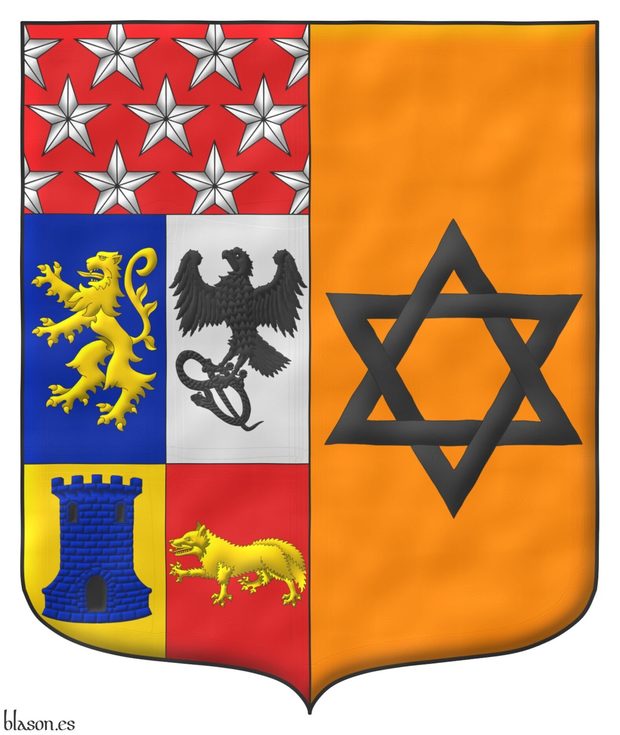
| Party per pale: 1 quarterly: 1 Azure, a lion rampant Or, 2 Argent, a falcon rising, grasping in its paws a serpent Sable, 3 Or, a tower Azure, port, windows, and masoned Sable, 4 Gules, a fox passant Or, a chief Gules semé of mullets Argent; 2 Orange, a mullet of six points voided, interlaced Sable. | Escudo partido: 1o cuartelado: 1o de azur, un león rampante de oro, 2o de plata, un halcón azorado, teniendo en sus garras una sierpe ambos de sable, 3o de oro, una torre de azur, aclarada y mazonada de sable, 4o de gules, una raposa pasante de oro, un jefe de gules sembrado de estrellas de cinco puntas de plata; 2o de anaranjado, una estrella de seis puntas, hueca y entrelazada de sable. |
|
Las anteriores son dos formas de visualizar los blasones estructurados en paralelo, la primera mediante una imagen y la segunda mediante una combinación de dos textos y una imagen.
Blazon keywords: Party per pale, Quarterly, Azure, One, Lion, Rampant, Or, Argent, Falcon, Rising, Grasping, Claw, Serpent, Sable, Tower, Port and windows, Masoned, Gules, Fox, Passant, Chief, Semé, Mullet, Orange, Six, Base (lower 1/3), Voided and Interlaced.
Style keywords: Ogee, Outlined in sable, Illuminated and Watercolor.
Classification: Personal, Interpreted, Coat of arms and Structured and parallel blazons.
Bearer: Correa, Lorena.
Moguer, municipality of

Chequey of fifteen Or and Azure; a bordure compony of sixteen sections, eight gules, a castle triple-towered Or, port and windows Azure, masoned Sable, eight Argent, a lion rampant Purpure, crowned Or, armed and langued Gules.
Escudo ajedrezado de quince piezas de oro y azur; una bordura componada de dieciséis compones, ocho de gules, un castillo de oro, aclarado de azur, mazonado de sable, ocho de plata, un león rampante de púrpura, coronado de oro, armado y lampasado de gules.
Coat of arms emblazoned by me, highlighted with lights and shadows, outlined in Sable, with a semi-circular outer contour and with a watercolor finish.
Coat of arm of the municipality of Moguer, Andalusia, emblazoned by me.
Blazon keywords: Or, Azure, Gules, Argent, One, Fifteen, Sixteen, Eight, Chequey, Bordure, Compony, Section, Charged, Castle, Triple-towered, Port and windows, Masoned, Lion, Rampant, Crowned, Armed and Langued.
Style keywords: Outlined in sable, Illuminated, Semi-circular and Watercolor.
Classification: Civic, Interpreted, Boa and Coat of arms.
Bearer: Moguer, municipality of.
Monroy, municipality of

Quarterly: 1 and 4 Gules, a castle triple-towered Or, port and windows Azure, and masoned Sable; 2 and 3 vair ancient.
Escudo cuartelado: 1o y 4o de gules, un castillo de oro, aclarado de azur, mazonado de sable; 2o y 3o de veros antiguos.
Arms depicted by me, illuminated with lights and shadows, contoured in Sable, with an ogee outer contour and with a freehand finish.
Coat of arms of the municipality of Monroy, Caceres, emblazoned by me with vair ancient. I have painted it using vair ancient, as I wish to illustrate with this coat of arms a reflection on the Virgin of the Sagrario of Plasencia, Caceres, dating from the mid-13th century, and on the forty-four coats of arms made of gilded silver sheet that adorn it, featuring lions, castles, and rounded vair ~ vair ancient, these may be associated with the lords of Monroy, a lineage of considerable importance in the town of Plasencia during the Late Middle Ages, can be seen in The Virgin of the Sagrario of Plasencia and the Monroy vair.
Blazon keywords: Gules, Or, Azure, Sable, One, Quarterly, Castle, Triple-towered, Port and windows, Masoned and Vair ancient.
Style keywords: Outlined in sable, Illuminated, Ogee and Freehand.
Classification: Civic, Interpreted, Boa and Coat of arms.
Bearer: Monroy, municipality of.
Noronha, House of
![Quarterly: 1 and 4 Argent, five escutcheons in cross Azure, each charged with five plates in saltire; a bordure Gules, charged with seven castles triple-towered Or, 3, 2, and 2 [for Portugal]; the whole debruised by a baston Sable; 2 and 3 party per chevron Argent and Gules, in chief two lions combatant Purpure, armed and langued Gules [for Leon], in base a castle triple-towered Or, port and windows Azure, masoned Sable [for Castile]; a bordure compony of eighteen sections Or and vair [for Álvarez de las Asturias].](../escudo_heraldico/_detalle.htm?img=NoronhaC.22.Escudo.Metal.Avr20.jpg&cla=Diestro "Noronha, House of")
Quarterly: 1 and 4 Argent, five escutcheons in cross Azure, each charged with five plates in saltire; a bordure Gules, charged with seven castles triple-towered Or, 3, 2, and 2 [for Portugal]; the whole debruised by a baston Sable; 2 and 3 party per chevron Argent and Gules, in chief two lions combatant Purpure, armed and langued Gules [for Leon], in base a castle triple-towered Or, port and windows Azure, masoned Sable [for Castile]; a bordure compony of eighteen sections Or and vair [for Álvarez de las Asturias].
Escudo cuartelado: 1o y 4o de plata, cinco escudetes en cruz de azur, cada uno cargado de cinco bezantes en sotuer de plata; una bordura de gules, cargada de siete castillos de oro, 3, 1 y 3; [de Portugal] brisado de un bastón de sable; 2o y 3o de plata, mantelado en punta de gules, en jefe, dos leones afrontados de púrpura, armados y lampasados de gules [de León], en punta un castillo de oro, aclarado de azur, mazonado de sable [de Castilla]; una bordura componada de dieciocho compones de oro y veros [de Álvarez de las Asturias].
Arms depicted by me, illuminated with lights and shadows, outlined in Sable, with an ogee external shape and with a metal beaten finish.
Coat of arms of the House of Noronha in Portugal, a lineage of dual royal origin. The House of Noronha originated with Alfonso Enríquez of Castile, Count of Noreña and Gijón, the natural son of King Henry II of Castile, founder of the Trastámara dynasty, and of Elvira Íñiguez. The lineage became linked to the Portuguese Royal House through the marriage of Alfonso Enríquez to Isabel of Portugal, the natural daughter of King Ferdinand I of Portugal, an alliance arranged in the context of the Treaty of Santarém of 1373, which brought an end to the Fernandine Wars, during which Ferdinand I of Portugal confronted the kings of the House of Trastámara over the throne of Castile following the murder of Peter I at the hands of his half-brother Henry. The House of Noronha became established in Portugal, and its arms quarter those of the Kingdom of Portugal, differenced by a brisure consisting of a baston Sable, and those of the House of Trastámara. This coat of arms has been emblazoned for Fernando Durán Cabral de Mello d’Alpoim by me as a preparatory work for his armorial bearings, his coat of arms has a inescutcheon with the arms of the House of Noronha.
Blazon keywords: Argent, Azure, Gules, Or, Sable, Purpure, One, Two, Five, Seven, Eighteen, Quarterly, Escutcheon, In cross, Charged, Plate, In saltire, Bordure, Castle, Triple-towered, Cadency, Baston, Party per chevron, In chief, Lion, Combatant, Armed, Langued, In base, Port and windows, Masoned, Compony and Vair.
Style keywords: Outlined in sable, Illuminated, Ogee and Metal beaten.
Classification: Civic, Interpreted, Boa and Coat of arms.
Bearer: Noronha, House of.
Ormazabal of the Basque Country, lineage

Or, a tower Gules, embattled, masoned and with a turret Sable.
Escudo de oro, una torre de gules, almenada, mazonada y donjonada de sable.
Coat of arms emblazoned by me, highlighted with lights and shadows, outlined in Sable, with a semi-circular outer contour and with a freehand finishing.
Ancient arms of the lineage Ormazabal of the Basque Country emblazoned by me.
Blazon keywords: Or, Gules, Sable, One, Tower, Embattled, Masoned and With a turret.
Style keywords: Outlined in sable, Illuminated, Semi-circular and Freehand.
Classification: Personal, Lineage, Interpreted, Boa and Coat of arms.
Bearer: Ormazabal of the Basque Country, lineage.
Pesquera de Ebro, outlined

Azure, on four bars wavy Argent a barbel bendwise Or and a three arch bridge Or, masoned Sable, throughout, supporting a elm couped Argent leaved Or, between, in dexter a tower Or, port and windows Azure, mazoned Sable, and in sinister three escutcheon Or, 2 and 1.
The coat of arms of Pesquera de Ebro, Burgos, Castile and Leon, designed and outlined by me.
Blazon keywords: Argent, Or, Azure, Sable, One, Three, On, Bar, Wavy, Barbel, Bendwise, Bridge, Masoned, Throughout, Upon, Elm, Tree, Couped (tree), Leaved, Tower, Port and windows, Escutcheon and Ordered.
Style keywords: Outlined and Semi-circular.
Classification: Civic, Created, Boa and Coat of arms.
Bearer: Pesquera de Ebro.
Philip of Castile, Infante

Quarterly: 1 and 4 Gules, a castle triple-towered Or, port and windows Azure, and masoned Sable; 2 and 3 Or, an eagle displayed Sable.
Escudo cuartelado: 1o y 4o de gules, un castillo de oro, aclarado de azur, mazonado de sable; 2o y 3o de oro, un águila de sable.
Arms painted by me, illuminated with lights and shadows, outlined in Sable, with an ogee external shape and with a freehand finish.
Coat of arms of the Infante Philip of Castile, 1231–1274, 7th offspring of the King Ferdinand III of Castile, 1199-1252, and the Queen Beatrice of Swabia, 1205–1235. This coat of arms has been emblazoned by me and can be consulted in [Messía de la Cerda y Pita, L.; 1990; page 146] with the field Or in the 2nd and 3rd quarters. He bears a quarterly shield combining the first quarter of his father’s arms, Castile, with his mother’s arms. Among all his siblings, he is the one who most closely combines the arms of both parents.
Blazon keywords: Gules, Or, Azure, Sable, One, Quarterly, Castle, Triple-towered, Port and windows, Masoned and Eagle.
Style keywords: Outlined in sable, Illuminated, Ogee and Freehand.
Classification: Personal, Kingdom of Castile and Leon, Interpreted, Boa and Coat of arms.
Bearer: Philip of Castile, Infante.
Pixiv

My heraldic Pixiv wall is Dr.A.Salmeron @antoniosheraldry and pixiv.me/antoniosheraldry.
Pixiv is a Japanese online community for artists. I post in Pixiv 2 or 3 coats of arms per week. They use a strict form to post with many mandatory input fields. This week, they have added a new mandatory field «AI-generated work: Yes / No», AI ~ Artificial Intelligence. In the image, I have highlighted this new field in red.

My animation of the coat of arms of Juan Lanzagorta reached position 33 in Pixiv’s daily Ugoira animation ranking. I am very happy about this, as it is not easy to achieve.

Categories: Technology, Social networks, Quarterly, Gules, One, Chevron, Argent, Between, Three, Fleur de lis, Or, Five, Mullet, In saltire, Four, Escutcheon, In cross, Azure, Charged, Nine, Bezant and plate, Two, Flank, Fesswise, Center, Overall, Carbuncle, Cord, In orle, Knotted, Purpure, Overall (all), Sable, Mount, Issuant from base, Vert, On, Tower, Port and windows, Masoned, Wolf, Supporting, Enté en point, Fess, Wavy, Crown of the Sovereign and Most Noble Order of the Pomegranate, Crown and Motto.
Roberto Luchoro and Darryn Carlo

Vert, on a fess Argent, between in chief a castle triple-towered Or, port and windows Gules, masoned Sable, between four mullets Argent, 2 and 2, and in base a Merino ram's head caboshed Or, between three mullets Argent, 2 and 1, two wolves passant Sable. Motto: «Amor Non Timet» Sable, with initial letters Gules, over a scroll Argent.
Escudo de sinople, una faja de plata, cargada de dos lobos pasantes de sable, acompañada en jefe de un castillo de oro, aclarado de gules, mazonado de sable, acompañado de cuatro estrellas de plata, 2 y 2, y en punta de un rencuentro de carnero merino de oro, acompañado de tres estrellas de plata, 2 y 1. Lema: «Amor Non Timet» de sable, con letras iniciales de gules, sobre una filacteria de plata.
Coat of arms devised by me, highlighted with lights and shadows, outlined in Sable, with a semi-circular outer contour and with a leather finishing.
Design rationale
The matrimonial and family arms of Darryn Carlo of the Commonwealth of Australia and longtime resident of the Kingdom of Spain, and Roberto Luchoro of the Kingdom of Spain, who were married in Madrid represents their lives together over nearly two decades cumulating in their union in marriage. The elements from their arms of the most significant places associated with their lives to date are as follows: The field of Vert from the arms of Darryn's hometown of Wagga Wagga in New South Wales, Australia, also represents Roberto's service in the Spanish armed forces and the Guardia Civil. The castle, taken from the arms of Alicante and Talavera de la Reina, represents Roberto’s birthplace and the city where both of them lived for a time. The Merino ram’s head also comes from Wagga Wagga. The Gules of the port and windows in the castle is a reference to the field of Gules in the arms of Talavera de la Reina. The two wolves are taken from the arms of the city of Bilbao in the Basque Country where the couple met and lived for many years and the seven stars are taken from the flag and arms of the region and city of Madrid where they currently live and work. The tinctures of Vert, Argent and Gules, shown in the port and windows of the castle, are also a hint to where they spent their honeymoon. The language of the motto, Latin, was chosen to represent the shared Latin heritage of the couple. The meaning of the motto «Amor Non Timet» is a powerful statement in itself and represents the strength of the commitment, the love and bond shared between them.
Blazon keywords: Vert, Argent, Or, Gules, Sable, One, Two, Seven, Fess, Between, In chief, Castle, Triple-towered, Port and windows, Masoned, Mullet, In base, Merino ram, Head, Caboshed, Wolf, Passant and Motto.
Style keywords: Outlined in sable, Illuminated, Semi-circular and Leather.
Classification: Personal, Created, Design rationale, Boa and Coat of arms.
Bearer: Luchoro and Darryn Carlo, Roberto.
Rui J. Vaz, structured and parallel blazons
Coat of arms of the family of Rui J. Vaz, US, designed by him and emblazoned by me, with the blazon written in English and Castilian in a structured way to observe the parallelism between both forms.
| Party per pale Azure and Gules, overall a lion rampant Argent, winged Or, grasping in his dexter forepaw a sword erect Or. Crest: Upon a helm lined Gules, its bevor charged with a Latin cross patty and pierced with a Latin cross, and with - a wreath Argent and Gules, a dexter winged forepaw Or, grasping an escutcheon quarterly: 1 Azure, a god Garuda sejant Argent; 2 Gules, a castle triple-towered Or, masoned Sable; 3 Argent, six pallets Gules; 4 Azure, five plates. Mantling: Gules doubled Argent. | Escudo partido de azur y gules, brochante sobre el todo un león rampante de plata, alado de oro, teniendo en su garra diestra una espada alzada de oro. Timbrado de un yelmo forrado de gules, su babera cargada de una cruz latina patada y perforada de una cruz latina, y adornado de dos lambrequines de gules doblados de plata, un burelete de plata y gules, cimado de una garra alada de oro teniendo un escudete cuartelado: 1 de azur, un dios Garuda sentado de plata; 2 de gules, un castillo de oro, mazonado de sable; 3 de plata, seis palos de gules; 4 de azur, cinco bezantes de plata. - |
 |
Blazon keywords: Azure, Gules, Argent, Or, One, Six, Five, Party per pale, Overall, Lion, Rampant, Winged, Grasping, Dexter, Forepaw, Sword, Erect, Crest and mantling, Crest, Upon (wreath), Helm, Lined, Bevor, Charged, Latin cross patty, Pierced, Latin cross, Wreath, Escutcheon, Quarterly, Garuda, Sejant, Castle, Triple-towered, Masoned, Pallet, Plate, Mantling and Doubled.
Style keywords: Outlined in sable, Plain tincture, Semi-circular and Leather.
Classification: Personal, Interpreted, Structured and parallel blazons, Boa and Coat of arms.
Bearer: Vaz, Rui J..
Sancho IV of Castile, open royal crown

Son of Alfonso X of Castile and Violant of Aragon.
Quarterly: 1 and 4 Gules, a castle triple towered Or, port and windows Azure, masoned Sable; 2 and 3 Argent, a lion rampant Purpure, armed and langued Gules, crowned Or. Crest: An open royal crown Or.
Escudo cuartelado: 1o y 4o de gules, un castillo de oro, aclarado de azur, mazonado de sable; 2o y 3o de plata, un león rampante de púrpura, armado y lampasado de gules, coronado de oro. Timbrado de una corona real abierta.
Arms of the king interpreted by me as follows: the shield of arms has a rounded (semicircular) base; the quarters are in flat tinctures Argent and Gules; the castles, lions and crown are illuminated; the castles and lions are shaded; and the whole has a parchment finish.
Blazon keywords: Quarterly, Gules, Or, Azure, Sable, One, Castle, Port and windows, Masoned, Argent, Purpure, Lion, Rampant, Armed, Langued, Crowned, Crest, Open royal crown and Crown.
Style keywords: Rounded, Illuminated and Parchment.
Classification: Interpreted, Personal, Coat of arms and Kingdom of Castile and Leon.
Bearer: Sancho IV of Castile.
Sancho of Castile, Infante

Party per pale: 1 Gules, a castle triple-towered Or, port and windows Azure, and masoned Sable; 2 Argent, a lion rampant Purpure, armed and langued Gules.
Escudo partido: 1o de gules, un castillo de oro, aclarado de azur, mazonado de sable; 2o de plata, un león rampante de púrpura, armado y lampasado de gules.
Arms emblazoned by me, highlighted with lights and shadows, contoured in Sable, with an ogee outer contour and with a freehand finish.
Coat of arms of the Infante Sancho of Castile, 1233–1261, 8th offspring of the King Ferdinand III of Castile, 1199-1252, and the Queen Beatrice of Swabia, 1205–1235. Unlike his siblings, he does not use a quarterly shield but rather impaled arms of Castile and Leon.
Blazon keywords: Gules, Or, Azure, Sable, Argent, Purpure, One, Party per pale, Castle, Triple-towered, Port and windows, Masoned, Lion, Rampant, Armed and Langued.
Style keywords: Outlined in sable, Illuminated, Ogee and Freehand.
Classification: Personal, Kingdom of Castile and Leon, Interpreted, Boa and Coat of arms.
Bearer: Sancho of Castile, Infante.
Spain, Kingdom of
![Quarterly: 1 Gules, a castle triple-towered Or, port and windows Azure, masoned Sable [for Castile]; 2 Argent, a lion rampant Purpure, armed and langued Gules, crowned Or [for Leon]; 3 Or, four pallets Gules [for Aragon]; 4 Gules, a chain orlewise, crosswise, and saltirewise Or, charged in the fess point with an emerald Vert [for Navarre]; enté en point Argent, a pomegranate proper, seeded Gules, slipped and leaved Vert [for Granada]; an inescutcheon Azure, three fleurs de lis Or, 2 and 1, a bordure Gules [for Bourbon].](../escudo_heraldico/_detalle.htm?img=EspanaR.21.Escudo.TrazoAlzado.jpg&cla=Diestro "Spain, Kingdom of")
Quarterly: 1 Gules, a castle triple-towered Or, port and windows Azure, masoned Sable [for Castile]; 2 Argent, a lion rampant Purpure, armed and langued Gules, crowned Or [for Leon]; 3 Or, four pallets Gules [for Aragon]; 4 Gules, a chain orlewise, crosswise, and saltirewise Or, charged in the fess point with an emerald Vert [for Navarre]; enté en point Argent, a pomegranate proper, seeded Gules, slipped and leaved Vert [for Granada]; an inescutcheon Azure, three fleurs de lis Or, 2 and 1, a bordure Gules [for Bourbon].
Escudo cuartelado: 1o de gules, un castillo de oro, aclarado de azur, mazonado de sable [de Castilla]; 2o de plata, un león rampante de púrpura, lampasado y armado de gules, coronado de oro [de León]; 3o de oro, con cuatro palos de gules [de Aragón]; 4o de gules, una cadena puesta en orla, en cruz y en sotuer de oro, cargada en el centro de una esmeralda de sinople [de Navarra]; entado en punta de plata, una granada al natural, tajada de gules, tallada y hojada de sinople [de Granada]; un escusón de azur, tres flores de lis de oro, 2 y 1, una bordura de gules [de Borbón].
Arms depicted by me, illuminated with lights and shadows, contoured in Sable, with a semi-circular outer contour and with a freehand finishing.
Arms of the Kingdom of Spain emblazoned by me. Although in the official blazon text it is blazoned as a point vert, and as a point what is painted in a way that it is not known whether it is a large point or an uncutt circular emerald, in the blazon I have described it as an emerald both in Spanish and in English, since the point does not have a clear heraldic existence in Spanish and even less so in English.
Blazon keywords: Gules, Azure, Purpure, Vert, Or, Argent, One, Three, Four, Quarterly, Castle, Triple-towered, Port and windows, Masoned, Lion, Rampant, Crowned, Pallet, Chain, Orlewise, Crosswise, Saltirewise, Charged, In the fess point, Emerald, Enté en point, Pomegranate, Proper, Slipped, Leaved, Inescutcheon, Fleur de lis, Ordered and Bordure.
Style keywords: Outlined in sable, Illuminated, Semi-circular and Freehand.
Classification: Civic, Kingdom of Spain, Interpreted, Boa and Coat of arms.
Bearer: Spain, Kingdom of.
Toison and crown of Felipe VI of Spain
![Quarterly: 1 Gules, a castle triple-towered Or, port and windows Azure, masoned Sable [for Castile]; 2 Argent, a lion rampant Purpure, armed and langued Gules, crowned Or [for Leon]; 3 Or, four pallets Gules [for Aragon]; 4 Gules, a chain orlewise, crosswise, and saltirewise Or, charged in the fess point with an emerald Vert [for Navarre]; enté en point Argent, a pomegranate proper, seeded Gules, slipped and leaved Vert [for Granada]; an inescutcheon Azure, three fleurs de lis Or, 2 and 1, a bordure Gules [for Bourbon]. Crest: A closed royal crown. The shield is surrounded by the Golden Fleece.](../escudo_heraldico/_detalle.htm?img=FelipeVI.28.Corona.Toison.Metal.Avr.20.jpg&cla=Siniestro "Toison and crown of Felipe VI of Spain")
Quarterly: 1 Gules, a castle triple-towered Or, port and windows Azure, masoned Sable [for Castile]; 2 Argent, a lion rampant Purpure, armed and langued Gules, crowned Or [for Leon]; 3 Or, four pallets Gules [for Aragon]; 4 Gules, a chain orlewise, crosswise, and saltirewise Or, charged in the fess point with an emerald Vert [for Navarre]; enté en point Argent, a pomegranate proper, seeded Gules, slipped and leaved Vert [for Granada]; an inescutcheon Azure, three fleurs de lis Or, 2 and 1, a bordure Gules [for Bourbon]. Crest: A closed royal crown. The shield is surrounded by the Golden Fleece.
Arms emblazoned by me, illuminated with lights and shadows, outlined in Sable, with a semi-circular outer contour and with a metal beaten finishing.
This is my interpretation of the coat of arms of His Majesty King Felipe VI of Spain, bearing the Collar of the Distinguished Order of the Golden Fleece.
Blazon keywords: Gules, Azure, Purpure, Vert, Or, Argent, One, Three, Four, Quarterly, Castle, Triple-towered, Port and windows, Masoned, Lion, Rampant, Crowned, Pallet, Chain, Orlewise, Crosswise, Saltirewise, Charged, In the fess point, Emerald, Enté en point, Pomegranate, Proper, Slipped, Leaved, Inescutcheon, Fleur de lis, Ordered, Bordure, Closed royal crown, Crown, Surrounded and Collar.
Style keywords: Outlined in sable, Illuminated, Semi-circular and Metal beaten.
Classification: Personal, Kingdom of Spain, Interpreted, Boa and Coat of arms.
Bearer: Felipe VI of Spain.
Trastámara, House of
![Party per chevron Argent and Gules, in chief two lions combatant Purpure, armed and langued Gules [for Leon], in base a castle triple-towered Or, port and windows Azure, masoned Sable [for Castile]; a bordure compony of eighteen sections Or and vair [for Álvarez de las Asturias].](../escudo_heraldico/_detalle.htm?img=TrastamaraC.22.Conopial.Metal.Avr20.jpg&cla=Diestro "Trastámara, House of")
Party per chevron Argent and Gules, in chief two lions combatant Purpure, armed and langued Gules [for Leon], in base a castle triple-towered Or, port and windows Azure, masoned Sable [for Castile]; a bordure compony of eighteen sections Or and vair [for Álvarez de las Asturias].
Escudo de plata, mantelado en punta de gules, en jefe, dos leones afrontados de púrpura, armados y lampasados de gules [de León], en punta un castillo de oro, aclarado de azur, mazonado de sable [de Castilla]; una bordura componada de dieciocho compones de oro y veros [de Álvarez de las Asturias].
Coat of arms emblazoned by me, illuminated with lights and shadows, outlined in Sable, with an ogee outer contour and with a metal beaten finish.
Coat of arms of the House of Trastámara, founded by Enrique of Trastámara, later King Henry II of Castile, son of Alfonso XI and his mistress Leonor de Guzmán. Adopted at birth by Rodrigo Álvarez de las Asturias, he inherited the lordship of the County of Noreña the following year upon his adoptive father’s death. Later, his father the king granted him the County of Trastámara, among other lordships, giving rise to the House and the Trastámara dynasty, which began when Henry II ascended the throne after killing his half-brother Peter I in 1369. The Trastámara dynasty ruled in Castile, Aragon, Navarre, and Naples, and came to an end with our Queen Joanna of Castile, daughter of Isabella I of Castile and Ferdinand II of Aragon, both members of the House of Trastámara. This coat of arms has been created for Fernando Durán Cabral de Mello d’Alpoim as a preparatory work for his armorial bearings. In that coat of arms, the House of Noronha inescutcheon bears the arms of Trastámara in the 2nd and 3rd quarters.
Blazon keywords: Argent, Gules, Purpure, Or, Azure, Sable, One, Two, Eighteen, Party per chevron, In chief, Lion, Combatant, Armed, Langued, In base, Castle, Triple-towered, Port and windows, Masoned, Bordure and Compony.
Style keywords: Outlined in sable, Illuminated, Ogee and Metal beaten.
Classification: Personal, Interpreted, Boa and Coat of arms.
Bearer: Trastámara, House of.
My heraldic channel @ntoniosalmeron at Twitter is twitter.com/ntoniosalmeron.

Categories: Technology, Social networks, Castle, Or, Port and windows, Azure, Masoned and Sable.
Valero de Bernabé, L.; 2009a

Luis Valero de Bernabé y Martín de Eugenio, «Los Castillos en la Heráldica Española», 2009.
I received this article directly from the author, to whom I am grateful for his kind submission. I consider it a preliminary and preparatory work for the article [Valero de Bernabé, L.; 2009b; pages 32-34] published later.
Bibliographical reference of century XXI.
Classification: Castilian language.
Author: Valero de Bernabé y Martín de Eugenio, Luis.
The following articles cite this bibliographic reference:
Internal resources: ValeroBernabeL2009.ElCastilloEnLaHeraldicaEspañola.pdf.
-
Language
-
Categories of heraldry
-
Divisions of the field
- Without divisions
- Party per pale
- Party per fess
- Party per bend
- Party per bend sinister
- Tierce
- Tierce sinister
- Tierced per pale
- Tierced per fess
- Tierced per bend
- Tierced pallwise inverted
- Quarterly
- Quarterly per saltire
- Gyronny
- Party per fess, the chief per pale
- Party per pale, the sinister per fess
- Party per fess, the base per pale
- Party per pale, the dexter per fess
- Chapé
- Chaussé
- Embrassé
- Contre-embrassé
- Chapé ployé
- Party per chevron
- Enté
- Enté en point
- Flanched
-
Metals
-
Colours
-
Furs
-
Other tinctures
-
Ordinaries and sub-ordinaries
-
Diminutives of the ordinaries
-
Geometric charges
-
Composite ordinaries
-
Inanimate charges from Nature
Atom, Cloud, Crescent, Decrescent, Diamond, Emerald, Estoile, Goutte, Increscent, Lightning flash, Moon, Mount, Mullet, Mullet of four points, Orbital, Plough of Ursa Major, Rainbow, Ray of the sun, River, Sea, Snowflake, Sun, Sun in splendour, Sun of May, Terrestrial globe, Trimount, Water and Wave.
-
Vegetal charges from Nature
Acorn, Apple, Apple tree, Ash, Bluebonnet, Bunch, Camellia, Chrysanthemum, Cinquefoil, Cornflower, Dogwood flower, Double rose, Easter lily, Eguzki-lore, Elm, Fleur de lis, Flower, Gourd, Grape, Holm oak, Hop cone, Indian paintbrush, Kapok tree, Laurel, Lily, Linden, Lotus flower, Madonna lily, Madrone tree, Mexican cedar tree, Mulberry tree, Oak, Olive tree, Palm tree, Plantain plant, Pomegranate, Poplar leaf, Rose, Scots pine, Shamrock, Sunflower, Thistle, Tree, Tulip, Vine and Wheat.
-
Animal charges from Nature
Badger, Bald eagle, Barbel, Barn owl, Bear, Beaver, Bee, Beetle, Bighorn sheep, Binson, Black grouse, Blackbird, Boar, Brach hound, Bull, Cat, Cow, Doe, Dog, Dolphin, Dove, Eagle, Elephant, Falcon, Female figure, Fish, Flame, Fly, Fox, Frog, Gazelle, Goat, Goldfinch, Goose, Heron, Horse, Hummingbird, Jaguar, Lark, Leopard, Lion, Lion passant, Lion rampant guardant, Lioness, Lynx, Male figure, Martlet, Merino ram, Monkey, Mountain bluebird, Owl, Panther, Parrot, Peacock, Pelican, Pelican in her piety, Pronghorn, Puffin, Quetzal, Raven, Roe deer, Rooster, Salamander, Savage, Seagull, Serpent, She-wolf, Stag, Starling, Swan, Talbot, Turtle, Tyger, Vulture, Warren hound and Wolf.
-
Parts of natural charges
Arm, Beak, Branch, Caboshed, Chest, Claw, Covert, Dorsal fin, Eagle claw, Ear of wheat, Ermine spot, Escallop, Feather, Foot (palmiped), Footprint, Foreleg, Forepaw, Hand, Head, Heart, Hoof, Leaf, Neck, Ostrich feather, Palm frond, Paw, Roe deer' attire, Shoulder, Sprig, Stag's attire, Stag's massacre, Stem, Swallow-tail, Tail, Tail addorsed, Tail fin, Talon, Tibia, Tooth, Trunk, Trunk (elephant), Two hands clasped, Two wings in vol, Udder, Wing and Wrist.
-
Artificial charges
Ace of spades, Adze, Anchor, Anvil, Arch, Archer, Arm vambraced, Armillary sphere, Arrow, Axe, Baton of Herald, Bell, Bell tower, Beret, Bonfire, Book, Bookmark, Bow, Branding iron, Bridge, Broken, Buckle, Cannon, Cannon dismounted, Cannon port, Canopy roof, Caravel, Carbuncle, Castle, Cauldron, Celtic Trinity knot, Celtic trefoil knot, Censer, Chain, Chess rooks, Chi-Rho symbol, Church, Clarion, Clay pot, Closed book, Club, Column, Comb, Comedy mask, Compass rose, Conductor's baton, Cord, Covered cup, Crossbow, Crossed staff, Crozier, Crucible, Cuffed, Cup, Cutlass, Cyclamor, Dagger, Displayed scroll, Double vajra, Drum, Ecclesiastical cap, Fanon, Federschwert, Flagpole, Fleam, Four crescents joined millsailwise, Full plate armor, Galician granary, Garb, Gauntlet, Geometric solid, Grenade, Halberd, Hammer, Harp, Host, Hourglass, Incense burner, Key, Key ward, Knight, Knot, Lantern, Letter, Line, Loincloth, Maunch, Menorah, Metal mortar, Millrind, Millstone, Millwheel, Minaret, Monstrance, Mortar, Mullet of six points pierced, Nail, Non-classic artifact, Norman ship, Number, Oar, Oil lamp, Open book, Page, Paintbrush, Pair of pliers, Pair of scales, Pestle, Piano, Pilgrim's staff, Plough share, Polish winged hussar, Port, Portcullis, Potent, Quill, Ribbon, Rolled scroll, Rosette of acanthus leaves, Sabre, Sackbut, Sail, Scepter, Scroll, Scythe, Sheaf of tobacco, Ship, Skirt, Spear, Spear's head, Stairway, Star of David, Step, Sword, Symbol, Tetrahedron, Torch, Tower, Tragedy mask, Trident, Trumpet, Turret, Two-handed sword, Two-man cross-cut saw, Wagon-wheel, Wall between two towers, Wall couped, Water-bouget, Wheel, Winnowing fan and With a turret.
-
Immaterial charges
Angel, Archangel, Basilisk, Dragon, Dragon's head, Garuda, Golden fleece, Griffin, Heart enflamed, Justice, Mermaid, Our Lady of Mercy, Ouroboros, Paschal lamb, Pegasus, Phoenix, Sacred Heart of Jesus, Saint George, Sea-griffin, Sea-lion, Trinity, Triton, Unicorn, Winged hand and Wyvern.
-
External elements
-
Heraldic creations
-
References
-
Formats
-
Keywords on this page
Port and windows, Between, Watercolor, Proper, Armed, Azure, Boa, Bordure, Charged, Castle, Crest, Five, Compony, Ogee, Crown, Crowned, Created, Quarterly, Four, Triple-towered, Outlined in sable, Two, In chief, In base, Enté en point, Coat of arms, Fleur de lis, Personal, Gules, Leaved, Illuminated, Interpreted, Langued, Lion, Masoned, Semi-circular, Or, Party per pale, Argent, Civic, Purpure, Rampant, Kingdom of Castile and Leon, Sable, Vert, Tower, Freehand, Three and One.