Letter

Castilian heraldry
Key Characteristics in Castilian Heraldry
Some of the main characteristics of the heraldry of Castile are:
- the rounded shapes, with a semicircle at the base,
- the importance of bordures,
- the inclusion of words and also letters in the coat of arms,
- the 2nd most common animal, after the lion, is the wolf [Valero de Bernabé, L.; 2010], and, of course,
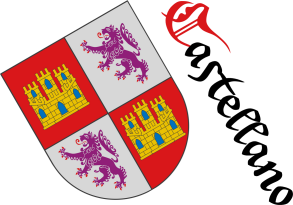
- our castle triple-towered Or, port and windows Azure, masoned Sable [Valero de Bernabé, L.; 2009a].
The following image shows 4 examples of coats of arms, each of which has some of these characteristics, including one Castilian castle.

Comparing Castilian and English Heraldry
In the United Kingdom, there are several heraldic traditions, one of them being English heraldry.
In the Kingdom of Spain, there are several heraldic traditions, for example, the Castilian tradition.
In my humble opinion, we should compare at the same level, English heraldry with, for example, Castilian heraldry, but not with all Spanish heraldry. We shouldn't do it for the same reason we don't mix Scottish heraldic tradition with English, as they are so different.
In the case of Castilian heraldry, the 8 main differences with English heraldry are:
- The rounded shapes, with a semicircle at the base.
- The importance of bordures and the existence of the diminished bordure, called in Castilian «filiera».
- The inclusion of words and also letters in the coats of arms.
- The wolf is the 2nd most common animal, after the lion.
- The castle, triple-towered, which is different from the English and French types of castles.
- We can inherit arms from our mother and/or father; for example, the castle in the 1st quarter of the coat of arms of Castile and the coat of arms of Spain comes from a mother, Queen Berenguela of Castile, mother of King Fernando III, the Saint.
- There are 3 kinds of supporters with their owns heraldic names: «tenantes», human forms; «soportes», animals; and «sostenes», plants and things.
- Our quarterings do not necessarily mean that the arms are marshalled by inheritance. [Williams, N.; 2017; page 135, paragraph 26.02] describing the arms of Éamon de Valera, 1882-1975, President of Ireland, writes «Those arms are Spanish in appearance. The quartering without functions as a means of marshalling, is distinctively Iberian».
Categories: Criterion, Semi-circular, Bordure, Letter, Lion, Wolf, Castle, Triple-towered, Port and windows, Masoned, Or, Azure, Sable, Diminished bordure, Quarterly, Supporter (human form), Supporter, Supporter (animal) and Supporter (thing).

Chaparro D'Acosta L.; 1979
Lino Chaparro D'Acosta, «Heráldica de los Apellidos Canarios», foreword by Vicente de Cadenas y Vicent, 2 volumes, Volume I from A to L, 285 surnames, 293 pages, Volume II from M to Z and a heraldic dictionary, 387 surnames, 439 pages, edited by Estudios Tecnicos del Blason, ISBN of the complete work 84-300-2000-4, ISBN of Volume I 84-300-1989-8, ISBN of Volume I II 84-300-418010-8, Las Palmas de Gran Canaria, 1979.

Bibliographical reference of century XX.
Classification: Black and white with color plates and Castilian language.
The author is Chaparro D'Acosta, Lino.
The following article cites this bibliographic reference:
Crepsi, plain tincture

Party per pale: 1 Gules, in base a castle triple-towered Or, port and windows Azure, and masoned Sable; 2 Argent, in base a lion rampant Gules, crowned Or; overall a psi letter sable; a diminished bordure Or.
Arms emblazoned by me, in plain tinctures, contoured in Sable, with a semi-circular outer contour and with a texturized finishing.
Coat of arms of Crepsi, «Centro Regional de Psicología». These arms were designed by my lieutenant colonel and friend Miguel Angel Nuñez Amador, and in this image, they have been emblazoned by me.
Blazon keywords: Gules, Argent, Or, Azure, Sable, Party per pale, In base, Castle, Triple-towered, Port and windows, Masoned, Lion, Rampant, Crowned, Overall, Letter and Diminished bordure.
Style keywords: Outlined in sable, Plain tincture and Semi-circular.
Classification: Military, Interpreted, Boa and Coat of arms.
Bearer: Crepsi.
Emblem of Kimberly Louise Severson

It has been painted by me, highlighted with lights and shadows, contoured in Sable, with a square outer contour and with a rough finishing.
The first badge of Kimberly Louise Severson designed by her and emblazoned by me. I have painted 3 heraldic badges for Kimberly Louise Severson: the first featuring 2 Easter lilies and Aslan's paw print, the second featuring a cross bottony, and the third, rather than a heraldic badge, depicting her earliest personal emblem with a harp and other elements. This is her earliest personal emblem.
Blazon keywords: Gules, Azure, Or, Argent, One, Letter, Incense burner, Censer, Enflamed, Harp and Bordure.
Style keywords: Outlined in sable, Illuminated, Square and Rough.
Classification: Personal, Interpreted, Boa and Emblem.
Bearer: Severson, Kimberly Louise.
Fernando Marán Bié, The Armorial Register

Registered by The International Register of Arms, 1st of December of 2022, Registration number 0690, Volume 4.
In Spanish heraldry, there are three terms for supporters: «sostenes» for objects or plants, «tenantes» for human figures, and «soportes» for animal forms. The following applies to sostenes, tenantes, and soportes. Unlike other heraldic traditions such as English heraldry, in Spanish heraldry there are no rules for the use of supporters; their use is at the armiger's discretion, without specific restrictions. Supporters are not reserved only for nobility; their use is free for all.
In the words of [Cadenas y Vicent, V. de; 1975; page 173] «there is no rule that determines the use of tenantes, soportes, and sostenes».
Categories: Armorial roll, Party per fess, Azure, One, Book, Open, Or, Leaved, Argent, Charged, Mullet, Gules, Tree, Erased, Between, Two, Apple, Diminished bordure, Embattled, Crest and mantling, Helm, Fimbriated, Wreath, Mantling, Dexter, Sinister, Crest, Pegasus, Rampant, Nascent, Flame, Supporter (animal), Supporter, Lion, Langued, Quill, Claw, Rolled scroll, Seal, Letter, War cry and Motto.
External link:
Root: The Armorial Register.
Guallini, Mario Antonio

Argent, the letters «GVA» conjoined Sable, a trimount in base Vert; on a chief Azure, three mullets of eight points Or, 1 and 2.
Escudo de plata, un monte de tres peñas de sinople, moviente de la punta, surmontado de las letras «GVA» unidas de Sable; en un jefe de azur, tres estrellas de ocho puntas de oro, 1 y 2.
Coat of arms painted by me, illuminated with lights and shadows, contoured in Sable, with an ogee external shape and with a freehand finish.
R0067, Chief Herald of Malta's register of the coat of arms of Mario Antonio Guallini. This coat of arms has been emblazoned by me.
Blazon keywords: Argent, Vert, Sable, Azure, Or, One, Three, Eight, Letter, Conjoined, Trimount, In base, Chief, Mullet and Disordered.
Style keywords: Outlined in sable, Illuminated, Ogee and Freehand.
Classification: Personal, Interpreted, Boa and Coat of arms.
Bearer: Guallini, Mario Antonio.
Hradec Králové Region

Quarterly: 1 and 4 Gules, a lion rampant, double queued Argent, armed, langued, and crowned Or; 2 Azure, a letter «G» Or; 3 Azure, a coronet trefoiled Or
Escudo cuartelado: 1o y 4o de gules, un león rampante, de cola horquillada de plata, armado, lampasado y coronado de oro; 2o de azur, una letra «G» de oro; 3o de azur, una corona trebolada de oro
This coat of arms is illuminated with lights and shadows and has a finish like glass.
The Hradec Králové Region is an administrative unit of the Czech Republic. It is located in the historical region of Bohemia. Its capital is Hradec Králové, whose Latin name is «Gradicium», hence its old name «Gradec». The letter «G» seen in both the coat of arms of the Hradec Králové Region and the coat of arms of its capital originates from this historical name. The lion rampant Anrgent, double queued and crowned in the 1st and 4th quarters is the symbol of Bohemia, and it also appears in the 1st and 4th quarters of the coat of arms of the Czech Republic. «Králové» means «of the queen» in Czech and there is a trefoiled crown in the 3rd quarter
Blazon keywords: Quarterly, Gules, One, Lion, Rampant, Tail, Double queued, Argent, Armed, Langued, Crowned, Or, Azure, Letter, Coronet trefoiled, Ancient coronet, Crown and Trefoiled.
Style keywords: Glass, Outlined in sable, Illuminated and Semi-circular.
Classification: Civic and Interpreted.
Bearer: Hradec Králové Region.
Jesus Christ

Azure, a pall couped Argent, its three arms charged with «es» Azure, within a triangle reversed Argent, its three arms charged with «no es» Azure, all debruised by four plates, three on the vertex of the triangle, in dexter chief, charged with «el Padre», in sinister chief, charged with «el Hijo», in base, charged with «el Espítiru», and one on the fess point, charged with «Dios» Azure; in chief a label of three points Argent.
Escudo de azur, una perla recortada de plata, sus tres brazos cargados con «es» de azur, dentro de un triángulo ranversado de plata, sus tres brazos cargados con «no es» de azur, todo resaltado de cuatro bezantes de plata, tres sobre los vértices del triángulo, en la diestra del jefe, cargado de «el Padre», en la siniestra del jefe, cargado con «el Hijo», en la punta, cargado con «el Espítiru» y uno sobre el corazón, cargado con «Dios» todo de azur; en jefe un lambel de tres pendientes de plata.
Imaginary coat of arms that I have interpreted with: a semicircular (round) base; its field illuminated in Azure; the rest illuminated in Argent and outlined in Sable; its letters in plain Azure ink; and the set with a rough finish.
Drawing a parallel between the coat of arms of Navarre that [[Menéndez Pidal de Navascués, F.; 1974]] transcribes for its original coat of arms as «Gules, a closed and pommetty carbuncle Or with an emerald...» I have characterized the pearl on the coat of arms as closed.
This is the imaginary coat of arms of the Holy Trinity with a label added for difference to the Son, to Jesus Christ.
Blazon keywords: Without divisions, Azure, One, Pall, Couped, Argent, Three, Charged, Letter, Within, Triangle, Reversed, Four, Plate, In the dexter chief, In the sinister chief, In base, In the fess point, Cadency and Label of three points.
Style keywords: Semi-circular, Illuminated, Outlined in sable and Rough.
Classification: Religious, Interpreted, Imaginary and Coat of arms.
Imaginary bearer: Jesus Christ.
José María Lanzagorta Aras, outlined

Argent, a Mexican cedar tree eradicated proper, fructed Or, its trunk charged with the letters «JML» Or, branded with a branding iron.
The coat of arms of Jose Maria Lanzagorta Aras designed by grand nephew Juan Lanzagorta Vallín and outlined by me. He was a cattle rancher and built the «hacienda» known as «Cedro Viejo» in Veracruz. The Mexican cedar tree (Cedrela salvadorensis) is different from the cedar of the Pinaceae family.
Blazon keywords: Argent, Or, One, Mexican cedar tree, Tree, Eradicated, Proper, Fructed, Trunk, Charged, Branding iron and Letter.
Style keywords: Outlined, Outlined in sable and Semi-circular.
Classification: Personal, Interpreted, Boa and Coat of arms.
Bearer: Lanzagorta Aras, José María.
Larre, lineage of Bayonne, French Basque Country

D'or à un arbre arraché de sinople, accosté à dextre de la lettre capitale «D» et à senestre de la lettre capitale «L» du même, et une étoile d'azur posée au canton dextre de la pointe.
Or, a tree eradicated Vert between a capital letter «D» and a capital letter «L» Sable, in the dexter of the base a mullet Azure.
Illuminated with lights and shadows and with a leather finish.
Blazon keywords: Without divisions, Or, One, Tree, Erased, Vert, Between, Letter, Sable, Canton, Dexter, Base (lower 1/3), Mullet, Five and Azure.
Style keywords: Leather, Outlined in sable, Illuminated and Semi-circular.
Classification: Interpreted, Lineage and Kingdom of France.
Lazcano, lineage of the Canary Islands

Blazon of the lineage Lazcano in the Canary Islands.
Vert, nine Poplar leaves ordered, in chief a «T» letter Or.
Illuminated and leather finishing.
It can be consulted at [Chaparro D'Acosta L.; 1979; página 251].
Blazon keywords: Without divisions, Vert, Letter, Poplar leaf, Or and Nine.
Style keywords: Leather, Outlined in sable and Illuminated.
Classification: Interpreted.
o-XI, tartan with the twill bend sinisterwise

Quarterly: 1 Sable, an «o» Or; 2 and 3 Or, two Wolves passant, in pale Sable; 4 Sable, an «XI» Or.
The image was produced using an alternative method for painting tartans. One of the key considerations has been the orientation of the twill: I have seen it represented both as bend sinisterwise and bendwise. In symmetric tartans, this difference may simply depend on how the cloth is positioned or, in photographs, on the direction from which the picture is taken. Photographing a piece of fabric from the south rather than from the east is enough to switch the diagonal from bend sinisterwise to bendwise, or vice versa. In symmetric tartans nothing essential changes except the visual direction of the twill.
However, in asymmetric tartans, such as the one shown here, these rotations do affect the order in which the design must be read and painted. I have also found books that consistently use one orientation, others that use the opposite one, and some that mix orientations depending on the specific tartan. I have seen a photograph of «The King Charles III tartan», (as can be seen in King Charles III Tartan, collage), worn by His Majesty himself, clearly shows the twill running in a bend sinisterwise direction, which gave me definitive confirmation that this orientation is perfectly valid for illustrating a tartan. Nevertheless, I do not rule out rendering it in the bendwise direction as well, since that is the style most commonly used in Tartan Register publications.
Additionally, the thread counts listed in the Tartan Register are typically double what the eye perceives in a woven cloth. This is because real weaving uses a double-pass system to achieve the density and colour blending characteristic of Scottish twill; consequently, the Register records the full structural count, while an accurate illustrated representation may require halving those numbers to match the visual appearance.
Blazon keywords: Quarterly, Sable, Or, One, Letter, Two, Wolf, Passant, In pale and Number.
Style keywords: Pointed, Illuminated, Outlined in the field tincture, Freehand and Chinapieria.
Classification: Tartan, Created and Personal.
Bearer: Salmerón Cabañas, Antonio.
Sebastián González Montenegro en Doce Linajes

First publication of my interpretation of the arms of Sebastián González Montenegro, on the blog Twelve Lineages of Soria in an article entitled Coats of arms of Mr. Sebastián González Montenegro, works by Mr. Antonio Salmerón Cabañas.

Second publication of my interpretation of the arms of Sebastián González Montenegro, on the blog Twelve Lineages of Soria including his insignias of the Order of Saint Michael of the Wing and of the National Monarchist Brotherhood of Spain.
The first publication is from March 29 and the second publication is later, from May 14.
In the first quarter of the inescutcheon of this coat of arms there is «a bend Or engouled by two dragon heads of the same, issuing from the corners» following the blazon structure of [Avilés, J.; 1780a; page 84], although it can also be blazoned more briefly as «a bend Or engouled by dragons».
The attribute engouled is used for «bends, crosses, saltires, and all other ordinaries, whose ends are in the mouths of lions, leopards, or dragons» according to [Avilés, J.; 1780a; page 83]. It is a word of French origin meaning to swallow or to engulf, that is, the beasts are devouring the ordinary.
Categories: Link, Or, One, Bend, Gules, Letter, Sable, Crown, Inescutcheon, Party per pale, Engouled, Head and Dragon.
Root: Twelve Lineages of Soria.
Supporters, pegasus, helm and mottos of Fernando Marán Bié

Party per fess: 1 Azure, an open book Argent, garnished Or, charged with a mullet Azure; 2 Gules, a tree eradicated between two apples Or; within a bordure embattled Or. Crest: Upon a helm with a wreath Or, Azure and Gules, a demi-pegasus Argent issuant from flames of fire Gules, fimbriated Or. Mantling: dexter Azure doubled Or, sinister Gules doubled Or. Supporters: Two lions rampant guardant Or, langued Gules, the one at dexter grasping in his sinister forepaw a quill Argent, the one at sinister grasping in his dexter forepaw a rolled scroll Argent, bearing a wax seal Gules, inscribed with the letters «MB» Sable. Warcry above the crest «Epimeleia Heautou». Motto: «Officium otium cum dignitate».
Arms interpreted by me, highlighted with lights and shadows, outlined in Sable, with a semi-circular outer contour and with a leather finishing.
The coat of arms of Fernando Marán Bié, designed by Ignacio Koblischek and registered in the International Register of Gentilitial Arms (RIAG), certified by the Chronicler of Arms of Castile and León, the Marquess of La Floresta, and by the Bureau of Heraldry of South Africa, with a Grant of Arms from the Chief Herald of Arms of Malta, certified by the American College of Heraldry, and painted by me after analysing all the aforementioned documentation.
Blazon keywords: Azure, Gules, Argent, Or, Six, One, Two, Party per fess, Open, Book, Garnished, Charged, Mullet, Tree, Eradicated, Between, Apple, Bordure, Embattled, Crest, Upon (wreath), Helm, Wreath, Demi, Pegasus, Issuant, Flame, Fimbriated, Mantling, Dexter, Sinister, Doubled, Supporter, Lion rampant guardant, Langued, Grasping, Forepaw, Quill, Rolled scroll, Inscribed, Letter, War cry, Above and Motto.
Style keywords: Outlined in sable, Illuminated, Semi-circular and Leather.
Classification: Personal, Interpreted, Boa, Coat of arms and Seal.
Bearer: Fernando Marán Bié.
The Heraldry Society, my arms

Quarterly: 1 Sable, an «o» Or; 2 and 3 Or, two Wolves passant, in pale Sable; 4 Sable, an «XI» Or. Crest: Upon a helm, with a wreath Or and Sable, a cross of Burgundy Gules, charged with three open books Argent, 1 and 2, leathered Sable, inner Gules, garnished Or, charged with twelve numbers «100 100 111 110 011 000 011 001 001 001 011 11» Azure, two in each page. Mantling: Sable doubled Or. Motto: «In principio erat Verbum» Argent over a scroll Azure, fimbriated Or.
Escudo cuartelado: 1o de sable, una «o» de oro; 2o y 3o de oro, dos lobos pasantes, en palo de sable; 4o de sable, un «XI» romano de oro. Timbrado de un yelmo, adornado de dos lambrequines de sable doblados oro, un burelete de oro y sable, cimado de una cruz de Borgoña de gules, cargada de tres libros abiertos de plata, 1 y 2, de tapas de sable, guardas de gules, filos de oro, cargados de doce números «100 100 111 110 011 000 011 001 001 001 011 11» de azur, dos en cada hoja. Lema: «In principio erat Verbum» de plata sobre una filacteria de azur, perfilada de oro.
Image of one of the web pages of the members belonging to The Heraldry Society where their coats of arms are shown, in this case mine with its blazon written in English, which can be consulted at TheHeraldrySociety.com/membersarms/antoniosalmeron.htm
New website design


Categories: Technology, Socioeconomic, Created, Personal, Semi-circular, Illuminated, Outlined in the field tincture, Freehand, Quarterly, Or, Sable, One, Letter, Two, Wolf, Passant, In pale, Number, Gules, Argent, Azure, Crest and mantling, Helm, Mantling, Wreath, Crest, On, Charged, Disordered, Cross, Cross of Burgundy, Cross couped, Book, Open, Motto, Scroll and Fimbriated.
Root: The Heraldry Society.
-
Language
-
Categories of heraldry
-
Divisions of the field
- Without divisions
- Party per pale
- Party per fess
- Party per bend
- Party per bend sinister
- Tierce
- Tierce sinister
- Tierced per pale
- Tierced per fess
- Tierced per bend
- Tierced pallwise inverted
- Quarterly
- Quarterly per saltire
- Gyronny
- Party per fess, the chief per pale
- Party per pale, the sinister per fess
- Party per fess, the base per pale
- Party per pale, the dexter per fess
- Chapé
- Chaussé
- Embrassé
- Contre-embrassé
- Chapé ployé
- Party per chevron
- Enté
- Enté en point
- Flanched
-
Metals
-
Colours
-
Furs
-
Other tinctures
-
Ordinaries and sub-ordinaries
-
Diminutives of the ordinaries
-
Geometric charges
-
Composite ordinaries
-
Inanimate charges from Nature
Atom, Cloud, Crescent, Decrescent, Diamond, Emerald, Estoile, Goutte, Increscent, Lightning flash, Moon, Mount, Mullet, Mullet of four points, Orbital, Plough of Ursa Major, Rainbow, Ray of the sun, River, Sea, Snowflake, Sun, Sun in splendour, Sun of May, Terrestrial globe, Trimount, Water and Wave.
-
Vegetal charges from Nature
Acorn, Apple, Apple tree, Ash, Bluebonnet, Bunch, Camellia, Chrysanthemum, Cinquefoil, Cornflower, Dogwood flower, Double rose, Easter lily, Eguzki-lore, Elm, Fleur de lis, Flower, Gourd, Grape, Holm oak, Hop cone, Indian paintbrush, Kapok tree, Laurel, Lily, Linden, Lotus flower, Madonna lily, Madrone tree, Mexican cedar tree, Mulberry tree, Oak, Olive tree, Palm tree, Plantain plant, Pomegranate, Poplar leaf, Prickly pear cactus, Rose, Scots pine, Shamrock, Sunflower, Thistle, Tree, Tulip, Vine and Wheat.
-
Animal charges from Nature
Badger, Bald eagle, Barbel, Barn owl, Bear, Beaver, Bee, Beetle, Bighorn sheep, Binson, Black grouse, Blackbird, Boar, Brach hound, Bull, Cat, Cow, Doe, Dog, Dolphin, Dove, Eagle, Elephant, Falcon, Female figure, Fish, Flame, Fly, Fox, Frog, Gazelle, Goat, Goldfinch, Goose, Heron, Horse, Hummingbird, Jaguar, Lark, Leopard, Lion, Lion passant, Lion rampant guardant, Lioness, Lynx, Male figure, Martlet, Merino ram, Monkey, Mountain bluebird, Owl, Panther, Parrot, Peacock, Pelican, Pelican in her piety, Pronghorn, Puffin, Quetzal, Raven, Roe deer, Rooster, Salamander, Savage, Seagull, Serpent, She-wolf, Stag, Starling, Swan, Talbot, Turtle, Tyger, Vulture, Warren hound and Wolf.
-
Parts of natural charges
Arm, Beak, Branch, Caboshed, Chest, Claw, Covert, Dorsal fin, Eagle claw, Ear of wheat, Ermine spot, Escallop, Feather, Foot (palmiped), Footprint, Foreleg, Forepaw, Hand, Head, Heart, Hoof, Leaf, Neck, Ostrich feather, Palm frond, Paw, Roe deer' attire, Shoulder, Sprig, Stag's attire, Stag's massacre, Stem, Swallow-tail, Tail, Tail addorsed, Tail fin, Talon, Tibia, Tooth, Trunk, Trunk (elephant), Two hands clasped, Two wings in vol, Udder, Wing and Wrist.
-
Artificial charges
Ace of spades, Adze, Anchor, Anvil, Arch, Archer, Arm vambraced, Armillary sphere, Arrow, Axe, Baton of Herald, Bell, Bell tower, Beret, Bonfire, Book, Bookmark, Bow, Branding iron, Bridge, Broken, Buckle, Cannon, Cannon dismounted, Cannon port, Canopy roof, Caravel, Carbuncle, Castle, Cauldron, Celtic Trinity knot, Celtic trefoil knot, Censer, Chain, Chess rooks, Chi-Rho symbol, Church, Clarion, Clay pot, Closed book, Club, Column, Comb, Comedy mask, Compass rose, Conductor's baton, Cord, Covered cup, Crossbow, Crossed staff, Crozier, Crucible, Cuffed, Cup, Cutlass, Cyclamor, Dagger, Displayed scroll, Double vajra, Drum, Ecclesiastical cap, Fanon, Federschwert, Flagpole, Fleam, Four crescents joined millsailwise, Full plate armor, Galician granary, Garb, Gauntlet, Geometric solid, Grenade, Halberd, Hammer, Harp, Host, Hourglass, Incense burner, Key, Key ward, Knight, Knot, Lantern, Letter, Line, Loincloth, Maunch, Menorah, Metal mortar, Millrind, Millstone, Millwheel, Minaret, Monstrance, Mortar, Mullet of six points pierced, Nail, Non-classic artifact, Norman ship, Number, Oar, Oil lamp, Open book, Page, Paintbrush, Pair of pliers, Pair of scales, Pestle, Piano, Pilgrim's staff, Plough share, Polish winged hussar, Port, Portcullis, Potent, Quill, Ribbon, Rolled scroll, Rosette of acanthus leaves, Sabre, Sackbut, Sail, Scepter, Scroll, Scythe, Sheaf of tobacco, Ship, Skirt, Spear, Spear's head, Stairway, Star of David, Step, Sword, Symbol, Tetrahedron, Torch, Tower, Tragedy mask, Trident, Trumpet, Turret, Two-handed sword, Two-man cross-cut saw, Wagon-wheel, Wall between two towers, Wall couped, Water-bouget, Wheel, Winnowing fan and With a turret.
-
Immaterial charges
Angel, Archangel, Basilisk, Dragon, Dragon's head, Garuda, Golden fleece, Griffin, Heart enflamed, Justice, Mermaid, Our Lady of Mercy, Ouroboros, Paschal lamb, Pegasus, Phoenix, Sacred Heart of Jesus, Saint George, Sea-griffin, Sea-lion, Trinity, Triton, Unicorn, Winged hand and Wyvern.
-
External elements
-
Heraldic creations
-
References
-
Formats
-
Keywords on this page
Open, Port and windows, Between, Embattled, Erased, Eradicated, Azure, Boa, Bordure, Wreath, Charged, Castle, Crest, Crown, Crowned, Party per fess, Quarterly, Outlined in sable, Dexter, Two, In base, Coat of arms, Mullet, Diminished bordure, Personal, Gules, Illuminated, Interpreted, Mantling, Langued, Motto, Letter, Lion, Book, Wolf, Semi-circular, Or, Fimbriated, Leather, Argent, Without divisions, Rampant, Sable, Vert, Supporter, Freehand, One, Helm and Tree.