Diminished bordure

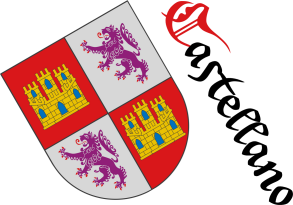
Castilian heraldry
Key Characteristics in Castilian Heraldry
Some of the main characteristics of the heraldry of Castile are:
- the rounded shapes, with a semicircle at the base,
- the importance of bordures,
- the inclusion of words and also letters in the coat of arms,
- the 2nd most common animal, after the lion, is the wolf [Valero de Bernabé, L.; 2010], and, of course,
- our castle triple-towered Or, port and windows Azure, masoned Sable [Valero de Bernabé, L.; 2009a].
The following image shows 4 examples of coats of arms, each of which has some of these characteristics, including one Castilian castle.

Comparing Castilian and English Heraldry
In the United Kingdom, there are several heraldic traditions, one of them being English heraldry.
In the Kingdom of Spain, there are several heraldic traditions, for example, the Castilian tradition.
In my humble opinion, we should compare at the same level, English heraldry with, for example, Castilian heraldry, but not with all Spanish heraldry. We shouldn't do it for the same reason we don't mix Scottish heraldic tradition with English, as they are so different.
In the case of Castilian heraldry, the 8 main differences with English heraldry are:
- The rounded shapes, with a semicircle at the base.
- The importance of bordures and the existence of the diminished bordure, called in Castilian «filiera».
- The inclusion of words and also letters in the coats of arms.
- The wolf is the 2nd most common animal, after the lion.
- The castle, triple-towered, which is different from the English and French types of castles.
- We can inherit arms from our mother and/or father; for example, the castle in the 1st quarter of the coat of arms of Castile and the coat of arms of Spain comes from a mother, Queen Berenguela of Castile, mother of King Fernando III, the Saint.
- There are 3 kinds of supporters with their owns heraldic names: «tenantes», human forms; «soportes», animals; and «sostenes», plants and things.
- Our quarterings do not necessarily mean that the arms are marshalled by inheritance. [Williams, N.; 2017; page 135, paragraph 26.02] describing the arms of Éamon de Valera, 1882-1975, President of Ireland, writes «Those arms are Spanish in appearance. The quartering without functions as a means of marshalling, is distinctively Iberian».
Categories: Criterion, Semi-circular, Bordure, Letter, Lion, Wolf, Castle, Triple-towered, Port and windows, Masoned, Or, Azure, Sable, Diminished bordure, Quarterly, Supporter (human form), Supporter, Supporter (animal) and Supporter (thing).

Categories of heraldry

Personal, governance, military, religious, socioeconomic, and, imaginary heraldry.
Quarterly in saltire: 1 Purpure, a crown Or; 2 Vert, a sword point upwards Or; 3 Azure, a crozier Or; 4 Sable, a bezant; an inescutcheon Or charged with a heart Gules; a bordure Argent.
Escudo cuartelado en sotuer: 1o de púrpura, una corona de oro; 2o de sinople, una espada alzada de oro; 3o de azur, un báculo de oro; 4o de sable, un bezante de oro; un escusón de oro cargado de un corazón de gules; una filiera de plata.
Imaginary coat of arms created by me with the following characteristics: its shape is semicircular; its field is enameled with flat tinctures of Purpure, Vert, Azure, Sable, Or, and Argent; all of its figures are illuminated and enameled in Or, except for the heart, which is Gules; and the whole composition has a watercolor finish.
Within the article on my approach to heraldic classification, you can find the symbolism contained within this shield and its category within heraldry.
The original shield design, along with many others, is registered in [Salmerón Cabañas, A.; 2015a; page 30].
All colors and metals
The heraldic colors Gules, Azure, Vert, Sable, and Purpure can be divided into two sets:
- the energetic colors Gules, Azure, and Vert, and
- the neutral colors Sable and Purpure.
Therefore, the Sable-Purpure combination is not the most vibrant.
I use both Sable and Purpure in this design because it incorporates all five colors and both metals, Or and Argent, representing different heraldic disciplines. Note that I have placed Purpure and Sable far apart, precisely due to the initial explanation.
Blazon keywords: Quarterly per saltire, Purpure, Vert, Azure, Sable, Or, Argent, Gules, Crown, Sword, Point upwards, Crozier, Bezant and plate, Inescutcheon and Diminished bordure.
Style keywords: Illuminated, Outlined in sable and Watercolor.
Classification: Created, Imaginary and Coat of arms.
Imaginary bearer: Categories of heraldry.
Crepsi

Party per pale: 1 Gules, in base a castle triple-towered Or, port and windows Azure, and masoned Sable; 2 Argent, in base a lion rampant Gules, crowned Or; overall a psi letter sable; a diminished bordure Or.
Escudo partido: 1o de gules, en punta un castillo de oro, aclarado de azur y mazonado de sable; 2o de plata, en punta un león rampante de gules, coronado de oro; brochante sobre la partición una letra psi de gules; una filiera de oro.
Coat of arms emblazoned by me, illuminated with lights and shadows, outlined in Sable, with a semi-circular outer contour and with a iridescent finishing.
Coat of arms of Crepsi, military psychology, former Central Military Region, Kingdom of Spain, where I was stationed during my military service. These arms were designed by my lieutenant colonel and friend Miguel Angel Nuñez Amador, and in this image, they have been emblazoned by me. The Crepsi was a pioneer in its functions: a) the identification of soldiers at psychological risk, among tens of thousands of soldiers, using advanced information systems, including Artificial Intelligence (an area where I contributed during my service in 1989), and b) the evaluation and individualized attention of soldiers at risk through mobile units. The Crepsi has provided trained personnel and methods that are being used for the psychological care of troops deployed to conflict zones and for the psychological care of civilians in massive humanitarian disasters such as terrorist attacks or plane crashes with hundreds of affected people.
Design rationale
The psi letter of psychology and the arms of the Central Military Region: Party per pale: 1 Gules, a castle triple-towered Or, port and windows Azure, and masoned Sable; 2 Argent, a lion rampant Gules, crowned Or. These two fields, in turn, Gules and Argent, charged with a castle triple-towered and a crowned lion, originate from the Kingdom of Castile and León. The diminished bordure is for difference.
Blazon keywords: Gules, Argent, Or, Azure, Sable, Party per pale, In base, Castle, Triple-towered, Port and windows, Masoned, Lion, Rampant, Crowned, Overall, Letter and Diminished bordure.
Style keywords: Outlined in sable, Illuminated, Semi-circular and Iridescent.
Classification: Military, Interpreted, Design rationale, Boa and Coat of arms.
Bearer: Crepsi.

Crepsi, comparation

Party per pale: 1 Gules, in base a castle triple-towered Or, port and windows Azure, and masoned Sable; 2 Argent, in base a lion rampant Gules, crowned Or; overall a psi letter sable; a diminished bordure Or.
Coat of arms of Crepsi, military psychology, former Central Military Region, Kingdom of Spain, emblazoned by me, where I was stationed during my military service. In the image: 1988, the original mold (1) with which the first 6 coats of arms were made; one of them is now in my office (2); the design of the badge for the 1st meeting of veterans (3), all of which were designed and made by my lieutenant colonel and friend Miguel Angel Nuñez Amador; and finally, the coat of arms of Crepsi emblazoned by me (4).
Blazon keywords: Gules, Argent, Or, Azure, Sable, Party per pale, In base, Castle, Triple-towered, Port and windows, Masoned, Lion, Rampant, Crowned, Overall, Letter and Diminished bordure.
Style keywords: Outlined in sable, Illuminated and Semi-circular.
Classification: Military, Interpreted, Compare, Boa and Coat of arms.
Bearer: Crepsi.
Fernando Marán Bié, The Armorial Register

Registered by The International Register of Arms, 1st of December of 2022, Registration number 0690, Volume 4.
In Spanish heraldry, there are three terms for supporters: «sostenes» for objects or plants, «tenantes» for human figures, and «soportes» for animal forms. The following applies to sostenes, tenantes, and soportes. Unlike other heraldic traditions such as English heraldry, in Spanish heraldry there are no rules for the use of supporters; their use is at the armiger's discretion, without specific restrictions. Supporters are not reserved only for nobility; their use is free for all.
In the words of [Cadenas y Vicent, V. de; 1975; page 173] «there is no rule that determines the use of tenantes, soportes, and sostenes».
Categories: Armorial roll, Party per fess, Azure, One, Book, Open, Or, Leaved, Argent, Charged, Mullet, Gules, Tree, Erased, Between, Two, Apple, Diminished bordure, Embattled, Crest and mantling, Helm, Fimbriated, Wreath, Mantling, Dexter, Sinister, Crest, Pegasus, Rampant, Nascent, Flame, Supporter (animal), Supporter, Lion, Langued, Quill, Claw, Rolled scroll, Seal, Letter, War cry and Motto.
External resource:
Root: The Armorial Register.
Full achievement of Luigi Gerard Martini

Gules, three ancient coronets, 2 and 1, within a bordure Or. Crest: Upon a helm befitting his degree, with a wreath Or and Gules, on two olive branches Vert, leaved Or and Vert, fructed Sable and Vert a mortar and pestle Or. Mantling: Gules doubled Or. Motto: «Solum Fortes Procedunt».
Arms interpreted by me, illuminated with lights and shadows, outlined in Sable, with an ogee outer contour and with a freehand finishing.
G0124, Chief Herald of Arms of Malta's grant for the arms of Luigi Gerard Martini, United Kingdom. These arms have been emblazoned by me for such grant.
Blazon keywords: Gules, Or, Vert, Three, One, Two, Ancient coronet, Crown, Ordered, Within, Diminished bordure, Crest, Upon (wreath), Helm, Wreath, Olive tree, Tree, Branch, Leaved, Fructed, Metal mortar, Pestle and Motto.
Style keywords: Outlined in sable, Illuminated, Ogee and Freehand.
Classification: Personal, Interpreted, Boa and Coat of arms.
Bearer: Martini, Luigi Gerard.
John Stuart, schema 2x3

Or, a fess chequey Argent, charged with an ermine spot, and Azure, between in chief two cross patty Gules, in base a thistle proper; a diminished bordure Azure.
The coat of arms of Reverend John Stuart, XVIII century, emblazoned by me in 3 approaches: 1) Classic bordure: Using a bordure with a width equal to 1/6 of the coat of arms' base. In the image, this is marked with texts and lines in Vert. Notice that the squares in columns 2 and 8 are split by the inner border of the bordure, which is unfortunate as it disrupts the design. 2) Diminished bordure: Using a narrower bordure with a width equal to 2/3 of the classic bordure, corresponding to 1 square of the fess chequey. In the image, this is marked with texts and lines in Gules. This approach avoids splitting any squares, allows for larger figures, and is my preferred solution. In England, diminished bordures, often simply blazoned as bordure, are more common than in Castile. 3) Without squares splitted: Retaining the classic bordure but shifting the fess chequey 1/2 square to either dexter or sinister to prevent splitting squares. However, this sacrifices the symmetry of the design. This last adjustment was used in the hatchment of Reverend John Stuart in St. George's Cathedral, Kingston, Ontario, 1785.
Blazon keywords: Or, Argent, Azure, One, Three, Nine, Two, Fess, Chequey, Charged, Ermine spot, Between, In chief, Cross, Patty, In base, Thistle, Proper and Diminished bordure.
Style keywords: Ratio, Outlined in sable, Illuminated, Semi-circular and Freehand.
Classification: Personal, Interpreted, Schema, Boa and Coat of arms.
Bearer: Stuart, John.
Martini, Luigi Gerard

Gules, three ancient coronets, 2 and 1, within a bordure Or.
Escudo de gules, tres coronas antiguas de oro, 2 y 1, dentro de una filiera todo de oro.
Arms emblazoned by me, highlighted with lights and shadows, outlined in Sable, with an ogee external shape and with a freehand finish.
G0124, Chief Herald of Arms of Malta's grant of the coat of arms of Luigi Gerard Martini, United Kingdom. This coat of arms has been emblazoned by me.
Blazon keywords: Gules, Or, Three, One, Ancient coronet, Crown, Ordered, Within and Diminished bordure.
Style keywords: Outlined in sable, Illuminated, Ogee and Freehand.
Classification: Personal, Interpreted, Boa and Coat of arms.
Bearer: Martini, Luigi Gerard.
Schema of a bordure and a diminished bordure

Proporciones de una bordura y una filiera, una filiera es una bordura con su ancho disminuido en 2/3.
In heraldry, a diminished bordure is a diminished bordure. In the design, it is typically drawn at 2/3 the width of a standard bordure. Since the width of a standard bordure is usually 1/6 of the coat of arms' width, a diminished bordure calculated this way would be 1/9 of the coat of arms' width.
However, diminished bordures can also be found with a width of 1/2 that of a standard bordure, in other words, 1/12 of the coat of arms' width, or 1/3 that of a standard bordure, that is to say, 1/18 of the coat of arms's width.
The so-called bordure of pieces usually has a width of 1/2 that of a standard bordure, which is 1/12 of the coat of arms's width.
Blazon keywords: Without divisions, Bordure and Diminished bordure.
Style keywords: Semi-circular.
Classification: Schema and Coat of arms.
Bearer: Categories of heraldry.
Stuart, John

Or, a fess chequey Argent, charged with an ermine spot, and Azure, between in chief two cross patty Gules, in base a thistle proper; a diminished bordure Azure.
Escudo de oro, una faja ajedrezada de plata, cargada de una cola de armiño, y azur, acompañada en jefe de dos cruces patadas de gules, en base de un cardo al natural; una filiera de azur.
Coat of arms painted by me, highlighted with lights and shadows, outlined in Sable, with a semi-circular outer contour and with a watercolor finish.
Coat of arms of Reverend John Stuart, XVIII century, emblazoned by me.
Blazon keywords: Or, Argent, Azure, One, Three, Nine, Two, Fess, Chequey, Charged, Ermine spot, Between, In chief, Cross, Patty, In base, Thistle, Proper and Diminished bordure.
Style keywords: Outlined in sable, Illuminated, Semi-circular and Watercolor.
Classification: Personal, Interpreted, Boa and Coat of arms.
Bearer: Stuart, John.
-
Language
-
Categories of heraldry
-
Divisions of the field
- Without divisions
- Party per pale
- Party per fess
- Party per bend
- Party per bend sinister
- Tierce
- Tierce sinister
- Tierced per pale
- Tierced per fess
- Tierced per bend
- Tierced pallwise inverted
- Quarterly
- Quarterly per saltire
- Gyronny
- Party per fess, the chief per pale
- Party per pale, the sinister per fess
- Party per fess, the base per pale
- Party per pale, the dexter per fess
- Chapé
- Chaussé
- Embrassé
- Contre-embrassé
- Chapé ployé
- Party per chevron
- Enté
- Enté en point
- Flanched
-
Metals
-
Colours
-
Furs
-
Other tinctures
-
Ordinaries and sub-ordinaries
-
Diminutives of the ordinaries
-
Geometric charges
-
Composite ordinaries
-
Inanimate charges from Nature
Atom, Cloud, Crescent, Decrescent, Diamond, Emerald, Estoile, Goutte, Increscent, Lightning flash, Moon, Mount, Mullet, Mullet of four points, Orbital, Plough of Ursa Major, Rainbow, Ray of the sun, River, Sea, Snowflake, Sun, Sun in splendour, Sun of May, Terrestrial globe, Trimount, Water and Wave.
-
Vegetal charges from Nature
Acorn, Apple, Apple tree, Ash, Bluebonnet, Bunch, Camellia, Chrysanthemum, Cinquefoil, Cornflower, Dogwood flower, Double rose, Easter lily, Eguzki-lore, Elm, Fleur de lis, Flower, Gourd, Grape, Holm oak, Hop cone, Indian paintbrush, Kapok tree, Laurel, Lily, Linden, Lotus flower, Madonna lily, Madrone tree, Mexican cedar tree, Mulberry tree, Oak, Olive tree, Palm tree, Plantain plant, Pomegranate, Poplar leaf, Prickly pear cactus, Rose, Scots pine, Shamrock, Sunflower, Thistle, Tree, Tulip, Vine and Wheat.
-
Animal charges from Nature
Badger, Bald eagle, Barbel, Barn owl, Bear, Beaver, Bee, Beetle, Bighorn sheep, Binson, Black grouse, Blackbird, Boar, Brach hound, Bull, Cat, Cow, Doe, Dog, Dolphin, Dove, Eagle, Elephant, Falcon, Female figure, Fish, Flame, Fly, Fox, Frog, Gazelle, Goat, Goldfinch, Goose, Heron, Horse, Hummingbird, Jaguar, Lark, Leopard, Lion, Lion passant, Lion rampant guardant, Lioness, Lynx, Male figure, Martlet, Merino ram, Monkey, Mountain bluebird, Owl, Panther, Parrot, Peacock, Pelican, Pelican in her piety, Pronghorn, Puffin, Quetzal, Raven, Roe deer, Rooster, Salamander, Savage, Seagull, Serpent, She-wolf, Stag, Starling, Swan, Talbot, Turtle, Tyger, Vulture, Warren hound and Wolf.
-
Parts of natural charges
Arm, Beak, Branch, Caboshed, Chest, Claw, Covert, Dorsal fin, Eagle claw, Ear of wheat, Ermine spot, Escallop, Feather, Foot (palmiped), Footprint, Foreleg, Forepaw, Hand, Head, Heart, Hoof, Leaf, Neck, Ostrich feather, Palm frond, Paw, Roe deer' attire, Shoulder, Sprig, Stag's attire, Stag's massacre, Stem, Swallow-tail, Tail, Tail addorsed, Tail fin, Talon, Tibia, Tooth, Trunk, Trunk (elephant), Two hands clasped, Two wings in vol, Udder, Wing and Wrist.
-
Artificial charges
Ace of spades, Adze, Anchor, Anvil, Arch, Archer, Arm vambraced, Armillary sphere, Arrow, Axe, Baton of Herald, Bell, Bell tower, Beret, Bonfire, Book, Bookmark, Bow, Branding iron, Bridge, Broken, Buckle, Cannon, Cannon dismounted, Cannon port, Canopy roof, Caravel, Carbuncle, Castle, Cauldron, Celtic Trinity knot, Celtic trefoil knot, Censer, Chain, Chess rooks, Chi-Rho symbol, Church, Clarion, Clay pot, Closed book, Club, Column, Comb, Comedy mask, Compass rose, Conductor's baton, Cord, Covered cup, Crossbow, Crossed staff, Crozier, Crucible, Cuffed, Cup, Cutlass, Cyclamor, Dagger, Displayed scroll, Double vajra, Drum, Ecclesiastical cap, Fanon, Federschwert, Flagpole, Fleam, Four crescents joined millsailwise, Full plate armor, Galician granary, Garb, Gauntlet, Geometric solid, Grenade, Halberd, Hammer, Harp, Host, Hourglass, Incense burner, Key, Key ward, Knight, Knot, Lantern, Letter, Line, Loincloth, Maunch, Menorah, Metal mortar, Millrind, Millstone, Millwheel, Minaret, Monstrance, Mortar, Mullet of six points pierced, Nail, Non-classic artifact, Norman ship, Number, Oar, Oil lamp, Open book, Page, Paintbrush, Pair of pliers, Pair of scales, Pestle, Piano, Pilgrim's staff, Plough share, Polish winged hussar, Port, Portcullis, Potent, Quill, Ribbon, Rolled scroll, Rosette of acanthus leaves, Sabre, Sackbut, Sail, Scepter, Scroll, Scythe, Sheaf of tobacco, Ship, Skirt, Spear, Spear's head, Stairway, Star of David, Step, Sword, Symbol, Tetrahedron, Torch, Tower, Tragedy mask, Trident, Trumpet, Turret, Two-handed sword, Two-man cross-cut saw, Wagon-wheel, Wall between two towers, Wall couped, Water-bouget, Wheel, Winnowing fan and With a turret.
-
Immaterial charges
Angel, Archangel, Basilisk, Dragon, Dragon's head, Garuda, Golden fleece, Griffin, Heart enflamed, Justice, Mermaid, Our Lady of Mercy, Ouroboros, Paschal lamb, Pegasus, Phoenix, Sacred Heart of Jesus, Saint George, Sea-griffin, Sea-lion, Trinity, Triton, Unicorn, Winged hand and Wyvern.
-
External elements
-
Heraldic creations
-
References
-
Formats
-
Keywords on this page
Port and windows, Between, Watercolor, Chequey, Proper, Azure, Boa, Bordure, Overall, Wreath, Thistle, Charged, Castle, Categories of heraldry, Crest, Ermine spot, Ogee, Crown, Ancient coronet, Crowned, Crepsi, Cross, Triple-towered, Outlined in sable, Within, Two, In chief, In base, Coat of arms, Schema, Fess, Diminished bordure, Personal, Gules, Leaved, Illuminated, Interpreted, Motto, Letter, Lion, Masoned, Semi-circular, Or, Argent, Rampant, Sable, Freehand, Three and One.