Three, two and one

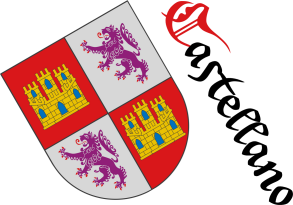
Coat of arms of Elias Yñigo-Genio

Or, six fleurs de lis, three, two, one, five Gules and one in the middle of the chief Azure.
Escudo de oro, seis flores de lis ordenadas, tres, dos y una, cinco de gules y una de azur en el centro del jefe.
Credits: Rolando Yñigo-Genio is the designer of the coat of arms and Antonio Salmerón y Cabañas is the author of the heraldic art.
Blazon keywords: Or, Six, Fleur de lis, Ordered, Three, two and one, Five, Gules, One, Azure and In the middle of the chief.
Style keywords: Semi-circular, Soft metal, Outlined in sable and Illuminated.
Classification: Interpreted, Personal and Coat of arms.
Bearer: Yñigo-Genio, Elias.

Geoffrey Plantagenet

Azure, six lions rampant Or, 3, 2 and 1.
Escudo de azur, seis leones rampantes de oro, 3, 2 y 1.
Existing armories interpreted by me as follows: the shape of the shield is pointed; the field has been enameled in flat azure; the 6 lions are illuminated and cast shadows on the field; and the entire composition has a hammered metal finish.
The shield of Geoffrey V, Count of Anjou is considered the first documented coat of arms in history, dated to 1127, when Henry I of England gifted it to him on the occasion of his marriage to his daughter Matilda of England [The Heraldry Society; 2013].
There is no direct evidence that Henry I possessed a coat of arms, nor that it featured a rampant lion [Humphery-Smith, C.; 1983], but the gift of a shield with 6 lions to his future son-in-law could be an indication of such.
Geoffrey is buried in the Cathedral of Saint Julian in Le Mans, and his tomb is decorated with an enamel depicting him with his shield, where of his 6 lions: 4 are fully visible, and 2 are suggested by their claws.
However, it is possible that both the wedding gift narrative and the enamel on the tomb are from years after his death in 1151, so [Pastoureau, M.; Garvie, F.; 1997; page 18] asserts that «this account was written after Geoffrey's death... and his funerary enamel commissioned by his widow Matilda between 1155 and 1160... therefore it is possible that Geoffrey Plantagenet never had a coat of arms».
Blazon keywords: Without divisions, Azure, Six, Lion, Or, Rampant and Three, two and one.
Style keywords: Pointed, Illuminated, Shaded, Outlined in the field tincture and Metal beaten.
Classification: Interpreted, Personal, Coat of arms and House of Plantagenet.
Bearer: Godfrey V, Count of Anjou.

Godfrey V, Count of Anjou

And Count of Touraine and Maine, Duke of Normandy, and founder of the Plantagenet dynasty.
Azure, six lions rampant Or, 3, 2 and 1.
Escudo de azur, seis leones rampantes de oro, 3, 2 y 1.
Existing armories interpreted by me as follows: the shield's shape is pointed; the field has been enameled in flat azure; the 6 lions are illuminated; and the entire composition has a watercolor finish.
When blazoning these 6 lions, considering that in heraldry the natural arrangement of elements is from more in chief to fewer in base, it would suffice to specify nothing more than «or and rampant». However, adding their arrangement «3, 2, and 1» can aid the reader, as done by [Avilés, J.; 1725b; page 124] and [Avilés, J.; 1780b; page 142] when blazoning the arms of Alfonso Enrique de Vick, writing «sable, and six bezants or, three, two, and one», meaning 6 ordered elements. In these sequences of number arrangements, I prefer to write Arabic numerals rather than words because, at times, the sequences can be long.
Blazon keywords: Without divisions, Azure, Six, Lion, Or, Rampant and Three, two and one.
Style keywords: Pointed, Illuminated, Outlined in the field tincture and Watercolor.
Classification: Interpreted, Personal, Coat of arms and House of Plantagenet.
Bearer: Godfrey V, Count of Anjou.
Yñigo-Genio, Elias

Or, six fleurs de lis, three, two, one, five Gules and one in the middle of the chief Azure.
Arms interpreted using a semi-circular shape; tinctures metal or and colors gules and azur; the color sable for delineation; and a freehand finish.
Credits: Rolando Yñigo-Genio is the designer of the coat of arms and Antonio Salmerón y Cabañas is the author of the heraldic art.
Blazon keywords: Or, Six, Fleur de lis, Ordered, Three, two and one, Five, Gules, One, Azure and In the middle of the chief.
Style keywords: Semi-circular, Freehand and Outlined in sable.
Classification: Interpreted, Personal and Coat of arms.
Bearer: Yñigo-Genio, Elias.
-
Language
-
Categories of heraldry
-
Divisions of the field
- Without divisions
- Party per pale
- Party per fess
- Party per bend
- Party per bend sinister
- Tierce
- Tierce sinister
- Tierced per pale
- Tierced per fess
- Tierced per bend
- Tierced pallwise inverted
- Quarterly
- Quarterly per saltire
- Gyronny
- Party per fess, the chief per pale
- Party per pale, the sinister per fess
- Party per fess, the base per pale
- Party per pale, the dexter per fess
- Chapé
- Chaussé
- Embrassé
- Contre-embrassé
- Chapé ployé
- Party per chevron
- Enté
- Enté en point
- Flanched
-
Metals
-
Colours
-
Furs
-
Other tinctures
-
Ordinaries and sub-ordinaries
-
Diminutives of the ordinaries
-
Geometric charges
-
Composite ordinaries
-
Inanimate charges from Nature
Atom, Cloud, Crescent, Decrescent, Diamond, Emerald, Estoile, Goutte, Increscent, Lightning flash, Moon, Mount, Mullet, Mullet of four points, Orbital, Plough of Ursa Major, Rainbow, Ray of the sun, River, Sea, Snowflake, Sun, Sun in splendour, Sun of May, Terrestrial globe, Trimount, Water and Wave.
-
Vegetal charges from Nature
Acorn, Apple, Apple tree, Ash, Bluebonnet, Bunch, Camellia, Chrysanthemum, Cinquefoil, Cornflower, Dogwood flower, Double rose, Easter lily, Eguzki-lore, Elm, Fleur de lis, Flower, Gourd, Grape, Holm oak, Hop cone, Indian paintbrush, Kapok tree, Laurel, Lily, Linden, Lotus flower, Madonna lily, Madrone tree, Mexican cedar tree, Mulberry tree, Oak, Olive tree, Palm tree, Plantain plant, Pomegranate, Poplar leaf, Rose, Scots pine, Shamrock, Sunflower, Thistle, Tree, Tulip, Vine and Wheat.
-
Animal charges from Nature
Badger, Bald eagle, Barbel, Barn owl, Bear, Beaver, Bee, Beetle, Bighorn sheep, Binson, Black grouse, Blackbird, Boar, Brach hound, Bull, Cat, Cow, Doe, Dog, Dolphin, Dove, Eagle, Elephant, Falcon, Female figure, Fish, Flame, Fly, Fox, Frog, Gazelle, Goat, Goldfinch, Goose, Heron, Horse, Hummingbird, Jaguar, Lark, Leopard, Lion, Lion passant, Lion rampant guardant, Lioness, Lynx, Male figure, Martlet, Merino ram, Monkey, Mountain bluebird, Owl, Panther, Parrot, Peacock, Pelican, Pelican in her piety, Pronghorn, Puffin, Quetzal, Raven, Roe deer, Rooster, Salamander, Savage, Seagull, Serpent, She-wolf, Stag, Starling, Swan, Talbot, Turtle, Tyger, Vulture, Warren hound and Wolf.
-
Parts of natural charges
Arm, Beak, Branch, Caboshed, Chest, Claw, Covert, Dorsal fin, Eagle claw, Ear of wheat, Ermine spot, Escallop, Feather, Foot (palmiped), Footprint, Foreleg, Forepaw, Hand, Head, Heart, Hoof, Leaf, Neck, Ostrich feather, Palm frond, Paw, Roe deer' attire, Shoulder, Sprig, Stag's attire, Stag's massacre, Stem, Swallow-tail, Tail, Tail addorsed, Tail fin, Talon, Tibia, Tooth, Trunk, Trunk (elephant), Two hands clasped, Two wings in vol, Udder, Wing and Wrist.
-
Artificial charges
Ace of spades, Adze, Anchor, Anvil, Arch, Archer, Arm vambraced, Armillary sphere, Arrow, Axe, Baton of Herald, Bell, Bell tower, Beret, Bonfire, Book, Bookmark, Bow, Branding iron, Bridge, Broken, Buckle, Cannon, Cannon dismounted, Cannon port, Canopy roof, Caravel, Carbuncle, Castle, Cauldron, Celtic Trinity knot, Celtic trefoil knot, Censer, Chain, Chess rooks, Chi-Rho symbol, Church, Clarion, Clay pot, Closed book, Club, Column, Comb, Comedy mask, Compass rose, Conductor's baton, Cord, Covered cup, Crossbow, Crossed staff, Crozier, Crucible, Cuffed, Cup, Cutlass, Cyclamor, Dagger, Displayed scroll, Double vajra, Drum, Ecclesiastical cap, Fanon, Federschwert, Flagpole, Fleam, Four crescents joined millsailwise, Full plate armor, Galician granary, Garb, Gauntlet, Geometric solid, Grenade, Halberd, Hammer, Harp, Host, Hourglass, Incense burner, Key, Key ward, Knight, Knot, Lantern, Letter, Line, Loincloth, Maunch, Menorah, Metal mortar, Millrind, Millstone, Millwheel, Minaret, Monstrance, Mortar, Mullet of six points pierced, Nail, Non-classic artifact, Norman ship, Number, Oar, Oil lamp, Open book, Page, Paintbrush, Pair of pliers, Pair of scales, Pestle, Piano, Pilgrim's staff, Plough share, Polish winged hussar, Port, Portcullis, Potent, Quill, Ribbon, Rolled scroll, Rosette of acanthus leaves, Sabre, Sackbut, Sail, Scepter, Scroll, Scythe, Sheaf of tobacco, Ship, Skirt, Spear, Spear's head, Stairway, Star of David, Step, Sword, Symbol, Tetrahedron, Torch, Tower, Tragedy mask, Trident, Trumpet, Turret, Two-handed sword, Two-man cross-cut saw, Wagon-wheel, Wall between two towers, Wall couped, Water-bouget, Wheel, Winnowing fan and With a turret.
-
Immaterial charges
Angel, Archangel, Basilisk, Dragon, Dragon's head, Garuda, Golden fleece, Griffin, Heart enflamed, Justice, Mermaid, Our Lady of Mercy, Ouroboros, Paschal lamb, Pegasus, Phoenix, Sacred Heart of Jesus, Saint George, Sea-griffin, Sea-lion, Trinity, Triton, Unicorn, Winged hand and Wyvern.
-
External elements
-
Heraldic creations
-
References
-
Formats
-
Keywords on this page
Watercolor, Pointed, Azure, House of Plantagenet, Five, Outlined in sable, Outlined in the field tincture, In the middle of the chief, Coat of arms, Fleur de lis, Personal, Godfrey V, Count of Anjou, Gules, Illuminated, Interpreted, Lion, Semi-circular, Metal beaten, Soft metal, Ordered, Or, Without divisions, Rampant, Six, Shaded, Freehand, Three, two and one, One and Yñigo-Genio, Elias.